
Game review
Crazy Oddballs: Idle RPG
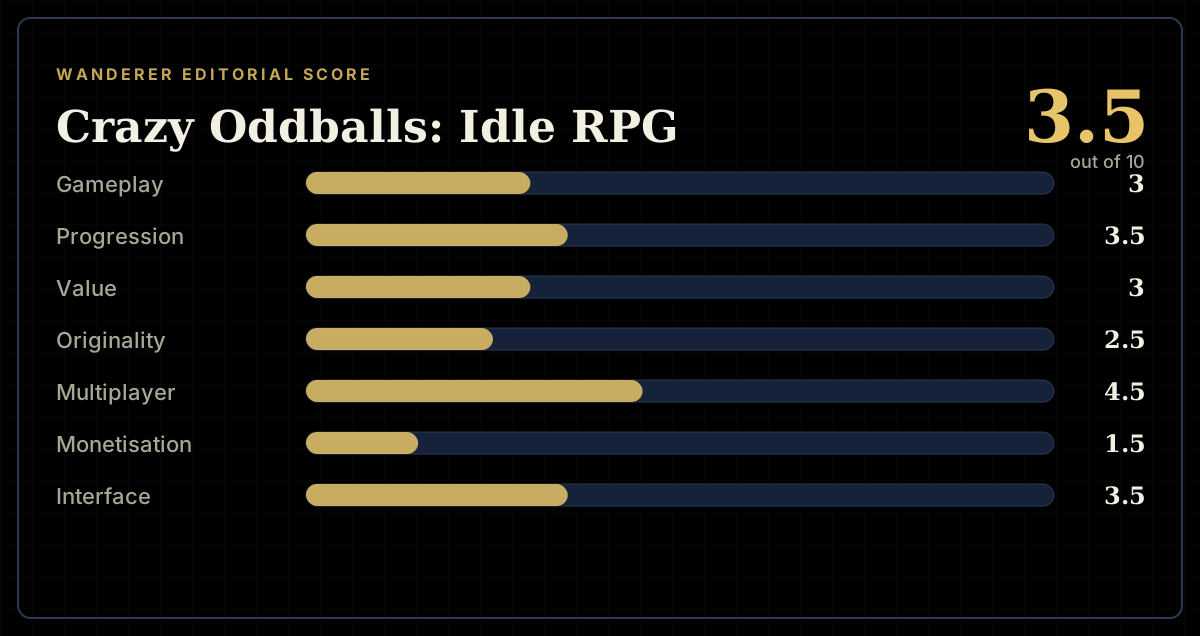
3.5 / 10
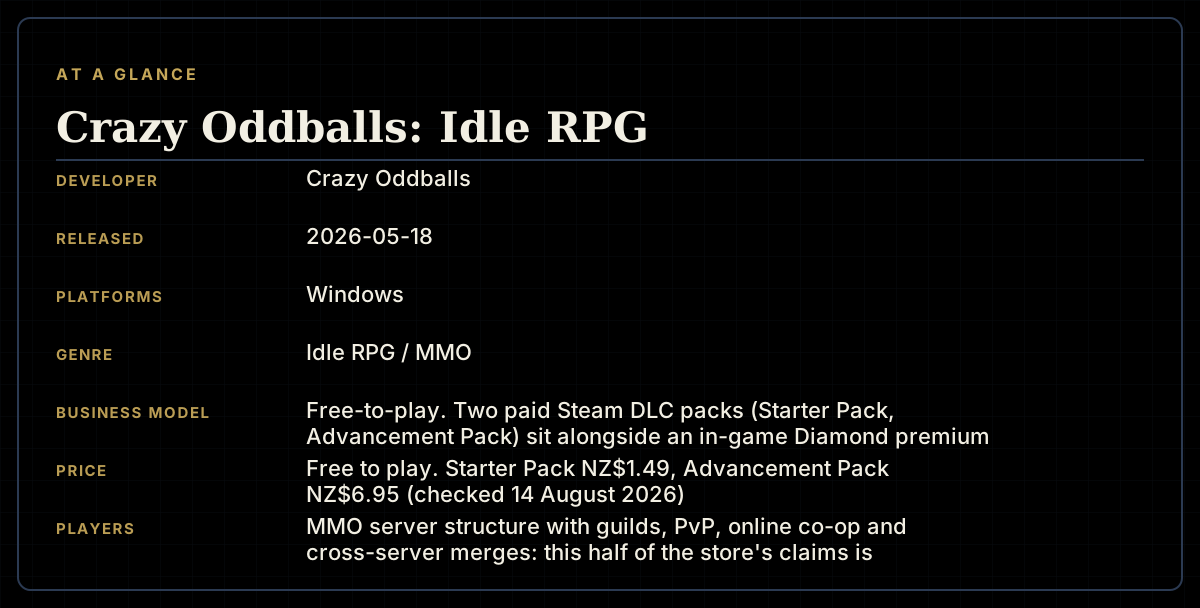
- Developer
- Crazy Oddballs
- Publisher
- Crazy Oddballs
- Released
- 18 May 2026
- Platforms
- Windows
- Genre
- Idle RPG / MMO
- Monetisation
- Free-to-play. Two paid Steam DLC packs (Starter Pack, Advancement Pack) sit alongside an in-game Diamond premium currency, weekly and monthly VIP subscription passes, and a gacha-style "Treasure Hunt" loot mechanic with an auto-spend option.
- Players
- MMO server structure with guilds, PvP, online co-op and cross-server merges: this half of the store's claims is genuinely implemented, not just a checkbox.
The short version
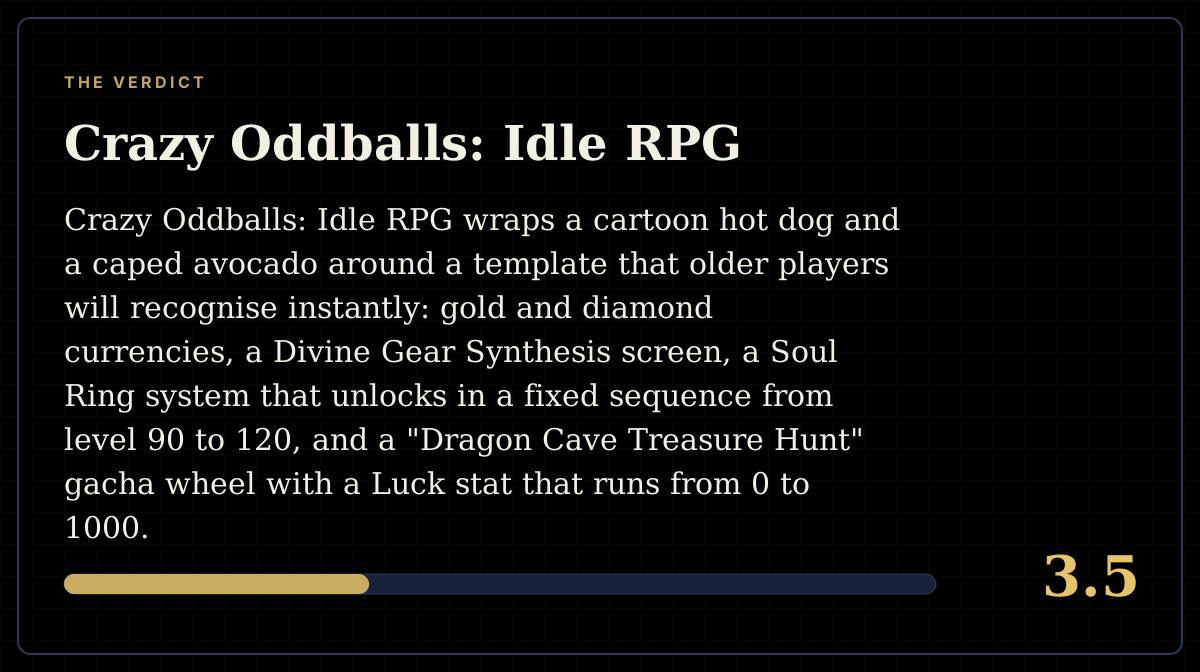
Crazy Oddballs: Idle RPG wraps a cartoon hot dog and a caped avocado around a template that older players will recognise instantly: gold and diamond currencies, a Divine Gear Synthesis screen, a Soul Ring system that unlocks in a fixed sequence from level 90 to 120, and a "Dragon Cave Treasure Hunt" gacha wheel with a Luck stat that runs from 0 to 1000. None of that is disguised particularly well — the mascot art doesn't match the rest of the interface, and the game's own news posts talk about merging "Cultivation Server" instances, language that belongs to an entirely different genre of game. What is disguised, or at least contested, is how positive the response to all this has actually been: alongside a "Mostly Positive" score built from 297 reviews, some of the most-upvoted negative write-ups on the store page allege the positive count is inflated by bought or AI-generated reviews, and separate community discussion threads are pursuing the same question. Underneath the noise sits a functioning, if generic, idle MMO — guilds and PvP genuinely work — but it is bolted to two paid DLC packs, a premium-currency loot box with an auto-spend toggle, and a stacked weekly-and-monthly VIP pass system, none of which needed the comedy branding to exist.
Biggest strengths
- Guilds, PvP, online co-op and cross-server merges are genuinely implemented rather than a single-player idle loop with multiplayer bolted on as a marketing line
- Auto-battle actually delivers on the "idle" promise: progress continues without the constant tapping some genre entries quietly require to keep pace
- The long-term progression web is objectively deep, with five separate systems (Four Symbols, Bestiary, Soul Ring, Divine Might, Tower) unlocking on a staggered level curve from 90 to 120
Biggest weaknesses
- A promotional screenshot of the "Dragon Cave Treasure Hunt" gacha screen shows the "Auto-Buy on Insufficient Keys" toggle switched on, converting a shortfall of free rolls into an automatic 200-Diamond debit per key with no extra confirmation step shown
- Two Steam DLC packs (Starter Pack, Advancement Pack) sit alongside in-game weekly and monthly VIP passes that separately promise thousands of Diamonds and stat bonuses, stacking four distinct purchase paths onto a game marketed as free
- The developer's own news feed reuses template update posts about merging "Cultivation Server" instances — terminology from a different, unrelated genre — suggesting the support communications are recycled from a wider publisher catalogue rather than written for this game
Who it's for: Players already comfortable with premium-currency loot boxes and VIP subscription tiers in a free idle MMO, and specifically those chasing the guild/PvP server structure rather than an offbeat solo idle experience the marketing implies.
Our recommendation: Free to try, which limits the downside, but budget nothing beyond that trial before reading how the gacha and VIP systems actually work — this is a spend-forward MMO template with a joke skin, not a lightweight comedy idle game.
3.5 / 10
The most useful screenshot on the Crazy Oddballs: Idle RPG store page isn't one of its combat shots. It's the one labelled "VIP," showing two stacked subscription tiers — a weekly "Honor Privileges" pass and a monthly "Supreme Privileges" pass — each promising daily Diamonds, gold coins and stat bonuses for as long as the subscription stays active. That single image tells you more about what this game actually is than the store copy does. The copy promises "bizarre heroes, ridiculous gear" and a world "full of surprises." What's underneath is a template MMO with a comedy skin loosely nailed on top, and the skin is thin enough that the seams show constantly.
A joke mascot on someone else's engine
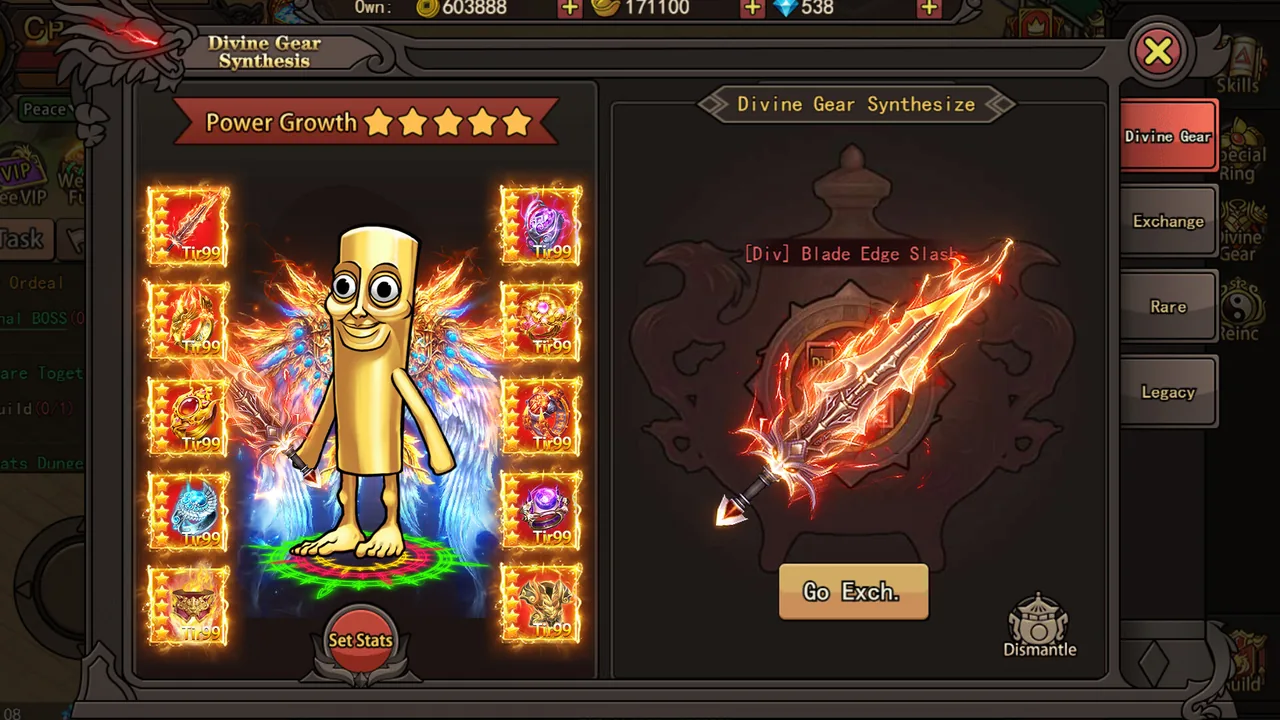
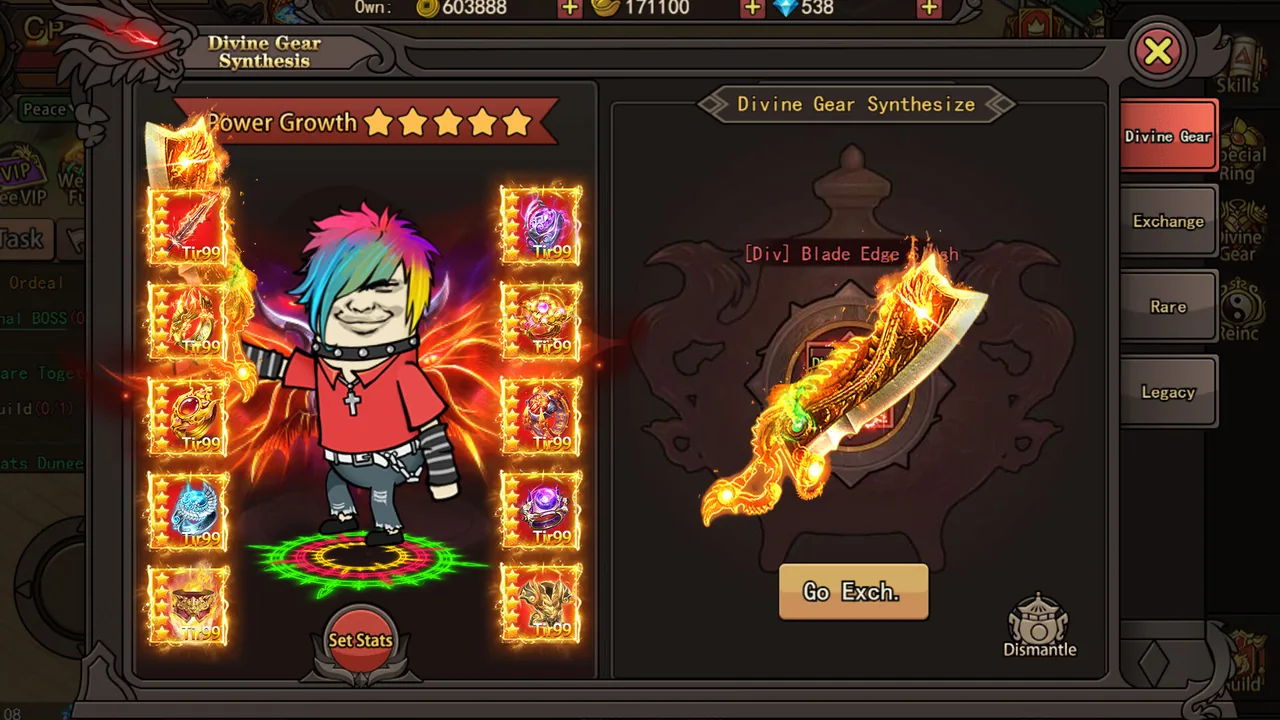
Crazy Oddballs' hook is its cast: a smiling, googly-eyed hot dog and a caped avocado stand in for the usual stoic fantasy hero. It's a fine idea for a distinct visual hook in a genre stuffed with interchangeable warriors and mages. The problem is that the mascot art was clearly dropped into an interface that wasn't built around it. Every other element on screen — the dragon-flanked menu borders, the "Divine Gear Synthesis" screen, the flaming sword icons, the Chinese-fantasy dragon deities guarding a "Dragon Cave" — belongs to a different aesthetic entirely, one common to a specific class of white-label gacha MMO template. The hot dog stands in the middle of all this looking like exactly what it is: a sprite pasted over assets built for another game's hero.
The game's own support communications reinforce the same impression. Its Steam news feed, checked at time of writing, consists almost entirely of "Server Merge" announcements written in template language — talk of merging "Cultivation Server 226" into "Cultivation Server 227," a term that belongs to wuxia and cultivation-genre games, not a comedy idle RPG about oddball heroes. Either the developer copy-pasted an update template from elsewhere in a wider catalogue without proofreading it, or the underlying game genuinely runs the same "cultivation server" backend as something else entirely. Neither is reassuring, and both point the same direction: the comedy branding is a layer, not the foundation.
What pressing play actually looks like
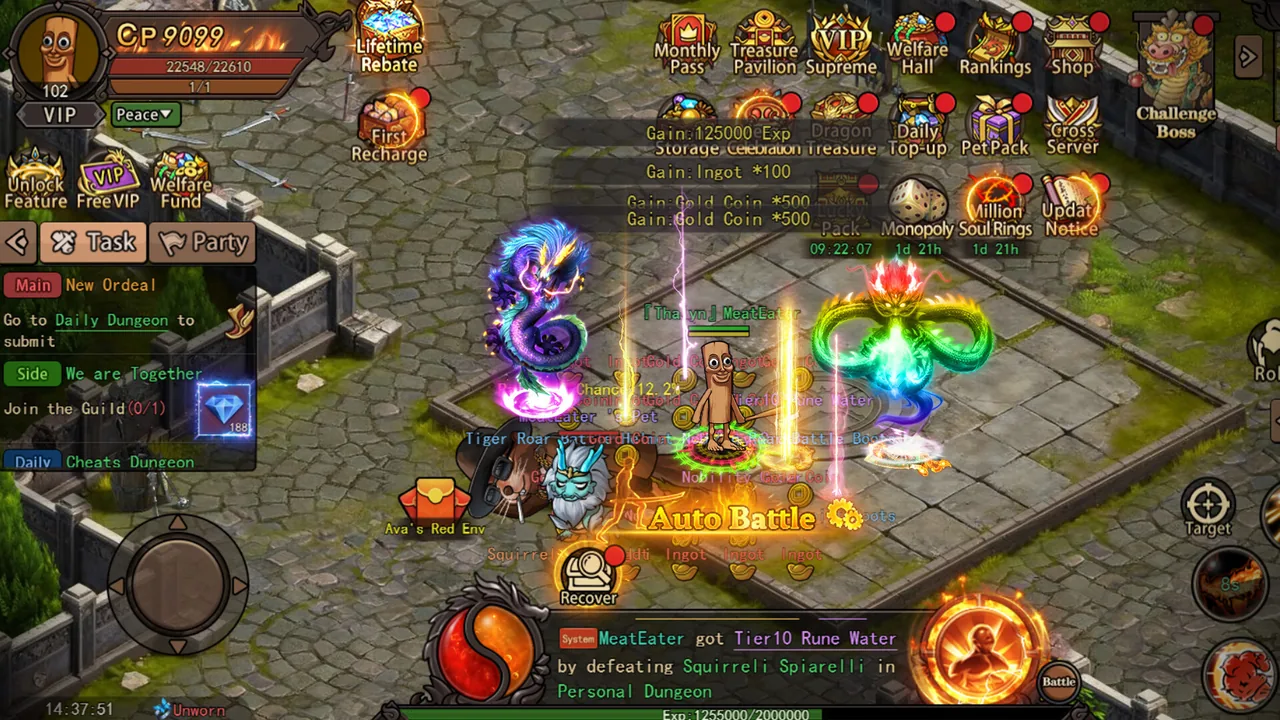
Strip away the marketing and the loop is standard idle-MMO fare. Heroes auto-battle through waves and dungeons while numbers climb — gold, gear tiers, character power — and the player's job is mostly menu management: equipping better gear, spending currencies, and deciding which of several parallel systems to feed next. The storefront's own screenshots show a "Personal Dungeon" combat screen cluttered with more than a dozen simultaneous UI prompts — daily login rewards, a "First Recharge" bonus, a "Lucky Pack," a countdown to the next "Cross Server" event — stacked around the actual fight, which is small, fast, and fully automated.
That's not automatically a flaw; "idle combat, active decisions" is the stated pitch, and to the game's credit the idle half works as advertised. Auto-battle keeps running, offline progress accrues, and nothing in the visible systems appears to gate that behind a subscription. One Steam discussion thread does report that AFK progress stops if the game window loses focus while alt-tabbed away, which — if accurate — undercuts the "walk away and it keeps working" promise idle players specifically buy into, though this review can't independently confirm the behaviour is universal rather than session-specific. The trouble, regardless, is what fills the space where decisions are supposed to happen. The most-upvoted negative reviews on the store page are overwhelmingly short sessions — under an hour of playtime in several of the highest-voted cases — describing the opening stretch as close to unplayable as an active game: mostly a spectator screen with popups to dismiss, closer to what one reviewer called an "idle movie" than an RPG with meaningful input. Whether that changes once a player reaches guild content and PvP is a fair question the short-session reviews can't answer, but it does mean the game's first impression, for a meaningful slice of the people who tried it, was passivity rather than play.
Five systems, one level curve
Where the game is legitimately substantial is its progression web. A "Feature Unlocked" screen in the official screenshots lays out five separate meta-systems — Four Symbols, Bestiary, Soul Ring, Divine Might and Tower — each gated behind its own level threshold: 90, 95, 103, 110 and 120 respectively. Each of those, in turn, runs its own currency and its own upgrade ladder on top of the base gold-and-experience loop, and that's before counting the separate Divine Gear Synthesis system shown fusing "Tier 99" equipment pieces into upgraded weapons. On paper, that's a genuinely deep long-term structure, the kind that can hold a dedicated player's attention for months.
In practice, stacking five parallel meta-systems with five different currencies and five different level gates reads less like meaningful build variety and more like surface area — more menus to open, not more decisions to make. Nothing in the available material suggests any of these systems interact with each other in an interesting way; they're presented as separate ladders to climb in sequence, each with its own "click to claim" reward, rather than a build space where choices in one system change what's optimal in another.
There's also no sign of Steam achievements anywhere in the available data — a query against Steam's global achievement stats for this app returns an empty result, meaning the game either shipped without an achievement list or without one Steam is tracking. For a game this heavily built around long-term number-climbing, that's a missed opportunity: achievements are the cheapest way a live game like this signals milestones back to a player, and their absence leaves the five meta-systems to speak for themselves with nothing marking progress through them beyond the in-game currency counters.
The monetisation stack
This is where the review score has to live or die, and it's not close. The game's official "Dragon Cave Treasure Hunt" screenshot shows a gacha wheel gated by a Luck stat running from 0 to 1000, explicitly stating that 1000 Luck guarantees "Ultimate Gear." Explore rolls cost a Key currency, in batches of 1, 10 or 50 — and the same screenshot shows an "Auto-Buy on Insufficient Keys" toggle already switched on, silently converting a shortfall of free Key currency into an automatic 200-Diamond debit per key with no extra confirmation shown. That's a loot box with the safety catch defaulted toward spending, presented in the developer's own promotional material.
Layer onto that the VIP screen described above — a weekly pass and a separate monthly pass, both active simultaneously if a player buys both, together promising a stated "Total Rebate" of 7,000 Diamonds alongside gold, gear-recycling perks and event bonuses — and then layer on the two paid Steam DLC listings sitting outside the in-game economy entirely: a Starter Pack at NZ$1.49 and an Advancement Pack at NZ$6.95. Four separate purchase paths (DLC, Diamonds, weekly pass, monthly pass) is an unusually aggressive stack for a game whose store page never uses the words "in-app purchase" as a selling point, only as one line in a Steam category tag. Steam's own AI-content disclosure for the game states plainly that "some characters are generated using AI," which at least is disclosed rather than hidden — a small credit against a monetisation design that otherwise gives no quarter.
The part of the MMO pitch that's actually true
It would be unfair to write this off as pure smoke. The categories Steam lists for Crazy Oddballs — Multi-player, MMO, PvP, Online PvP, Co-op, Online Co-op — aren't just boilerplate. The community tag list backs it up: MMORPG sits at 200 votes, PvP at 146, and the news feed's repeated "Server Merge" posts, template language aside, describe a real, active server population being consolidated over time, which is more than can be said for plenty of idle games that call themselves "online" while running entirely offline. Guilds, cross-server events and PvP appear to be genuinely functioning systems rather than a marketing checkbox, and that's the strongest thing this review can say about the game. It's just one working pillar propping up a structure that leans hard on everything around it.
The reviews problem
No review of this game can responsibly ignore what's happening on its own store page. Alongside its "Mostly Positive" score — 75% of 297 reviews, as of this writing — several of the highest-voted negative reviews aren't complaining about difficulty or bugs. They're alleging the positive score itself is manufactured. One review carrying 88 helpful votes claims that filtering the store's reviews by "Steam Purchasers" returns zero positive results, and describes the game as "an aggressive 'idle movie' designed solely to trigger microtransaction popups." Others, independently, use nearly identical language — "AI Slop," "It looks like all the positive reviews on Steam are AI generated and fake" — with vote counts in the dozens rather than one outlier. Separate Steam discussion threads, titled things like "botted reviews??" and "publisher is buying positive reviews," show the same question being raised outside the review section entirely. This review can't verify who wrote any individual review or why, and doesn't claim to; the point is prevalence. When multiple well-upvoted, independently-written reviews and separate discussion threads converge on the same specific allegation, that's a real signal about the reception this game has actually earned, whatever the headline percentage says. Treat the 75% figure as contested by the game's own playerbase, not as a settled verdict.
Where that leaves the score
Take away the mascot and the joke framing, and Crazy Oddballs: Idle RPG is a competent, generic gacha MMO template — one with a real guild and PvP backbone, a genuinely deep if repetitive progression web, and a monetisation design that leans on loot boxes, stacked subscriptions and paid DLC harder than its "free to play, chaotic idle RPG" pitch prepares a player for. None of that would be disqualifying on its own in a genre where premium currencies are the norm. What tips this into Very Poor territory is the combination: an auto-spend gacha toggle shown switched on in the developer's own screenshots, four simultaneous purchase paths, template support content that doesn't appear to have been written for this specific game, and a review score under active, specific, well-evidenced dispute from the people who actually installed it. It costs nothing to find out whether the guild and PvP content is worth the rest of the stack — just go in knowing exactly which systems are built to separate a player from their Diamonds before doing so.
Pros and cons
Pros
- Guilds, PvP, online co-op and cross-server merges are genuinely implemented rather than a single-player idle loop with multiplayer bolted on as a marketing line
- Auto-battle actually delivers on the "idle" promise: progress continues without the constant tapping some genre entries quietly require to keep pace
- The long-term progression web is objectively deep, with five separate systems (Four Symbols, Bestiary, Soul Ring, Divine Might, Tower) unlocking on a staggered level curve from 90 to 120
- Downloading and reaching the first hour costs nothing, so the monetisation stack described below can be evaluated firsthand before any money changes hands
Cons
- A promotional screenshot of the "Dragon Cave Treasure Hunt" gacha screen shows the "Auto-Buy on Insufficient Keys" toggle switched on, converting a shortfall of free rolls into an automatic 200-Diamond debit per key with no extra confirmation step shown
- Two Steam DLC packs (Starter Pack, Advancement Pack) sit alongside in-game weekly and monthly VIP passes that separately promise thousands of Diamonds and stat bonuses, stacking four distinct purchase paths onto a game marketed as free
- The developer's own news feed reuses template update posts about merging "Cultivation Server" instances — terminology from a different, unrelated genre — suggesting the support communications are recycled from a wider publisher catalogue rather than written for this game
- A store page built around MMORPG and guild-battle tags lists English as the only supported language, an odd gap for a game whose news posts describe merging Asia-Pacific and NA/EU servers
- Several of the most-upvoted negative reviews, including one with 88 helpful votes, allege the positive review score is inflated by purchased or AI-generated reviews, and separate Steam discussion threads titled "botted reviews??" and "publisher is buying positive reviews" show the concern is shared rather than isolated
- The highest-voted negative write-ups mostly come from very short sessions (well under an hour), describing the opening experience as a passive auto-battle screen offering little to do beyond dismissing currency popups, rather than deep endgame complaints
Screenshots
-
Crazy Oddballs: Idle RPGImage: Crazy Oddballs via Steam -
Crazy Oddballs: Idle RPGImage: Crazy Oddballs via Steam -
Crazy Oddballs: Idle RPGImage: Crazy Oddballs via Steam -
How the review scores each part of the gameWanderer Editorial -
The game at a glanceWanderer Editorial -
The short versionWanderer Editorial