Game review
Starbound
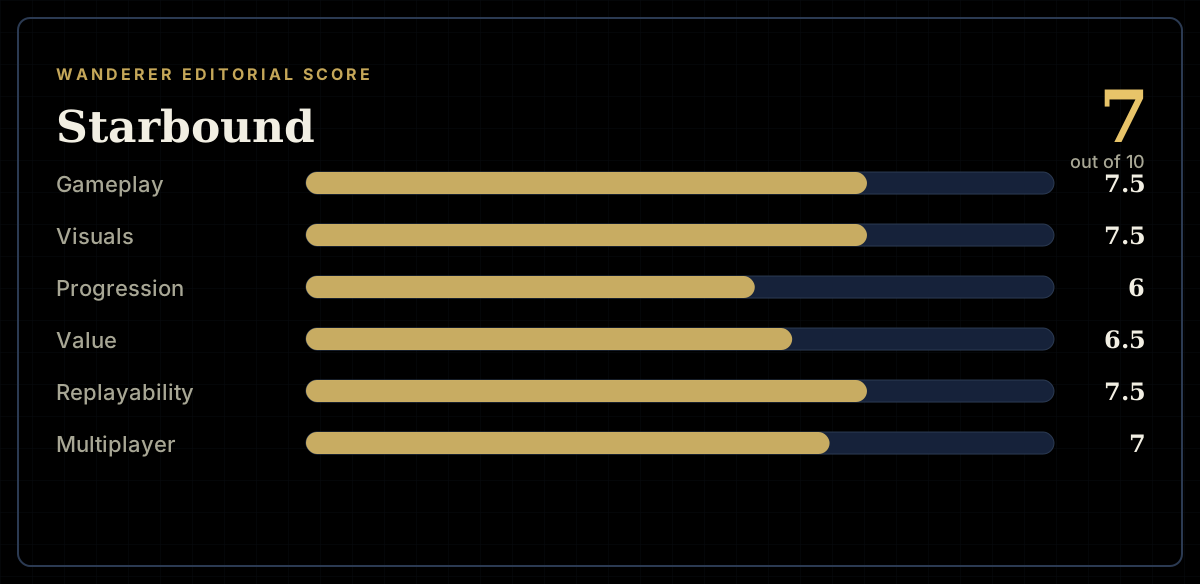
7 / 10
- Developer
- Chucklefish
- Publisher
- Chucklefish
- Released
- 22 July 2016
- Platforms
- Windows, macOS, Linux
- Genre
- Sandbox Survival-Crafting RPG
- Monetisation
- One-time purchase; the only DLC is a NZ$1.29 soundtrack, no in-game shop, no ads, no subscription
- Players
- Player-hosted co-op and PvP across Windows, macOS and Linux clients, either over a local network, direct IP or through a self-run dedicated server — no official matchmaking or server browser
The short version
Starbound drops you on a procedurally generated planet with a broken ship, a mining laser and no real instructions, and the first dozen hours of digging, crafting and fighting your way toward a working spaceship are still genuinely good — inventive biomes, a satisfying tier-by-tier gear loop, and co-op that turns "figure this planet out" into a proper shared project. The trouble is everything past that opening stretch, where the game that was pitched as a build-anything answer to Terraria noticeably runs out of ambition, and where the studio itself checked out years ago.
Chucklefish shipped one hotfix in the five and a half years since its last real content update, then marked ten years since the 1.0 launch with a vinyl soundtrack release instead of a patch. Players noticed immediately: the same store page that has carried a Very Positive rating for a decade logged more negative reviews than positive ones in the thirty days around that announcement. The modding scene is doing the work Chucklefish stopped doing, and it's doing that work well — but it can't be the reason to recommend buying the base game today.
Biggest strengths
- The early loop of scanning a planet, mining toward better gear tiers and patching together a working ship gives crafting-sandbox fans a genuinely inventive alternative to Terraria's single persistent world
- Co-op multiplayer turns exploration into a shared project rather than a race, and it's the context in which most of the game's positive reviews describe having the most fun
- Frackin' Universe, the game's largest community overhaul, sits at over 645,000 current Steam Workshop subscribers and was still receiving updates as recently as July 2026 — the modding scene has kept building on Starbound long after the developer stopped
Biggest weaknesses
- Chucklefish's last content update was the 2019 Bounty Hunter patch; the only release since is a November 2024 hotfix, and the tenth-anniversary announcement in July 2026 was merchandise, not a patch
- That announcement visibly reignited a 2019 controversy over unpaid teenage contributors working "hundreds of hours" on the game during development, which shows up repeatedly in the reviews written in its wake
- Steam's 30-day review score sat at 58% positive at the time of writing, against a 90% positive all-time average — a real, current dip, not an old fossil sitting on the page
Who it's for: Sandbox and survival-crafting fans who want a Terraria-adjacent game built around space exploration rather than a single 2D world, especially in co-op with a friend or two, and players who are already planning to install a large overhaul mod and treat the base game as a chassis.
Our recommendation: Worth it at NZ$22.49 for the opening crafting-and-exploration loop and for co-op, as long as you go in knowing the studio isn't updating it any more and the story content thins out well before the credits. If you want the full, ambitious version of what Starbound promised in 2013, that version now exists as a community mod, not as the base game.
7 / 10
Starbound's Steam page still says Very Positive, and on the all-time numbers that's not wrong — ten years after its 1.0 launch, the game sits at 90% positive across more than 123,000 reviews. Look at just the last thirty days, though, and the picture flips: 58% positive, dragged there by a wave of reviews that all cite the same trigger. On 22 July 2026, ten years to the day after Starbound exited Early Access, Chucklefish marked the anniversary with a vinyl soundtrack release. Not a patch. Not even a promise of one. A record you can buy. Players who'd been quietly waiting years for the studio to come back to a game it once described as an ambitious answer to Terraria read that as the final word on where things stand, and said so, at length, in the review section. That collision — a genuinely good decade-old sandbox game running headlong into a genuinely bad-faith piece of anniversary marketing — is the actual story of Starbound in 2026, and it's worth separating from the game itself before getting into whether the game is worth your time. It mostly still is.
The loop that still works
Strip away the last five years of silence and Starbound's opening hours hold up. You crash-land on a procedurally generated planet with a damaged ship, a basic mining tool and a scanner, and the game's entire opening act is figuring out how to leave. That means mining ore tiers in roughly the order the game wants you to find them, fighting off planet-native wildlife that scales with the biome rather than a hard difficulty curve, and slowly assembling a functioning FTL drive out of progressively rarer materials. It's Terraria's structure — dig, craft, upgrade, dig further — run through a different lens: instead of one persistent 2D world you dig sideways and downward through forever, Starbound gives you an entire generated galaxy and asks you to treat each planet as disposable. Find a biome, strip what you need from it, and move to the next one when a planet stops having anything new to offer.
That structure produces Starbound's best moments and its worst ones in roughly equal measure. At its best, a lava planet or a bioluminescent forest world genuinely earns the "what's over that ridge" curiosity the genre depends on, and the crafting tree gives you a real reason to keep returning to a workbench between trips. At its worst, once you've seen the handful of biome templates the base game ships with, later planets start to feel like reskins of ones you've already cleared — a complaint that shows up constantly in longer-form negative reviews, several written by players well past the 200-hour mark, who describe the galaxy as wide rather than deep. Both descriptions are accurate for different stretches of the same playthrough, and which one dominates your experience depends heavily on how much of the base content you burn through before the repetition sets in.
Co-op is where it's meant to be played
Starbound supports player-hosted co-op and PvP across Windows, macOS and Linux, either over a local network, by trading a direct IP, or through a dedicated server one of you stands up. There's no official matchmaking and no server browser to speak of — multiplayer here means coordinating with people you already know, not finding strangers to play with. Within that limitation, though, co-op is consistently the context that gets Starbound's most enthusiastic reviews: splitting up to scan a planet faster, pooling ore toward a ship upgrade, or just having a second set of hands during a dangerous cave dive turns the exploration loop from a solitary grind into the kind of shared project the genre is built for. If you're deciding whether to buy this alone or with a friend, buy it with a friend — the reviews bear that out as clearly as anything in the game's own systems do.
How far people actually get
Steam's global achievement data gives a harder look at where that early promise starts to fade than any single review can. Starbound ships with 51 achievements, and the picture across them is a steep staircase rather than a gentle slope. completequest and protectorate, both early-game milestones, sit at 82.1% and 82.0% of all owners respectively — genuinely excellent numbers that show the opening hours are landing with almost everyone who installs the game. harvestcrop holds at 78.4%. From there the drop is fast: killdreadwing, tied to the game's first major boss encounter, sits at 29.4%, and gaincrew — recruiting your first ship crew member, a fairly early-to-mid-game milestone — sits at 30.4%. Past that point the list is almost entirely single digits, with completionist goals like collecting every fossil, crafting every armor set or filling out the in-game bestiary sitting at 1–2% each.
None of that alone proves the content thins out — Starbound is a sandbox, not a linear story, and a lot of owners are legitimately done once they've built a base and explored a few planets rather than chasing every achievement. But it does line up precisely with the shape of the "wide, not deep" complaint that recurs across years of reviews: strong initial retention, then a hard fall-off right around the point players would be pushing into content past the early planets, which is exactly where reviewers describe the galaxy starting to repeat itself.
Five years of near-silence, then a vinyl record
The honest version of Starbound's release history looks nothing like its Steam page. The game entered Early Access as a public beta on 4 December 2013 and sold over a million copies within its first month — while still unfinished. It stayed in that state for two years and seven months before exiting to 1.0 on 22 July 2016, the date the storefront actually shows. Real content kept arriving for a few years after that: a 1.3 update in mid-2017, and the 1.4 "Bounty Hunter" update in June 2019, which is the last major content patch the game has received. Since then, Chucklefish's own news feed lists exactly one release: a 1.4.4 hotfix on 19 November 2024, over five years after Bounty Hunter and more than a year and a half before this review. Then, on 22 July 2026, the tenth anniversary of 1.0, the only thing to appear on that same news feed was an announcement for a vinyl pressing of the soundtrack.
That timing is what set off the current review-bomb, and reading the wave of one-star reviews it produced, the vinyl announcement is really acting as a trigger for a grievance that predates it by seven years. In 2019, several people credited on Starbound — a writer, a graphic artist, a concept artist, all contributing what they describe as hundreds of unpaid hours, at least one of them sixteen years old at the time — said publicly that Chucklefish treated their volunteer labour as equivalent to paid staff work without paying for it. Chucklefish's response at the time was that contributors were under no obligation to hit deadlines or log specific hours; several of the contributors disputed that characterisation and said the disagreement was about how they were treated, not whether it was technically legal. That controversy had mostly faded from the front of the store page by 2026. The vinyl announcement brought it straight back, and it's now sitting inside a large share of the negative reviews written in the weeks since, alongside the more straightforward complaint that a company willing to sell merchandise around an anniversary ought to be willing to patch the actual game.
The mod scene isn't a substitute, but it is a real reason to stay
It would be easy to read all of that and assume Starbound is functionally dead. It isn't, and the reason is almost entirely down to its community rather than its developer. Frackin' Universe, the largest overhaul mod, currently sits at over 645,000 subscribers on the Steam Workshop and was still being updated as recently as July 2026 — actively maintained, in other words, well after Chucklefish stopped touching the base game in any meaningful way. It adds new biomes, an overhauled crafting and research system, new monsters and enough additional systems that installing it changes the game's identity rather than just extending it. Smaller mods layer on top of it constantly. For players willing to treat the vanilla game as a foundation rather than the finished product, that scene genuinely delivers a lot of what the 2013 pitch promised.
It shouldn't, however, be read as an argument for the base game's current state. A thriving mod community is evidence that Starbound's underlying systems were good enough to be worth building on for a decade — it isn't evidence that the studio is supporting what you actually paid for, and it doesn't change the fact that the last substantial first-party content is now more than six years old.
Value and final verdict
At NZ$22.49 with no discount active, no loot boxes and a grand total of one NZ$1.29 soundtrack DLC in ten years, Starbound's pricing has never been the problem — it's one of the more straightforward, respectful transactions you'll find in the genre, and that hasn't changed. What's changed is the confidence you can have that you're buying a maintained product rather than a snapshot the developer walked away from. You are, functionally, doing the latter.
That split is exactly what a 7.0 is for. The crafting-and-exploration loop, especially in co-op, still earns the Very Positive rating it's carried for a decade, and Steam's own achievement numbers confirm the opening hours land well with almost everyone who tries it. But the drop-off past that point is real and measurable, the studio has done essentially nothing to address either the content thinning out or the labour dispute hanging over the game's development since 2019, and its idea of marking ten years of goodwill from its playerbase was a vinyl record. The base game earns its score on its own merits. What it doesn't earn is the benefit of the doubt about where it goes from here — and the players currently tanking its recent-review score have a fair point about that.
Players who want the genre's other major touchstone should read Wanderer's review of Terraria for the tighter, single-world version of this same crafting loop, still under active development years past its own 1.0. Anyone drawn to Starbound's promise of progress that keeps building even when you're not actively grinding for it might also want to try Wanderer, where offline progression is a core system rather than something the developer walked away from.
Pros and cons
Pros
- The early loop of scanning a planet, mining toward better gear tiers and patching together a working ship gives crafting-sandbox fans a genuinely inventive alternative to Terraria's single persistent world
- Co-op multiplayer turns exploration into a shared project rather than a race, and it's the context in which most of the game's positive reviews describe having the most fun
- Frackin' Universe, the game's largest community overhaul, sits at over 645,000 current Steam Workshop subscribers and was still receiving updates as recently as July 2026 — the modding scene has kept building on Starbound long after the developer stopped
- A single NZ$22.49 purchase with no loot boxes, no premium currency and only one optional NZ$1.29 soundtrack DLC in ten years
- Steam's own achievement data shows most owners get well into the early-mid game — the completequest and protectorate milestones both sit above 80% of all owners — so the opening hours are landing with the broad audience, not just enthusiasts
Cons
- Chucklefish's last content update was the 2019 Bounty Hunter patch; the only release since is a November 2024 hotfix, and the tenth-anniversary announcement in July 2026 was merchandise, not a patch
- That announcement visibly reignited a 2019 controversy over unpaid teenage contributors working "hundreds of hours" on the game during development, which shows up repeatedly in the reviews written in its wake
- Steam's 30-day review score sat at 58% positive at the time of writing, against a 90% positive all-time average — a real, current dip, not an old fossil sitting on the page
- Achievement completion falls off hard past the opening hours: killing the game's first major boss sits at 29.4% of owners and most late-game or completionist achievements sit under 5%, matching the frequent complaint that content thins out once the early planets stop feeling new
- No official matchmaking, server browser or in-game way to find other players — multiplayer means running your own server or trading an IP with someone you already know
Screenshots
-
StarboundImage: Chucklefish via Steam -
StarboundImage: Chucklefish via Steam -
StarboundImage: Chucklefish via Steam -
How the review scores each part of the gameWanderer Editorial -
The short versionWanderer Editorial