Game review
Necesse
8 / 10
- Developer
- Fair Games ApS
- Publisher
- Fair Games ApS
- Released
- 16 October 2025
- Platforms
- Windows, macOS, Linux
- Genre
- Sandbox action RPG, colony management
- Monetisation
- Premium, one-off purchase. No ads, no premium currency, no energy systems, no gameplay-affecting DLC. An optional Supporter Pack adds cosmetic-only items, and a separate soundtrack DLC is exactly that
- Players
- Singleplayer, local and online co-op, and dedicated server hosting for persistent worlds with many concurrent players; full Steam Workshop mod support
The short version
Necesse takes Terraria's dig-craft-fight loop, drops the camera to a top-down angle, and welds a genuine settlement-management layer onto the side of it — settlers you recruit, house, and assign jobs to, who then keep farming, mining, and crafting while you're off clearing a dungeon three biomes away. That colony layer is the best reason to own the game, and after six years of Early Access refinement it's a legitimately deep system in its own right. The trade-off is a UI and a settler AI that still show their scrappy-solo-dev roots at the edges, and a world so large that its pacing occasionally slackens in the middle stretch.
For US$14.99, with no strings attached beyond that one purchase, it's an easy recommendation for anyone who's ever wished Terraria let them build an actual functioning village instead of a row of NPC shops.
Biggest strengths
- The settler job system genuinely delegates farming, mining, forestry, and crafting to NPCs, and that work keeps happening while you're off adventuring elsewhere in the loaded world
- Four fully realised combat styles (melee, ranged, magic, summoning) with distinct build paths rather than one true optimal loadout
- The Fallen Altar incursion system gives the post-story game an actual structure instead of trailing off into repeated boss farming
Biggest weaknesses
- Settlers path around a fixed 80x80-tile settlement footprint and can still get stuck on oddly placed furniture or crowd around a single feeding trough, so colony automation needs babysitting
- The interface leans on small icons and dense tooltips that don't scale well, particularly for anyone playing with a controller from a couch
- Progression continues only while a world is actually running — there is no true offline simulation, so a persistent colony needs either an open client or a dedicated server left on
Who it's for: Players who liked Terraria's core loop but wanted the base-building half to matter as much as the combat half, and anyone drawn to RimWorld-style colony management who'd rather swing a sword personally than direct everything from a menu.
Our recommendation: Buy it. At its current price it's one of the least risky purchases in the genre, and the settlement system alone justifies picking it up even for players who bounce off the combat.
8 / 10
Most sandbox RPGs that borrow Terraria's dig-craft-fight loop borrow it wholesale and change the camera angle. Necesse does that too — it drops you into a 2D, top-down world instead of a side-scrolling one, more Core Keeper than Terraria at a glance — but the angle isn't the point. The point is what Fair Games ApS built alongside it: a settlement system where the NPCs you recruit aren't decorative shopkeepers standing next to a crafting bench, they're workers with jobs, and those jobs keep getting done whether you're standing there watching or three biomes away clearing out a bandit camp. Six years of Early Access iteration went into making that system actually work, and it's the reason Necesse earned its own identity instead of becoming one more Terraria-shaped footnote.
The full 1.0 release landed on 16 October 2025, closing out just under six years of Early Access that began in December 2019 — itself the professionalised continuation of a solo hobby project Skovgaard had been chipping away at since 2012. That's an unusually long runway even by survival-sandbox standards, and it shows in how settled the core systems feel. It also means the game arrived with the kind of user-review base most launches only dream of: comfortably in "Very Positive" territory across close to 28,000 reviews, with the overwhelming majority of the negative feedback clustered around specific, fixable friction rather than the game's fundamentals.
The settlement layer is the actual pitch
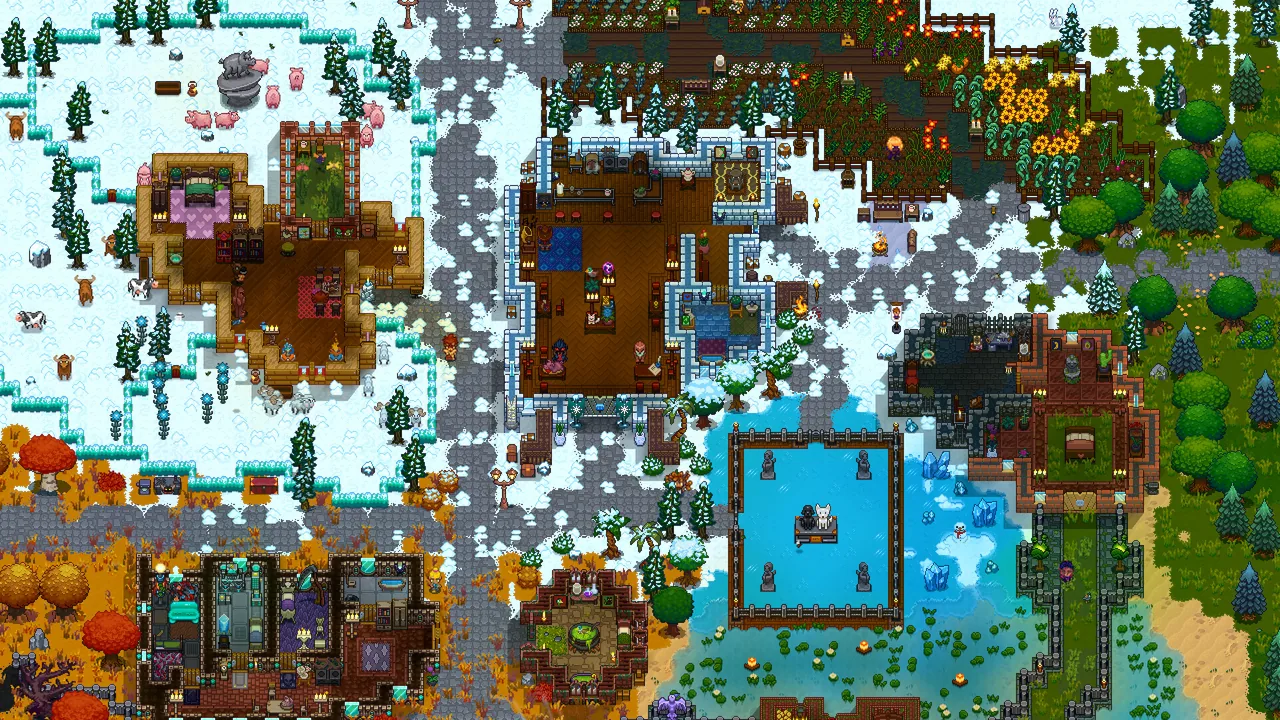
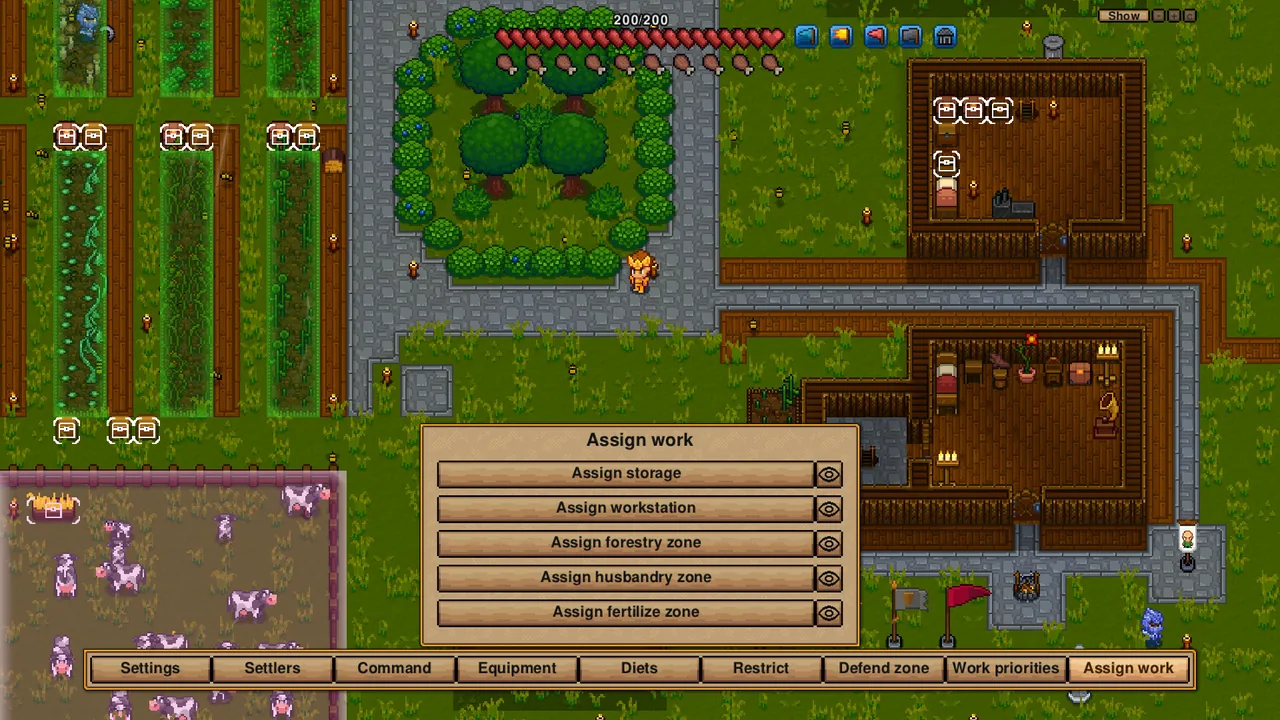
Plant a Settlement Flag, and the game carves out an 80x80-tile territory around whichever 16x16 region it landed in — not centered on the flag itself, which trips up a lot of new players trying to eyeball their boundaries. Recruit settlers from the villages you find or the people you run into wandering the world, build them houses with proper walls and doors, and an Elder NPC shows up to run the place. From there, settlers pick up jobs on their own within the settlement bounds: farming and fertilizing crops, tending fenced livestock, replanting harvested trees, staffing workstations to turn raw materials into finished goods. None of it requires micromanagement once it's set up. That's the entire appeal, and it's a real one — you go fight a boss or dig a dungeon, and you come back to a stockpile that grew while you were gone.
It's worth being precise about what "while you were gone" actually means here, because it's the detail that separates Necesse from games built around true offline progression. Settlers work whenever the world is simulating — meaning your client is open, or a dedicated server hosting that world is running. Log out of a singleplayer world and the simulation pauses with you; nothing advances until you're back. Run a dedicated server instead, and the colony genuinely keeps ticking around the clock, which is exactly why the store page leans on "establish a dedicated server with hundreds of other players" as a selling point. For a solo player without a server to leave running, the delegation is real but bounded: it buys you freedom to be elsewhere in the world right now, not freedom to log off entirely and return to free progress. Players coming from genuinely idle-driven games should recalibrate that expectation before they buy.
The job system's other rough edge is pathfinding. Settlers are reported, consistently enough across player feedback to call it a pattern rather than a one-off bug, to get stuck on awkwardly placed furniture, crowd a single feeding trough instead of spreading across a pen, or wander outside their job range and stall out. None of it is catastrophic, and 1.0 tightened the system by removing the old adjustable job-search radius in favor of a hard settlement-bounds cutoff, which cut down on settlers disappearing to chase distant tasks. But "build the house, place the furniture, hope the pathing cooperates" is still a real part of setting up an efficient colony, and new players will lose an evening to a settler stubbornly refusing to do the one thing you built the building for.
Four ways to fight, one world to fight in
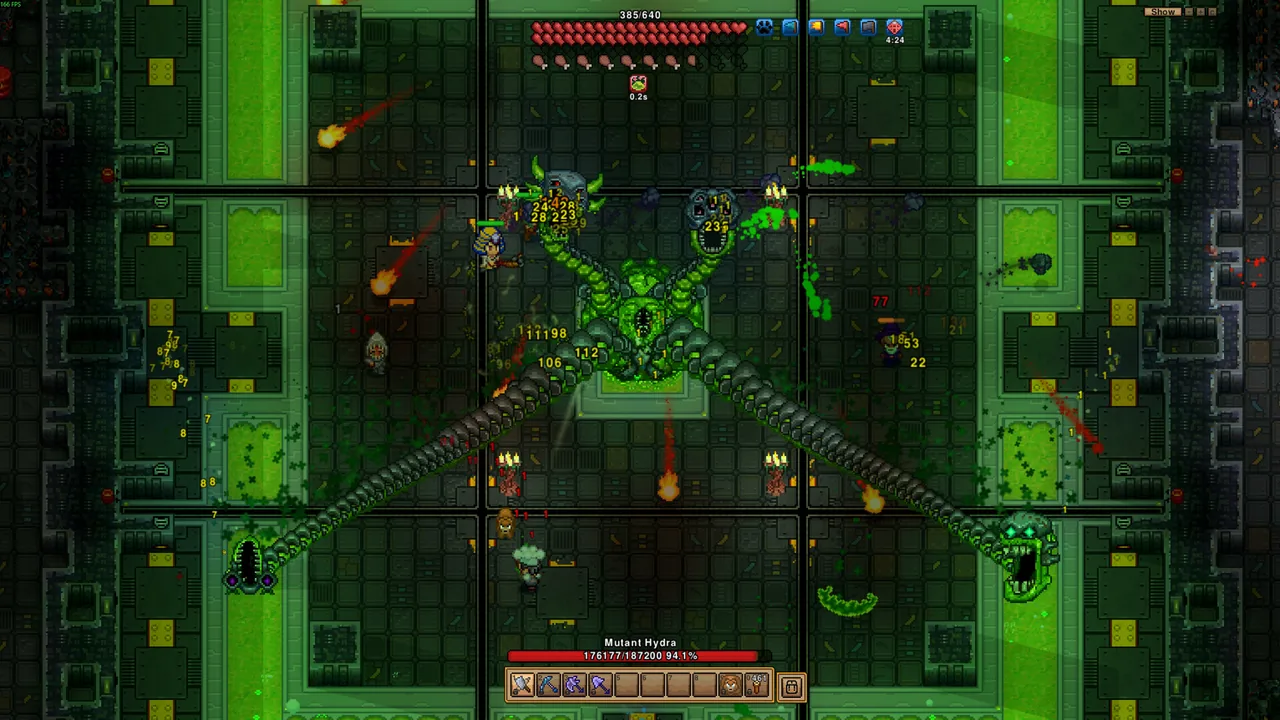
Combat sits on four separate pillars — melee, ranged, magic, and summoning — and each one supports its own gear progression rather than existing as a reskinned version of the others. Summoning in particular gives Necesse something Terraria's own summoner class only gestures at: a genuinely different play pattern built around positioning your minions and managing cooldowns rather than landing hits yourself. Dungeons, caves, and biome-specific enemy rosters scale the challenge as you push outward from your starting area, and boss fights gate access to new tiers of crafting material the same way Terraria's hardmode bosses do, just without the permanent world-altering aftershock that makes Terraria's version so dramatic.
Where Necesse pulls ahead of the comparison is what happens after the story boss. The Fallen Wizard drops a Gateway Tablet, which unlocks the Fallen Altar and a Path of Exile-flavored endgame called incursions — self-contained instanced challenges with seven difficulty tiers, enemy modifiers that scale up the higher you push, and a 48-perk tree that lets you customise how brutal (and how rewarding) each run gets. It's a genuine structure for the post-campaign hours rather than a vague invitation to keep farming the same boss, and 1.0 extended it further by raising the equipment tier cap from six to ten. Whether that's enough to hold a min-maxer's attention for hundreds of hours the way Path of Exile itself does is a fair question — Necesse's system is considerably shallower — but as a capstone bolted onto a sandbox-crafting game, it's more ambition than most of the genre bothers with.
An infinite world with a soft middle
1.0's headline world-generation change replaced the old island-based map structure with genuinely seamless, infinite procedural terrain — no more sailing between disconnected chunks, just one continuous world that blends biomes into each other as you walk. It's a meaningful upgrade for anyone who found the island structure claustrophobic, and it gives exploration an actual sense of distance and discovery that the earlier structure didn't have room for.
The trade-off is pacing. The early game — first settlement, first tier of gear, first few dungeons — is tightly designed and teaches its systems well. The endgame incursion content gives the back half a clear destination. The stretch between them, pushing through the game's mid-tier biomes and gear tiers before the incursion system opens up, is where the "infinite" part of infinite procedural generation starts working against the game rather than for it: more distance to cover for roughly the same density of things worth finding. It's not a dead zone, and settlement-building gives you something to do with the downtime regardless, but players expecting a tightly curated mid-game will notice the slack.
Presentation, performance, and the interface
The pixel art is functional and reads clearly at a glance — biomes are distinct, enemy silhouettes are legible even in busy fights, and the top-down perspective keeps combat readable in a way some side-scrolling sandbox games struggle with once the screen fills up with effects. It's not chasing Core Keeper's more polished, moodier lighting work, and it doesn't need to; it's a serviceable house style rather than a selling point on its own. Sound design is competent without being a highlight, and the soundtrack — sold separately as its own small DLC — is pleasant background music rather than anything that demands attention.
The interface is where the solo-project origins show most clearly. Menus, crafting lists, and inventory grids lean on small icons and text-dense tooltips that work fine with a mouse and a reasonably sized monitor and get noticeably more cramped with a controller from a couch. Full controller support is genuinely implemented, which many PC-first sandbox games can't claim, but it's support in the sense of "everything is reachable," not "everything was designed with a gamepad in mind first."
Performance holds up well in normal solo or small-group play. It gets more strained the moment a settlement grows large or a server hosts a genuinely big population — settler pathfinding and job calculations for dozens of NPCs at once is real CPU load, and player reports of laggy larger servers are consistent enough to flag here, even though plenty of smaller communities report running smoothly with ten or more concurrent players. If you're planning a persistent, heavily populated server rather than a small co-op group, budget for decent hardware and expect some tuning.
Value and monetisation
There's very little to analyse here, which is itself worth saying plainly in a genre full of energy timers and premium currencies: Necesse is a flat US$14.99 purchase (currently discounted to US$7.49 at time of writing) with no in-game store, no ads, and no purchase that affects gameplay balance in any way. The only paid add-ons are a cosmetic Supporter Pack and a standalone soundtrack, neither of which touches progression. Combined with full Steam Workshop mod support and dedicated server tools included at no extra cost, it's about as clean a value proposition as the survival sandbox genre offers right now.
Verdict
Necesse earns its place next to the genre's bigger names by doing the one thing most Terraria-likes never attempt: making the settlement half of the game a real system rather than set dressing. The job-assignment layer, six years refined, genuinely lets a colony produce and grow while you're off doing something else in the same running world, and the four-class combat and incursion endgame give that colony something worth defending and a reason to keep pushing gear tiers once the story ends. It loses ground to a settler AI that still needs occasional hand-holding, an interface that wasn't built controller-first, and a middle stretch of its now-infinite world that doesn't always reward the extra distance. None of that undoes what's genuinely one of the more complete indie sandbox packages available for the price.
Players who liked what Terraria does with dig-craft-fight but wanted the settlement half of the equation to actually matter, or who enjoyed Core Keeper's top-down mining loop and want a deeper colony layer stacked on top of it, should put this near the top of their list. Fans of RimWorld's job-assignment systems who'd rather be swinging a sword personally than watching from a management screen will find a lot to like too, even if Necesse's colony simulation is nowhere near as deep as Ludeon's. And anyone who likes a system that keeps producing results while their attention is elsewhere — just, here, only while something is actually running the world — may also find something familiar in Wanderer.
Price and store details checked 31 July 2026.
Pros and cons
Pros
- The settler job system genuinely delegates farming, mining, forestry, and crafting to NPCs, and that work keeps happening while you're off adventuring elsewhere in the loaded world
- Four fully realised combat styles (melee, ranged, magic, summoning) with distinct build paths rather than one true optimal loadout
- The Fallen Altar incursion system gives the post-story game an actual structure instead of trailing off into repeated boss farming
- One flat price with no monetisation layer whatsoever — the only paid extras are a cosmetic pack and a soundtrack
- Full mod support through Steam Workshop, plus dedicated server tools for persistent multiplayer worlds
Cons
- Settlers path around a fixed 80x80-tile settlement footprint and can still get stuck on oddly placed furniture or crowd around a single feeding trough, so colony automation needs babysitting
- The interface leans on small icons and dense tooltips that don't scale well, particularly for anyone playing with a controller from a couch
- Progression continues only while a world is actually running — there is no true offline simulation, so a persistent colony needs either an open client or a dedicated server left on
- Large settlements and busy multiplayer servers show real CPU strain once settler pathfinding and job-queue calculations stack up
- The infinite world can feel padded in the middle third, between the early biomes and the endgame incursion content, before the pacing picks back up
Screenshots
-
NecesseImage: Fair Games ApS via Steam -
NecesseImage: Fair Games ApS via Steam -
NecesseImage: Fair Games ApS via Steam -
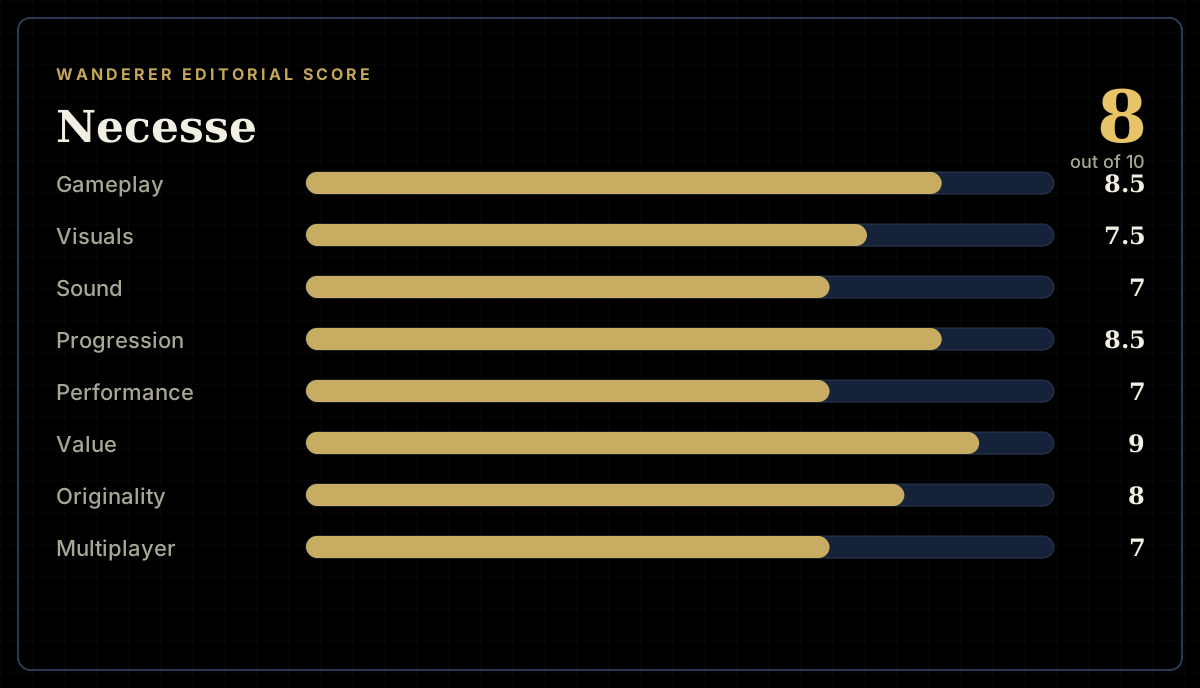
How the review scores each part of the gameWanderer Editorial -
The short versionWanderer Editorial