Game review
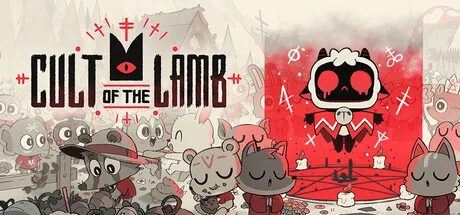
Cult of the Lamb
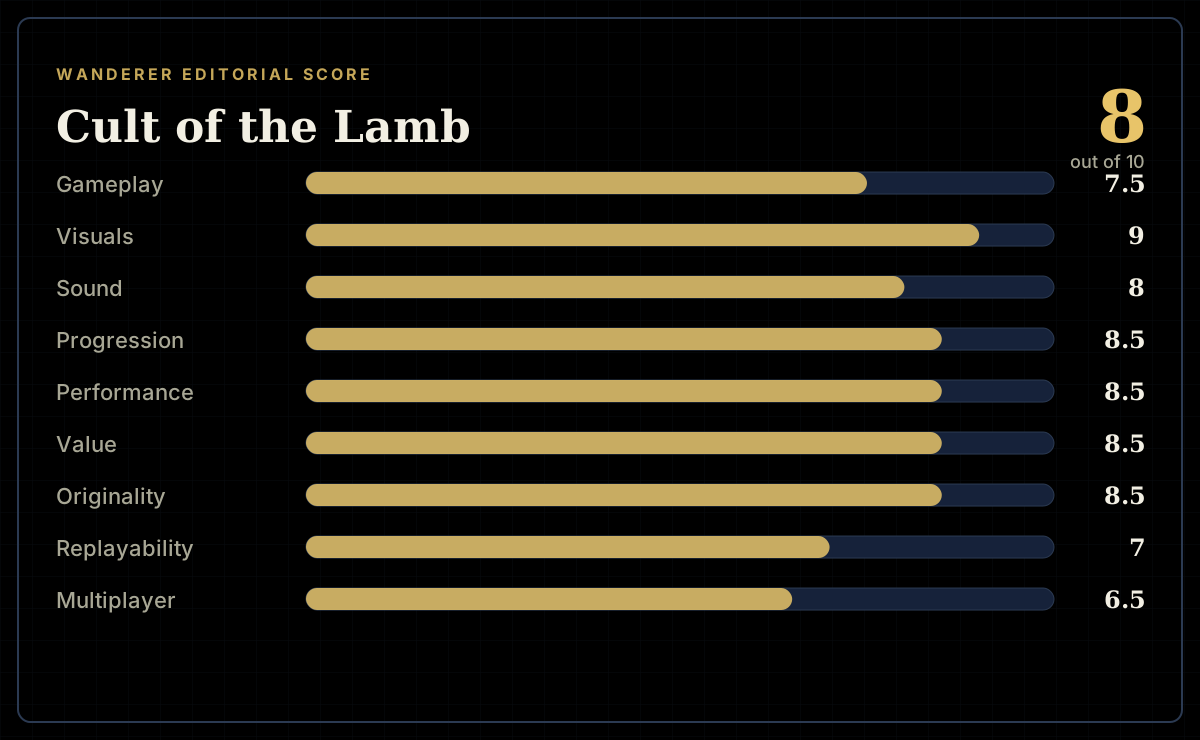
8 / 10
- Developer
- Massive Monster
- Publisher
- Devolver Digital
- Released
- 11 August 2022
- Platforms
- Windows, macOS, PlayStation 4, PlayStation 5, Xbox One, Xbox Series X|S, Nintendo Switch
- Genre
- Roguelite action / colony management sim
- Monetisation
- Premium, one-off purchase. Three free content updates since launch (Relics of the Old Faith, Sins of the Flesh, Unholy Alliance); cosmetic packs, two soundtracks and one paid full-length expansion (Woolhaven) sold separately
- Players
- Local split-screen co-op for two (Unholy Alliance update, added August 2024); no native online co-op, though Steam's Remote Play Together can stream a local session to a remote friend
The short version
Cult of the Lamb's pitch sounds like two half-finished games stapled together: a Zelda-adjacent roguelite where a possessed lamb hacks through procedurally shuffled dungeons, feeding directly into a Stardew-adjacent management sim where that same lamb runs a cult of woodland creatures who need feeding, preaching to and occasionally sacrificing. It shouldn't work as one game. It mostly does, because the loop between the two halves is real — crusades fund the cult, the cult buffs the crusades — and because the presentation is good enough to paper over the moments where either half runs thinner than the other.
The crack in the foundation is that the two halves don't grow at the same rate. Combat variety plateaus well before the credits roll, and cult management degrades from "an interesting set of trade-offs" into "a checklist you run every morning" a good stretch before the campaign ends. Four years of free updates and one substantial paid expansion have made the ceiling of this game much higher than it was in 2022. They haven't fixed the mid-game sag underneath it.
Biggest strengths
- Resources earned in dungeon crusades map directly onto specific cult upgrades, so a bad run has a visible, immediate cost back home
- Doctrines let you shape a genuinely different cult identity — a lean, disciplined flock plays nothing like a cult built on gluttony and excess
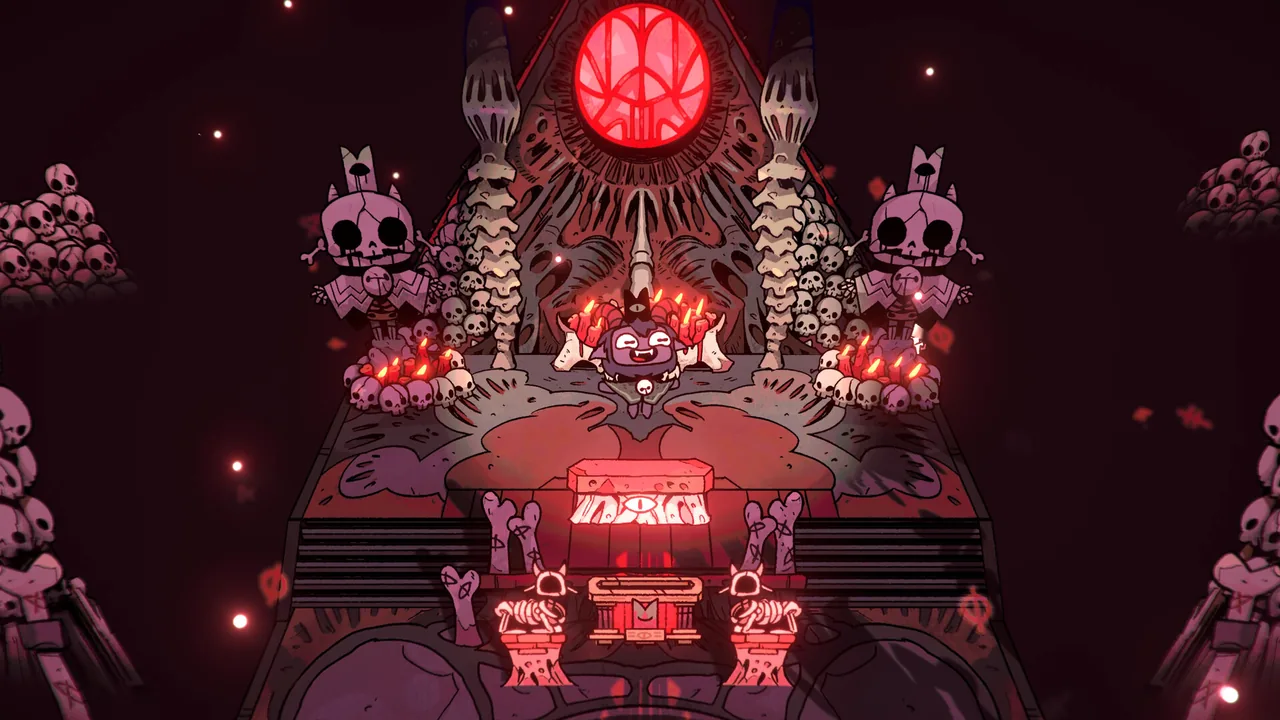
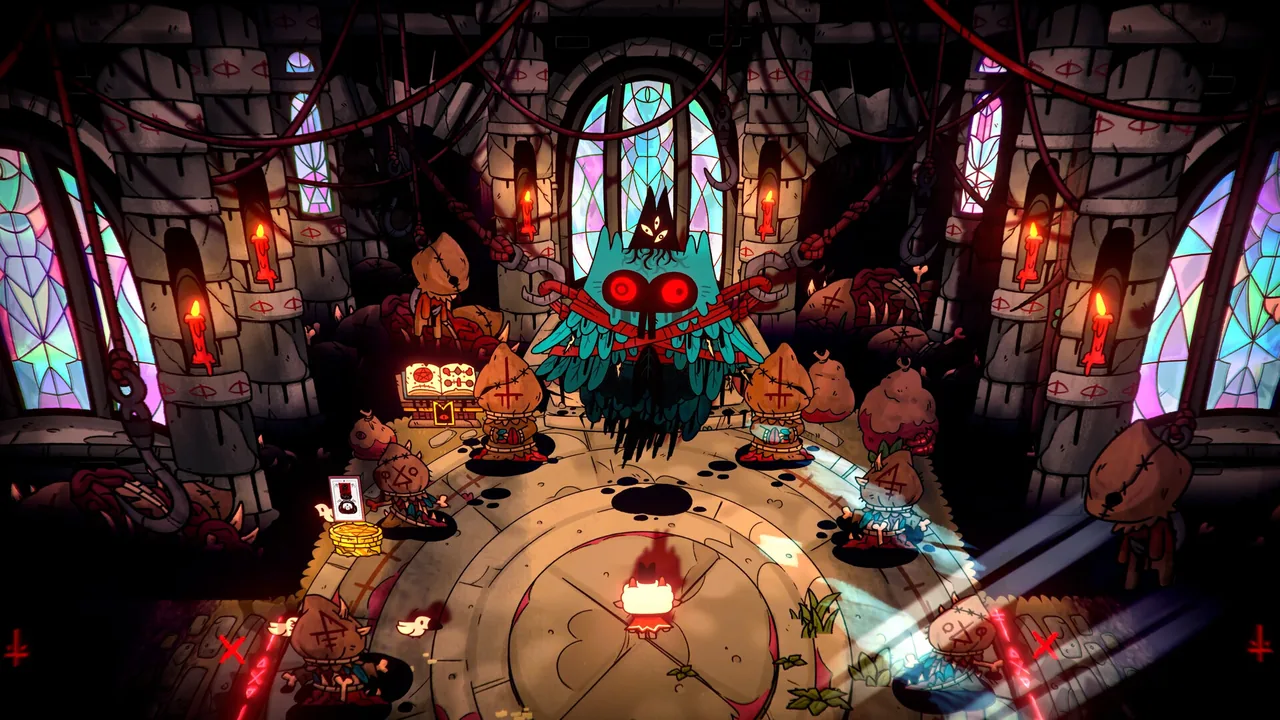
- The art direction sells its central joke perfectly, staging blood sacrifice and cannibalism with the warmth of a cosy life-sim palette
Biggest weaknesses
- Dungeon layouts recombine from a fixed set of rooms and enemies, and by the second region very little in a crusade feels new
- Feeding, cleaning faeces and preaching sermons every morning becomes rote well before the campaign's back half, and skipping it has real consequences
- Curses and relics rarely combine into the kind of build-defining synergy that similar roguelites lean on for late-game replay value
Who it's for: Players who want their power fantasy delivered by two systems instead of one — dungeon loot that visibly makes your village stronger, and village management that visibly makes your next run easier — plus anyone drawn in purely by the tonal whiplash of cute woodland cultists performing genuinely dark rituals.
Our recommendation: Buy it. Four years of free major updates (Relics of the Old Faith, Sins of the Flesh, Unholy Alliance co-op) have turned the 2022 base game into a considerably deeper package at the same price, and Woolhaven gives returning players a real reason to come back rather than a reskinned excuse. Go in expecting the base loop to soften around the twenty-hour mark rather than keep escalating, and you won't be disappointed by what's actually here.
8 / 10
Cult of the Lamb sells itself on a joke that could have curdled in five minutes: a fluffy woodland cult run by an adorable, doomed lamb, staging rituals that would read as horror in any other art style. It doesn't curdle, because Massive Monster commits completely — the sacrifices are genuine, the doctrines are genuinely dark, and the pastel-cute presentation never winks at the camera to undercut it. That tonal commitment is the first thing the game gets right. The harder question, almost four years and three free content updates past launch, is whether the mechanical marriage underneath the joke — dungeon crusades funding cult growth, cult growth buffing dungeon crusades — still holds up its half of the bargain by the time a save file is thirty hours deep.
Mostly, yes. Not evenly, and not forever.
The loop that's supposed to hold it all together
The structural idea is simple to state and genuinely clever to execute: you lead crusades into procedurally arranged dungeons for resources, followers and unlockable Tarot cards, then spend those resources back at the cult building shrines, sermons halls, prisons and farms that make the cult stronger, happier and more productive — which in turn improves the buffs, blessings and follower support available on the next crusade. On paper that's a perfect closed loop, each half feeding the other, and for the first ten or so hours it plays that way. Early game, every dungeon run visibly changes what's possible back at camp, and every camp upgrade visibly changes what a dungeon run feels like.
The trouble shows up once both halves have been explored for a while. Camp management stops being a set of interesting choices about what to build next and starts being a maintenance list: feed the followers, clean up after them, deliver a sermon so faith doesn't decay, check on a doctrine you unlocked three hours ago. None of those tasks are difficult. They're also not decisions any more — they're chores with a UI, and doing them on autopilot every morning is a noticeably different experience than the resource-allocation puzzle the opening hours promise. Dungeon runs hold their shape a little better because loot and curses keep changing the immediate tactical picture, but enemy and room variety within a region is finite, and by the second biome a crusade reads as familiar rather than surprising. The loop between the two halves never actually breaks. It just stops tightening once you've built most of what there is to build, which is a real problem for a game whose whole pitch is that the two halves keep escalating together.
Followers, doctrines and the trade-offs that matter
Where Cult of the Lamb earns its management-sim half is in doctrine design. Choosing between, say, a Vegetarian doctrine that keeps followers content on cheaper food or one built around ritual sacrifice for faster faith gains isn't cosmetic — it changes what buildings are worth constructing, what your followers will tolerate, and how quickly the cult's resource economy moves. Building a lean, efficiency-focused flock plays meaningfully differently from building an indulgent one stacked on Sins of the Flesh's gluttony and lust mechanics, and that's a real design achievement for a genre that often lets management options collapse into a single obviously-correct build.
What doesn't hold up as well is the stakes attached to individual followers. Recruits die on crusades, get executed for heresy, or simply age out, and the game's writing wants each of those to land as a small tragedy — a named creature with a face and quirks, gone. Mechanically, replacing a lost follower is nearly free: recruit another one on the next run, assign it the same job, move on. The emotional framing and the actual system cost are pulling in opposite directions, and the system wins. It's a smaller version of the same problem the crusades have: the surface keeps presenting new stories, but underneath, very little of consequence is actually changing run to run.
Combat: enough to carry the early game, not the whole game
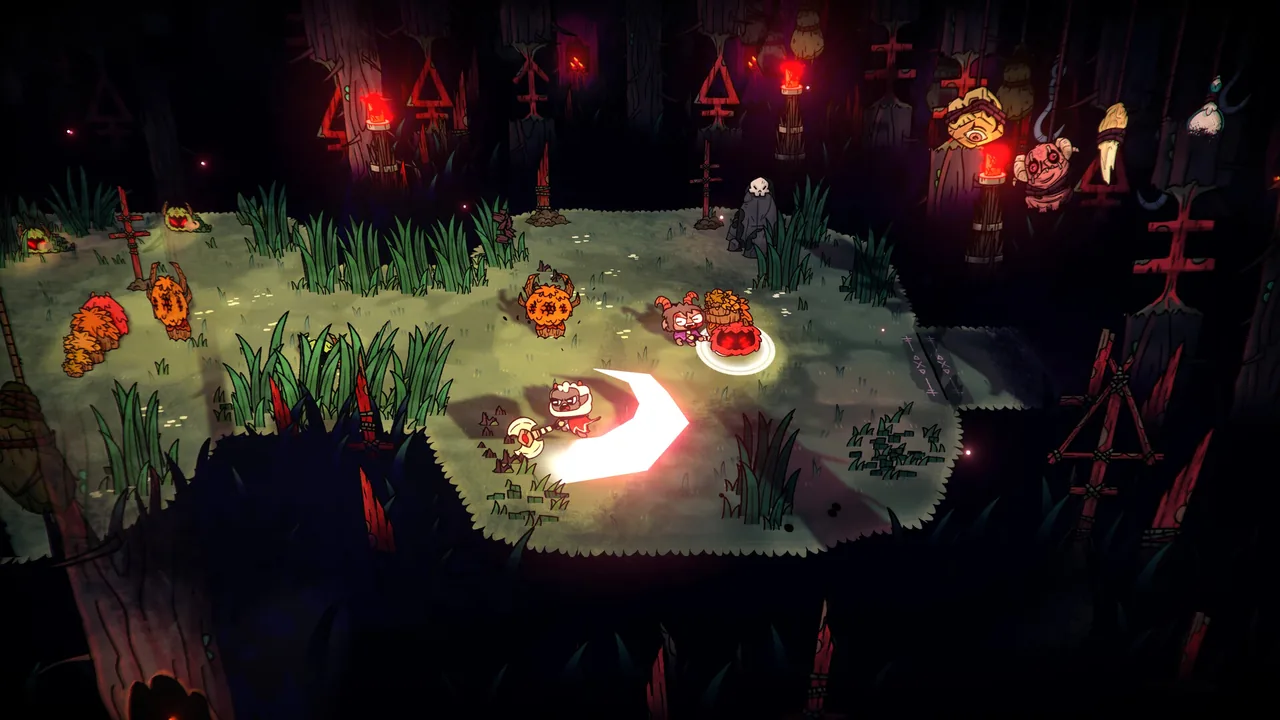
Four weapon archetypes — sword, dagger, axe, hammer, later joined by ranged options like the Blunderbuss added in Sins of the Flesh — plus a rotating pool of curses give early crusades a real sense that a run's identity is being built as you go. Curses in particular are the game's best combat idea: single-use, powerful, and genuinely worth planning a run around rather than hoarding.
The ceiling on all of it is lower than the genre's best. Curse and relic combinations rarely produce the kind of build-defining synergy that makes a roguelite worth returning to dozens of times — most runs escalate in raw numbers rather than in how a fight is actually played. And the difficulty curve stays soft throughout: death costs you the loot from that specific run, not real cult progress, so even a bad crusade rarely threatens anything you've actually built. That's a reasonable design choice for a game this broad in scope — punishing permadeath would fight against the cosy tone the base-management half is going for — but it does mean players coming from harder roguelites will find little tension in the dungeon half specifically, which is exactly the half most responsible for carrying the game's back third.
Art and animation doing more work than the writing gives them credit for
The pixel art is the single best argument for playing this over reading about it. Followers have genuine personality conveyed almost entirely through animation — the way they shuffle, panic, or huddle together during a ritual sells emotional beats the dialogue barely attempts. Dungeon regions are distinct and colourful without losing legibility in combat, and the game's willingness to cut straight from a cosy farming montage to a genuinely unsettling ritual sequence, in the same visual language, is the tonal trick that makes the whole premise work. Woolhaven's winter setting extends that same confidence to a colder, bleaker palette without losing the house style, and it's a noticeably more ambitious environment than anything in the base four regions.
Co-op: real, but still local-only
Unholy Alliance, the free update that added two-player support in August 2024, lets a second player take the role of the Goat and share the full campaign — crusades, minigames, cult chores — in split-screen. It's a genuine, well-built addition rather than a token multiplayer mode bolted on after the fact, with its own curses and relics designed around two-player synergy. It's also, nearly two years later, still local-only: there's no native online co-op, and the only way to bring in a remote friend is Steam's Remote Play Together, which streams the host's session rather than running a proper networked session. For a management sim as suited to "one of us runs the farm, one of us crusades" as this one is, the lack of a real online option is a persistent, slightly surprising gap.
Performance and interface
The game runs comfortably on hardware well below current mid-range, which tracks given its 2D presentation, and load times between camp and crusades are short enough not to interrupt the loop the design depends on. The interface itself is straightforward on a controller and translates cleanly to keyboard and mouse, though the busier late-game menus — doctrine trees, follower assignment lists, Disciple management added in Sins of the Flesh — start to feel like they're managing more systems than the original UI was built to hold.
What four years of free updates actually changed
This is where Cult of the Lamb's value case gets genuinely strong. Relics of the Old Faith (April
- added a real postgame built around Relic items and revamped crusades for players who'd already
finished the story. Sins of the Flesh (January 2024) was the bigger swing: a new Sin-and-Disciple progression layer, follower customisation via a Tailor building, follower breeding and offspring, and a new ranged weapon. Unholy Alliance (August 2024) added the co-op mode discussed above along with a fresh batch of co-op-aware Tarot cards and relics. None of that cost existing owners a cent, and together they represent a meaningfully larger game than the one that shipped in August 2022.
Woolhaven, released in January 2026 at roughly NZ$24.99, is the first time Massive Monster has asked for money beyond cosmetic packs and soundtracks. It's a legitimate full-length expansion rather than a reskinned side-dungeon — a new winter region, a returning lost deity storyline, fresh dungeons and an animal-ranching system that gives late-game cult management something genuinely new to build around. Paying customers are also the reason the free-update era was sustainable for four years, so the shift to a paid expansion after that much free content reads as fair rather than a bait-and-switch. Cosmetic packs (Cultist, Heretic, Sinful, Pilgrim) sit in the seven-to-ten-dollar range and change nothing but appearance; the two soundtrack releases are optional and irrelevant to the game itself. None of it is aggressive, none of it gates content behind a paywall inside the base game, and the overall shape — years of free support, then one clearly-labelled paid expansion — is close to a model worth pointing to.
Verdict
Cult of the Lamb's central bet — that dungeon crusades and cult management could feed each other well enough to carry a whole game — mostly pays off, and four years of substantial free content have made that bet stronger than it was at launch. Doctrine choice gives the management half real weight, the art direction sells the entire premise better than the writing does on its own, and the resource loop between crusade and camp genuinely functions rather than just alternating for show.
It falls short of the top of the scale because both halves plateau well before the game does. Dungeon variety and curse synergy run out of new ideas by the second region, cult management curdles into daily chores rather than staying a set of live decisions, and a soft difficulty curve means neither half ever really threatens the player in a way that keeps tension high across a full playthrough. Co-op is a genuine addition that's still missing the online option a lot of players clearly want. None of that erases what four years of free updates built on top of a strong original idea, or what Woolhaven adds for players ready to come back. It's a very good game that never quite becomes a great one, mostly because it never solves the mid-game sag in either of its two halves at once.
Players who like a management layer that keeps ticking away and rewarding attention even when combat isn't the focus may also want to look at Wanderer — a persistent RPG built around exactly that kind of parallel progression, running whether you're actively playing or not.
Pricing, DLC and platform details checked via Steam's storefront listing, 30 July 2026.
Pros and cons
Pros
- Resources earned in dungeon crusades map directly onto specific cult upgrades, so a bad run has a visible, immediate cost back home
- Doctrines let you shape a genuinely different cult identity — a lean, disciplined flock plays nothing like a cult built on gluttony and excess
- The art direction sells its central joke perfectly, staging blood sacrifice and cannibalism with the warmth of a cosy life-sim palette
- Four weapon types plus a deep curse pool give early crusades a real sense of build variety run to run
- Three free major updates since 2022 (Relics of the Old Faith, Sins of the Flesh, Unholy Alliance) added a real postgame, a follower customisation layer and co-op at no extra cost
- Woolhaven's winter setting and animal ranching justify its price as a genuine expansion rather than a reskinned dungeon pack
Cons
- Dungeon layouts recombine from a fixed set of rooms and enemies, and by the second region very little in a crusade feels new
- Feeding, cleaning faeces and preaching sermons every morning becomes rote well before the campaign's back half, and skipping it has real consequences
- Curses and relics rarely combine into the kind of build-defining synergy that similar roguelites lean on for late-game replay value
- Difficulty stays forgiving throughout; death costs a run's loot but rarely threatens the cult itself, so crusades carry little lasting tension
- Co-op is local-only nearly two years after launch, with no native online option outside Steam's screen-sharing workaround
- Follower death and replacement is nearly consequence-free once the cult is established, undercutting the emotional stakes the game's writing wants those relationships to have
Screenshots
-
Cult of the LambImage: Devolver Digital via Steam -
Cult of the LambImage: Devolver Digital via Steam -
Cult of the LambImage: Devolver Digital via Steam -
How the review scores each part of the gameWanderer Editorial -
The short versionWanderer Editorial