Game review
Ascension Trail
7 / 10
- Developer
- Flying Brick Face Studio
- Publisher
- Flying Brick Face Studio
- Released
- 26 July 2026
- Platforms
- Windows
- Genre
- Action Roguelike
- Monetisation
- One-time purchase, no in-game store, no DLC
- Players
- Online co-op
The short version
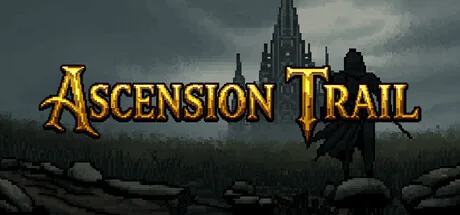
Ascension Trail is a top-down co-op action roguelike where players fight through procedurally generated dungeon floors inside a tower, choosing swords, bows, spellbooks or bare fists, either aiming manually or leaning on auto-aim to let a build do the killing. It released 26 July 2026 after a public alpha and beta period, and this review reads its complete Steam sample — ten reviews, every one positive — rather than a filtered slice of a larger corpus.
What that small sample repeatedly credits isn't just the moment-to-moment combat, though several reviewers praise it in Binding of Isaac terms. It's the trajectory: multiple reviewers who followed the game since its earliest alpha builds specifically call out how much it's changed, and credit the developer directly for fast, responsive patching. The Steam news feed backs that up independently — nine distinct updates and hotfixes in the roughly two and a half weeks since launch, including a substantial content update adding dozens of new items and full six-language localisation.
Biggest strengths
- The core loop — fight through procedurally generated rooms, build a character through combat drops, push as far as possible before a run ends — draws specific, enthusiastic praise, with build variety and weapon choice singled out repeatedly
- Long-term alpha and beta testers describe the game as substantially improved since those early builds, specifically crediting the developer for listening to and acting on player feedback
- Genuine post-launch support: nine distinct patches and hotfixes in under three weeks, including a major content update adding 90 armour pieces, 13 item sets, save-and-continue for runs, and full localisation in six languages
Biggest weaknesses
- The review sample is very small — ten reviews at time of writing — so any read on lasting quality or long-term balance is necessarily provisional, however unanimous it currently is
- At least one reviewer found the early mechanics unclear before the loop "clicked," suggesting onboarding could be smoother for players who don't dig into item descriptions and room menus right away
- A minor but specific complaint from one reviewer: certain ability icons don't visually match the game's dark fantasy tone, a small but real presentation inconsistency
Who it's for: Fans of Binding of Isaac-style roguelikes who want a co-op-friendly, dark fantasy dungeon crawl with real build variety, and anyone drawn to watching a small studio actively build out a young release. Suits both careful manual play and a more relaxed auto-aim approach for players who want to zone out to a podcast while grinding.
Our recommendation: A confident recommendation at its price, helped by a visibly active developer and a small but completely positive review record. Go in aware the sample is still small, and expect the game to keep changing meaningfully given the pace of updates so far.
7 / 10
Introduction
Ascension Trail asks a simple question repeatedly: how far can you climb before the dark catches up with you? Players descend — or rather ascend — through a procedurally generated tower, clearing combat rooms, survival rooms and treasure vaults floor by floor, with a "shard-fire" burning down throughout each run. Let it die, and the tower's protections fail along with it. Developed by Flying Brick Face Studio, it left a public alpha and beta period to reach full release on 26 July 2026, and this review reads its entire Steam sample to date — ten reviews, every single one positive — rather than treating a fragment of it as representative.
A loop reviewers keep comparing to genre favourites
The praise across this small sample is specific rather than generic, which matters more at this size than it would in a thousand-review pull. One reviewer described the appeal directly: "this game gives Binding of Isaac vibes but with some added features of different weapons you can get from various chest you find along the way," going on to list dark magic, lightning and explosive abilities as standouts in a genre they don't normally seek out. Another described losing track of time entirely: "I didn't expect to spend this many hours playing Ascension Trail, but it just keeps pulling me back in... trying out different builds never gets old." A third captured the run structure's appeal in a single line: "you level up, push as far as you can, ascend, reset, and dive right back in stronger than before." Co-op draws its own specific credit rather than being folded into general praise, with at least one reviewer describing how playing alongside a friend changes the shape of a run.
Accessibility of pacing is a smaller but real thread through the sample. One reviewer explicitly described the game as suited to zoning out with a podcast running in the background thanks to its auto-aim and auto-attack options, while still describing genuine progression underneath that more relaxed approach — a combination that's harder to pull off than it sounds, since games built for full manual engagement often make automated play feel like a lesser version of themselves rather than a genuine alternative.
Watching a small studio build in public
What stands out most in this sample, though, isn't praise for the current build so much as testimony to its trajectory. Multiple reviewers explicitly identify themselves as alpha or beta testers and describe the distance travelled since then. "I'm playing AT since the very early alpha, and it's pleasant to watch how the game develops and changes its foundations," wrote one, in translated sense, adding specific thanks for the developer's fast bug-report turnaround. Another, who'd played since pre-alpha, described concrete additions since the beta — mazes requiring players to find an exit, and difficulty tiers that actively prevent standing still and grinding passively.
That testimony checks out independently against the Steam news feed rather than resting on trust alone. In the roughly two and a half weeks between launch and this review, Flying Brick Face Studio shipped nine distinct updates and hotfixes, including a substantial "Blackout" content update adding 90 unique armour pieces, 13 item sets, ten pattern-changing weapons, save-and-continue support for runs in both solo and co-op, and full localisation across six languages. That's a genuinely active pace for a small studio's young release, and it's the kind of independently verifiable detail that turns "the devs are responsive" from a compliment into a checkable fact.
The shard-fire, and why it changes the shape of a run
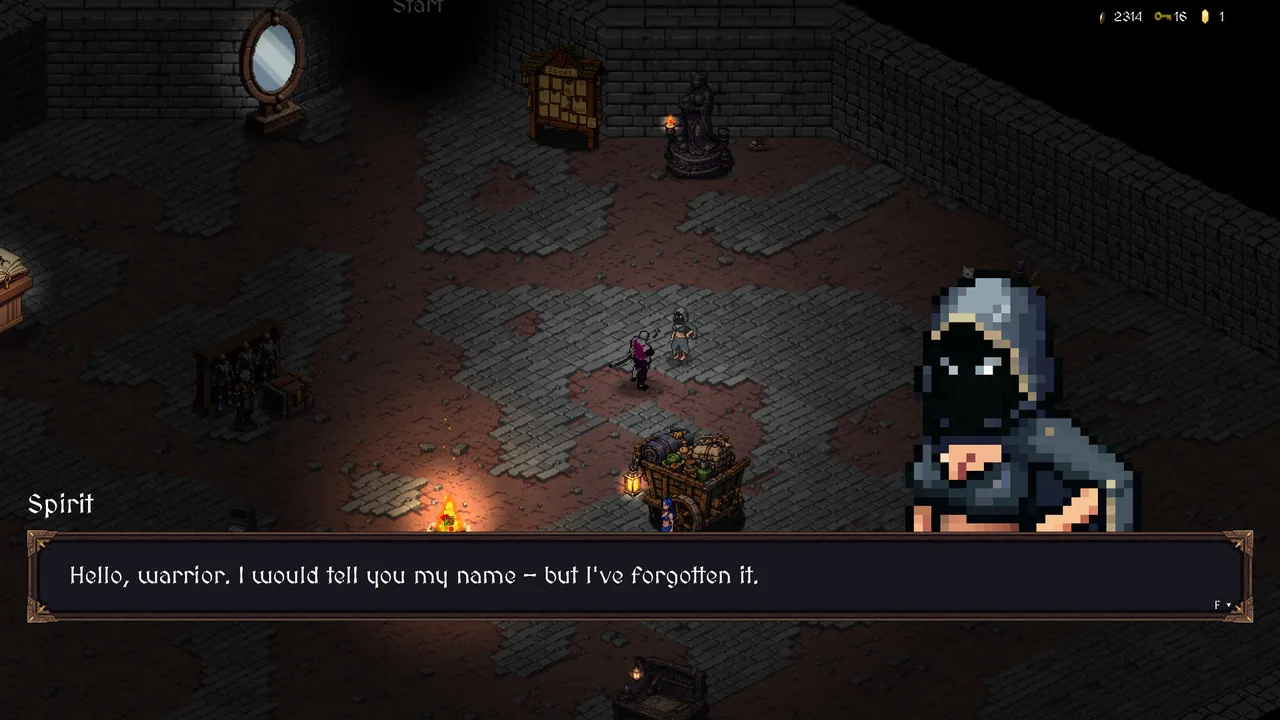
It's worth explaining the game's central pressure mechanic in a bit more detail, since it's what separates Ascension Trail from a straightforward room-clear roguelike. Every run burns a "shard-fire" resource continuously, and when it runs out, the tower's protective walls stop containing the monsters that were previously sealed in each room — turning a controlled, room-by-room clear into something closer to a rolling emergency. That's a clean, legible way to keep pressure building across a run without relying purely on a time limit or an escalating enemy-level counter, and it gives the otherwise familiar "clear rooms, get loot, go deeper" structure a reason to keep moving rather than letting players fully clear and loot every room at their leisure. Combined with the procedurally generated room types — kill rooms, survival rooms, treasure vaults, mimic ambushes and pitch-dark chambers where only a monster's glowing eyes give it away — the variety within a single run reads as more considered than the genre's most basic entries, on the evidence of what this small sample describes.
Final Verdict
Ascension Trail is a small, young release with an unusually clean early record, and reading its complete review sample turns up specific, credible reasons why rather than an accident of low review volume. The combat loop draws real comparisons to genre favourites, co-op is treated as a genuine strength rather than an afterthought, and a visibly active, fast-patching developer gives this review real confidence the game will keep improving from here rather than stalling after launch. Ten reviews is still ten reviews, and this verdict should be read as an encouraging early signal rather than a settled long-term judgment — but at NZ$11.99, with this much genuine momentum behind it, it's an easy recommendation for roguelike and dungeon-crawler fans looking for something new to grow with.
Pros and cons
Pros
- The core loop — fight through procedurally generated rooms, build a character through combat drops, push as far as possible before a run ends — draws specific, enthusiastic praise, with build variety and weapon choice singled out repeatedly
- Long-term alpha and beta testers describe the game as substantially improved since those early builds, specifically crediting the developer for listening to and acting on player feedback
- Genuine post-launch support: nine distinct patches and hotfixes in under three weeks, including a major content update adding 90 armour pieces, 13 item sets, save-and-continue for runs, and full localisation in six languages
- Co-op is a real, credited strength rather than an afterthought, with at least one detailed review specifically praising how the mode changes the experience
- Auto-aim and auto-attack options let players choose a more relaxed pace without abandoning progression, which one reviewer specifically credits as a good fit for half-attentive, podcast-listening play sessions
Cons
- The review sample is very small — ten reviews at time of writing — so any read on lasting quality or long-term balance is necessarily provisional, however unanimous it currently is
- At least one reviewer found the early mechanics unclear before the loop "clicked," suggesting onboarding could be smoother for players who don't dig into item descriptions and room menus right away
- A minor but specific complaint from one reviewer: certain ability icons don't visually match the game's dark fantasy tone, a small but real presentation inconsistency
- As a young, still-rapidly-patched release, specific mechanics and balance described in any given review — including this one — may already be out of date by the time a reader checks
Screenshots
-
Ascension TrailImage: Flying Brick Face Studio via Steam -
Ascension TrailImage: Flying Brick Face Studio via Steam -
Ascension TrailImage: Flying Brick Face Studio via Steam -
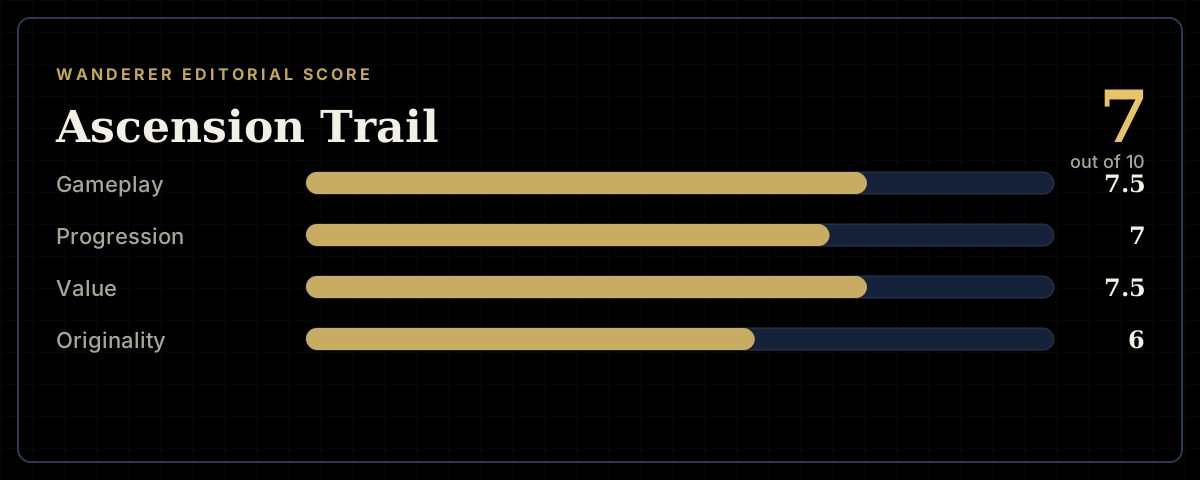
How the review scores each part of the gameWanderer Editorial -
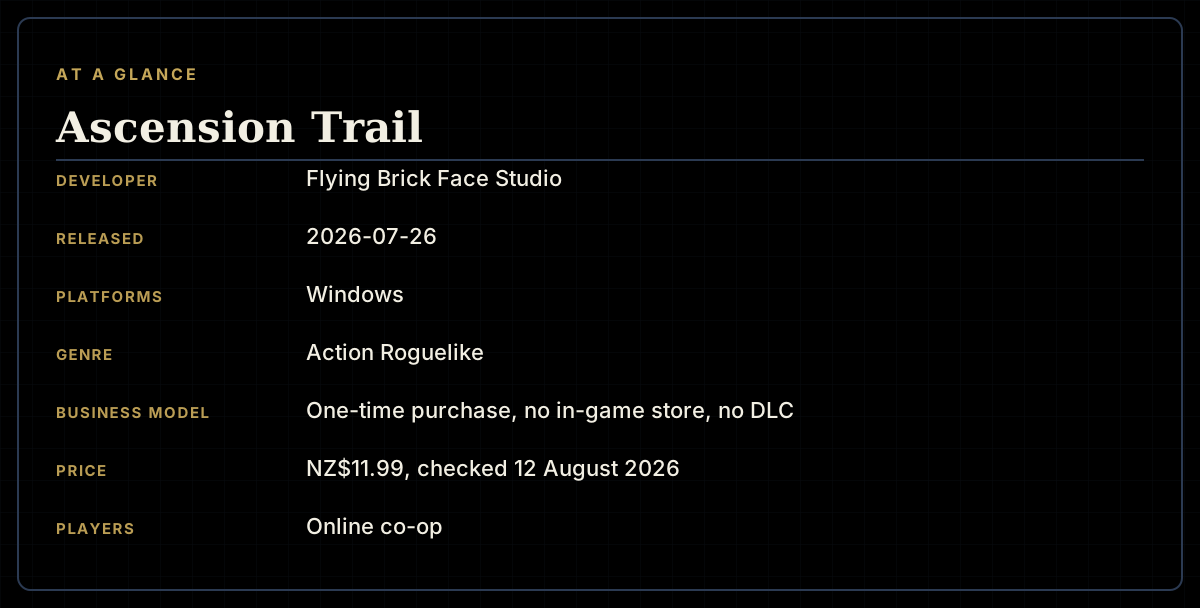
The essentials at a glanceWanderer Editorial -
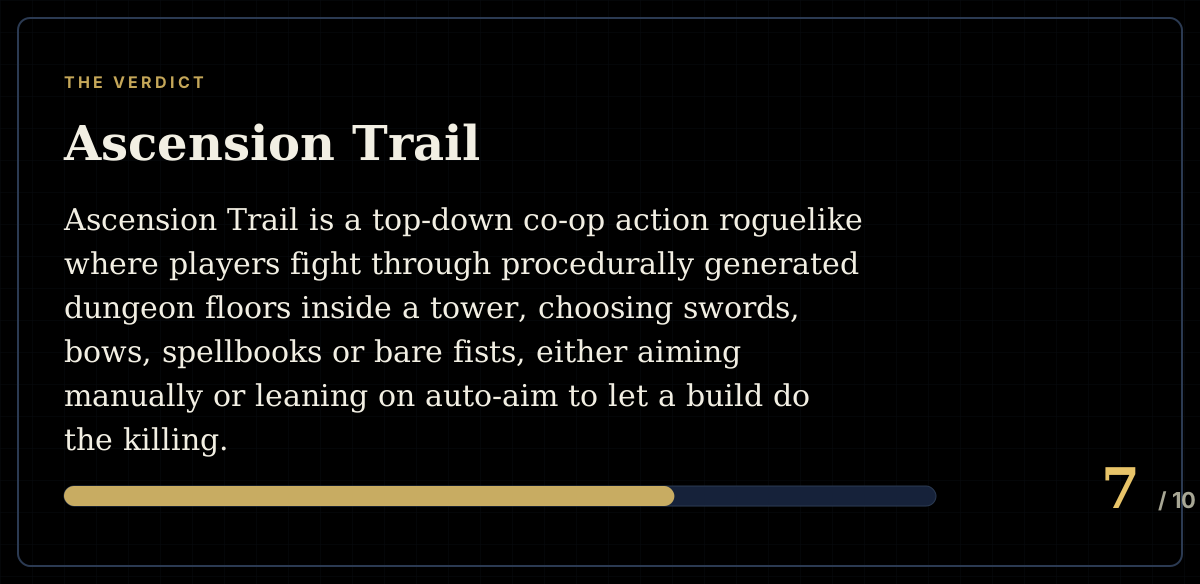
The short versionWanderer Editorial