Game review
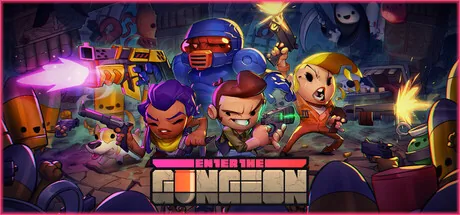
Enter the Gungeon
8.5 / 10
- Developer
- Dodge Roll
- Publisher
- Devolver Digital
- Released
- 5 April 2016
- Platforms
- Windows, Linux
- Genre
- Bullet Hell Roguelike
- Monetisation
- One-off premium purchase, no DLC, no in-app purchases and no premium currency
- Players
- Local split-screen co-op only on PC and console; a separately-developed August 2025 mobile port added online co-op that has never been brought to PC or console, a gap that draws real, ongoing frustration from long-time players
The short version
Enter the Gungeon sends a band of Gungeoneers, each carrying a deep personal regret, into a procedurally-generated fortress of guns in search of the one weapon that can kill the past. Nine years after its April 2016 release, it remains close to the platonic ideal of the bullet-hell roguelike, holding an Overwhelmingly Positive rating across almost 80,000 Steam reviews, with playtimes in the hundreds and even thousands of hours common among its most devoted fans. What keeps this review from unqualified celebration is real, specific, still-current criticism from a meaningful minority: a difficulty curve some describe as punishing rather than fair, weapon and item RNG that can make or break an entire run regardless of skill, and — most pointed of all — a 2025 controversy in which online co-op arrived on a separately-developed mobile port years before it was ever made available on the PC and console versions long-time fans have been requesting it for.
Biggest strengths
- A genuinely distinctive, deeply realised gun-collecting bullet-hell roguelike that helped define its genre, with scores of unique weapons and items that reward experimentation
- Content depth is enormous by wide consensus, with completionist players routinely logging hundreds to thousands of hours chasing full item collections and achievements
- Movement, dodge-rolling and bullet-pattern combat draw sustained praise as some of the most satisfying moment-to-moment gameplay in the genre
Biggest weaknesses
- A specific, still-current complaint from a meaningful minority describes weapon and item RNG as excessive, with runs frequently determined by drop luck rather than skillful play, and limited in-game tools to mitigate bad draws
- The difficulty curve is genuinely steep even by roguelike standards, and Steam's own achievement data confirms a majority of players never progress past the game's second floor
- Local co-op implementation draws specific technical complaints, including forced control schemes and restricted character selection for the second player
Who it's for: Bullet-hell and roguelike fans who genuinely relish a steep learning curve and RNG-driven runs, and existing fans of the genre looking for one of its most influential, content-dense entries.
Our recommendation: An essential genre landmark worth the price for anyone drawn to bullet-hell roguelikes, though newcomers should brace for real difficulty and RNG frustration, and PC players wanting online co-op should know it still isn't available nearly a decade after launch.
8.5 / 10
Nearly a decade after its April 2016 release, Enter the Gungeon remains the game a huge slice of the bullet-hell roguelike genre still gets measured against. Dodge Roll's premise is simple enough to fit in a sentence and rich enough to have sustained an enormous, devoted fanbase for close to ten years: descend through a procedurally-generated fortress packed with the "dangerously adorable Gundead," collecting an ever-growing arsenal of increasingly absurd guns, in search of a weapon legendary enough to kill your own past. Almost 80,000 Steam reviews sit at Overwhelmingly Positive, and the review sample includes some of the more extreme playtime figures this reviewer has encountered in any genre — hundreds, and not infrequently thousands, of hours logged by players still coming back. Understanding both why that devotion runs so deep, and what a meaningful, still-vocal minority of players genuinely wish were different, is what makes this landmark worth revisiting carefully.
A genre landmark that still holds up
The review sample's enthusiasm is difficult to overstate, and it's rarely generic. "Best game that can technically be beaten in 40 minutes but takes 50+ hours of playtime to even get there," one review states, capturing the gap between a single successful run and true mastery. Another, reporting over 500 hours and full completion of the game's in-universe item encyclopedia, describes looking back fondly on their first tentative hours as a beginner — a common structure across the most devoted reviews, tracing a genuine arc from struggling newcomer to expert. "Every time I buy a new game, I close it after about 15 minutes and play Enter the Gungeon again. Are there group therapy sessions for this?" reads one of the more self-aware confessions in the sample, and it's far from an outlier — reviewer after reviewer describes the game as a kind of default fallback they return to compulsively regardless of what else is in their library.
The moment-to-moment combat is where that devotion is earned. Dodge-rolling through bullet patterns, learning boss attack sequences, and building out a run from an ever-expanding pool of wildly inventive guns and items draws sustained, specific praise as some of the most satisfying gunplay in the genre. The scale of content backing that combat is genuinely enormous — scores of unique weapons, items and secrets that reward the kind of obsessive exploration completionist players in the sample describe undertaking. Nearly a decade on, the developer's continued support — crossover events, promotional bundles, and a full sequel officially confirmed for Steam — is itself a signal of how much the game still matters to its publisher and its audience alike.
The difficulty and RNG complaints that never fully went away
None of that erases a real, specific, still-current thread of criticism running through the review sample, and it's worth taking seriously precisely because it comes from players who clearly gave the game a genuine chance rather than bouncing off immediately. "Before buying this game, ask yourself if you love a challenge. Not just LIKE a challenge, but L-O-V-E one," one review opens, before describing themselves as simply not built for the skill level the game demands. Steam's own achievement data backs up how real that difficulty is at scale: only 31.2% of players have reached the Sewers, the game's second floor, and completion rates fall off sharply from there — a majority of the game's own purchasers never see more than a fraction of what it offers.
RNG draws a more specific, more contested criticism than difficulty alone. "Nice art direction, good mechanics, horrid RNG that lets you down almost every time, lack of progression — grind the same level over and over and over again starting with the same sucky weapon over and over and over again," one detailed review states. Another, more measured but reaching a similar conclusion: "As a roguelike, its RNG design feels off. There's a large pool of weapons, but in practice they barely differ beyond DPS." A third makes the frustration concrete: "there's too many frustrating elements to the game for me to enjoy it. Too much of it is just feels tedious instead of challenging." This isn't a fringe view — it's a coherent, recurring thread from players who otherwise praise the art direction, sound design and core mechanical "bones" of the game, arguing specifically that the balance between skill and luck tips further toward luck than the genre's best examples typically allow.
A real, well-documented 2025 controversy
The single most pointed and specific complaint in the recent review sample doesn't concern difficulty or RNG at all — it concerns online co-op, or rather its conspicuous absence on the platforms long-time fans have been asking for it on. In June 2025, Enter the Gungeon's mobile version was confirmed to be launching with online co-op — a feature that reached iOS and Android in August 2025, developed by a separate team from the one working on Enter the Gungeon 2 while the original PC and console versions have never received it. The reaction from long-time players was immediate and sustained. "It is downright insulting to hear that," one review states directly. "I don't care who thinks it's a good idea to put online multiplayer only for mobile users and no other console — we've been waiting years for that feature," reads another, dated the day after the announcement. Independent press coverage confirms the basic facts: the mobile port was built by a different studio while Dodge Roll's attention has been on the sequel, a plausible resourcing explanation rather than deliberate neglect — but that context hasn't fully defused the frustration among fans who specifically feel, as one Steam forum poster put it, "discriminated against just for playing on a different platform." It's worth noting this complaint continues to surface in reviews written well over a year after the original announcement, suggesting it remains an open sore point rather than a passing news-cycle reaction.
Local co-op, the multiplayer option PC and console players do have, draws its own specific technical complaints rather than escaping criticism by default. "Despite selecting KBM for P1 it will force [to] default (Controller for P1) anyways. Also P2 is fixed to one character only," one detailed review states, describing implementation issues that make the existing local option less flexible than players would like even setting the online-co-op gap aside entirely.
Where this leaves a player
At NZ$21.99, Enter the Gungeon remains an easy recommendation for bullet-hell and roguelike fans who want one of the genre's defining, most content-dense entries — the sheer volume of guns, items and secrets, combined with combat that's held up for nearly a decade of scrutiny from an enormous and demanding fanbase, speaks for itself. The honest caveats belong specifically to two groups: players who want a gentler difficulty curve or more consistent, skill-rewarding RNG should know this is a genuinely hard, sometimes luck-dependent game even by roguelike standards, backed up by Steam's own completion data. And PC or console players specifically hoping for online co-op should know that feature has existed on mobile since August 2025 without ever reaching the platforms they're actually playing on — a real, still-current gap worth factoring into a purchase decision if that's a feature you're counting on.
Pros and cons
Pros
- A genuinely distinctive, deeply realised gun-collecting bullet-hell roguelike that helped define its genre, with scores of unique weapons and items that reward experimentation
- Content depth is enormous by wide consensus, with completionist players routinely logging hundreds to thousands of hours chasing full item collections and achievements
- Movement, dodge-rolling and bullet-pattern combat draw sustained praise as some of the most satisfying moment-to-moment gameplay in the genre
- Still actively supported nearly a decade after release, with crossover events, promotional bundles, and a full sequel officially announced for Steam
Cons
- A specific, still-current complaint from a meaningful minority describes weapon and item RNG as excessive, with runs frequently determined by drop luck rather than skillful play, and limited in-game tools to mitigate bad draws
- The difficulty curve is genuinely steep even by roguelike standards, and Steam's own achievement data confirms a majority of players never progress past the game's second floor
- Local co-op implementation draws specific technical complaints, including forced control schemes and restricted character selection for the second player
- A real, well-documented 2025 controversy saw online co-op ship on a separately-developed mobile port months before release, while PC and console versions — the platforms long-time fans have requested the feature on for years — still don't have it as of this review
Screenshots
-
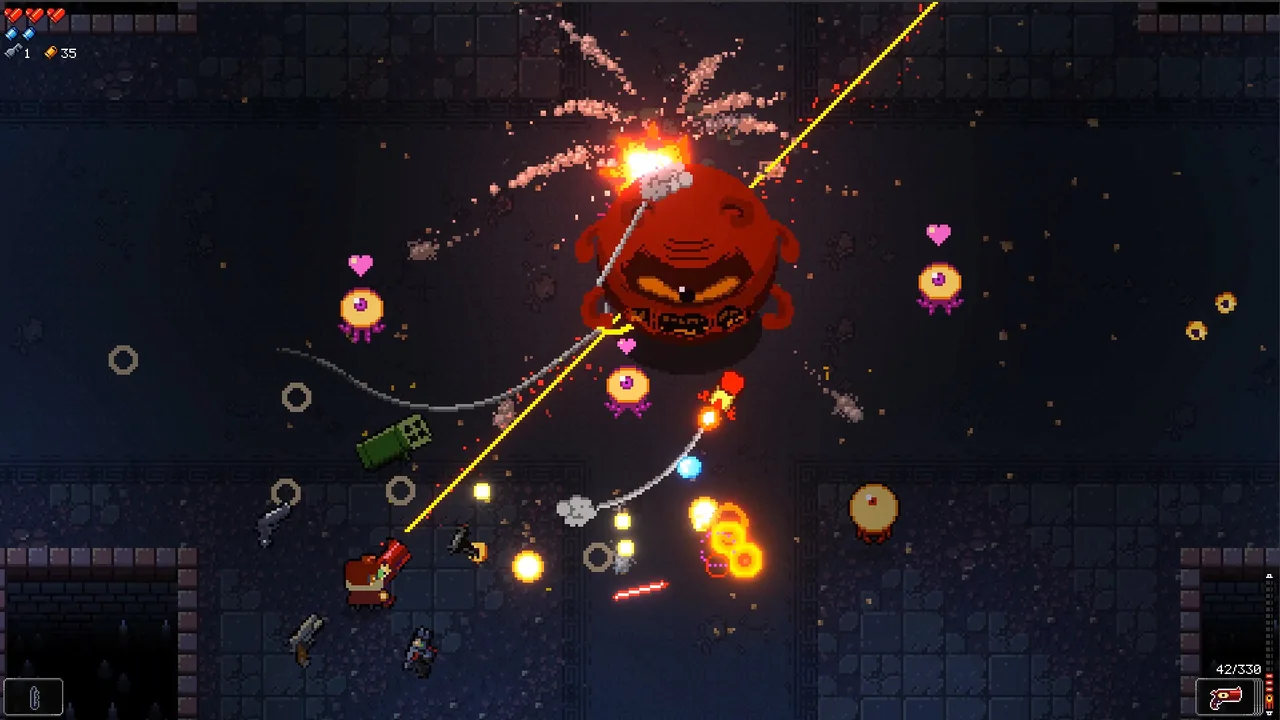
Enter the GungeonImage: Devolver Digital via Steam -
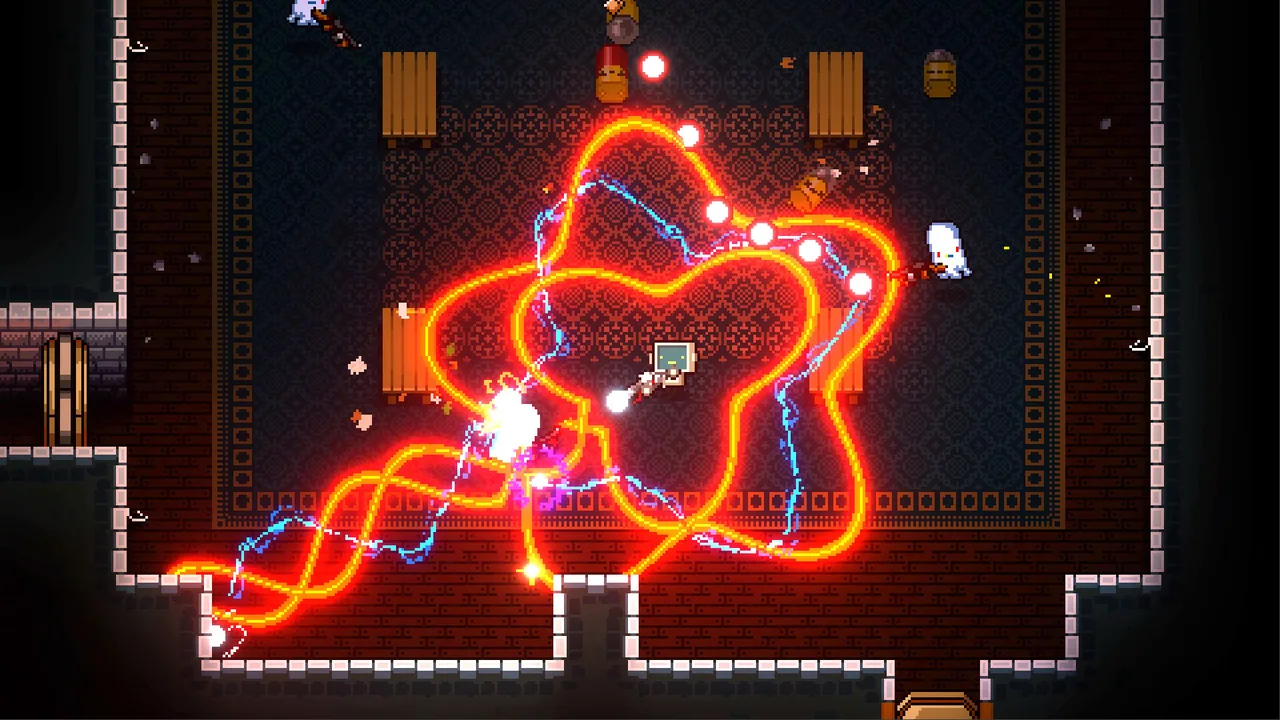
Enter the GungeonImage: Devolver Digital via Steam -
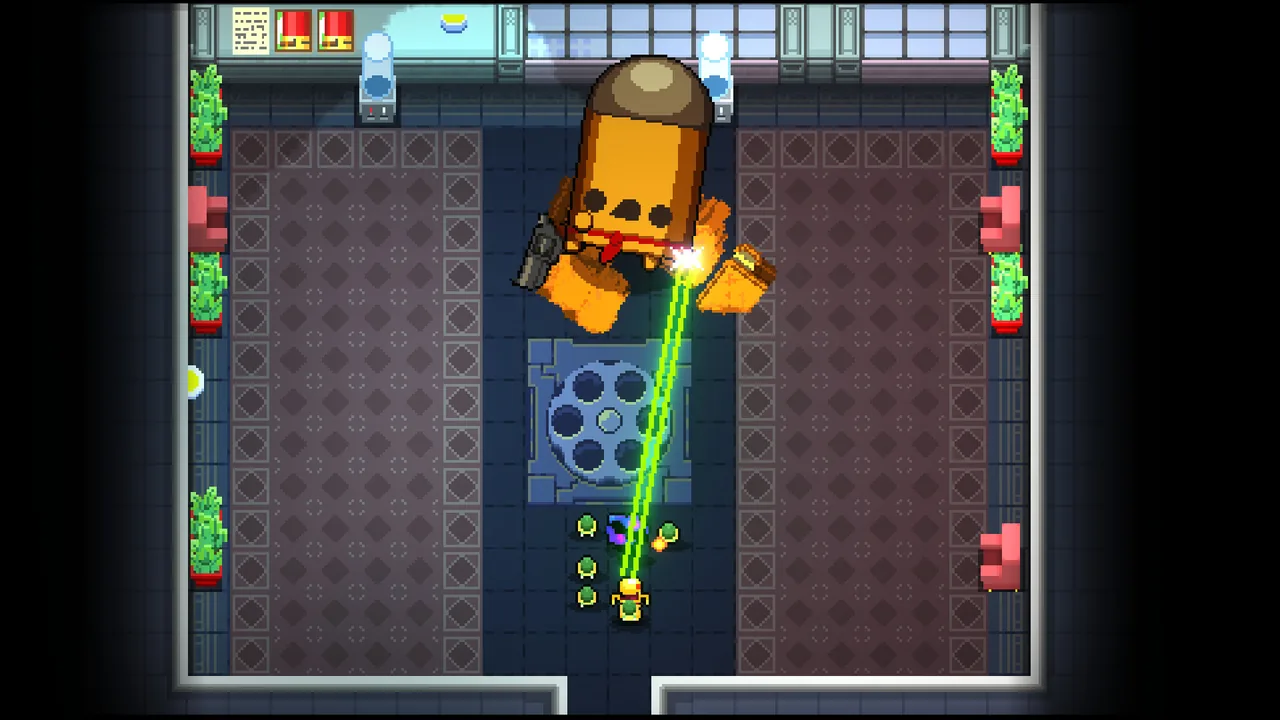
Enter the GungeonImage: Devolver Digital via Steam -
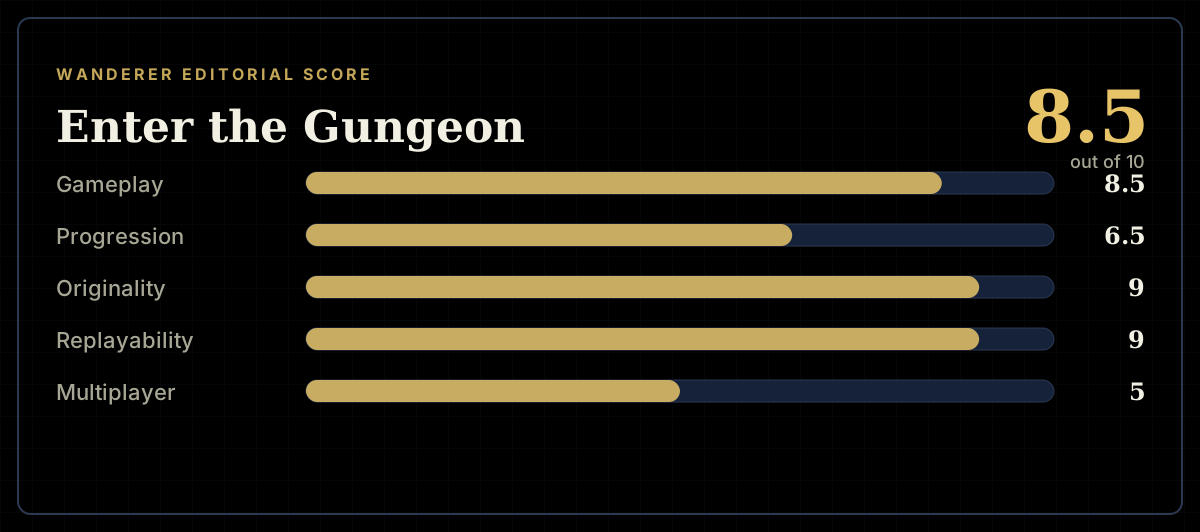
How the review scores each part of the gameWanderer Editorial -
The short versionWanderer Editorial