
Game review
Super Night Riders S1 Review
7 / 10
- Developer
- miyu.works
- Publisher
- miyu.works
- Released
- 31 August 2026
- Platforms
- ["Windows"]
- Genre
- Racing
A Full Rebuild, Not Just A Reskin
Super Night Riders S1, released August 31, 2026 by miyu.works (the studio also behind the Light Fairytale RPG series), is a full retail follow-up to the developer's earlier, smaller game simply called Super Night Riders, rebuilt from the ground up under its own "Season 1" branding and its own fresh Steam listing. It's an arcade night-racing game steeped in retro 1980s aesthetics: neon horizons, synth-adjacent visual language, and an anime-styled female protagonist tearing down empty highways on a motorbike. The English review pool is small but unanimous, 30 of 30 positive, and several reviewers explicitly frame their impressions in terms of how far it's come from the original. One reviewer put it plainly: this entry is "a massive improvement on the original," with the boost mechanic singled out repeatedly as the thing that turns straightforward point-to-point racing into something with real rhythm.
Boost Is The Whole Game, And That's A Good Thing
At its core, Super Night Riders S1 is about managing a boost meter through a sequence of tight, high-speed courses rather than negotiating cornering physics or traffic in any deep simulation sense. Reviewers consistently describe the loop as tight and readable: build boost, spend it at the right moment, chain it through a course, and watch your placement on the leaderboard shift as a result. It's a small mechanical idea, but the review pool treats it as the load-bearing one, with multiple players describing runs where shaving a few tenths of a second off a lap felt genuinely satisfying rather than grindy. For a $9.99 arcade racer, that's exactly the kind of tight, legible core loop the price point calls for, and it's the part of the game that draws the least criticism across the whole pool.
An Unapologetically Anime Package
The presentation leans hard into anime styling, and the review pool treats that as a selling point rather than a compromise. Character customization lets players adjust their rider's appearance, and more than one reviewer joked about just how far that customization goes, with one bluntly noting you can "change the body physics" of your rider, alongside more straightforward praise for the character art and the neon-drenched night courses. It's a game clearly aimed at a specific audience that wants its arcade racing wrapped in stylized, retro-anime packaging, and for that audience the reviews suggest it delivers convincingly on tone even where the mechanical depth stays intentionally shallow.
Leaderboards That Don't Quite Separate Difficulties
The most specific structural complaint in the review pool concerns how leaderboards are organized: rather than keeping separate rankings per difficulty setting, times from every difficulty appear to feed into the same shared leaderboard. Reviewers who enjoy climbing the ranks flagged this as a real design gap, since a fast time set on an easier configuration can sit above a genuinely harder run on a tougher one, undercutting the sense that the leaderboard reflects skill on comparable terms. It's not a complaint about the racing itself, but for a game whose whole hook is chasing better times against other players, a leaderboard that doesn't separate difficulty tiers is a legitimate structural miss rather than a nitpick.
Higher Difficulty Means More Clutter, Not More Craft
A second, more pointed criticism comes from a reviewer who otherwise recommended the game but pushed back on how difficulty scaling actually works. Rather than reshaping track layouts or demanding sharper boost timing, higher difficulty settings mostly add more rider traffic to dodge, turning later courses into what that reviewer called "a random series of lefts and rights" cluttered with other bikes rather than a track that's genuinely harder to master. That's a meaningful distinction: difficulty built from obstacle density reads as artificial padding once the novelty of the boost mechanic wears thin, and it's the kind of complaint that tends to surface more once a player has put in enough hours to chase the harder tiers seriously, which is exactly the context this reviewer was writing from.
Runs Well Everywhere, Including Handheld And VR Displays
On the technical side, the reviews are close to uniformly positive. Multiple players specifically called out strong performance on Steam Deck, describing the game as an easy, low-friction handheld pick, and at least one reviewer mentioned running it through a Quest 3 headset via a 3D display pass-through mode, describing the experience favorably. For a small studio's genre pivot away from its usual RPG output, that breadth of platform support, without accompanying performance complaints anywhere in the pool, is a genuinely strong technical showing, and it's a detail worth crediting on its own rather than assuming it as a given for an indie arcade racer at this price.
Verdict
Super Night Riders S1 is a confident, narrowly-scoped arcade racer that knows exactly what it wants to be: a boost-driven night-racing loop wrapped in retro-1980s neon and unapologetically anime presentation, built as a substantial step up from miyu.works' earlier, smaller game of the same name. The core boost mechanic is tight enough to carry the whole experience, the presentation lands with its intended audience, and it runs cleanly across desktop, Steam Deck, and even VR headset displays without a single performance complaint surfacing in the review pool. Where it falls short is in the finer structural details that matter most to the players chasing every leaderboard spot: a shared leaderboard that doesn't separate difficulty tiers, and a higher-difficulty curve built more from added rider clutter than from smarter track design.
None of that stops the review pool from being unanimously positive, and for good reason, a $9.99 arcade racer with this much stylistic identity and this clean a technical record is a genuinely easy recommendation for anyone who wants a short, boost-chasing session rather than a full racing sim. It's a game that's honest about its scope rather than one straining against it, and the sharpest praise in the review pool isn't really about any single course or feature, it's the simple, repeated observation that this Season 1 rebuild finally makes good on an idea the original Super Night Riders only sketched out.
Screenshots
-
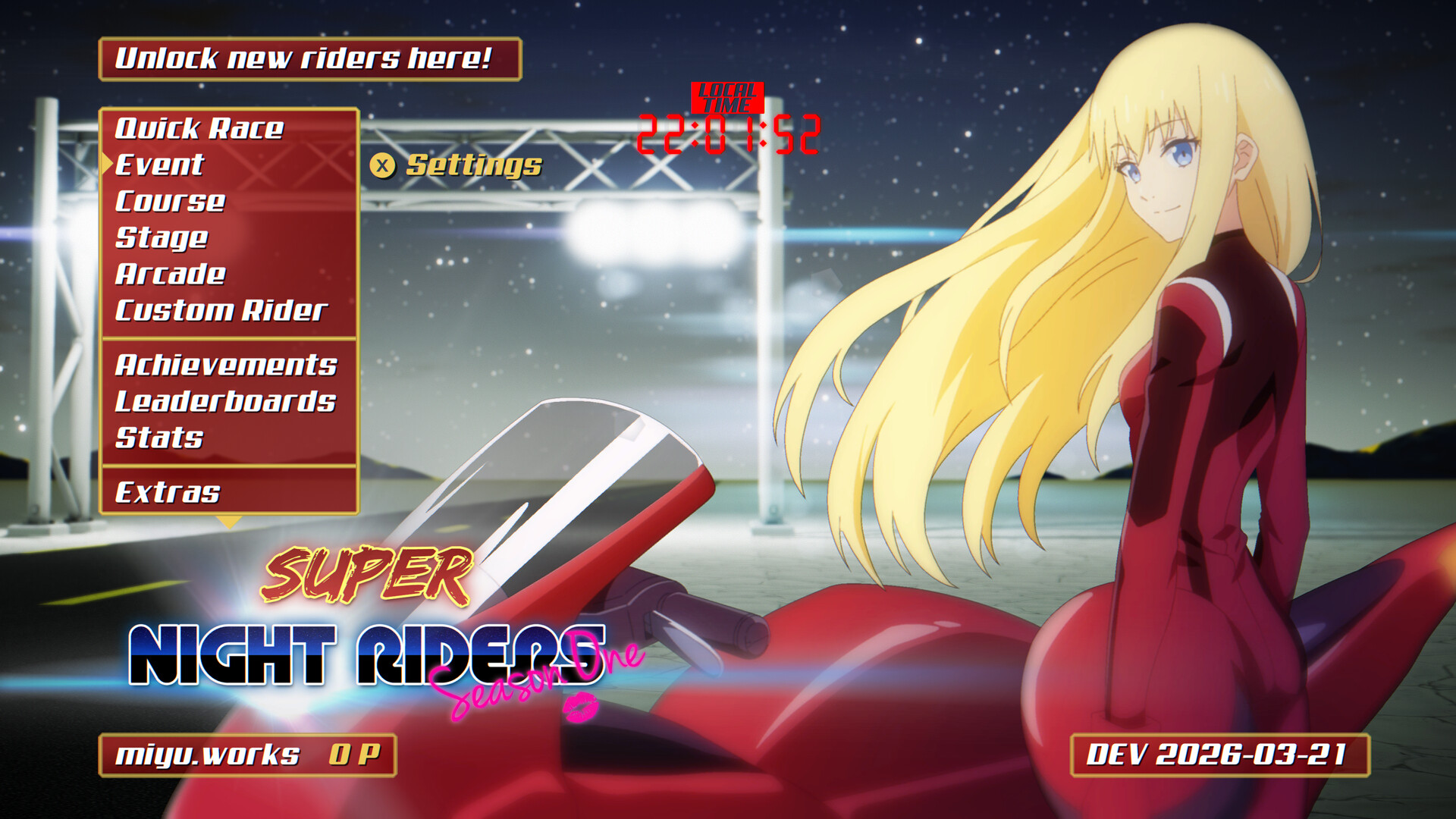
The main menu, with Custom Rider and Leaderboards sitting alongside the standard race and event modes.Image: miyu.works via Steam -
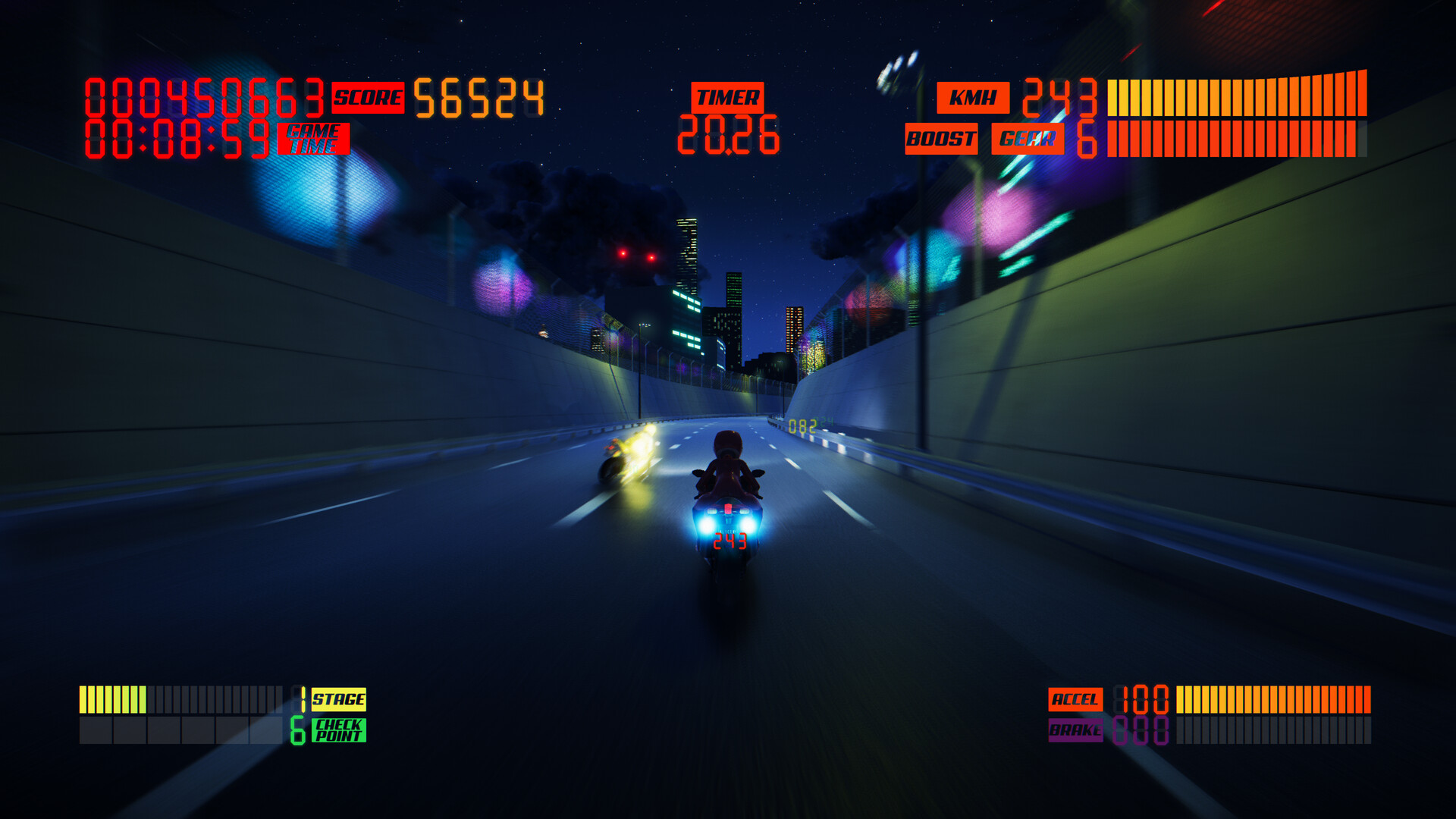
A night tunnel run at 243 km/h, boost meter maxed out, with a rival rider drafting alongside.Image: miyu.works via Steam -
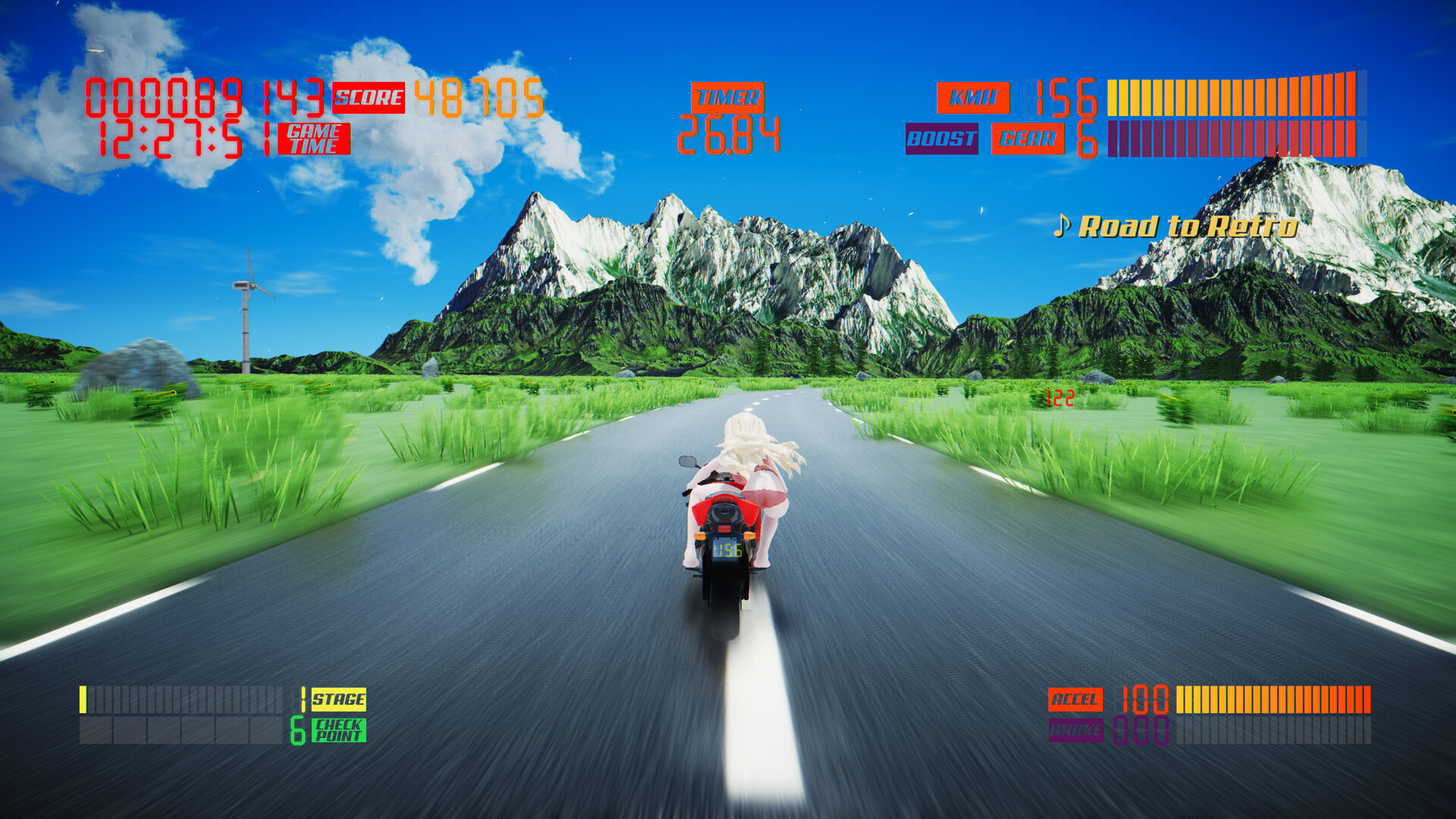
A daytime mountain stage, one of the brighter, more scenic courses outside the game's neon-night signature look.Image: miyu.works via Steam