Game review
Heroes of Hammerwatch
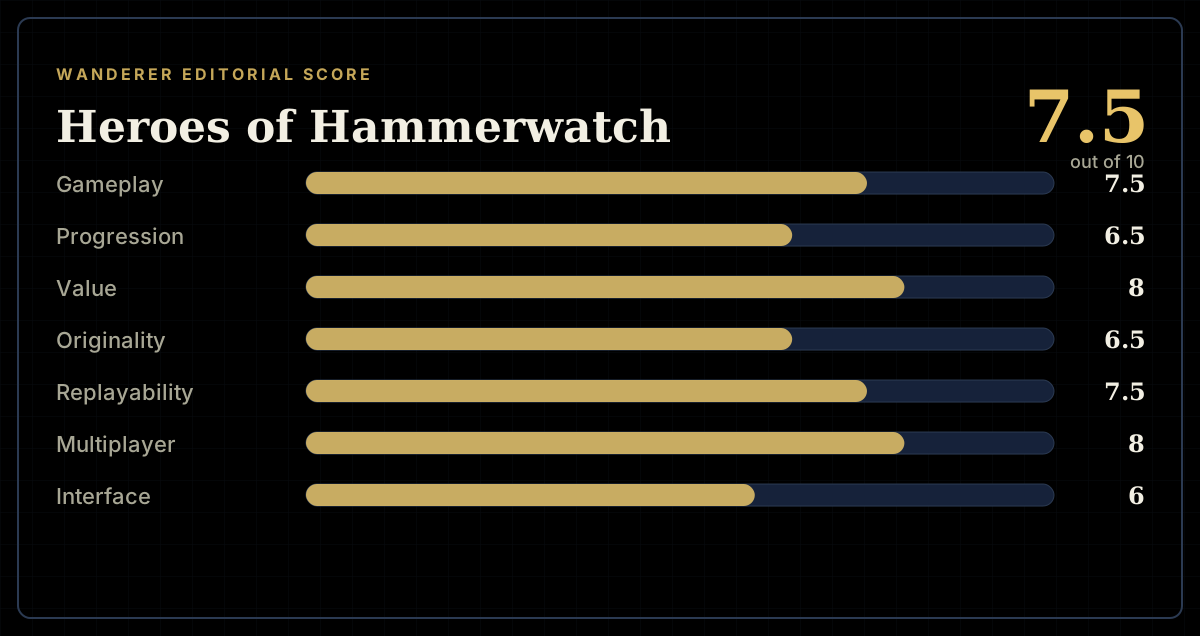
7.5 / 10
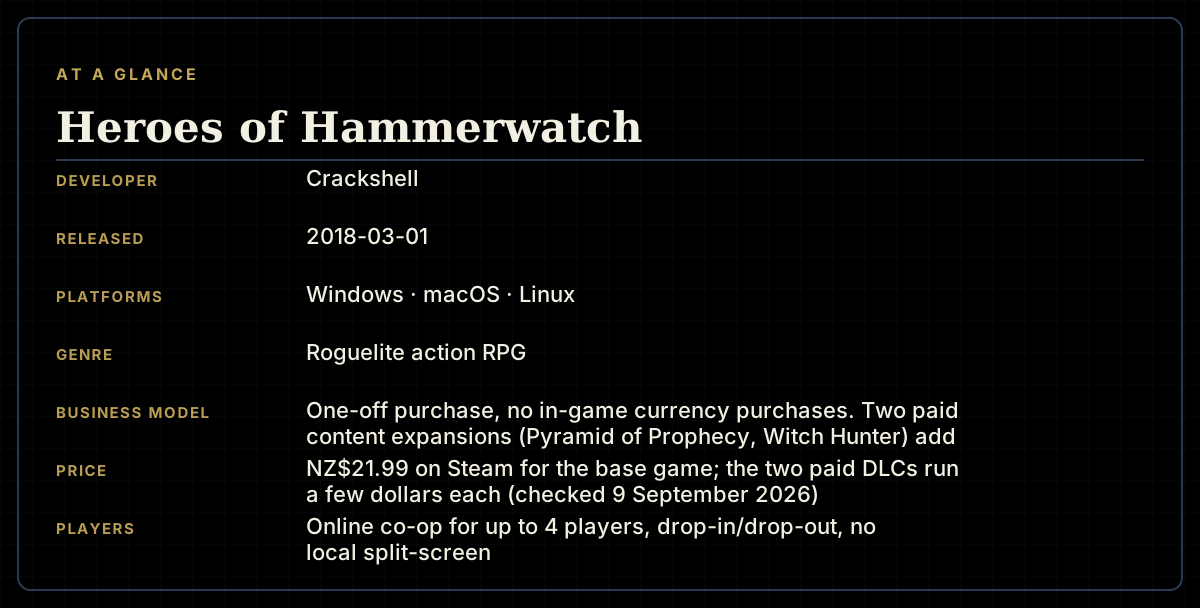
- Developer
- Crackshell
- Publisher
- Team17
- Released
- 1 March 2018
- Platforms
- Windows, macOS, Linux
- Genre
- Roguelite action RPG
- Monetisation
- One-off purchase, no in-game currency purchases. Two paid content expansions (Pyramid of Prophecy, Witch Hunter) add new classes and campaigns; a third, Moon Temple, was released as free content rather than paid DLC.
- Players
- Online co-op for up to 4 players, drop-in/drop-out, no local split-screen
The short version
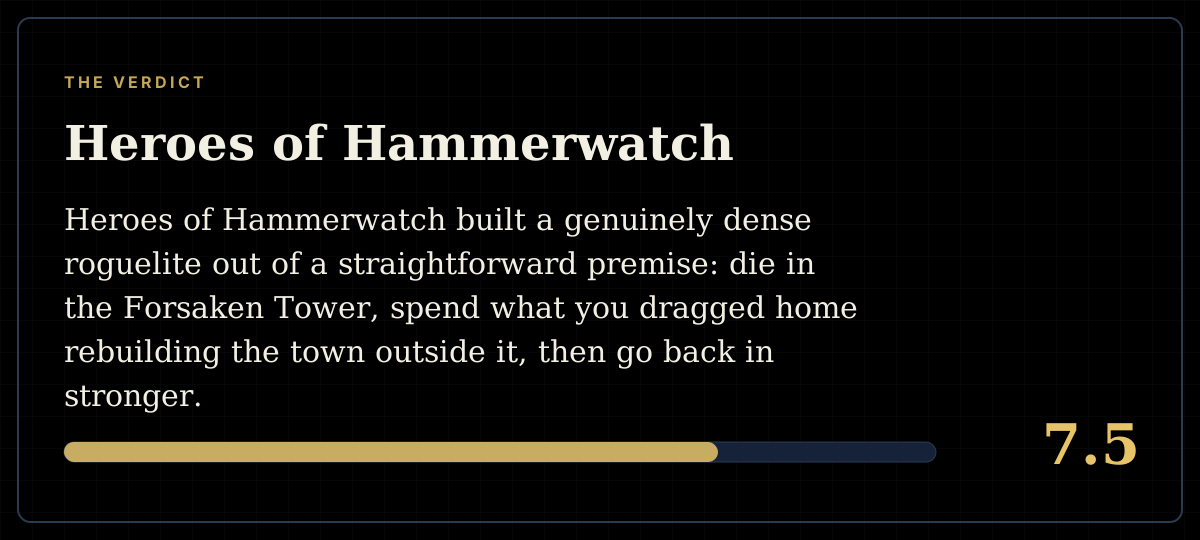
Heroes of Hammerwatch built a genuinely dense roguelite out of a straightforward premise: die in the Forsaken Tower, spend what you dragged home rebuilding the town outside it, then go back in stronger. Seven years of patches and two expansions gave it seven classes, a second full campaign, and a New Game+ ladder with no visible ceiling, and none of that is padding — the achievement data shows players genuinely working through it, floor by floor, class by class. What it never solved is the tension between that scale and the specific grind for gold and ore that gates almost all of it, a complaint detailed and specific enough, and repeated by enough players who otherwise like the game, that it can't be waved off as impatience. Play it in co-op with people who also don't mind a long climb, and budget for a controller quirk nobody seems to have fixed.
Biggest strengths
- Seven distinct classes plus a second full campaign (Pyramid of Prophecy) give the New Game+ ladder real build variety rather than the same solved loadout run after run
- The town-rebuilding loop between runs gives every death visible, permanent payoff instead of resetting you to nothing
- Co-op is the mode the design was built around, and reviewers consistently rate it far above the solo experience
Biggest weaknesses
- The core resource grind for gold and ore is specific and repeated enough across reviews, including from players who otherwise recommend the game, that several openly describe using an exploit against the Tavern's gambling odds rather than farming it as intended
- Runs draw from a small pool of level layouts and enemy types, so the moment-to-moment dungeon rarely feels different once its patterns are learned, even as the meta-progression around it deepens
- A reported controller bug locking two skill slots to fixed left/right aim directions instead of free aim has no confirmed fix in the last several patch cycles
Who it's for: Co-op groups who want a long-haul dungeon crawler they can return to for months rather than finish in a weekend, and solo players who don't mind repetition in exchange for genuine build variety across seven classes. Less suited to anyone who wants a roguelite's runs to feel meaningfully different from each other on a moment-to-moment basis, or who plays primarily with a controller.
Our recommendation: Buy it, especially for a regular co-op group — the price is modest for how much content two expansions and seven years of free patches have piled on top of the base game, and the grind that frustrates some solo players is far easier to tolerate when it's split four ways.
7.5 / 10
Heroes of Hammerwatch takes the original Hammerwatch's straightforward four-player arcade dungeon crawl and bolts a full roguelite structure onto it: die in the Forsaken Tower, keep whatever gold and ore you dragged out before dying, and spend it rebuilding the town outside so the next run starts from a stronger position. Seven years, dozens of numbered patches, and two paid expansions later, the shape of the game is settled and its 88% Very Positive score across nearly 4,700 English reviews confirms plenty of players got exactly what they wanted from it. The more useful question this deep into its life isn't whether the content is there — it demonstrably is — but whether the specific grind tying all of that content together still holds up, and reviewers are unusually consistent and specific about exactly where it doesn't.
Dying is the mechanic, not the failure state
The core loop is well-worn roguelite shape with a genuinely satisfying twist: every hero who dies in the Tower sends their gold and ore back to town rather than losing it outright, and that currency buys permanent upgrades to buildings that persist across every future run and every future character. A blacksmith upgrade helps every class that ever visits it; a tavern upgrade buys better drinks for the whole roster. This means death never resets you to zero the way a purer roguelike would — it just changes what your next attempt is optimizing for, which is a smarter answer to roguelite fatigue than most genre peers manage. Reviewers who stuck with the game for hundreds of hours consistently cite this as the reason the format doesn't wear thin the way a simpler "die and restart from nothing" structure would.
The class roster backs this up structurally rather than just cosmetically. Seven playable classes across the base game and its two expansions — Paladin, Ranger, Warlock, Rogue-adjacent Thief, Wizard, Sorcerer, Gladiator, Witch Hunter — each level up independently and unlock their own skill trees, so New Game+ progression isn't one character getting linearly stronger but a roster filling out in parallel. Global achievement data shows this structure is genuinely used rather than ignored: 51.5% of the entire playerbase has unlocked the Priest class and 47.3% the Thief, meaning roughly half of everyone who owns the game has pushed far enough to diversify beyond whichever class they started with. That's a meaningfully healthy number for a roguelite's mid-game gate, and it's the strongest objective evidence that the class variety reviewers praise is actually being experienced, not just theorized about in patch notes.
The grind reviewers keep describing the same specific way
Set against that is a complaint that shows up with unusual consistency and specificity across both positive and negative reviews: the amount of gold and ore required to meaningfully progress town buildings outpaces what a normal run naturally generates, to the point that several detailed reviews — including ones that recommend the game overall — describe deliberately exploiting the Tavern's gambling minigame (a legitimate feature added in a 2019 patch that lets players stake items for a chance at a better one) by starting and stopping the game to manipulate its odds, rather than earning currency through ordinary play. One reviewer with 317 hours and full completionist achievements put it plainly: "the grind for money and materials is undoable for time purposes unless you exploit the gambling system... without that trick, you'd spend 85% of your time grinding money and materials." That's not a single frustrated voice; it's a repeated, specific, checkable claim about the intended economy being slower than the community consensus now treats as acceptable, and it's worth taking at face value rather than dismissing as one player's impatience.
The achievement curve corroborates the shape of that complaint even where it doesn't confirm the exploit itself. Early-game achievements like reaching the Stone Guardian or Warden sit at 74% and 60% of the playerbase respectively — healthy numbers for content most buyers see — but level-60 class achievements and the endgame "mercenary" tier drop below 1% across the board, several landing at 0.5-0.9%. Some of that gap is simply late-game roguelites being hard by design, which isn't a flaw. But combined with reviewers' specific, repeated description of an intentionally throttled currency curve, it reads less like players hitting a difficulty wall and more like the large majority of buyers deciding the climb past a certain point isn't worth the time it costs, which is a different and more damning outcome for a game built around exactly that climb.
A patch history long enough to show its own priorities
Crackshell's support record for this game is genuinely unusual for its price point: over 115 numbered patches between launch in March 2018 and late 2024, two paid expansions (Pyramid of Prophecy in 2019, Witch Hunter the same year) and one free one (Moon Temple, 2020), plus console ports in 2020. That's not a studio that shipped and walked away, and it shows in specific, checkable ways — the Tavern gambling system itself was added post-launch in response to player feedback, and a 2019 patch reworked the game's "fountain" buff system to give players direct choice over its effects rather than pure randomness, a change made explicitly because the original version frustrated players. Reviewers citing "outdated" or "copy-pasted content" complaints are describing a real limitation of the dungeon generator's variety, but they're not describing a neglected game.
That support did eventually stop, and the reason is visible rather than mysterious: Crackshell announced a full sequel, Heroes of Hammerwatch II, in 2023, took it through Early Access, and shipped 1.0 in January 2025. The last numbered patch to this game landed in November 2024, one month before the sequel's release — a clean handoff rather than an abandonment, but a handoff all the same, meaning the controller aiming bug and grind-pacing complaints still active in reviews posted in 2026 are very unlikely to see further attention here. One recent reviewer's complaint — that two skill slots are locked to fixed left and right aim directions on controller rather than supporting free aim — appears nowhere in the patch history as an acknowledged issue, despite controller support being touched in at least four separate updates over the years for other bugs. It reads like a genuine, still-live limitation rather than a recently introduced regression.
Built for four players, tolerable alone
Almost every piece of praise in the review sample that isn't about content volume is specifically about co-op. The town's shared upgrades, the tavern's shared drink buffs, and the raw pacing of clearing floors are all noticeably better with three friends splitting the workload than solo, and several reviewers explicitly downgrade their recommendation to "co-op only" rather than a blanket one. That's a reasonable caveat rather than a flaw exactly, but it does mean the value case for a solo buyer is meaningfully weaker than the aggregate 88% positive score implies on its own — the same grind that four players can split and laugh about falls entirely on one person playing alone, and it's the solo reviews specifically that use words like "tedium" and "mind- numbing."
Verdict
Heroes of Hammerwatch earned its Very Positive standing honestly: a persistent-progression roguelite with seven real classes, two substantial expansions, and one of the more sustained patch records in the genre at this price. What keeps it from a higher score is a specific, well-corroborated complaint that isn't about difficulty but about pacing — a currency grind tuned tightly enough that a meaningful share of its own fanbase describes exploiting a side mechanic rather than engaging with the intended loop, backed up by an achievement curve that falls off a cliff exactly where that complaint says it should. None of that erases what's here. It just means the honest recommendation is conditional: bring friends, expect the climb to take longer than feels fair at times, and don't buy it expecting a controller to work quite right.
Sources: Steam store page and appdetails API (release date, pricing, platform and language data); Steam's aggregate review data (query_summary totals, English-language sample); individually read user reviews (both positive and negative, sorted by helpfulness and recency); Steam's global achievement statistics API; Crackshell's own partner-events patch notes and DLC announcements from 2018 through the 2024 handoff to Heroes of Hammerwatch II.
Pros and cons
Pros
- Seven distinct classes plus a second full campaign (Pyramid of Prophecy) give the New Game+ ladder real build variety rather than the same solved loadout run after run
- The town-rebuilding loop between runs gives every death visible, permanent payoff instead of resetting you to nothing
- Co-op is the mode the design was built around, and reviewers consistently rate it far above the solo experience
- Two expansions and dozens of numbered patches across more than six years is a genuinely rare level of sustained post-launch support for an indie roguelite at this price
- Achievement data shows a real, working difficulty curve rather than a wall — most players clear the early game, and the drop-off tracks specific late content rather than a broken gate
Cons
- The core resource grind for gold and ore is specific and repeated enough across reviews, including from players who otherwise recommend the game, that several openly describe using an exploit against the Tavern's gambling odds rather than farming it as intended
- Runs draw from a small pool of level layouts and enemy types, so the moment-to-moment dungeon rarely feels different once its patterns are learned, even as the meta-progression around it deepens
- A reported controller bug locking two skill slots to fixed left/right aim directions instead of free aim has no confirmed fix in the last several patch cycles
- Class and late-campaign achievement completion falls off a cliff past the early game, meaning a large share of buyers never see most of what the two expansions added
- The developer's attention has visibly moved to a full sequel since 2023, so further changes to this game are unlikely regardless of which complaints remain open
Screenshots
-
Heroes of HammerwatchImage: Team17 via Steam -
Heroes of HammerwatchImage: Team17 via Steam -
Heroes of HammerwatchImage: Team17 via Steam -
How the review scores each part of the gameWanderer Editorial -
The specsWanderer Editorial -
The short versionWanderer Editorial