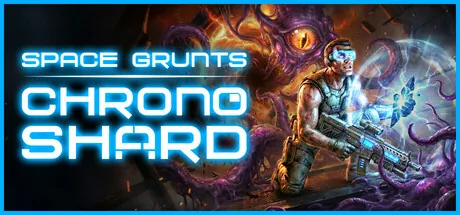
Game review
Space Grunts: Chrono Shard
7.8 / 10
- Developer
- Orangepixel
- Publisher
- HandyGames
- Released
- 22 June 2026
- Platforms
- Windows, macOS, Linux
- Genre
- Turn-Based Tactical Roguelike
- Monetisation
- Premium, one-off purchase, no in-app purchases, no ads
- Players
- Single-player
The short version
Space Grunts: Chrono Shard takes Orangepixel's twenty-year house style — fast, punishing, turn-based arcade combat with no patience for slow menus — and wraps it around a time-loop premise that solves roguelike design's oldest complaint: a failed run here isn't wasted, because whatever you placed, built or scavenged before the Chrono Shard finally gave out is still sitting on the map when you go back in.
It's a tighter, smarter sequel than its modest launch attention suggests, but the time-travel framing occasionally promises more narrative and system depth than the actual loop delivers, and the skill-tree subclasses need more runs than a casual player will always want to give them before they start feeling distinct.
Biggest strengths
- Dying mid-mission still leaves placed items and environmental changes on the map for the next attempt, so a collapsed run isn't a wiped run
- Turn resolution is fast enough that the game keeps its arcade pulse despite being fully turn-based
- Nine subclasses spun out of three skill trees give repeat missions a real reason to play a different way
Biggest weaknesses
- The Chrono Shard's charge management is the whole tension engine, and running dry reads as a punishment for exploring rather than a meaningful choice
- Procedural station layouts repeat enough set-piece furniture that the "new sector every time" pitch feels thinner after a dozen runs
- The skill-tree subclasses take a real time investment to differentiate, which will lose players expecting build variety from run one
Who it's for: Roguelike veterans who want permadeath tension without a full reset every time, fans of Orangepixel's earlier arcade-roguelike catalogue, and turn-based tactics players who find games like Into the Breach a little too slow between moves.
Our recommendation: Worth the asking price for genre fans, especially anyone burned by roguelikes that erase a bad run completely. Newcomers to Orangepixel's style should try the free demo first — the turn-based pacing and permadeath stakes aren't for everyone, and the game doesn't waste time easing you into either.
7.8 / 10
A time loop that actually respects a bad run
Every roguelike eventually has to answer the same design question: what happens to the hour you just spent when the run ends badly? Space Grunts: Chrono Shard's answer is right there in the subtitle. The Chrono Shard is both a diegetic gadget and the entire meta-progression thesis of the game — when your grunt dies or the mission collapses, items you dropped, gear you placed at a crafting station and changes you made to the map's layout don't vanish with you. They're waiting in the next attempt at the same sector, letting a doomed run function as reconnaissance and stock-piling instead of a wasted evening.
That's a genuinely different answer from the genre's two standard ones. It isn't Hades' hub-based narrative drip-feed, and it isn't Dead Cells' pure currency-and-blueprint unlock ladder. It's closer to leaving supply caches in a game like Escape from Tarkov, except reframed through a time-travel conceit that at least gives Orangepixel's writers a reason for the world to remember what you did. Inside a single expedition, the Shard also acts as your safety net: dying resets you to your last recharge point rather than ending the mission outright, provided the Shard still has charge left. It's a soft-permadeath system stacked on top of a hard one, and understanding which failure state you're actually in — recoverable rewind or genuine restart — is the first skill the game expects you to learn.
The catch is that the Shard depletes with every move you make, and it only tops back up at fixed transport platforms scattered through the station. That turns exploration itself into the resource you're spending against your own safety margin, which is a clever pressure valve in theory. In practice it can feel less like a choice and more like a leash: wander too far from a recharge point chasing loot and you're not weighing risk against reward so much as watching a timer you can't see clearly enough to plan around. Orangepixel has always liked systems that punish greed — Heroes of Loot and the original Space Grunts both ran on the same instinct — but the Chrono Shard is the first version of that idea with account-level stakes attached to getting it wrong.
Combat that never stops to think, even though you have to
The "fastest turn-based shooter" pitch isn't new marketing copy for this studio, and it's still accurate. Every enemy moves and reacts the instant you commit to an action, so a turn-based structure ends up producing arcade-speed tension rather than the deliberate chess-match pacing of something like Into the Breach. Weapons carry their own spread patterns, and the game leans on physical interactions — shockwaves that shove enemies into hazards, spread shots that clear a corridor at the cost of ammo efficiency — rather than pure damage-number comparisons. That keeps positioning meaningful in a way a lot of turn-based shooters lose once players work out the optimal button to mash.
Where it gets interesting is how little patience the interface has for anything that isn't a decision. There's no idle browsing of a paused menu while enemies wait politely; every second you spend deliberating is a second the map keeps ticking against you. That design choice is the game's clearest inheritance from Orangepixel's arcade roots, and it's also the thing that will filter out players who came in expecting a slower, XCOM-style tactical pause. This is a game that wants you thinking in seconds, not minutes, even though the underlying system is turn-based math.
Skill trees and subclasses: build variety that takes its time
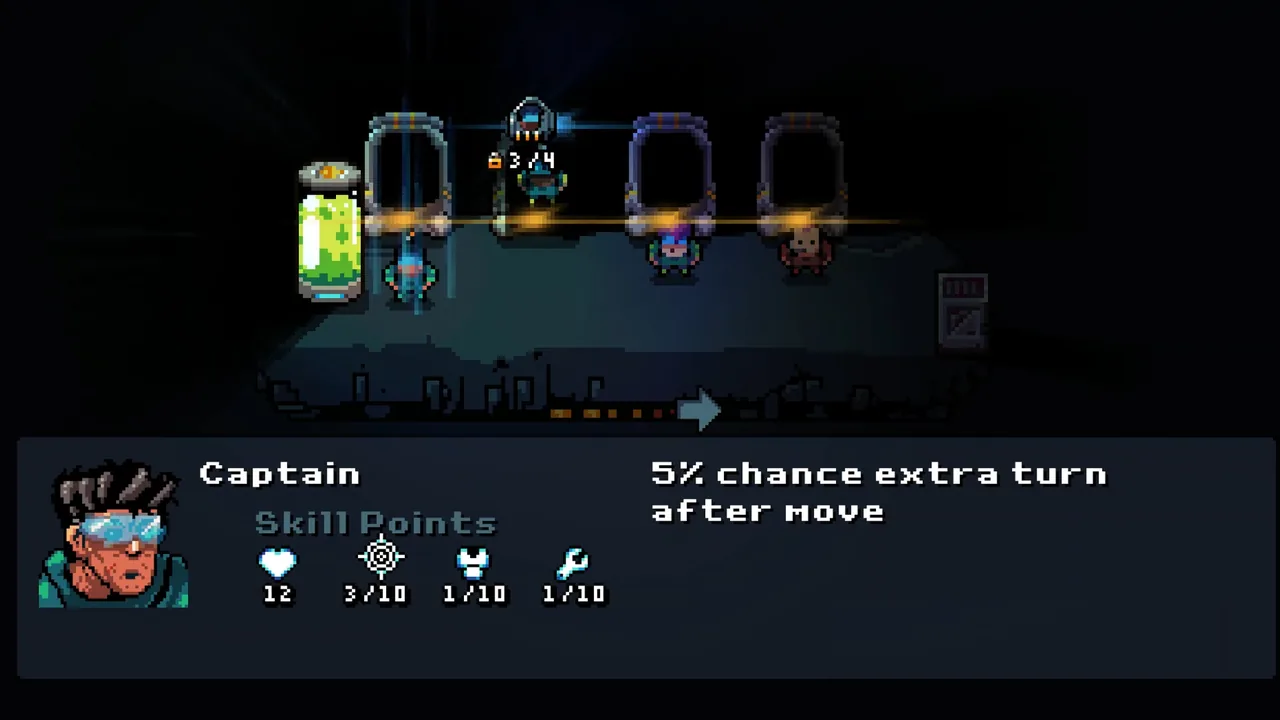
Character growth runs through three core skill categories that eventually fork into nine named subclasses — Sniper, Assassin, Hitman, Hardened, Elite, Engineer, Gadget, Gearhead and Veteran. On paper that's a strong spread: three archetypal directions (precision, stealth/burst, and support/engineering) each splitting into three specialised flavours gives the game more build identity than most $16 roguelikes bother with.
The honest caveat is that none of this differentiates itself quickly. Early missions play similarly regardless of which tree you're leaning into, because the specialised benefits only really separate once a subclass has enough investment behind it to change your moment-to-moment options rather than just your numbers. Combined with the Chrono Loop's persistence mechanic, that creates an odd rhythm: the game's headline feature (carry-over progress between runs) is generous, but the build-defining feature (subclasses) is comparatively stingy with its payoff. Players who commit to one tree across several attempts will get more out of this system than players hopping between builds looking for an immediate power spike.
Crafting sits underneath all of this as the more consistently satisfying loop. Stations let you disassemble found weapons for parts and reassemble those parts into upgrades, which gives loot a purpose beyond "bigger number, sell the rest." It's a small system, but it's the one place where the moment-to-moment scavenging and the longer meta-progression genuinely reinforce each other — what you strip for parts on a doomed run becomes the upgrade waiting for you on the next one.
Presentation and the weight of the back catalogue
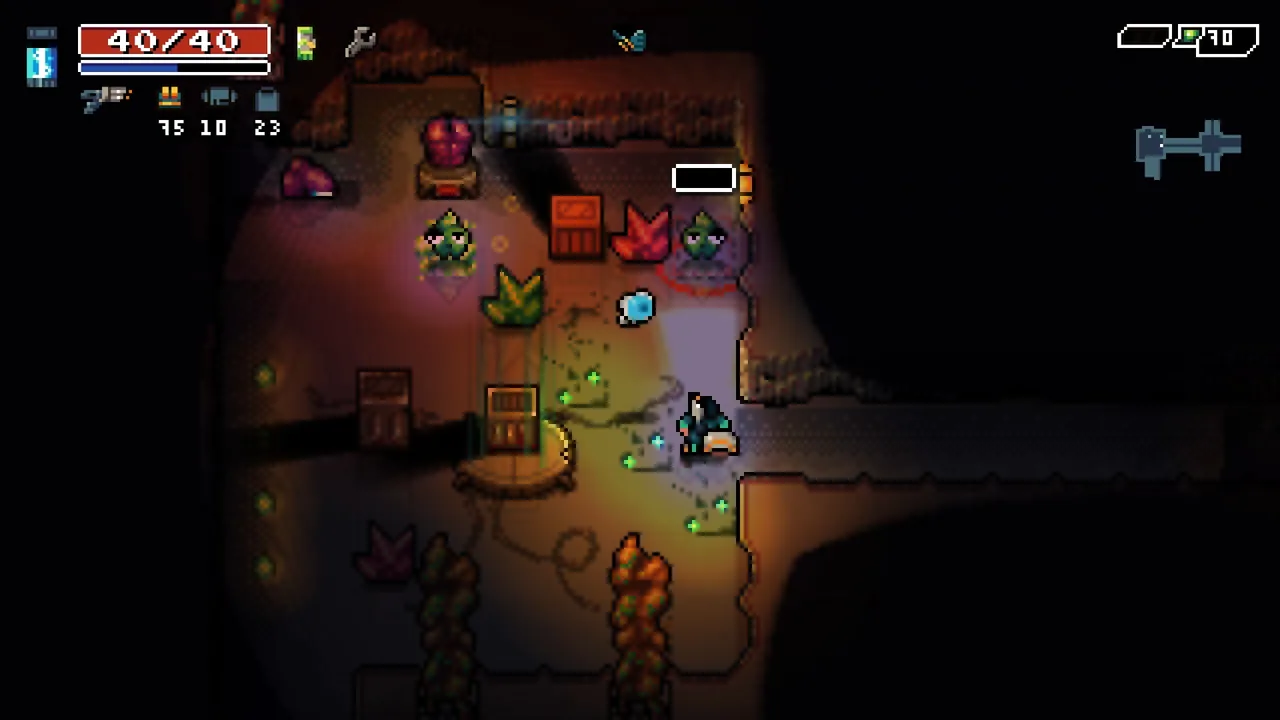
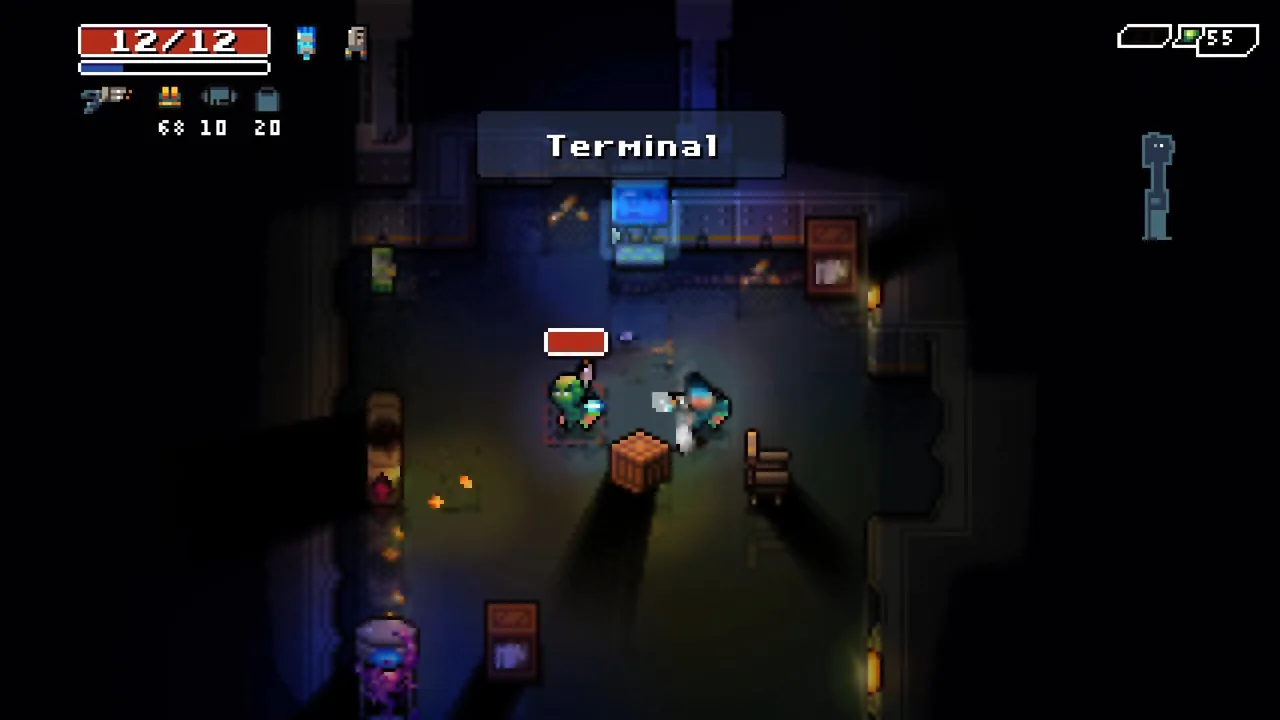
Visually this is unmistakably an Orangepixel game — chunky, high-contrast pixel art with the kind of confident, readable silhouettes that come from two decades of making sprites work at a glance during split-second combat. It doesn't chase the more painterly pixel-art trend some contemporaries have moved toward, and it's better for staying in its lane; legibility matters more than detail when the game's whole pitch is split-second reactions. Environmental variety across the procedurally generated stations and moon bases is respectable for a launch build but not inexhaustible — recurring room shapes and prop sets become recognisable well before the twentieth mission, which slightly undercuts the "every layout is new" promise on the store page.
The game also carries small connective tissue back to Orangepixel's other current project, the survival game Residual, which players who've spent time in both titles have already picked up on. It's a minor touch, but it's consistent with a studio that has spent twenty-plus years building a coherent internal universe rather than treating each release as disposable.
Where the money goes
There's nothing to flag on the monetisation front — this is a straight one-time purchase with no in-app currency, no battle pass and no cosmetic storefront bolted on afterward, which is worth stating plainly given how rare that's become even in premium indie releases. At roughly NZ$25 (US$15.99 list), it lands squarely where a focused, single-player roguelike with real replay structure should sit. A free demo is available for anyone unsure whether the turn-based-but-fast pacing suits them, and it's the right way to test the waters before committing, since this isn't a game that eases newcomers in gently.
Console versions for PlayStation, Xbox and Switch are confirmed as in development but carry no release window yet, so anyone outside PC, Mac or Linux is currently buying a promise rather than a product. Player response so far is thin in volume but consistently positive, and the pattern in that early feedback — praise for the music, for the "you have to think your way through" pacing, and for how the game rewards patience over button-mashing — lines up with what the systems themselves suggest on paper.
Final verdict
Space Grunts: Chrono Shard succeeds at the thing that actually matters most for a $16 turn-based roguelike: it makes losing feel like progress instead of punishment, without going soft on the tension that makes permadeath worth caring about in the first place. The Chrono Shard's charge-management pressure is a little too opaque for its own good, and the subclass system asks for more patience than its early hours reward, but the combat is fast, the crafting loop gives scavenging a real point, and the whole thing is built by a studio that has been quietly refining this exact formula since well before "roguelite" was a word anyone used. It won't convert players who bounced off Orangepixel's earlier games, and it isn't reinventing the meta-progression roguelike so much as reflavouring a familiar structure through a well-executed time-travel lens. For the audience it's built for, that's enough to recommend without hesitation.
Wanderer players who like the idea of progress that survives a bad outcome — rather than resetting to zero — will recognise the instinct behind the Chrono Loop immediately, even if the genres sit worlds apart.
Pros and cons
Pros
- Dying mid-mission still leaves placed items and environmental changes on the map for the next attempt, so a collapsed run isn't a wiped run
- Turn resolution is fast enough that the game keeps its arcade pulse despite being fully turn-based
- Nine subclasses spun out of three skill trees give repeat missions a real reason to play a different way
- Crafting stations turn scavenged junk into a genuine equipment upgrade path instead of a stat-padding side system
- Accessibility options — keyboard-only play, no timed inputs, adjustable difficulty — are built in rather than bolted on
Cons
- The Chrono Shard's charge management is the whole tension engine, and running dry reads as a punishment for exploring rather than a meaningful choice
- Procedural station layouts repeat enough set-piece furniture that the "new sector every time" pitch feels thinner after a dozen runs
- The skill-tree subclasses take a real time investment to differentiate, which will lose players expecting build variety from run one
- Console versions are still "in development" with no date, so anyone off PC is buying a promise
Screenshots
-
Space Grunts: Chrono ShardImage: HandyGames via Steam -
Space Grunts: Chrono ShardImage: HandyGames via Steam -
Space Grunts: Chrono ShardImage: HandyGames via Steam -
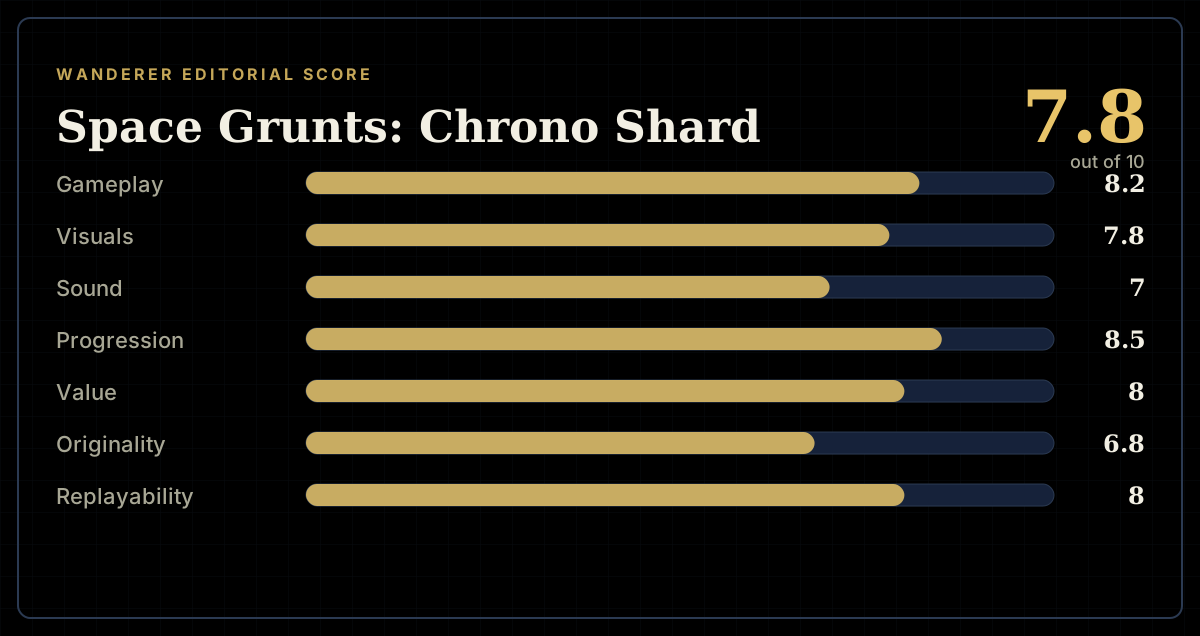
How the review scores each part of the gameWanderer Editorial -
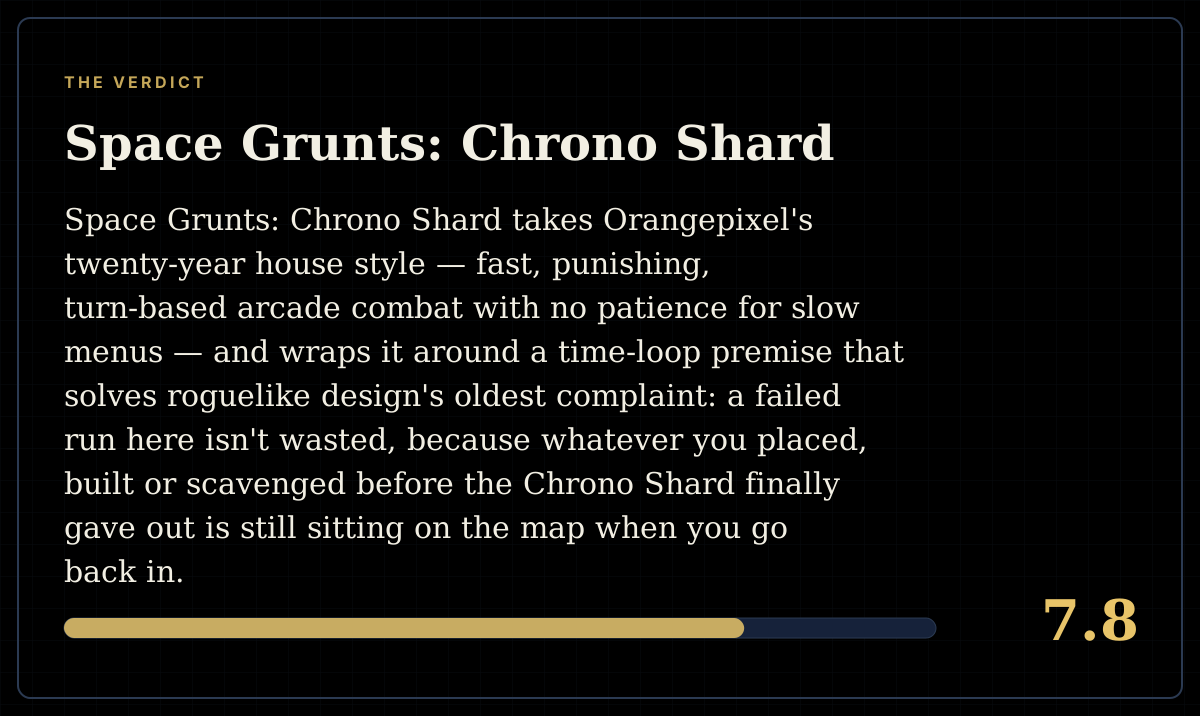
The short versionWanderer Editorial