
Game review
Vault of the Void
8 / 10
- Developer
- Spider Nest Games
- Publisher
- Spider Nest Games
- Released
- 4 October 2022
- Platforms
- Windows, macOS
- Genre
- Roguelike Deckbuilder
- Monetisation
- One-time purchase at NZ$5.69 with three DLC. No microtransactions. Includes cross-save between platforms. Checked 4 August 2026.
- Players
- Single-player only
The short version
Most roguelike deckbuilders are about making good decisions with incomplete information. Vault of the Void gives you the information. You can see the card rewards before you choose a path, you can rebuild your deck between every single fight, and Void Stones let you upgrade cards to your exact specification. The result is the most *controllable* game in the genre — a technical, deliberate puzzle where a loss is genuinely your fault. Whether that's the genre perfected or the genre neutered is the argument in its review section, and both sides make a decent case.
Biggest strengths
- Deck editing between every fight is a genuine innovation — you're curating rather than praying
- Void Stones let you upgrade cards along chosen axes, so improvements are designed rather than rolled
- Four classes with two sub-types each, all with mechanics distinct enough to play like separate games
Biggest weaknesses
- The low-randomness design removes the surprise discoveries many players consider the genre's core pleasure
- Because each class's signature mechanic dictates deck direction from the start, runs within a class can feel similar
- Complexity is front-loaded and unapologetic; it is a poor first deckbuilder and its fans agree
Who it's for: Deckbuilder veterans who want control, planning and mastery rather than lucky discoveries. Explicitly not a first deckbuilder — its own fans say so. Not for players who love the moment a random relic reshapes a run.
Our recommendation: Buy it if you've already played Slay the Spire to death and found yourself wishing you could fix the one card ruining your deck — that's precisely the itch this scratches, and at under six dollars it's barely a decision. Start with the class whose mechanic you find most interesting rather than the "beginner" one, since the mechanic dictates the deck anyway. And go in expecting a technical exercise rather than a chaotic one.
8 / 10
Here is a criticism I have never seen levelled at another game, from a review with fifteen helpful votes: "It does everything right that you could ask for, and definitely refines the card battler roguelike to the furthest extent the genre can be refined. But maybe it's a little too perfect."
That's Vault of the Void's whole story. It is, by some distance, the most carefully engineered deckbuilder I've looked at, and the reason people bounce off it is the engineering.
What it does differently
Three decisions separate it from everything else in the genre.
You see the rewards before you commit. Choosing a path on the map isn't a gamble — you know what each branch offers. Planning replaces hoping.
You rebuild your deck between every fight. Not at rest sites, not at shops. Every fight. Your full collection is available and you assemble the thirty cards you want for the encounter in front of you. That single change reframes the entire genre: your deck stops being an accumulating mess you manage and becomes a toolkit you curate.
Upgrades are specified, not rolled. Void Stones let you improve cards along chosen axes, so "this card is nearly right" is a solvable problem rather than a disappointment.
Add four classes with two sub-types each, all built around genuinely distinct mechanics, and you get a game where a loss is unambiguously your fault. That's rare and, for a certain player, deeply satisfying. One recent reviewer with 191 hours calls it their favourite deckbuilder of all time, having played plenty of the competition.
The completion data supports the "fair" claim: 57% of everyone who owns it has beaten the base game. For a roguelike deckbuilder that is a strikingly high number.
Why the same design loses people
Now the other side, and it's argued well.
The most articulate negative review puts it like this: part of the appeal of roguelikes is that you sometimes get an item or combination by chance that you'd never have chosen, and it makes the run into something new and makes you see the whole game differently. Vault of the Void has very little of that. You plan, you plot, you execute.
A second reviewer adds the structural version: because you're shown all the card rewards up front, what remains is mapping the route — and with boss rewards described as tame, the run lacks the escalating jolts that make each floor feel like a new problem.
A third identifies the sharpest version. Each class is built around a signature mechanic, and that mechanic dictates which cards are worth taking from the very first turn. So the deckbuilding converges: you already know what you're building toward before you've seen a single card. Several reviewers describe feeling "bound" to a mechanic and unable to branch out.
None of that is a bug. It is the direct, foreseeable consequence of removing randomness, and it's why the same design produces both "my favourite deckbuilder of all time" and "I got bored after one or two fights" in the same review section.
Where I land: this is a puzzle game wearing a roguelike's clothes. Slay the Spire asks you to play well with what you're given; Balatro asks you to notice a broken interaction and chase it. Vault of the Void asks you to solve the encounter with full information. That's a legitimate and under-served pleasure — it's just a different one, and the marketing doesn't tell you which you're buying.
Eight games in one box
The counter-argument to "runs feel similar" is the class roster, and it's stronger than the critics allow.
There are four classes, each with two sub-types, and the sub-types aren't stat variants — they change what the class is doing. One might convert your defensive resource into an offensive one; another turns card retention into a win condition; another rewards deliberately overdrawing. Because deck editing is unrestricted between fights, each of those wants a genuinely different collection, so switching sub-type is closer to switching game than to switching loadout.
That's where the replay value actually lives. It isn't in run-to-run surprise — the critics are right that there isn't much — it's in the eight distinct problems the game hands you and the mastery curve attached to each. The achievement spread bears this out: 57% have cleared the base game, but the per-boss and per-class achievements fan out well below that, which is the shape of a game people return to in order to learn something rather than to be surprised by something.
So the honest framing is that Vault of the Void replays like a fighting game rather than a slot machine. You come back to get better at a specific thing. If that sounds appealing, the "low randomness" criticism will read to you as a feature list. If you came for the story of the run rather than the solving of it, it won't.
The practical notes
It is complicated, immediately and without apology. A well-voted review simply describes the game in one word — "Complicated" — and warns that anyone wanting a carefree card game will not find it here. Its own admirers agree: "It should never be your first deckbuilder, but if you are an aficionado of the genre then this one is for you." That's the most accurate sentence anyone has written about it.
Presentation is the weak spot. Functional art, forgettable enemies, no real atmosphere. In a genre where Monster Train and Balatro have enormous personality, this one is a spreadsheet you play.
And it's cheap in a way that borders on absurd: NZ$5.69, with 251 achievements and a 27-hour median playtime among recent reviewers. One reviewer's complaint is simply that it never got hyped and so it stays buried in Steam's recommendations, which after reading the corpus seems fair.
Cross-save between platforms is included, and reviewers keep raising it unprompted as something the bigger names in the genre still don't offer.
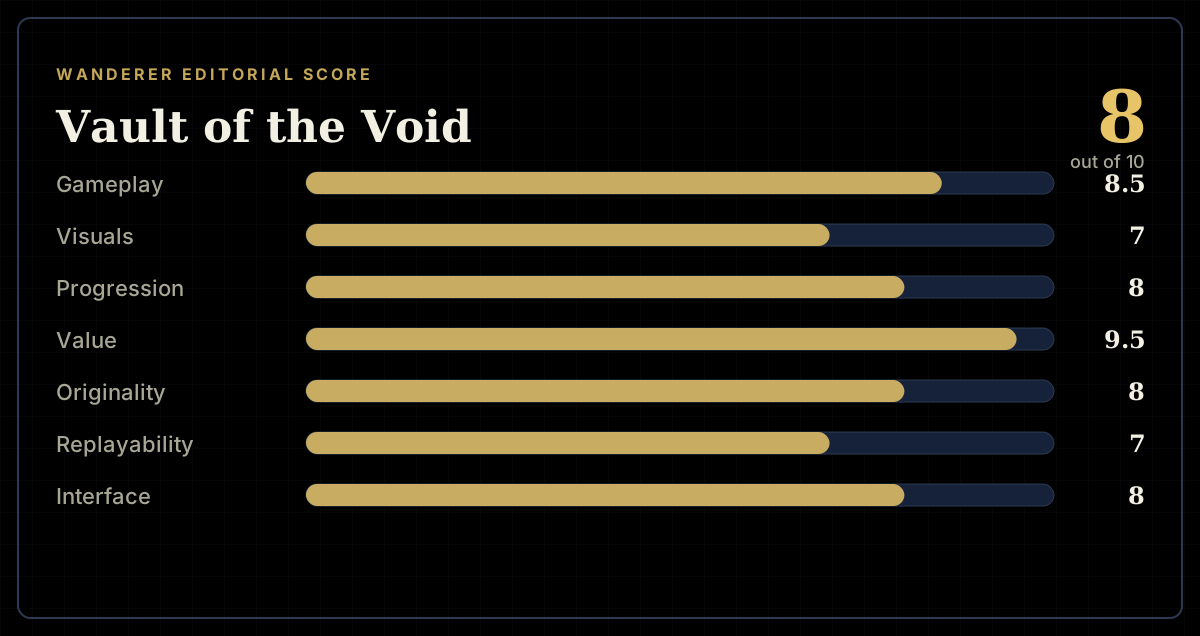
8.0 out of 10. Rated 8.0 out of 10.
Vault of the Void is an excellent game for a specific person: the deckbuilder veteran who has internalised the genre and now wants control instead of chaos. For that player it's a bargain at any price and a genuine favourite at this one.
Two points come off — one for presentation that never rises above functional, one for the replayability cost of its own central idea. Removing luck makes every loss fair and every run a little more like the last, and no amount of class variety fully solves that. Know which of those trades you want before you buy, and at under six dollars, finding out is hardly a risk.
Pros and cons
Pros
- Deck editing between every fight is a genuine innovation — you're curating rather than praying
- Void Stones let you upgrade cards along chosen axes, so improvements are designed rather than rolled
- Four classes with two sub-types each, all with mechanics distinct enough to play like separate games
- Extraordinary value at under six dollars, with 251 achievements and a 27-hour median playtime
- Cross-save between platforms, which reviewers single out as unusually thoughtful
- 57% of all owners have beaten the base game, which for a roguelike deckbuilder is a very high completion rate
Cons
- The low-randomness design removes the surprise discoveries many players consider the genre's core pleasure
- Because each class's signature mechanic dictates deck direction from the start, runs within a class can feel similar
- Complexity is front-loaded and unapologetic; it is a poor first deckbuilder and its fans agree
- Presentation is functional rather than characterful, and several reviewers describe the world and enemies as forgettable
- Boss rewards are widely considered tame, which flattens the run's escalation
- Some players find it mechanically faultless and emotionally flat — praise and complaint in one
Screenshots
-

Vault of the VoidImage: Spider Nest Games via Steam -

Vault of the VoidImage: Spider Nest Games via Steam -

Vault of the VoidImage: Spider Nest Games via Steam -
How the review scores each part of the gameWanderer Editorial -
The short versionWanderer Editorial