Game review
Monster Train
7.5 / 10
- Developer
- Shiny Shoe
- Publisher
- Good Shepherd Entertainment
- Released
- 21 May 2020
- Platforms
- Windows, Xbox One, Nintendo Switch, iOS, PlayStation 5
- Genre
- Roguelike Deckbuilder
- Monetisation
- Premium, one-off purchase; one paid content expansion (The Last Divinity, adding a new clan and a harder final boss) plus an optional soundtrack DLC — no microtransactions, no premium currency, no ads
- Players
- Hell Rush pits up to eight players against the same seed and resources in a real-time race rather than head-to-head combat, alongside Daily and Custom Challenge leaderboards; the game is designed and played overwhelmingly as a single-player experience
The short version
Monster Train's one real idea is a great one: instead of a single lane of enemies marching at a single deck, you're defending three stacked floors of a train at once, with heat rising from the furnace at the bottom and enemies trying to punch through to the pyre at the top. Pairing a primary clan with a secondary one and building a deck that has to work across floors rather than along one is a genuinely different puzzle from anything Slay the Spire asks of you, and five and a half years after launch, 96% of its nearly 19,900 Steam reviews are still positive.
What that headline number hides is a hard wall partway through the game's own difficulty ladder. Steam's global achievement data shows 96.6% of owners beating the very first boss, but only 14.1% have ever watched the credits roll on a completed run, and the top four Covenant tiers fall from 34% of owners to 8% in a straight line. That matches what hundreds of veteran reviewers — many with a thousand-plus hours logged — say directly: the run stays fun for a while, and then the scaling stops being fair faster than the deckbuilding gets deep enough to keep up with it.
Biggest strengths
- The three-floor train is a real structural twist on the deckbuilding-roguelike formula, not a reskin — heat rises from the furnace, enemies push up from the bottom, and a deck has to work across floors rather than down a single lane
- Pairing a primary and a secondary clan out of five available options produces genuinely different decks and playstyles, not just re-coloured versions of the same strategy
- 96% of nearly 19,900 Steam reviews are positive nearly six years after launch, backed by an IGN 9/10 and an 86 on Metacritic at release
Biggest weaknesses
- Global achievement data shows a steep wall: 96.6% of owners beat the first boss, but only 14.1% have ever finished a run to see the credits, and the top Covenant tiers sit at 34%, 21%, 14% and 8% of owners — hard numbers behind years of "the balance falls apart past the midpoint" complaints
- Hell Rush, the only multiplayer mode, races players against a shared seed rather than each other; Steam's own community discussions note it barely qualifies as multiplayer beyond emotes thrown at another player's screen
- A significant share of long-time reviewers — including several past 30,000 minutes played — describe the run variety thinning out once every clan combination has been seen once or twice
Who it's for: Deckbuilding-roguelike fans who've already finished Slay the Spire and want a structurally different puzzle rather than a reskin, and anyone drawn to the idea of defending a stack of floors at once rather than a single lane.
Our recommendation: Buy it if the vertical-train hook genuinely appeals to you — the first twenty to thirty hours across the five base clans are some of the best deckbuilding design on Steam. Go in knowing the difficulty curve gets sharply unfair well before most players run out of things to discover, and that the game's own achievement numbers back that complaint up.
7.5 / 10
Three floors, one fire, nowhere to retreat to
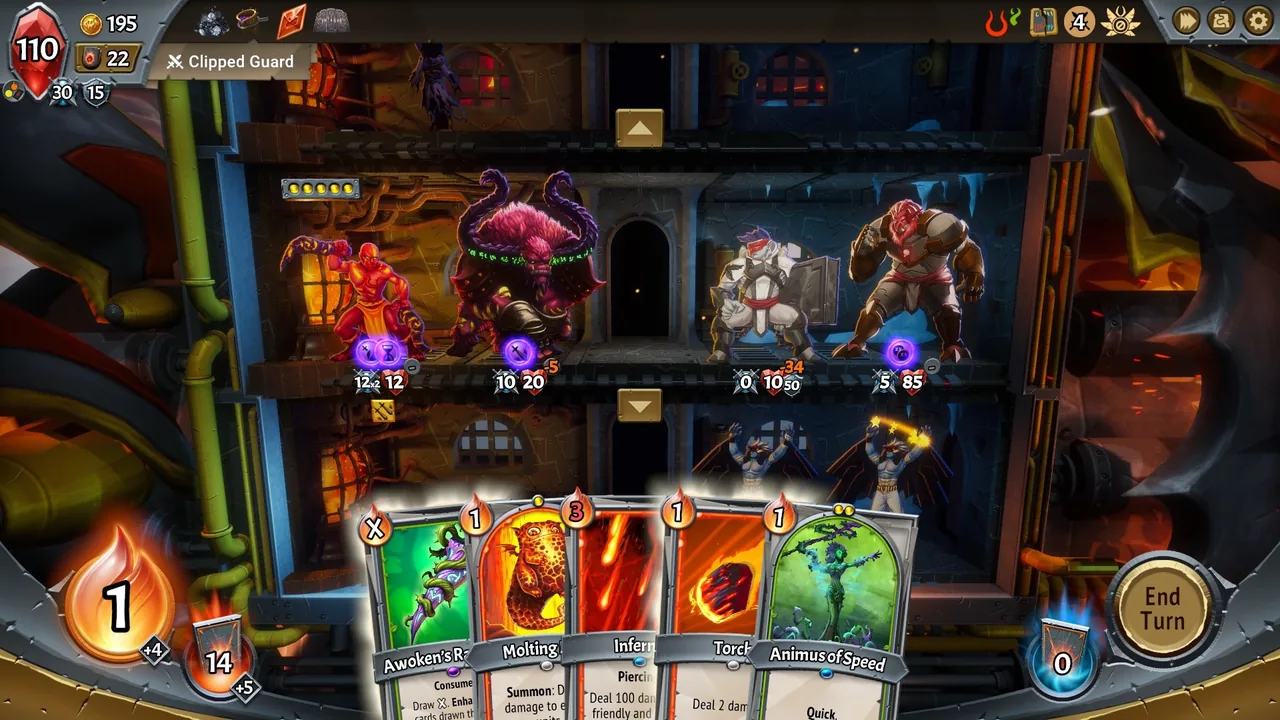
Slay the Spire's map is a single corridor: one lane of enemies, one deck deciding whether you survive it. Monster Train throws that structure out and replaces it with a train car split into three fighting floors stacked on top of a furnace, with a pyre at the very top that ends the run if it goes out. Enemies climb from the bottom, heat rises with them, and units placed on a lower floor that get pushed off it don't just die — the ones that survive keep climbing. A deck that only knows how to win on one floor loses on the other two, and reinforcing the top of the train too early starves the bottom of the defence it needs to hold the door shut in the first place.
That's a genuinely different tactical problem from "which single lane do I hold," and it's the reason Monster Train earned comparisons to Slay the Spire without ever reading as a copy of it. The five-year run of user reviews bears that distinction out: Monster Train sits at Overwhelmingly Positive with 19,092 of 19,892 Steam reviews recommending it (96%, checked 3 August 2026), backed at release by an IGN score of 9/10 and an 86 on Metacritic. Those numbers are the reason this is still worth writing about years after launch, not a footnote to be gotten out of the way.
Five clans, one deck, and the pairing that actually matters
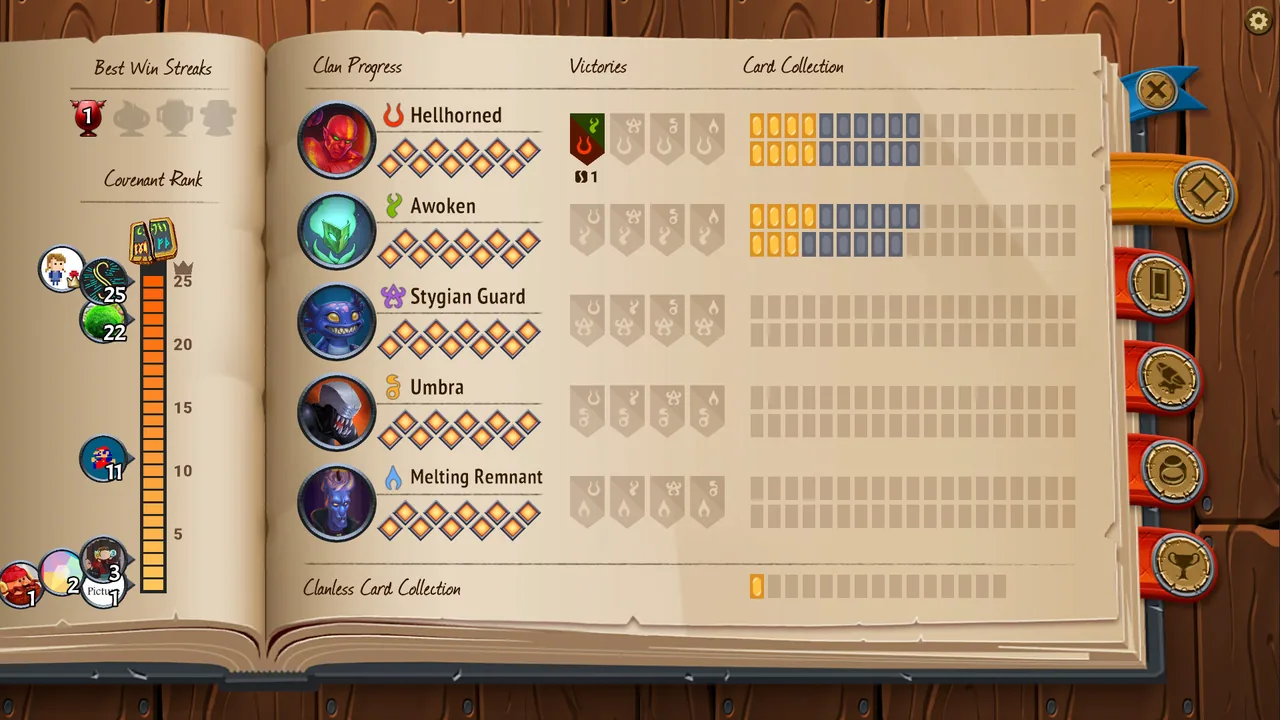
The base game ships with five monster clans, each built around a distinct mechanical identity — Steam's own store page describes it as "five clans to choose from, each has its own unique and surprising gameplay" — and the design decision that makes the whole system work is that you don't pick one. Every run pairs a primary clan with a secondary one, and the deck you build has access to both pools simultaneously. That's the actual replayability engine: not more cards inside a single clan, but which of the other four clans you're combining it with, since a pairing that stacks armour and stalling against one that wants to burn the whole train down produces a completely different plan than pairing the same clan with something built around unit sacrifice. With 220-plus cards spread across ten starter decks, twenty-one-plus random events, and each clan carrying ten unlockable levels of its own, there's a genuinely large combinatorial space here on paper.
The gap between that combinatorial space and what it feels like thirty hours in is the single most common complaint in the game's negative-review corpus. Across a hundred English-language negative reviews sampled from launch week through July 2026, 27 explicitly compare the game unfavourably to Slay the Spire, and 11 specifically describe a ceiling on how varied a single run feels once a player has tried most of the ten clan pairings once or twice. "Not enough content to be called a roguelike," reads one; "every battle of a run is pretty much the same," reads another. That's not the majority experience — most of the 96% positive share never write a review at all — but it's a consistent enough thread across six years of feedback that it isn't noise either.
Where the numbers say the run stops being fun
Monster Train's difficulty runway is called Covenant, and the store page advertises 25 tiers of it stacked on top of a completed base run. Steam's global achievement percentages give a far more precise picture of where that runway actually gets used than review text alone can. 96.6% of owners have beaten the very first boss, and 86.7% have an achievement for simply losing a run — so the overwhelming majority of buyers do actually sit down and play multiple attempts. But only 14.1% of owners have ever triggered the achievement for watching the credits roll, meaning a completed run — not a high-Covenant one, just a finished one — is something roughly six in seven owners have never seen. Climb further and the drop gets sharper still: the top four Covenant-tier achievements sit at 34.2%, 20.6%, 13.9% and 8.0% of owners in a clean descending line.
That curve lines up with what the most-invested reviewers say directly, and it's worth noting these aren't drive-by complaints — several of the negative reviews describing broken late-game balance carry playtimes past 30,000 and even 60,000 minutes, meaning the writers loved the game enough to spend hundreds of hours in it before turning against the difficulty ladder specifically. "Covenant Rank 26: RNG" is the title one reviewer gave their own writeup after 75 hours; another, at over a thousand hours logged, calls it simply "not balanced well" at the highest difficulty. Twenty of the hundred sampled negative reviews raise balance directly, and eleven raise randomness as the specific mechanism — the complaint isn't that the top of the ladder is hard, it's that at the top, a run's outcome increasingly depends on what the game deals you rather than what you build.
Hell Rush, and the multiplayer mode nobody quite agreed was multiplayer
Monster Train advertises three online modes — Hell Rush, Daily Challenge and Custom Challenge — and only one of them looks anything like traditional multiplayer. Hell Rush drops up to eight players into the same seed with the same starting resources and the same opponents, racing to see who survives fastest or furthest; nobody is attacking anybody else's train directly. Steam's own community discussions for the game reflect that gap between the label and the experience, with players noting the most direct interaction on offer is throwing an emote at someone else's screen while playing the identical map, and openly wondering whether the feature deserves the "multiplayer" tag Steam lists it under at all. Daily and Custom Challenge are honest about what they are — leaderboard attacks on a shared seed, not competitive play — but Hell Rush is marketed with language ("eight players compete," "a frantic real time contest") that promises more head-to-head tension than a shared-seed speed run actually delivers. For a deckbuilder this strong solo, that's a minor miss rather than a real flaw, but it means nobody should buy Monster Train expecting a PvP card game.
The freeze that keeps coming back
A smaller but persistent thread runs through the negative-review corpus: crashes and freezes, described in remarkably similar terms across a remarkably wide span of time. A 2020 review describes the game going to "black screen every time I try to load it"; a 2024 review reports a bug that "freezes your PC" and notes it's "been out for 4 years they haven't fixed"; a March 2026 review, six years after launch, describes crashes "when I close the game then go back into it." Only three of the hundred sampled negative reviews raise stability directly, which puts it well behind balance and repetition as a driver of dissatisfaction — but the fact that the same description recurs from year one through year six, on a game that has otherwise received two free content updates and four additional platform ports, suggests whatever's causing it was never fully run to ground.
What NZ$35.99 buys in 2026
There's no way around the obvious comparison for anyone deciding whether to buy this now: Monster Train 2 exists, published under Devolver Digital's Big Fan Games label and reviewing well in its own right, and at least one negative review in the sample says exactly that — skip the original, buy the sequel instead. That's a fair note for a shopper to weigh, but it isn't a reason to write the original off. The base game is a complete, finished 8.6-Metacritic release with no Early Access asterisk, five clans' worth of deckbuilding that most players never fully exhaust, two free content updates layered on top of launch, and Steam Workshop mod support through the Herzal's Workshop update. At full price it's a fair trade for the twenty-plus hours most players report before the difficulty complaints start; anyone waiting for a sale gets an easy yes.
Verdict
Monster Train's central idea — three floors, one fire, heat that punishes hesitation — is good enough to have earned five and a half years of Overwhelmingly Positive standing on its own merits, not on Slay the Spire's coattails. Pairing clans instead of picking one gives the deckbuilding real range, and the vertical structure asks questions the genre's founder never has to. Where it loses ground is exactly where its own achievement numbers say it does: a Covenant ladder that a supermajority of owners never get near the top of, a shared-seed race mode wearing a multiplayer label it hasn't quite earned, and a stability complaint that's shown up in some form every single year since launch. None of that undoes what's genuinely original here — it just means the honest recommendation is to play it for the floors-and-heat idea, not to expect it to out-balance the game it's most often compared to.
Anyone who likes systems that reward planning several moves ahead rather than reflexes might also find something familiar in Wanderer, which builds its own progression around patient, persistent choices rather than a single high-stakes run.
Pricing, review figures and achievement data checked 3 August 2026.
Pros and cons
Pros
- The three-floor train is a real structural twist on the deckbuilding-roguelike formula, not a reskin — heat rises from the furnace, enemies push up from the bottom, and a deck has to work across floors rather than down a single lane
- Pairing a primary and a secondary clan out of five available options produces genuinely different decks and playstyles, not just re-coloured versions of the same strategy
- 96% of nearly 19,900 Steam reviews are positive nearly six years after launch, backed by an IGN 9/10 and an 86 on Metacritic at release
- One-time purchase with no microtransactions or premium currency anywhere in the game; The Last Divinity is the only paid gameplay expansion, and two free content updates (Friends & Foes, Wild Mutations) shipped after launch at no extra cost
- Clean ports to Xbox, Switch, iOS and PlayStation 5 without cutting Steam Workshop mod support or the 25-tier Covenant difficulty ladder
Cons
- Global achievement data shows a steep wall: 96.6% of owners beat the first boss, but only 14.1% have ever finished a run to see the credits, and the top Covenant tiers sit at 34%, 21%, 14% and 8% of owners — hard numbers behind years of "the balance falls apart past the midpoint" complaints
- Hell Rush, the only multiplayer mode, races players against a shared seed rather than each other; Steam's own community discussions note it barely qualifies as multiplayer beyond emotes thrown at another player's screen
- A significant share of long-time reviewers — including several past 30,000 minutes played — describe the run variety thinning out once every clan combination has been seen once or twice
- Crash and freeze reports recur in negative reviews from nearly every year since launch, from 2020 through March 2026, describing the same black-screen or lockup symptom
- Full price is NZ$35.99 with no discount active as of the date checked, and the one gameplay expansion is a further NZ$17.49 on top
Screenshots
-
Monster TrainImage: Good Shepherd Entertainment via Steam -
Monster TrainImage: Good Shepherd Entertainment via Steam -
Monster TrainImage: Good Shepherd Entertainment via Steam -
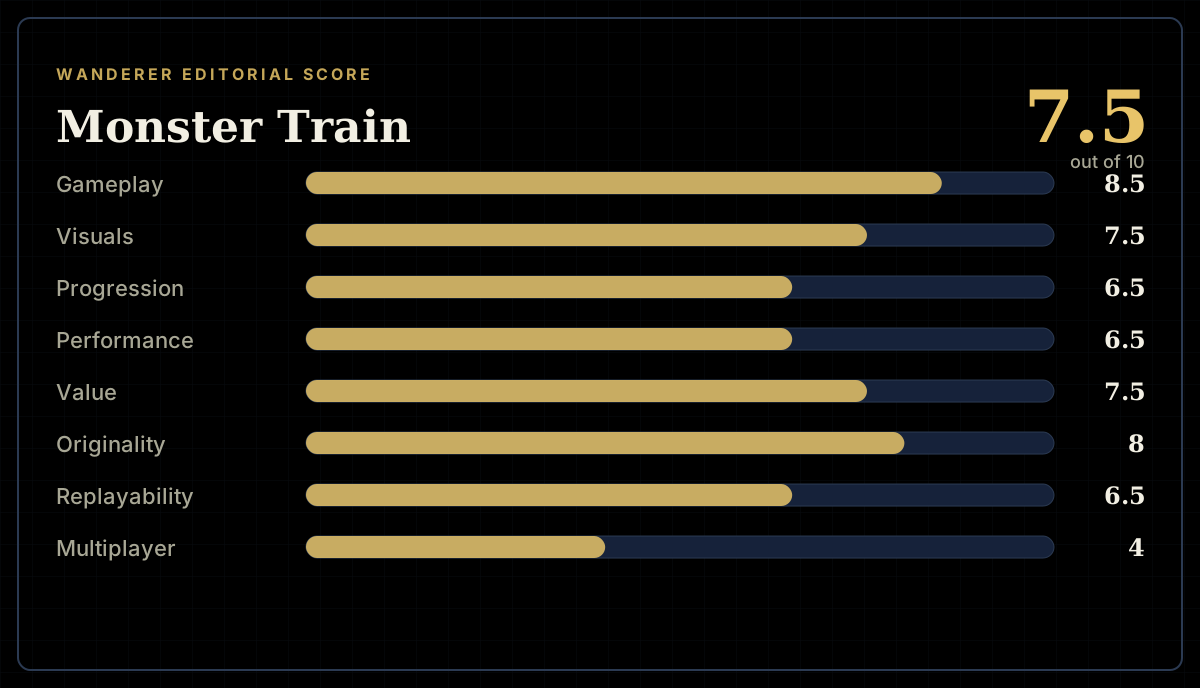
How the review scores each part of the gameWanderer Editorial -
The short versionWanderer Editorial