Game review
Where Winds Meet
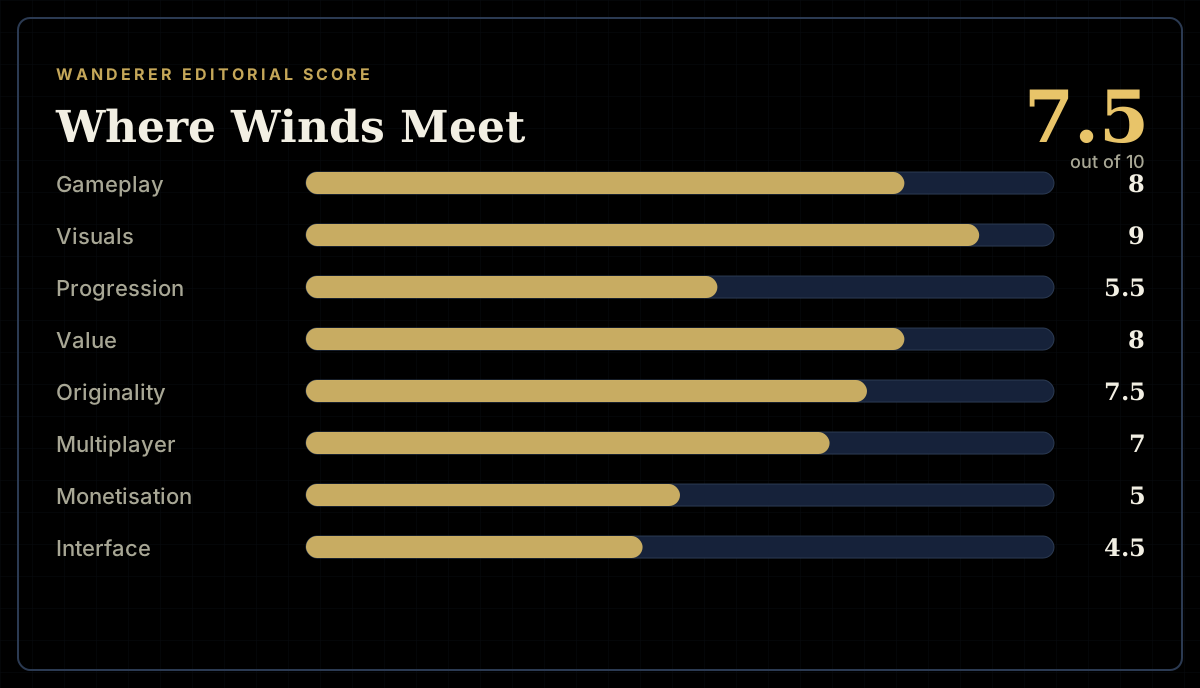
7.5 / 10
- Developer
- Everstone Studio
- Publisher
- NetEase Games
- Released
- 14 November 2025
- Platforms
- Windows, PlayStation 5, Xbox Series X|S, iOS, Android
- Genre
- Open World Action RPG
- Monetisation
- Free to play with in-app purchases. Multiple premium currencies, cosmetic gacha and several concurrent battle passes; the developer states gameplay content is free and monetisation is cosmetic-only.
- Players
- Solo-playable throughout, with drop-in co-op, world bosses, arena PvP and guild war; always online
The short version
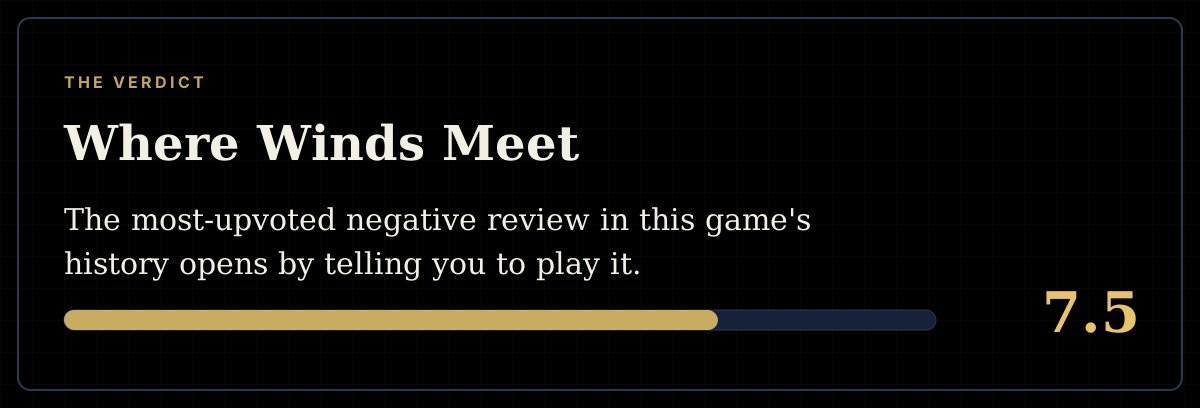
The most-upvoted negative review in this game's history opens by telling you to play it. That is Where Winds Meet in one gesture: a beautiful, strange, wildly generous wuxia sandbox where you can learn tai chi from a bear, hatch a goose that follows you around, and get into a boss fight with a village bird — wrapped in an economy that meters how much of it you're allowed to have per day.
The open world and its sixteen life systems are the real attraction, and they're free in a way that genuinely means something: the campaign, the map and the martial arts are not behind a paywall. What you pay for is appearance, and what you wait for is Energy. Gear progression runs through an energy meter that takes days of real time to refill, the interface buries a dozen daily claim-buttons under menus within menus, and the cosmetic gacha carries every dark pattern the genre knows. None of it makes anyone stronger than you. All of it decides how fast you get to play.
Biggest strengths
- The open world is beautiful and unusually playful, with sixteen non-combat life systems that reward wandering rather than just clearing markers
- A genuinely free campaign — the story, map, weapons and martial arts are not gated behind purchases
- Full cross-play and cross-progression across PC, PlayStation, Xbox and mobile, which very few games this size manage
Biggest weaknesses
- Gear progression is gated by an Energy meter that reviewers describe as taking days of real time to refill fully, with each boss or outpost costing a fifth to a half of a full bar
- The interface is the single most consistent complaint in the entire review corpus — menus inside menus, several parallel currencies, and a notification queue that takes minutes to clear
- Cosmetics are sold through gacha with multiple premium currencies, several concurrent battle passes, and prices global players compare unfavourably against the Chinese version
Who it's for: Players who want an enormous, beautiful martial-arts world to live in rather than finish, and who can treat a daily-quest economy as background noise. Anyone who wants to binge an action RPG in long uninterrupted sessions will hit the Energy wall within a week.
Our recommendation: Install it — it's free, the first forty hours are excellent, and you'll know quickly whether the systems overhead bothers you. Set a hard rule about the cash shop before you open it, because the pricing is built to be compared against itself rather than against your wallet.
7.5 / 10
The most-upvoted negative review of Where Winds Meet, sitting at nearly five thousand helpful votes, opens by recommending the game. "Even though this review is marked as a negative review, I RECOMMEND the game," it says. "I only marked this as a negative review so people who specifically read negative reviews can see the full picture." Then it spends several thousand words explaining the systems, and concludes that the menus are the reason for the thumbs-down.
That is a remarkably precise summary of what this game is. Where Winds Meet is a free, enormous, frequently beautiful wuxia open world containing some of the most charming design ideas anyone shipped in 2025 — and every one of them arrives wearing three layers of live-service scaffolding. Players love it and resent it, usually in the same paragraph, and after nine months of updates it still holds a Very Positive 86.6% across 113,103 reviews. Working out why both halves of that are true is the whole job of reviewing it.
A world that rewards messing about
The setup is the Five Dynasties and Ten Kingdoms period, a genuinely underused stretch of Chinese history, and you play a wanderer with amnesia climbing from a village nobody to a name in the imperial capital. The traversal is pure wuxia: rooftop parkour, a grappling hook, and a windstride glide that turns the map into something you cross in long, ridiculous arcs rather than a horse ride.
What separates it from every other open-world checklist is how much of the map isn't combat. There are sixteen life systems — craft, architecture, astronomy, medicine, folk games, performance — and they're not menu abstractions. You can heal villagers as a doctor, forge, build and decorate a homestead, play instruments, gamble at folk games. Over thirty mystic arts run from Tai Chi to Lion's Roar, and you learn them by stealing techniques from sects rather than buying nodes.
The stories reviewers actually tell about this game are the tell. One player with a thousand hours logged writes about hatching an egg they found in their inventory into a goose that then followed them everywhere, learning tai chi from a bear, and later beating that same bear with it. Someone punched a village goose and got a boss fight. Another got married in-game and watched a stranger get struck by lightning. These aren't the beats a marketing department writes; they're what a world feels like when its systems are allowed to collide. For a game this commercially engineered, the sandbox underneath is startlingly loose and good-natured.
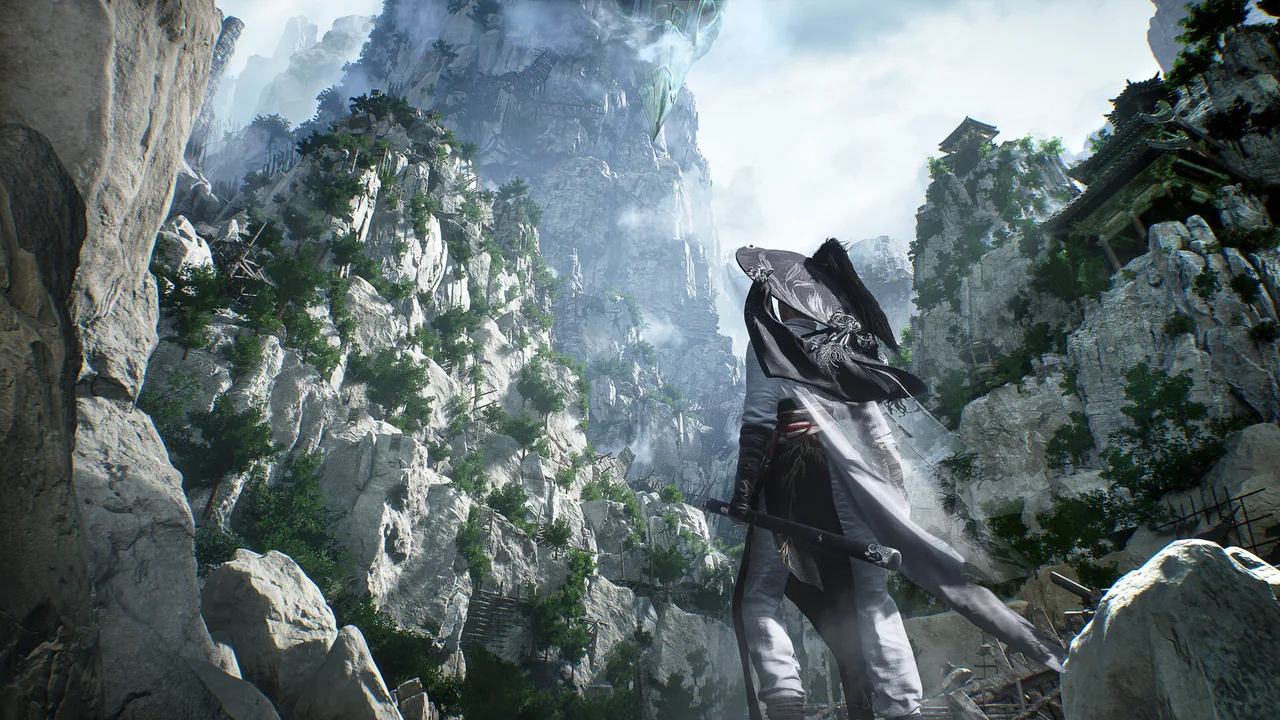
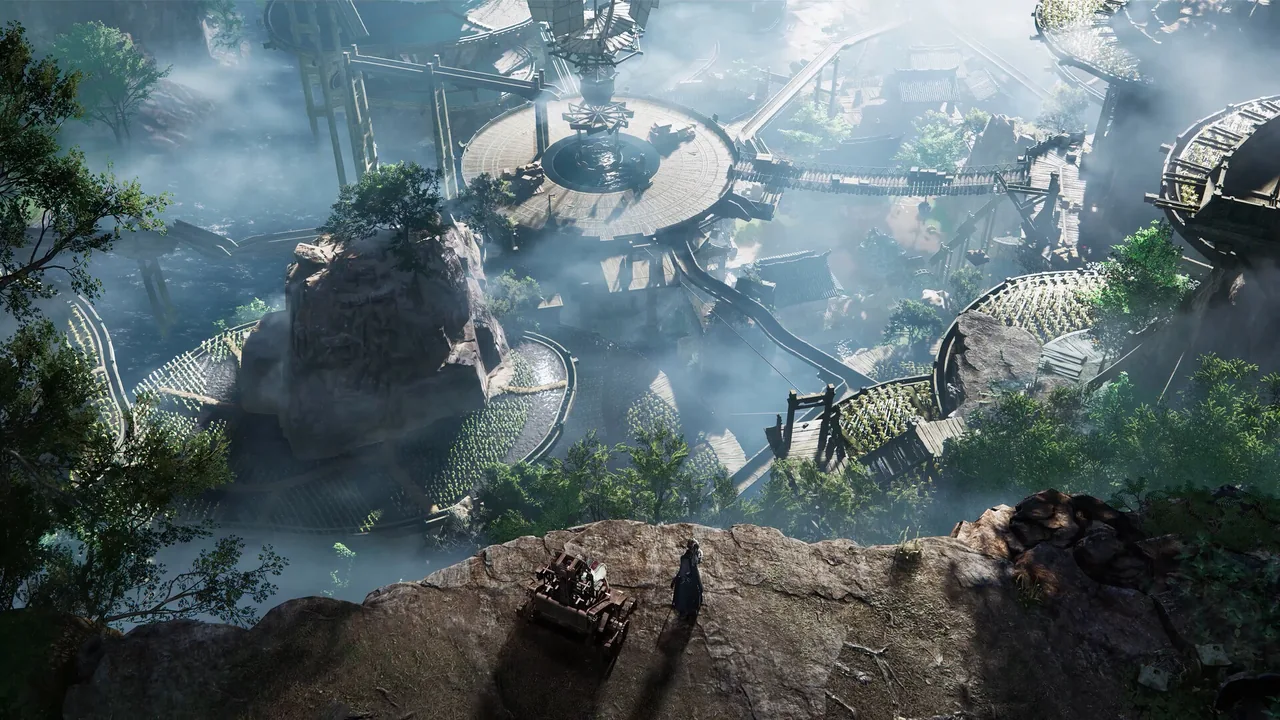
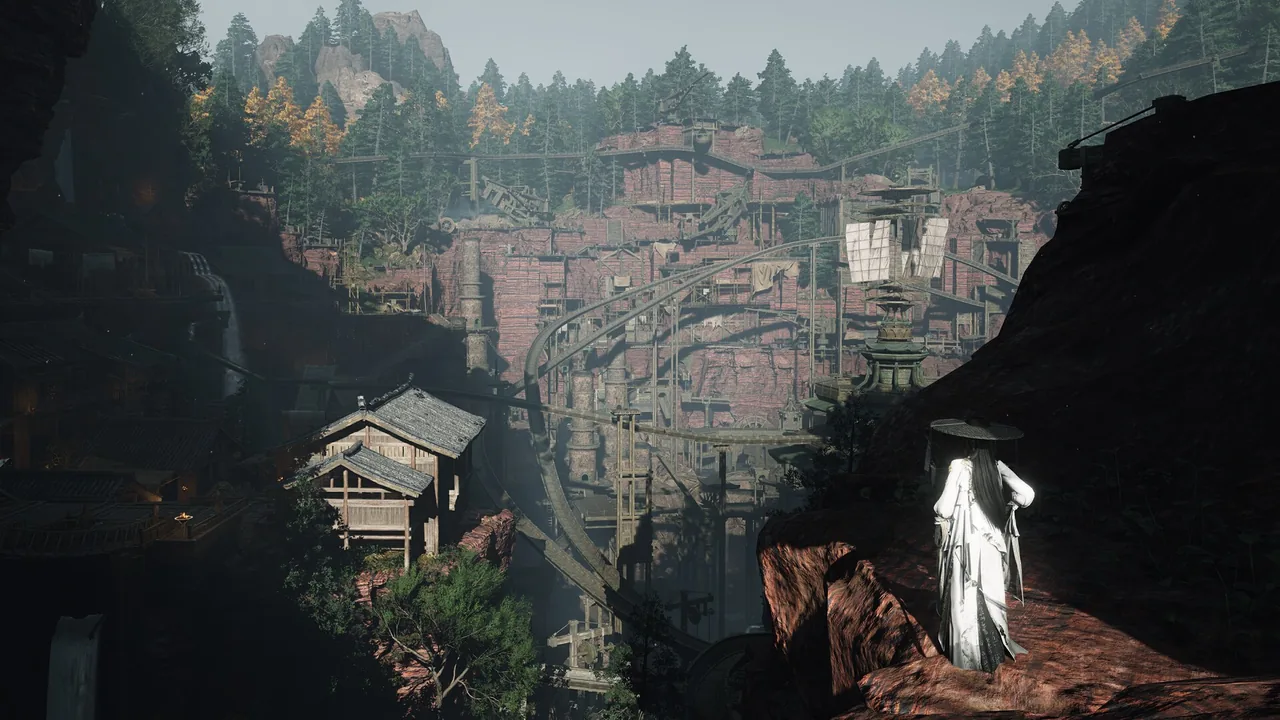
Visually it is close to the top of the free-to-play field. Environments are dense and specific, weather and light do real work, and the character creator is good enough that reviewers cite it as the reason they installed. It also asks for 130 GB and a GTX 1060 as the floor, which is a real ask for a free download.
Combat: sharp, and divisive on purpose
Combat is weapon-stance based with a deep martial-arts layer over the top, and it's built around parrying. Time the deflect and fights become the flowing exchange the genre promises; miss the window and you're eating a combo. It's closer to Black Myth: Wukong or Nioh 2 than to a typical MMO's rotation, which is a compliment.
The dissent is loud and specific. A recurring complaint among recent negative reviewers is that the parry window is unreasonably tight and that boss animations are deliberately built to disguise the timing — one 70-hour player describes chaining twenty to thirty near-frame-perfect parries in a single fight. Others report parries simply not registering. There's a difficulty selector and a Smart Combat Assist the developers have been patching, so the game is clearly aware of the gap, but the divide is real: this is a demanding action game wearing an approachable free-to-play costume, and a chunk of the audience arrives expecting the costume.
The part that decides everything: Energy
Here is the mechanic that shapes the entire experience, and it isn't combat or story. Gear progression runs on Energy. Bosses, outposts and the challenge modes that drop equipment each cost Energy — roughly twenty to sixty per run — and the meter refills on a real-world clock. One reviewer, 239 hours in and broadly positive about everything else, worked out that a full refill takes on the order of seventy real hours, and puts the consequence plainly: when you want to try a new weapon or build, you need gear, and gear needs Energy you don't have.
This is a mobile stamina system installed in a game that otherwise presents as a premium open-world RPG, and it produces the strangest experience in the package — a 130 GB world you can explore endlessly, wrapped around a progression track you can touch for maybe twenty minutes a day. As one of the most-upvoted reviews puts it, this is "the ultimate time-gated time sink," and "a single-player MMO" rather than an action-adventure game.
To be fair about current conditions rather than launch ones: the developers have been sanding it down rather than defending it. Patch notes through 2026 add extra upgrade materials for every sixty Energy spent, hand out Energy as event mail, and reorganise the Energy reward screens. A "Fledgling" onboarding status gives new characters a fortnight of boosted returns. What none of it does is remove the gate. Nine months on, Energy is still the thing standing between you and the next piece of gear, and any review that tells you the system was patched away would be wrong.
Testing the "cosmetics only" claim
The store page makes an unusually direct promise: "No pay-to-win. Gameplay content is entirely free, with monetization limited to cosmetic items." That deserves testing rather than repeating, because it is simultaneously true and doing an enormous amount of work.
The true part is genuinely worth crediting, and it's more than most of this game's peers offer. The campaign is free. The map is free. Weapons, martial arts and the sixteen life systems are free. Nothing in the shop sells you raw power, and in a market where Raid: Shadow Legends exists, "you cannot buy strength" is a real distinction.
The rest is where players push back, and their objections are consistent enough across a hundred negative reviews to be structural rather than anecdotal. Cosmetics are sold through gacha, not priced storefront items. There are multiple premium currencies, and you can't purchase the exact amount you need — the standard remainder trick. Several battle passes run concurrently; one frequently-cited review counts five. The premium currency has no earnable path, so a 1,700-hour player's summary is simply that looking good requires cash, full stop. And global players compare outfit pricing against the Chinese version and come away angry, with one widely-upvoted review claiming a cosmetic costing around €30 on the Chinese client is priced far higher globally, and noting that in-game cosmetic trading — which exists on the Chinese version — was removed for the global release.
I'd call it what the evidence supports: not pay-to-win, and not close to it. But "cosmetics only" describes what is sold, not how it's sold, and the how is a catalogue of every FOMO pattern the gacha genre has developed. Readers who've built up antibodies from Genshin Impact will recognise every mechanism here. The difference is that Genshin's gacha buys characters who fight for you; this one buys clothes, and still manages to feel heavier.
The interface is the game's biggest self-inflicted wound
Almost every critical review lands here eventually, and the complaint is always the same shape. There are menus inside menus. There are a dozen things to claim, scattered across unrelated screens, several reachable from more than one place and none from an obvious one. One 40-hour reviewer reports needing over ten minutes to dismiss accumulated notifications after an hour of play. Another, otherwise glowing about the art, calls the currency situation "an annoying mess."
This matters more than a UI gripe usually would, because the systems underneath are the reason to play. A game with sixteen life systems needs an interface that makes them legible, and this one buries them under a live-service dashboard that treats your attention as a resource to be harvested. It's the clearest case in the library of an interface actively hiding a good game.
Bans, moderation and a support problem
One thread in the negative corpus is serious enough to flag directly rather than fold into a list. A review with nearly four thousand helpful votes describes being banned for ten years, without explanation, shortly after joining a stranger's co-op session to help with a boss — the player's conclusion, after asking around, being that the host was cheating. Other reviewers describe appeals going nowhere. Separately, a player with over 1,700 hours reports that their own reports of cheating and abuse were never acted on.
These are player accounts, not a verified policy, and no review should present them as proof of how the anti-cheat works. But the pattern — automated enforcement with severe durations, plus an appeals process people describe as unresponsive — appears often enough to be worth knowing before you accept a co-op invite from a stranger in a game where you cannot buy your account back.
The AI features, stated plainly
Where Winds Meet carries an AI content disclosure on its own store page, so this isn't speculation: the developers state the game includes AI-driven NPC text and voice chat that responds to player input in real time, plus optional AI-assisted character-face generation from uploaded images or audio.
Player reaction splits hard, and both sides are represented among the most-upvoted reviews. A 1,000-hour positive review lists "interesting incorporation of AI for NPCs" among its pros. Several recent negative reviews name it as the specific reason they uninstalled, some objecting to voice work in the game itself. It's a real, disclosed, load-bearing feature rather than a rumour, it's optional in the character creator, and how you feel about it is a matter you'll want to settle before a 130 GB download rather than after.
Live service, and whether it's being looked after
Better than most. Since the November 2025 global launch the game has shipped roughly monthly named updates — the Hexi expansion, Imperial Palace, Flow of Dreams, a full homestead-building system in Companions Make Home, and version 2.0 in July 2026 — alongside constant fix passes, gear-progression reworks and arena and guild-war matchmaking changes. The patch notes read like a team responding to telemetry and complaints rather than one shipping content and looking away, which is not something you can say about every game in this genre.
Cross-play and cross-progression across PC, PlayStation 5, Xbox and mobile genuinely work, and for a world this size that's a technical achievement worth noting. It also explains some of the design: the Energy meter and the daily-claim sprawl make far more sense as a phone game's architecture than a PC one, because the phone version is not an afterthought here.
Reading the numbers
86.6% of 113,103 reviews are positive across all languages, and 86.8% of 62,870 in English, so this isn't one market carrying the score — the sample splits across English, Russian, Portuguese, Turkish, Spanish, Chinese and French without any single language dominating. Recent sentiment is holding: 84 of the last 100 English reviews, posted over four days in early August 2026, are positive, with a median playtime of about 40 hours.
The negative timeline is the more interesting shape. Of the hundred most-helpful English negatives, 49 were posted in November 2025, the launch month, falling to a handful per month through 2026 and just two in July. Launch anger — server problems, ban waves, the first shock of the monetisation — is doing a lot of work in that lifetime figure, and current conditions are visibly better than the score implies.
One number to treat carefully: the top achievement sits at 41.4% and the tail runs to zero across 61 entries. On a paid game that would suggest catastrophic drop-off, but a free download's denominator includes everyone who ever installed it out of curiosity, which is a very different population from everyone who bought it. Read alongside a 40-hour median playtime among recent reviewers, the fair conclusion is that a lot of people bounce off early and the ones who stay, stay hard.
The verdict
Where Winds Meet earns a 7.5, and it's one of the widest spreads between a game's ceiling and its floor in this library. The world is a 9: playful, gorgeous, dense with systems that have nothing to do with killing anything, and free in a way that isn't a trick. The combat is sharp if you meet it on its terms. The support since launch has been serious.
What holds it down is that the good game is administered rather than played. Energy decides your pace, the interface taxes every session, and the shop is engineered by people who have clearly read the same research as everyone else in mobile publishing. Compare it to Throne and Liberty, which had a stronger economy and a far duller world; this one has the better game and the worse plumbing.
Install it if you want a world to inhabit for months at a low intensity — an hour here, a homestead there, a boss with friends on the weekend. Avoid it if you want to sit down for a six-hour session and progress, because the game will stop you at hour one and hand you a timer. And if the cash shop is where you draw your line, know that nothing in it will make you weaker for skipping it. It'll just keep asking.
Readers who like the idea of a world that keeps working on your character between sessions — rather than one that meters how long you're allowed to play — might find Wanderer an easier fit. It runs on an offline clock instead of an energy bar.
Pros and cons
Pros
- The open world is beautiful and unusually playful, with sixteen non-combat life systems that reward wandering rather than just clearing markers
- A genuinely free campaign — the story, map, weapons and martial arts are not gated behind purchases
- Full cross-play and cross-progression across PC, PlayStation, Xbox and mobile, which very few games this size manage
- Roughly monthly major content updates since launch, from the Hexi expansion through homestead building to the 2.0 update in July 2026
- Solo and co-op switch freely, so the persistent world never forces grouping
Cons
- Gear progression is gated by an Energy meter that reviewers describe as taking days of real time to refill fully, with each boss or outpost costing a fifth to a half of a full bar
- The interface is the single most consistent complaint in the entire review corpus — menus inside menus, several parallel currencies, and a notification queue that takes minutes to clear
- Cosmetics are sold through gacha with multiple premium currencies, several concurrent battle passes, and prices global players compare unfavourably against the Chinese version
- Repeated player reports of long automated bans after joining strangers' co-op sessions, with appeals described as going unanswered
- Combat leans hard on tight parry timing that a meaningful minority find unreadable rather than demanding
Screenshots
-
Where Winds MeetImage: NetEase Games via Steam -
Where Winds MeetImage: NetEase Games via Steam -
Where Winds MeetImage: NetEase Games via Steam -
How the review scores each part of the gameWanderer Editorial -
The short versionWanderer Editorial