Game review
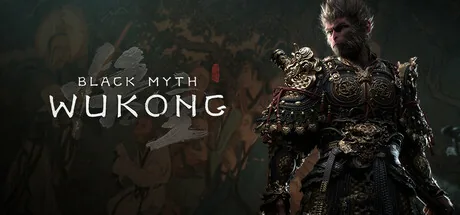
Black Myth: Wukong
8.5 / 10
- Developer
- Game Science
- Publisher
- Game Science
- Released
- 19 August 2024
- Platforms
- Windows, PlayStation 5, Xbox Series X|S
- Genre
- Action RPG
- Monetisation
- Premium, one-off purchase; Digital Deluxe Edition Upgrade and a soundtrack sold separately
- Players
- None. Black Myth: Wukong is entirely single-player, with no co-op and no PvP of any kind
The short version
Black Myth: Wukong takes the Chinese literary classic Journey to the West and turns its shapeshifting protagonist into the backbone of an action RPG's entire combat philosophy: three staff stances that change your rhythm on the fly, a spell wheel built around transformation into the very enemies you've beaten, and a boss gauntlet that is, fight for fight, as good as almost anything the genre has produced. What keeps it from the very top tier is structural rather than mechanical — chapters that are staged and lit to look like open zones are, on inspection, corridors with detours, the camera struggles against the game's biggest and fastest enemies in tight spaces, and getting a stable frame rate on PC leans harder on upscaling than a game this technically demanding should need to. It sold an enormous amount regardless, and mostly earned that.
Biggest strengths
- Three staff stances (Smash, Pillar and Thrust) genuinely change combat rhythm rather than just reskinning the same swing
- Transformations let you fight as defeated bosses and enemies with entirely different movesets, not a reskinned version of Wukong's own kit
- Boss variety and choreography are the clear headline strength, with telegraphed, readable attacks even in the game's hardest required fights
Biggest weaknesses
- Chapters are staged to look like open regions but funnel players through a fairly linear critical path with limited genuine detours
- The camera and lock-on struggle in tight interiors against the game's largest and fastest enemies, turning some fights into a fight against the frame as much as the boss
- PC performance depends heavily on DLSS or FSR upscaling to hold a stable frame rate at higher settings, even on capable hardware
Who it's for: Souls-like veterans looking for a boss-first game rather than an exploration-first one; players drawn to Chinese mythology and folklore who want a AAA production built around it rather than around it as set dressing; anyone comfortable learning a no-parry, dodge-and-punish combat system with real depth once its stance and spell systems open up.
Our recommendation: Buy it if boss design is what actually sells you on this genre — that's where the budget clearly went, and it delivers. At NZ$99.95 it's priced like the AAA release it is, and the campaign is long and dense enough to justify that on content alone. Go in expecting a much more linear game than its marketing and screenshots suggest, and budget for a PC capable of running Unreal Engine 5 well, because this is not a title that's kind to weaker hardware.
8.5 / 10
Journey to the West has been adapted, sampled and referenced in East Asian media for centuries, but Game Science's Black Myth: Wukong is the first time the 16th-century novel's mischievous, endlessly transforming Monkey King has anchored a big-budget Western-facing action RPG. You don't play Sun Wukong exactly — you play "the Destined One," a spirit sent to recover the six relics of the original Great Sage's power, wearing his memories and picking fights with the same gods, demons and monks who ended his rebellion the first time around. Released 19 August 2024 for PC and PlayStation 5, with an Xbox Series X|S version following a full year later on 20 August 2025 after Game Science said the console build needed more optimisation time, it became the fastest-selling game ever based on a work of classic literature and one of the largest Steam launches of the decade, peaking at around 2.4 million concurrent players — second only to PUBG in the platform's history, and the highest number ever recorded for a single-player game. That's not a review score, but it's not nothing either: it's the size of the audience this review is speaking to.
Three stances, one weapon
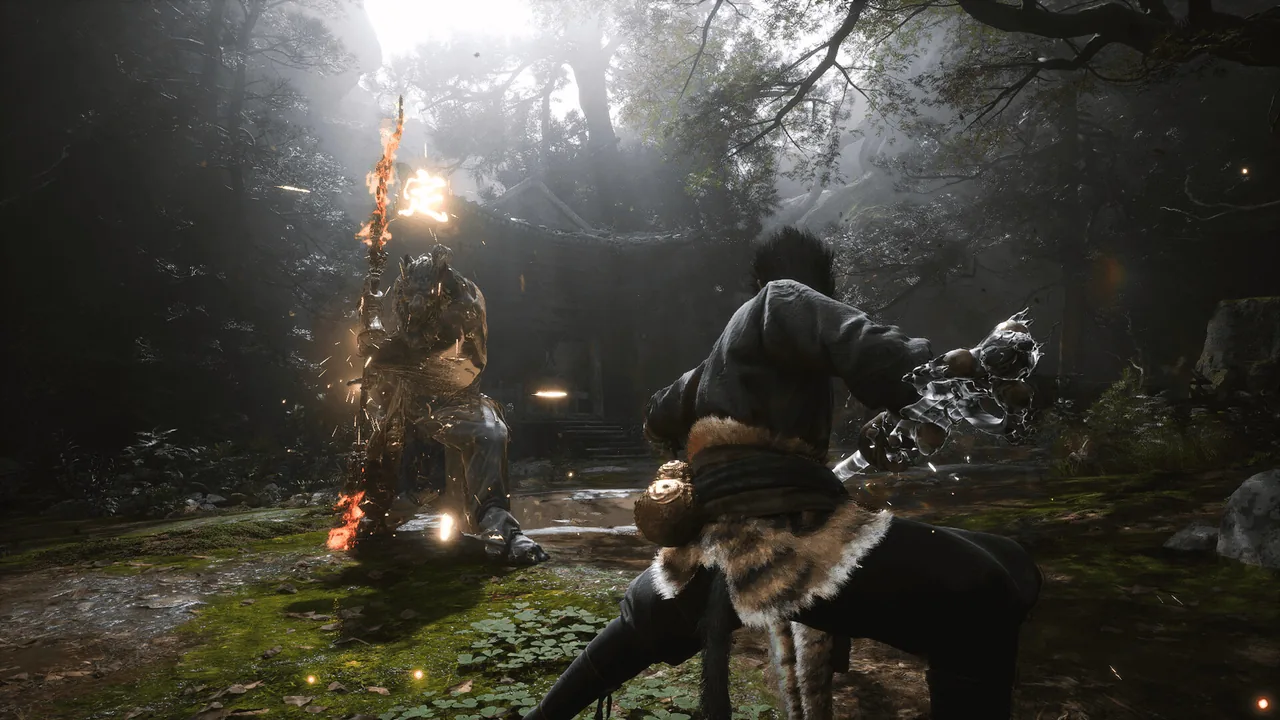
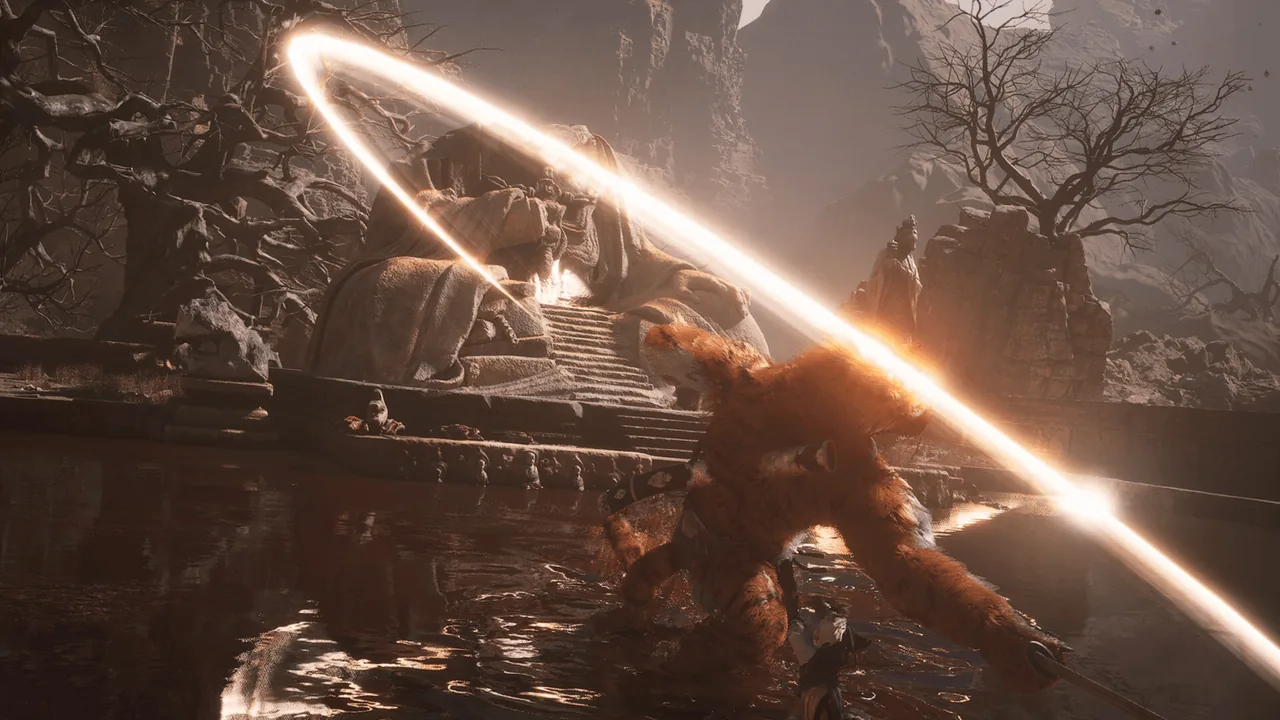
Every fight in Black Myth: Wukong runs through a single weapon type — the Iron Staff — and the game gets an enormous amount of mileage out of that restriction by giving it three switchable stances instead of a wardrobe of separate weapons. Smash Stance is the default: heavy, telegraphed swings that build stagger fast and hit hardest, at the cost of leaving you exposed mid-animation. Pillar Stance has you plant the staff and vault off it into a heavier follow-up, with a charge window that rewards patience over button-mashing. Thrust Stance is the mobile option, faster and safer but lighter on damage, built for repositioning around an enemy rather than trading blows in place. None of the three is objectively best; the game is tuned so that swapping mid-fight, based on an opponent's current animation, is the actual skill it's testing. That's a smarter use of a single weapon type than it sounds on paper, and it avoids the trap a lot of Souls-likes fall into where "build variety" just means picking one weapon class at the start and never touching the others.
Where the combat departs hardest from the Souls formula it's clearly borrowing from is defence. There's no shield, no parry in the FromSoftware sense, and blocking outright doesn't exist — dodging is the only defensive tool, timed for a brief invulnerability window that, when hit correctly, triggers "Precise Dodge" and opens a punish. It's a rawer, more aggressive combat loop than Elden Ring's stamina-and-shield toolkit, closer in spirit to Sekiro's commitment to offence, and it means the learning curve is entirely about reading attack windups rather than managing a defensive resource. Players coming in expecting a block button, several early Steam reviews confirm, lose an hour or two figuring that out before the game clicks.
Transformations and spells: the real build system
The staff and its stances are the moment-to-moment combat layer, but the actual character-building happens through four spell disciplines Wukong's Destined One collects across the campaign: Immobilize (freezing enemies in place for a free hit), Pluck-Weed (summoning a decoy clone of yourself to bait attacks), a Rock body-style defensive discipline, and — the game's signature system — Transformation. Beat certain bosses and enemy types and you earn the ability to become them for a limited duration, trading the staff and its stances entirely for a wholly different moveset: a nimble insect form that darts around a battlefield too fast to be hit, a hulking brute that trades speed for raw damage, a wolf-like form built around fast combo strings. This isn't a cosmetic transformation with the same three attacks recoloured — each form plays like its own character, with its own stamina rules and its own strengths, and the smartest players treat a transformation as a tool for a specific match-up rather than a panic button.
Between the four disciplines, each with its own small skill tree, and the main "Destined One" skill tree governing vitality, stamina, mana and stance-specific upgrades, the game gives you a meaningfully wide net of build choices for something built around a single weapon. It's the closest thing Black Myth: Wukong has to Elden Ring's Ashes of War or Lies of P's blade-and-handle assembly — just channelled through spells and transformations instead of gear swaps, which is a legitimate design choice but does leave the actual armour and equipment progression feeling thinner by comparison. You will find and equip new gear across the campaign, and stat bonuses matter, but two players who've made different spell and transformation choices will feel more different from each other than two players wearing different armour sets.
Boss design: the headline strength
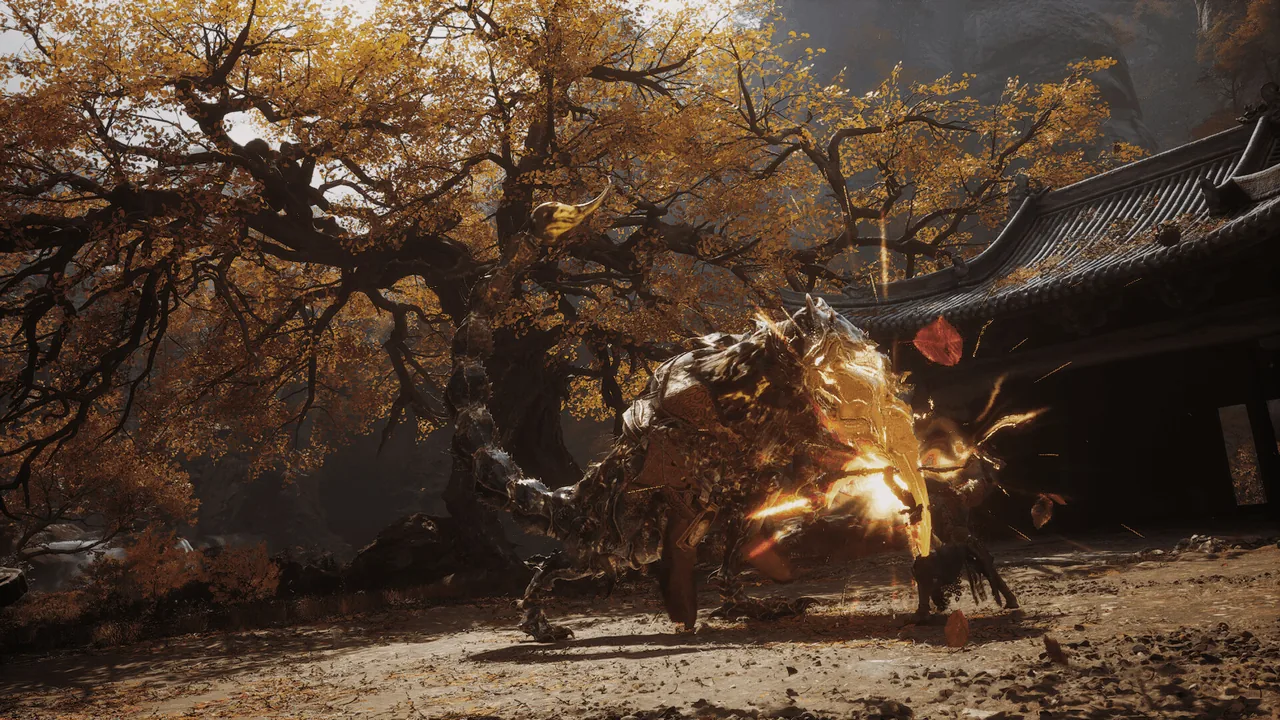
If there's one section of this review that should decide whether Black Myth: Wukong is for you, it's this one. The boss roster — well over eighty fights across the campaign once you count optional and hidden encounters — is the best thing the game does, and it's not close. Game Science drew directly from Journey to the West's episodic structure, where the source novel is essentially a long chain of Wukong and his companions meeting a new demon, spirit or fallen deity in nearly every chapter, and that structure maps almost perfectly onto a boss-first action game. The variety is real: towering multi-phase deities that reshape their entire arena, fast humanoid duelists that test stance-switching directly, grotesque, body-horror-inflected demons drawn straight from the novel's stranger passages. Attack telegraphs stay legible even in the hardest required fights, which matters more than raw difficulty — losing to a Black Myth: Wukong boss almost always feels like a mistake you can point to and fix, rather than a random spike you had to memorise blind.
The game does lean on genre-standard tricks to hit that fight count — reused enemy types reappear as mini-bosses, and a handful of late fights repeat an earlier boss with a new elemental coat of paint — but the ratio of genuinely bespoke, memorable encounters to filler is high enough that it doesn't sour the whole roster. This is the section of the game the marketing was built around, and for once the marketing wasn't oversell.
Six chapters, and how open they actually are
The one place Black Myth: Wukong's presentation gets ahead of what it actually delivers is structure. The campaign is split into six chapters, each a large, vertically detailed realm dense with side-paths, hidden shrines and optional bosses, and the environmental artistry — waterfalls, collapsing temples, mist-choked bamboo forests — is staged to suggest the kind of open, go-anywhere world Elden Ring popularised. Play it for more than an hour, though, and the shape underneath becomes clear: this is a critical path with generous detours bolted onto it, not an open world you're free to explore in any order. You will find side content worth pursuing — extra transformations, optional bosses, lore items — but you are moving through a chapter roughly the way the designers intended, region by region, rather than choosing your own order the way Elden Ring's map genuinely allows. That's not automatically a flaw; a more linear structure lets a team stage set-pieces and pace difficulty far more precisely than an open world can, and Black Myth: Wukong uses that control well in its best chapters. But it is a meaningful gap between what the screenshots promise and what the campaign actually plays like, and players expecting Elden Ring's escape-valve design — walk away from a hard boss and get strong somewhere else — will find far less room to do that here.
The Shrines that serve as this game's checkpoint-and-respawn system work exactly like the genre's bonfires: rest to heal and refill your gourd of restorative wine, and every enemy in the area respawns. Fast travel between discovered Shrines is available from early on, at least easing the backtracking that a more linear structure otherwise demands.
Wukong through Western eyes
Black Myth: Wukong's story is told mostly through cutscenes and voiced dialogue between the Destined One and the various spirits and deities he meets, layered with fully animated short films — some of the best character animation work in the game — bridging each chapter. The trouble for a lot of Western players is that none of it assumes you're coming in without Journey to the West already loaded into your head. Character motivations, the significance of a specific relic, the weight of a specific betrayal — the game gestures at these rather than explaining them, on the reasonable assumption that its home audience already knows the novel the way English-speaking audiences know the broad beats of Greek mythology or Arthurian legend. Players unfamiliar with the source material can still follow the plot's surface mechanics — get the relic, beat the boss, move on — but a real layer of what the story is doing goes past without context. That's a legitimate gap for the review to flag rather than a failure exactly; a studio isn't obligated to write a primer on its own national literature for an international audience, and doing so would likely have slowed the game's pacing. It's simply worth knowing going in that Black Myth: Wukong rewards outside reading more than it rewards playing blind.
Art direction and creature design
Visually this is one of the strongest fantasy productions of its year, and the industry agreed: Black Myth: Wukong won Golden Joystick's Ultimate Game of the Year for 2024, Best Action Game and the Players' Voice award at The Game Awards, Steam's own Game of the Year vote, and D.I.C.E.'s Outstanding Achievement in Art Direction. The strength isn't raw technical fidelity so much as specificity — temple architecture, demon anatomy and landscape design are all drawn from a genuinely different visual well than the gothic-European default most Western fantasy games reach for, and the game is confident enough in that material to let entire chapters be built around a single striking location rather than generic dungeon filler. Sound design supports it well without being the loudest part of the package: the orchestral, mythologically-inflected score has its own separate soundtrack release, and boss-fight audio cues do the same job the genre's best entries rely on, telling you what's coming before your eyes catch up.
Performance, PC and the upscaling question
Built on Unreal Engine 5 with full ray tracing support, Black Myth: Wukong is genuinely demanding, and the PC version's performance has been the least consistent part of the package since launch. Hitting a stable high frame rate at the game's best-looking settings depends heavily on DLSS or FSR upscaling rather than native rendering, even on capable modern hardware, and Unreal Engine 5's familiar shader-compilation stutter shows up when entering new areas for the first time — a known issue across most UE5 titles of this generation rather than something unique to this build, but a real one all the same. Metacritic's critic aggregate reflects the gap between platforms fairly closely: 81 on PC against 76 on PS5, with the console version drawing more specific complaints about frame pacing during the game's busiest boss fights.
The launch period also came with a genuine controversy worth naming plainly: Hero Games, a marketing partner working with Game Science, reportedly sent some content creators activation codes alongside guidance not to discuss certain topics — politics and feminism among them — in their coverage, which drew criticism from parts of the games press over pre-release review guidance attempting to shape independent coverage. It's a fair thing to know about the game's launch, and it sits alongside, rather than instead of, the game's technical and design record.
It's also worth being precise about what that enormous "Overwhelmingly Positive" Steam score is actually built from. Across all languages the game sits at roughly 97% positive from just over 1.2 million reviews — a genuinely massive sample by any standard. But that combined figure is overwhelmingly weighted by Simplified Chinese reviews, which alone account for more than 1.05 million of those 1.2 million — over 87% of the total — at close to 97% positive themselves. English-language reviews are a much smaller slice of the total, a little over 85,000, and sit lower, at roughly 94% positive, still a Very Positive rating but a noticeably different number from the headline figure. None of that makes the overall score less real or implies anything about the reviews' authenticity; it just means the widely quoted percentage reflects a playerbase that skews heavily toward one language community, and reading it as a single undifferentiated number flattens a genuinely interesting split.
Value at NZ$100
At NZ$99.95, Black Myth: Wukong is priced at the top of the premium-release bracket, and the campaign's length and production values largely justify it — this plays and looks like the AAA release its budget suggests, not a mid-tier game stretched to fit a full price tag. The Digital Deluxe Edition Upgrade, available separately for NZ$20.00, adds an exclusive weapon, a piece of equipment, a cosmetic curio and a music library pulled from the game's score; none of it is necessary to finish or enjoy the campaign, and it's honestly the kind of edition-upgrade content that's easy to skip without missing anything mechanically meaningful. A separate soundtrack release collects 67 tracks from the score for players who want the music on its own. There's no subscription, no premium currency and nothing resembling a battle pass — this is a one-off purchase in the most old-fashioned sense, and the DLC on offer is genuinely optional rather than gated content held back from the base game.
Players who like a world that keeps advancing whether or not they're actively fighting a boss in it might also enjoy Wanderer, which leans the opposite direction from this game's structure — offline progression instead of hand-authored set-pieces — but the appeal of watching numbers and characters grow over time is the same instinct either way.
Verdict
Black Myth: Wukong succeeds most clearly at the thing it was built around: a boss-first action RPG where the fights themselves, not the map between them, carry the experience, and on that measure it stands with the best of its genre. The staff-stance system gives a single weapon type real range, transformations turn beaten enemies into genuinely distinct playable tools rather than a costume change, and the art direction proves Chinese mythology can anchor a AAA production on its own terms rather than as set dressing for a more familiar fantasy skeleton. It falls short of the very top tier for structural reasons rather than a lack of polish: chapters staged to look open are considerably more linear underneath, the camera struggles in the tight spaces its biggest enemies create, PC performance leans on upscaling more than it should, and a story built for readers of its source novel offers little foothold for those coming in without it.
Eight and a half out of ten is a very good score for a game whose greatest strength — bosses — is strong enough to carry real structural and technical shortcomings elsewhere. If you're the kind of player who forgives a lot when the fights themselves are this good, Black Myth: Wukong delivers handsomely. If open-world freedom or build diversity is what you actually show up for in this genre, temper your expectations before paying full price.
Pricing checked 30 July 2026.
Pros and cons
Pros
- Three staff stances (Smash, Pillar and Thrust) genuinely change combat rhythm rather than just reskinning the same swing
- Transformations let you fight as defeated bosses and enemies with entirely different movesets, not a reskinned version of Wukong's own kit
- Boss variety and choreography are the clear headline strength, with telegraphed, readable attacks even in the game's hardest required fights
- Environmental and creature art direction translate Chinese mythological sources into some of the most distinctive fantasy visuals of 2024
- The staff's reach and stance-switching give it a different feel from typical Souls weapon categories, so the core moveset stays interesting across a long campaign
Cons
- Chapters are staged to look like open regions but funnel players through a fairly linear critical path with limited genuine detours
- The camera and lock-on struggle in tight interiors against the game's largest and fastest enemies, turning some fights into a fight against the frame as much as the boss
- PC performance depends heavily on DLSS or FSR upscaling to hold a stable frame rate at higher settings, even on capable hardware
- The story assumes real familiarity with Journey to the West's characters and events, and offers little onboarding for players coming in cold
- Gear and build variety is thin next to genre peers like Elden Ring, since stances and spells do almost all of the differentiating work instead of loadout choice
Screenshots
-
Black Myth: WukongImage: Game Science via Steam -
Black Myth: WukongImage: Game Science via Steam -
Black Myth: WukongImage: Game Science via Steam -
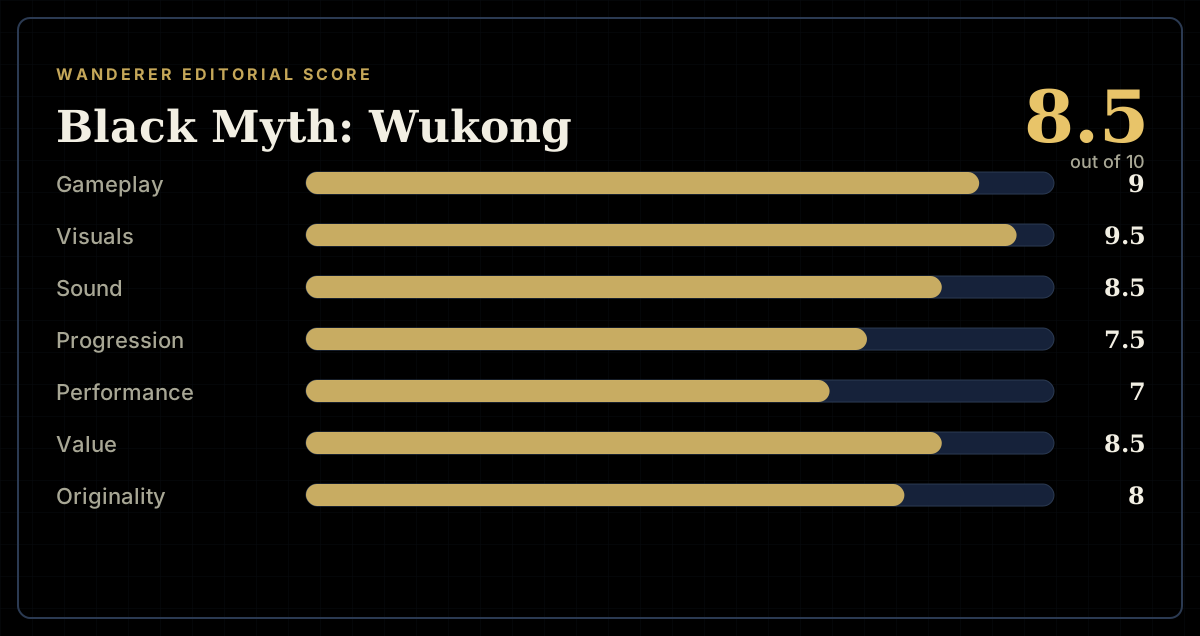
How the review scores each part of the gameWanderer Editorial -
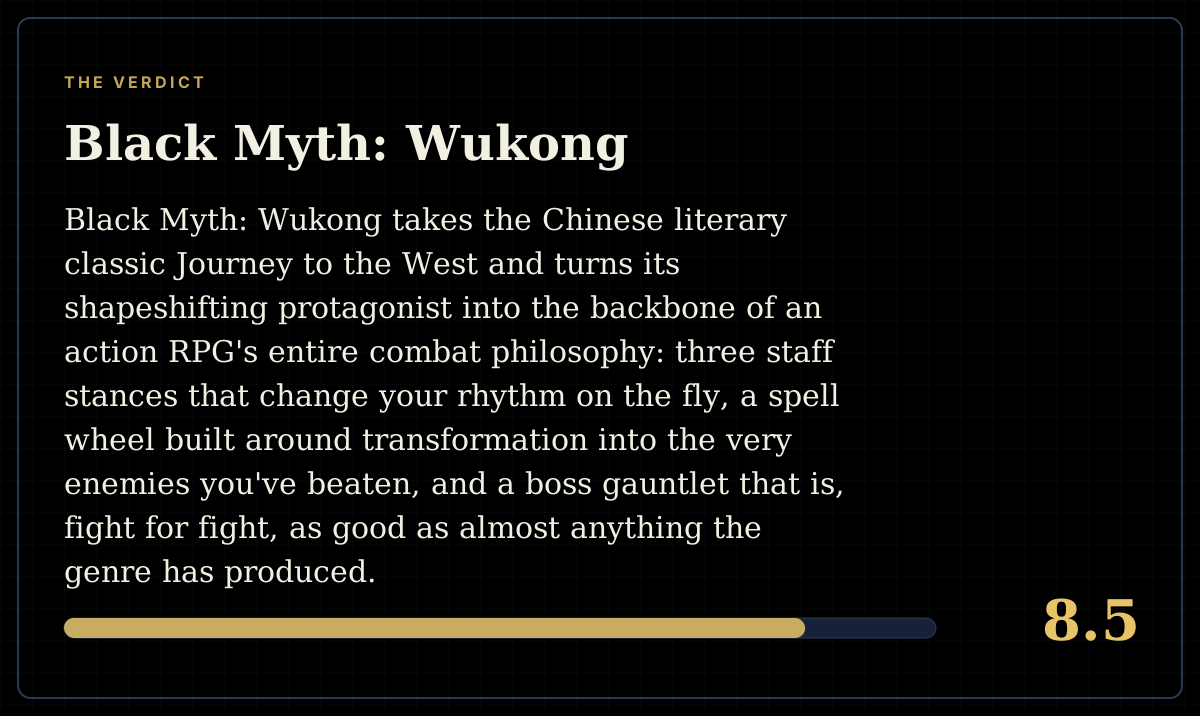
The short versionWanderer Editorial