Game review
Throne and Liberty
6.5 / 10
- Developer
- NC (NCSOFT), with FirstSpark Games
- Publisher
- Amazon Game Studios
- Released
- 1 October 2024
- Platforms
- Windows, PlayStation 5, Xbox Series X|S
- Genre
- MMORPG
- Monetisation
- Free-to-play. The shop sells Lucent (premium currency), cosmetic outfits, Morphs, Amitoi companions, server transfers and rename scrolls — NC states outright that purchasable outfits provide no player-power enhancement. A Battle Pass and a separate Leveling Pass exist each season, priced in Lucent, with a free track and a paid track running side by side. There is no subscription. Lucent itself, though, spends on the player-run Auction House, where end-game gear, Growthstones and other upgrade materials change hands for Lucent extracted from other players' grinding — so real money converts into gear progression indirectly, one market listing at a time, rather than through a direct "buy power" button. The Frozen Divide: Nix also introduced a one-time, real-money Character Boost pack (see the review body for what it grants and what it doesn't)
- Players
- Massively multiplayer with persistent open-world PvP, guild-versus-alliance Castle Sieges for control of Stonegard supporting hundreds of concurrent players, night-only open-world bosses, 6-player co-op dungeons, 12-player Guild Raids, 3v3 Arenas and a seasonal Battlegrounds mode
The short version
Throne and Liberty's weapon-swap combat and its guild sieges are genuinely the best version of those two ideas currently shipping in an MMO, and the storefront itself never sells raw stat power in a box. What it does sell is Lucent, and Lucent buys Auction House listings for the Growthstones and gear that decide who wins a siege — a laundering step, not a loophole, but one that still lets a deep enough wallet outpace a grinding one. A one-time $50 Character Boost that starts a new character near the current gear floor makes the same point from a different angle. Worth playing for the combat and the sieges; go in knowing exactly what the market is actually selling.
Biggest strengths
- Swapping between two of eight weapon types with no cooldown turns one character into dozens of viable builds instead of forcing a reroll to try a new role
- Castle Sieges genuinely support hundreds of concurrent players fighting over one persistent objective, not an instanced arena dressed up as a war
- Rain adding lightning damage and bosses that only spawn at night make weather and the day-night cycle a real tactical variable, not a graphics setting
Biggest weaknesses
- Lucent converts into Auction House purchasing power for Growthstones and finished gear, so real money still buys a faster climb even without a "buy power" button in the shop
- The Frozen Divide: Nix's Item Level overhaul reset a chunk of the previous gear ladder's relevance, and Steam's recent reviews are full of returning players describing a full season's progression going stale overnight
- A one-time $50 Character Boost that starts a new character near the current gear floor is hard to read as anything but a real-money shortcut past the early grind
Who it's for: PvP players who want a genuinely large-scale, persistent open-world war rather than an instanced arena, and who don't mind that winning it eventually means understanding a market economy as well as a rotation. A poor fit for anyone who wants MMO progression to stay purely a function of time played, or who resents an auction house sitting between "grinding" and "gear."
Our recommendation: Download it free and spend the first twenty or so hours on the weapon-swap system and the story zones before touching the shop at all — the combat holds up entirely on its own. Decide whether Castle Sieges sound like the reason you play MMOs before committing a guild's worth of evenings to catching a character up to contested-content gear levels.
6.5 / 10
NC built Throne and Liberty around a promise most MMOs only pay lip service to: that the world itself should fight back. Rain doesn't just look different, it changes what a lightning attack does. Night doesn't just darken the sky, it spawns bosses that were never there at noon. And combat isn't locked to a class you picked at character creation — it's built fresh every time you swap between two of eight weapon types, live, mid-fight, with no cooldown standing between you and a completely different role. Those systems are the best version of their ideas currently running in the genre, and the guild Castle Sieges built on top of them are the most convincing large-scale open-world PvP on the market in 2026. None of that changes what sits underneath all of it: an Auction House that turns real-money currency into gear-deciding purchasing power, and a June 2026 expansion that shipped a $50 pack to start a new character near the current gear floor. Both things are true about the same game, and a fair review has to hold onto both at once.
Weapon-swap combat: the strongest idea in the box
Throne and Liberty doesn't ask you to pick a class. It asks you to pick two weapons out of eight — sword and shield, dagger, greatsword, bow, crossbow, staff, wand, and, as of the Nix expansion, the new close-range Gauntlets — and whatever role those two weapons imply becomes your class. Sword and Shield with a Wand is a very different character from Sword and Shield with a Greatsword, and both are different again from Dagger and Bow. Nine fresh two-weapon combinations opened up when Gauntlets arrived alongside every weapon that existed before it, and the realistic build count across the full roster now comfortably runs past twenty archetypes without a single alt.
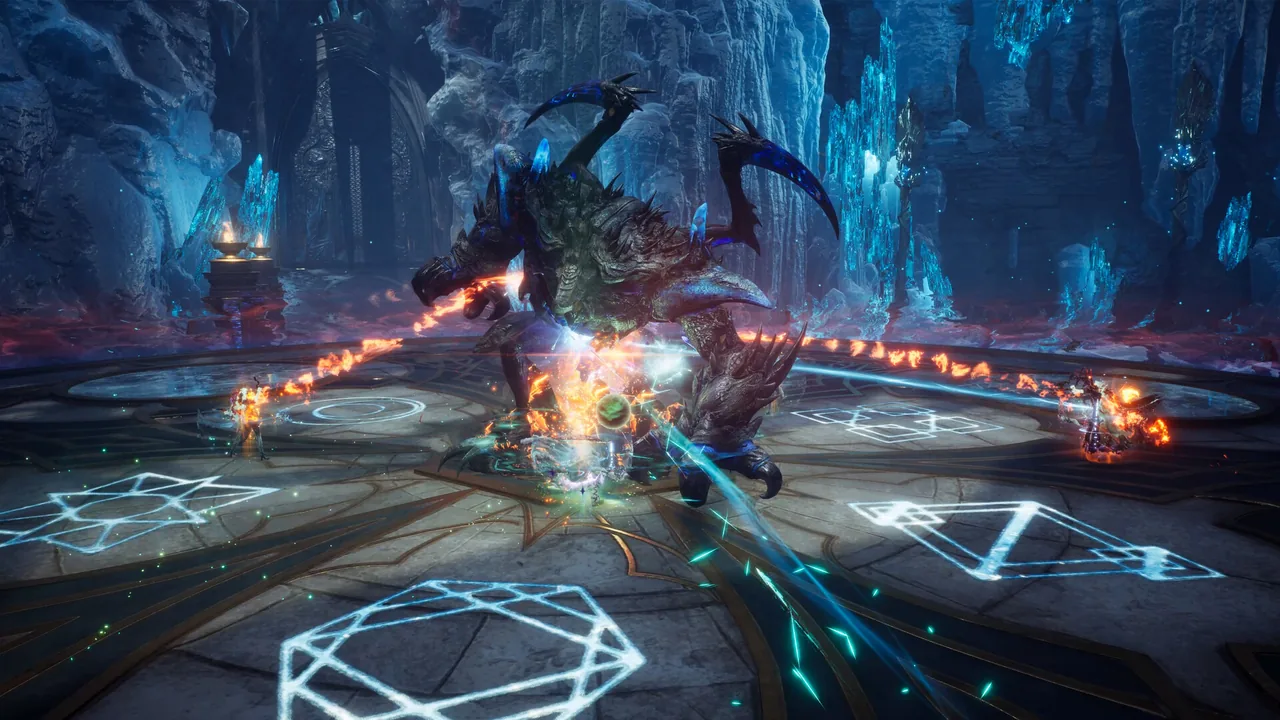
The part that actually matters in play is that there's no penalty for changing your mind. A single keybind swaps your active weapon pair mid-combat, with no cooldown and no resource cost, so a fight that starts as ranged kiting can become a melee trade the moment an opening appears. That's a genuinely different design philosophy from the rest of the genre, where trying a new playstyle usually means rolling a second character and re-levelling it from scratch. Here, the same character who tanked last night's dungeon can rebuild into a burst-damage duelist for this afternoon's Arena queue, and the only cost is learning the new combo, not grinding a new gear set from level one.
Sieges, sieges, sieges
Everything else in Throne and Liberty's endgame is, to some extent, in service of Castle Sieges, and that's the correct priority. Up to four allied guilds battle to occupy Stonegard Castle in fights that genuinely support hundreds of concurrent combatants on one contested, persistent objective — not an instanced 40-versus-40 arena with a countdown timer, but an open zone where siege weapons matter, sewers offer a sneak route that a rainstorm can ruin, and the throne itself changes hands in real time in front of everyone fighting for it. Nothing else currently shipping in the MMO space stages a fight at that scale without falling back on instancing to keep server load sane, and Throne and Liberty's willingness to let it stay messy and open is the single best argument for playing the game at all.
The day-night and weather systems that sound like ambience on a feature list turn out to be load- bearing during those fights. Rain adds lightning damage that can arc between nearby enemies, turning a clustered push into a liability; certain world bosses only spawn after dark, giving guilds a reason to organize around the clock rather than a fixed raid window; and the interplay between weather, terrain and a siege's sewer routes means the same castle plays differently depending on what the sky is doing when the gates open. It's a rare example of an environmental system that changes tactics rather than just changing the screenshot.
Progression: gear resets, weekly caps, and a ladder that keeps moving
Getting a character strong enough to matter in a siege is where the review has to slow down. Throne and Liberty's gear system runs on Growthstones, Sollant (gold), Precious Parchment and a web of Trait materials that enhance weapons and armor through a percentage-chance upgrade — fail enough times and you've burned real time for nothing beyond a small pity-adjusted bump to the next attempt. That's a familiar shape for anyone who's played a Korean-published MMO before, and on its own it isn't unusually cruel; the early tiers succeed often enough that new characters barely notice the mechanic's teeth.
June 2026's Frozen Divide: Nix expansion complicated that ladder rather than simply extending it. Alongside raising the level cap to 60 and adding Gauntlets, Nix replaced the previous gearing model with a new Item Level system and Skill Cores, and Steam's recent English-language reviews are heavy with players describing exactly what that transition felt like from the inside: reaching a comfortable PvP bracket after months of grinding, then watching an update land and turn that same gear into a starting point rather than a destination. One recent reviewer put it as plainly as the system deserves: "you feel 'yea, I've reached the upper bracket,' then an update hits and BAM — all your gear is useless." A gear reset tied to a major content drop is defensible design in the abstract — stale ceilings need raising eventually — but it lands very differently for a returning player who spent real hours, or real money, climbing a ladder that got pulled out from under them without warning that it was temporary.
Weekly and daily caps compound the same frustration from the other direction. Co-op dungeons are limited to a couple of runs a day per difficulty, the open-world Dimensional Trial opens for a thirty-minute window once a week, and 12-player Guild Raids clear once weekly per character. None of that is unusual for the genre's endgame pacing, but it does mean a motivated new or returning player cannot simply grind harder to close a gear gap — the content that grants the best materials is metered by the calendar, not by effort, which pushes the fastest remaining route to relevance toward the Auction House instead.
What the shop actually sells, and what the Auction House actually does
Here is the distinction that has to be made precisely, because NC's own public position on it is accurate as far as it goes and misleading if left there. The in-game store sells Lucent, cosmetic outfits and helms, Morphs (transformations that let a character travel as an animal across land, air or sea), Amitoi companions, and convenience items like character rename scrolls and server transfers. Amazon Games has stated outright that purchasable outfits provide no player-power enhancement of any kind, and checking the storefront confirms it: there is no line item that reads "buy a Growthstone" or "buy an upgraded sword."
The advantage doesn't live in the shop. It lives one step downstream, in the Auction House, which trades exclusively in Lucent rather than Sollant. Players who grind out rare drops, crafted gear or extracted Traits can sell them for Lucent; players who buy Lucent with a credit card can spend it on exactly the same listings. Growthstones, Precious Parchment and finished gear all move through that market, and every one of them is a real input to the enhancement ladder described above. Run the test the brief for this review insists on: what's being bought is faster access to upgrade materials and finished gear that a grinding player would otherwise have to earn directly; it absolutely affects competitive outcomes, since siege and Arena performance is gear-gated; it doesn't bypass the enhancement system's success rolls, but it does bypass the time cost of acquiring the raw materials that feed them; equivalent rewards can be earned by any player through play, so nothing is exclusively for sale — but the game meters that play through the weekly and daily caps covered above, which is exactly what makes the purchasable shortcut attractive rather than redundant. That combination — real advantage, real competitive relevance, a formally earnable but calendar-throttled alternative — is close to the textbook shape of indirect pay-to-win, even though no single purchase in the shop is labeled as power. Amazon Games' Daniel Lafuente has defended the design publicly by pointing out that Lucent is earnable through normal play, including selling drops on the Auction House itself, which is true and also the same argument every MMO with a real-money-to-gold pipeline has made for a decade.
The Nix expansion added a second, blunter data point to the same argument: a one-time Character Boost pack, priced at USD $50 (a 40% launch discount brought it to roughly $30 through 9 July 2026), that creates a brand-new level 55 character equipped with Tier 3-equivalent gear at roughly 7,200 Combat Power and an item level of 50 or higher, plus 82.5 million Sollant and a stack of upgrade tokens. It only applies at character creation and can't be retrofitted onto an existing character, which limits its use mostly to alts and returning players restarting after a long break rather than a direct boost to anyone's main. That's a meaningful limitation, and it's worth stating plainly rather than rounding it up to worse than it is. It's also, just as plainly, a real-money purchase of character power with no in-game earnable equivalent at all — nobody grinds their way to an equivalent packaged boost, because the boost is the product, not a market listing for something a free player could also accumulate. The rollout wasn't clean, either: NC had to patch in missing progression items retroactively for players who'd already bought the pack after community feedback flagged the omission, which at minimum suggests the team shipped it faster than it tested it.
Trade, sociability, and the alt problem this creates
The upside of routing so much progression through a single Auction House is that Throne and Liberty's economy is legible in a way plenty of MMOs never manage — one marketplace, one currency, visible prices, no server-hopping required to find a buyer. The downside is that it makes the whole game read as a spreadsheet the moment you start optimizing for siege relevance, and it means the weapon-swap flexibility praised earlier only gets you so far: trying a genuinely different build often still means re-earning a second full set of gear for a second weapon combination, on the same character, on the same capped weekly schedule. The freedom not to reroll a class is real; the freedom to gear a second build for free is much less real.
Presentation and the parts that haven't caught up
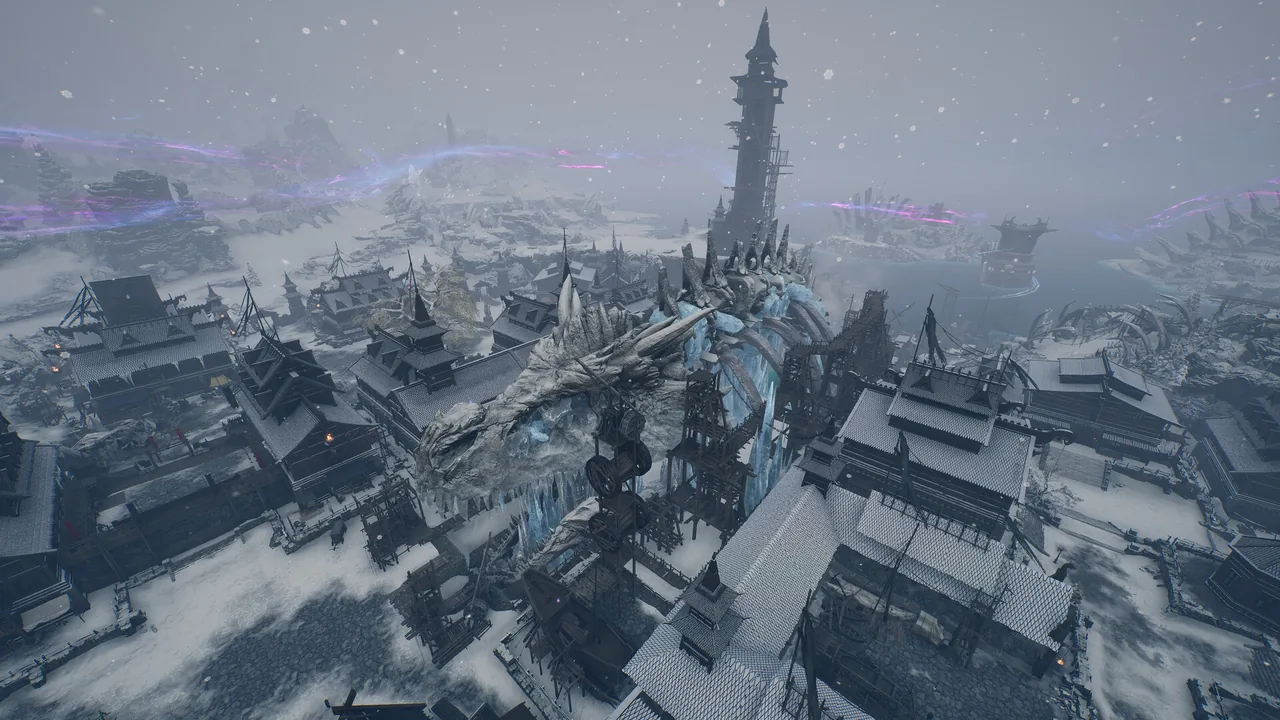
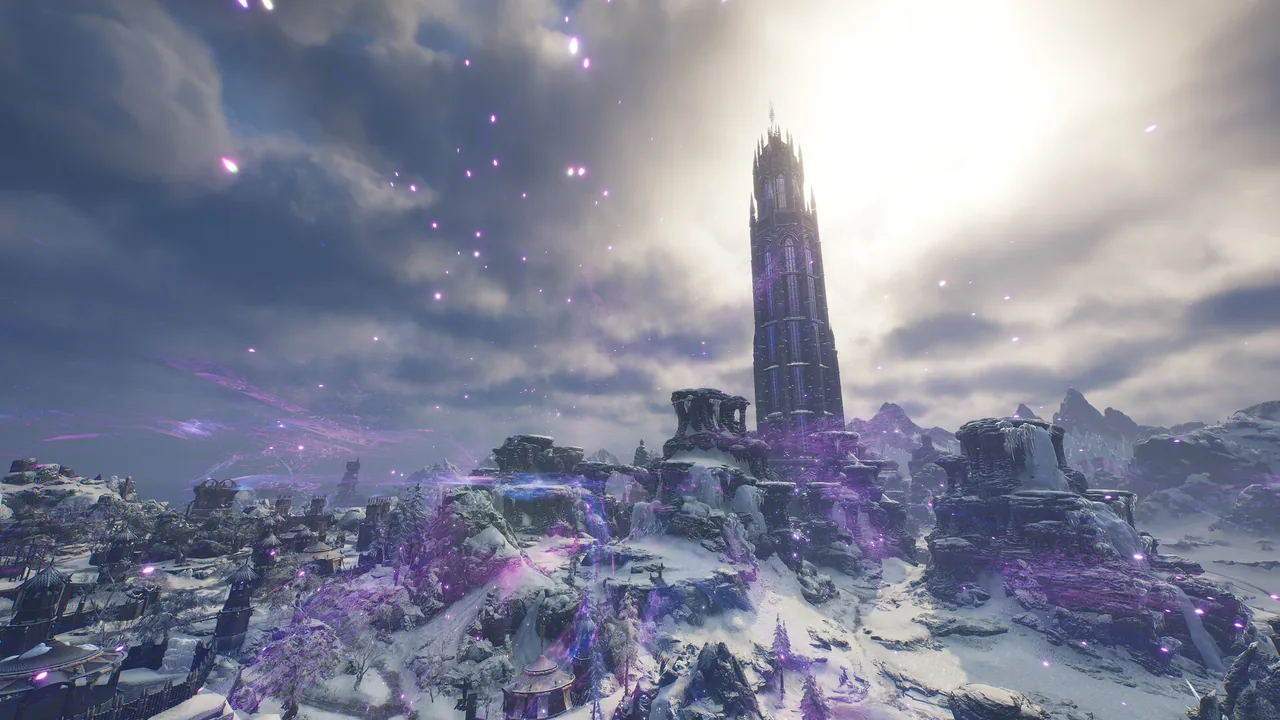
Visually, Nix's frozen tundra is a legitimate step up from Solisium's earlier zones, and the engine handles hundreds of players clashing in a siege without falling over, which is no small technical feat given how many MMOs still fudge that number with instancing. Where the presentation lags is the writing: quest structure is still built on old-fashioned go-here-kill-that-report-back chains that the combat and siege systems have clearly outgrown, and more than one recent review calls the main story forgettable next to the systems wrapped around it. The interface itself is dense — multiple currencies, multiple codex systems layered on top of each other since launch, and a Trait/enhancement screen that assumes you've already read a build guide before you open it. None of that is disqualifying on its own, but it adds friction on top of a progression system that already asks a lot of a new player's patience.
Verdict
Throne and Liberty gets the two hardest things in modern MMO design right: combat flexible enough that one character can be several classes, and a siege format ambitious enough to let hundreds of players fight over one real objective instead of an instanced facsimile of one. Those are not small achievements, and they're reason enough for a PvP-minded player to install this for free and see whether the weapon-swap system clicks. What keeps the score from climbing higher is everything downstream of that combat: an Auction House that launders real money into gear-deciding purchasing power while the storefront insists it sells only cosmetics, a June 2026 expansion that reset a season's worth of gear relevance overnight, and a $50 pack that starts a fresh character near the current power floor with no earnable equivalent anywhere in the game. None of it is hidden, and NC hasn't lied about what the shop sells — but the honest accounting of what money buys in this game has to include the Auction House and the Character Boost, not just the cash shop's own item list, and once you include them, "pay-to-win" is a defensible label rather than an overreaction. 6.5 out of 10 reflects a genuinely excellent combat and siege system carrying a progression economy that asks a serious wallet, or a serious weekly schedule, to keep up with either.
Players who want the payoff of contested guild warfare without an auction house standing between grinding and gearing might also want to look at how Wanderer handles equipment progression — a much smaller game, but one where nothing you've earned can be undercut by someone else's credit card.
Pricing, Steam review figures and patch details checked 30 July 2026.
Pros and cons
Pros
- Swapping between two of eight weapon types with no cooldown turns one character into dozens of viable builds instead of forcing a reroll to try a new role
- Castle Sieges genuinely support hundreds of concurrent players fighting over one persistent objective, not an instanced arena dressed up as a war
- Rain adding lightning damage and bosses that only spawn at night make weather and the day-night cycle a real tactical variable, not a graphics setting
- The cash shop itself sticks to cosmetics, Morphs, Amitoi and passes, and NC is correct that none of it is a direct stat purchase
- Night-only open-world bosses and weekly Guild Raids give a guild recurring reasons to log in together beyond the siege calendar
Cons
- Lucent converts into Auction House purchasing power for Growthstones and finished gear, so real money still buys a faster climb even without a "buy power" button in the shop
- The Frozen Divide: Nix's Item Level overhaul reset a chunk of the previous gear ladder's relevance, and Steam's recent reviews are full of returning players describing a full season's progression going stale overnight
- A one-time $50 Character Boost that starts a new character near the current gear floor is hard to read as anything but a real-money shortcut past the early grind
- Multiple time-gated currencies and weekly-capped activities (co-op dungeon lockouts, one 30-minute open-world dungeon window, one weekly 12-player raid) mean a returning or new player cannot simply grind harder to catch up faster
- Story questing runs on old-fashioned MMO fetch-and-report structure that the fluid combat and ambitious sieges have clearly outgrown
Screenshots
-
Throne and LibertyImage: Amazon Game Studios via Steam -
Throne and LibertyImage: Amazon Game Studios via Steam -
Throne and LibertyImage: Amazon Game Studios via Steam -
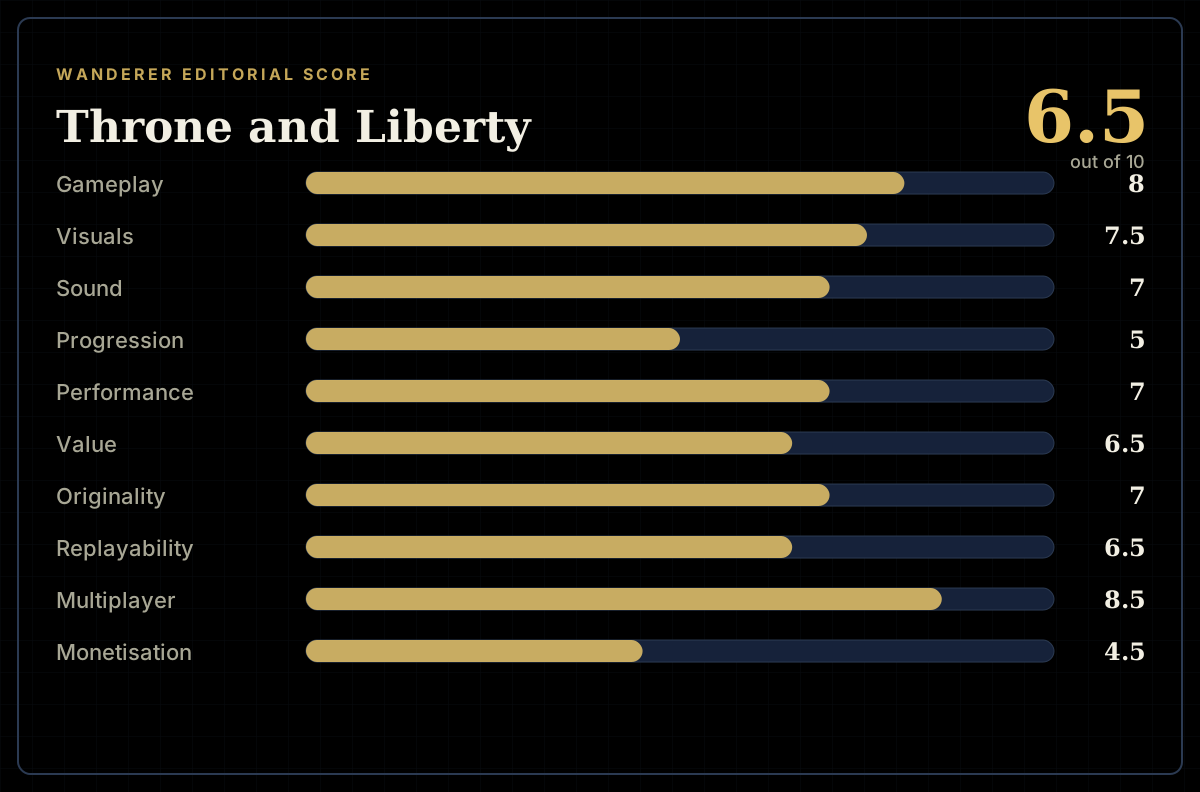
How the review scores each part of the gameWanderer Editorial -
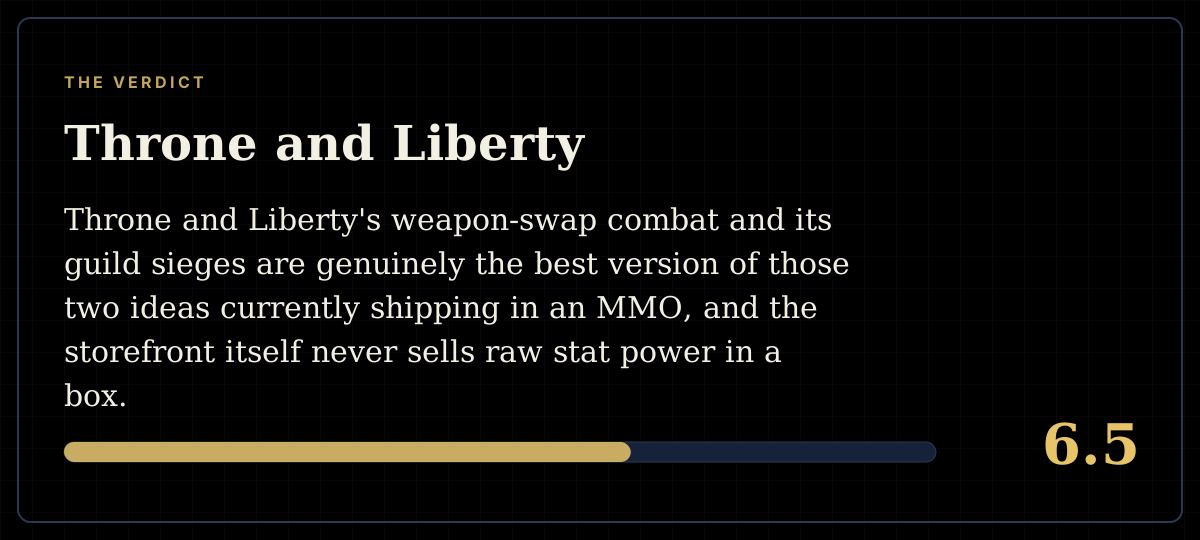
The short versionWanderer Editorial