
Game review
MapleStory
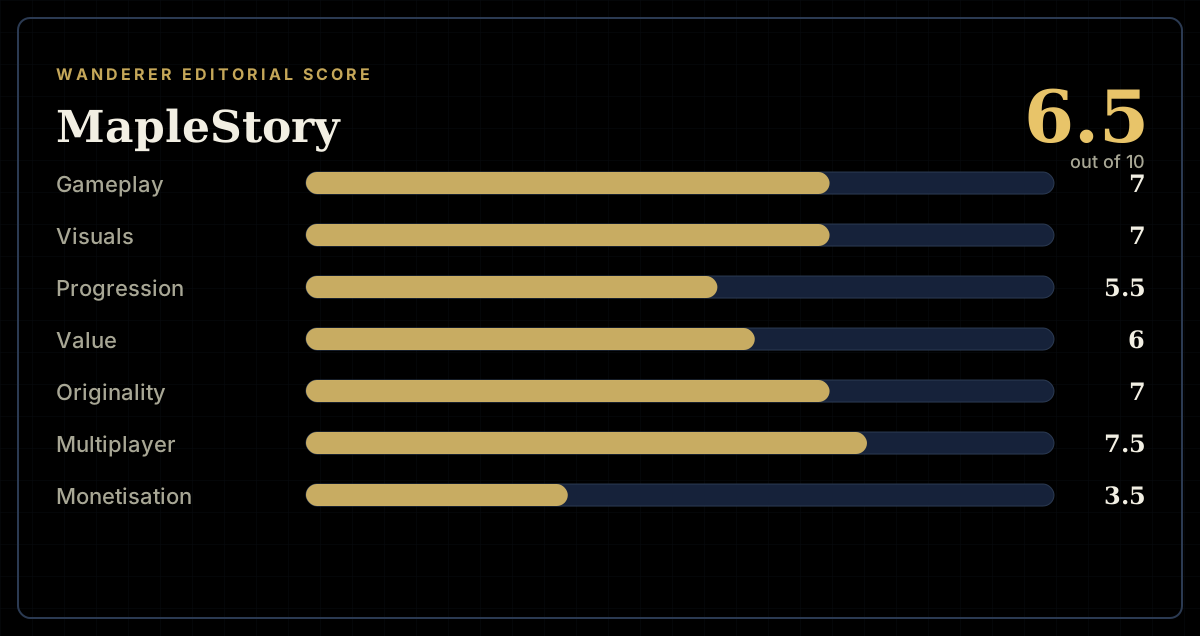
6.5 / 10
- Developer
- NEXON Korea Corporation
- Publisher
- Nexon America Inc.
- Released
- 29 April 2003
- Platforms
- Windows, macOS
- Genre
- MMORPG
- Monetisation
- Free-to-play with an NX Cash shop selling cosmetics, storage, quality-of-life items and randomised gear-enhancement consumables (Cubes); Regular servers let real money accelerate gear power through those consumables and a player-driven trade economy, while the separate Reboot servers ban all player trading and cash-shop power items outright, funding progression entirely through boosted meso and drop rates instead
- Players
- Massively multiplayer with parties, guilds, a player-run trade economy on Regular servers, and a separate trade-free Reboot server line
The short version
MapleStory earns its status as one of the genre's genuine originals: forty-plus classes, two decades of accumulated zones and bosses, and a side-scrolling combat feel nothing else in the MMO space quite replicates. None of that changes what sits underneath its progression curve — a Star Force and Cube enhancement system built on randomised outcomes serious enough that South Korea's own competition regulator fined Nexon for quietly manipulating the odds.
Reboot servers are the honest answer to that problem, trading a faster wallet for a longer grind and nothing else. Regular servers are the game most of its history and its cash shop was built around, and that's the version this review has to grade on its own terms.
Biggest strengths
- Reboot servers genuinely remove pay-to-win pressure by banning trading and cash-shop power items outright, funding progression through boosted meso and drop rates instead
- Over forty explorer and non-explorer classes each carry a distinct skill kit and playstyle, so trying a new job is a real change of pace rather than a reskinned rotation
- Free-to-play access covers the overwhelming majority of the story, zones, classes and bosses with no subscription wall anywhere in the game
Biggest weaknesses
- Regular-server progression past the midgame runs through Star Force and Cube enhancement, randomised systems severe enough that South Korea's Fair Trade Commission fined Nexon over undisclosed odds manipulation
- A single failed high-tier Star Force attempt can destroy the equipment being enhanced, converting real hours or real money into nothing with only a small consolation toward the next try
- The interface and underlying engine still show their mid-2000s origins even after repeated visual and UI passes
Who it's for: Nostalgic returning players and anyone drawn to a huge, class-diverse 2D MMO who is willing to either grind meso on Reboot or budget seriously for cube and Star Force gambling on a Regular server. A poor fit for anyone who wants gear progression to feel like a guaranteed reward for time spent rather than a dice roll against inflating odds.
Our recommendation: Start on a Reboot world. It is free, it removes the cash shop's worst incentives entirely, and it is the version of MapleStory that lets a new or returning player judge the class design and world on its own merits before any spending decision enters the picture.
6.5 / 10
MapleStory has been running long enough to outlive most of the genre twice over. Wizet, a small Seoul studio founded in 2001, shipped it in Korea on 29 April 2003; Nexon acquired Wizet the following year and has run the game ever since, bringing it to North America on 11 May 2005. Twenty-three years later it's still free, still built on the same 2D side-scrolling foundation, and still adding classes, zones and bosses. It's also still selling randomised gear-enhancement consumables severe enough that South Korea's competition regulator fined Nexon over how they were priced and disclosed — a fact that belongs in the same paragraph as the nostalgia, not a footnote after it.
Before any of that, a word on which MapleStory this actually is, because the family tree is a minefield. This review covers the original PC client, sometimes called MapleStory Global or GMS — not MapleStory M, the separate mobile game with its own client and progression systems; not MapleStory 2, the 3D voxel spin-off that Nexon launched globally in 2018 and shut down completely in May 2020; not MapleStory Worlds, a 2024-launched user-generated-content platform built on MapleStory's assets that plays more like a Roblox competitor than an MMO; and not MapleStory N, an announced blockchain and NFT project layered onto the IP. Four different products share a name and, in places, art assets. Only one of them is the twenty-three-year-old MMORPG this review is actually about.
Forty classes, one long side-scroller
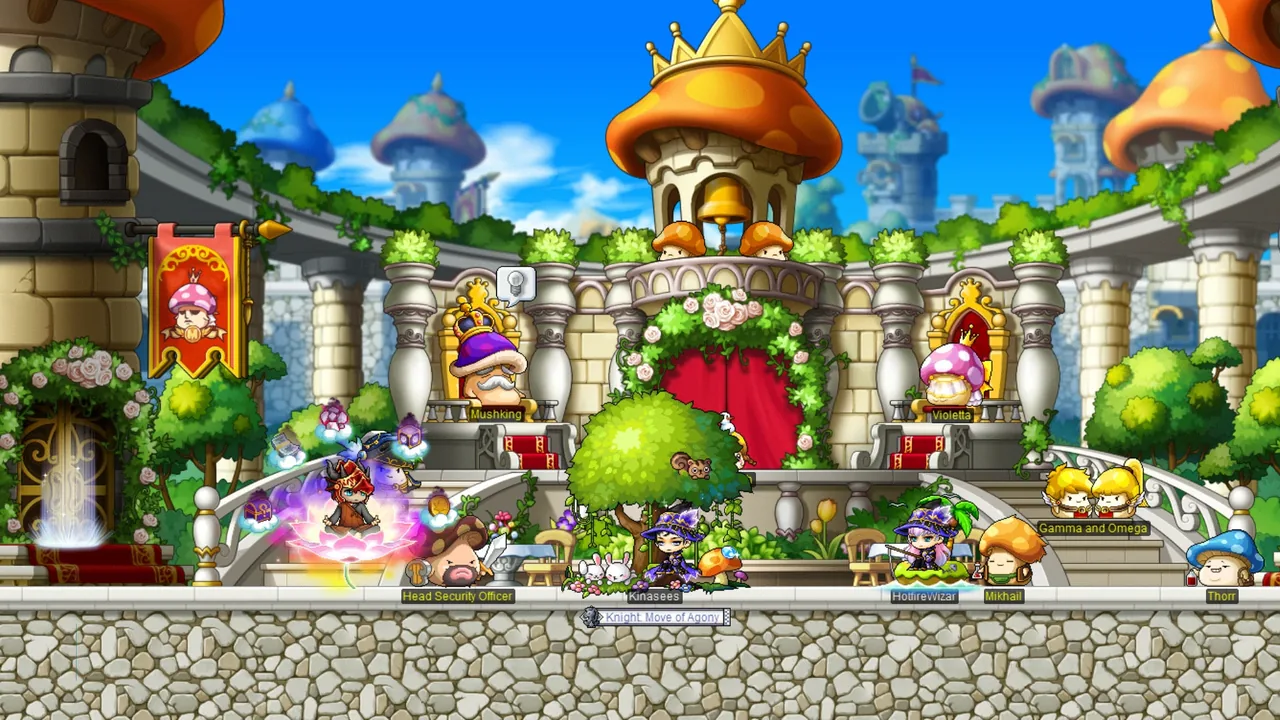
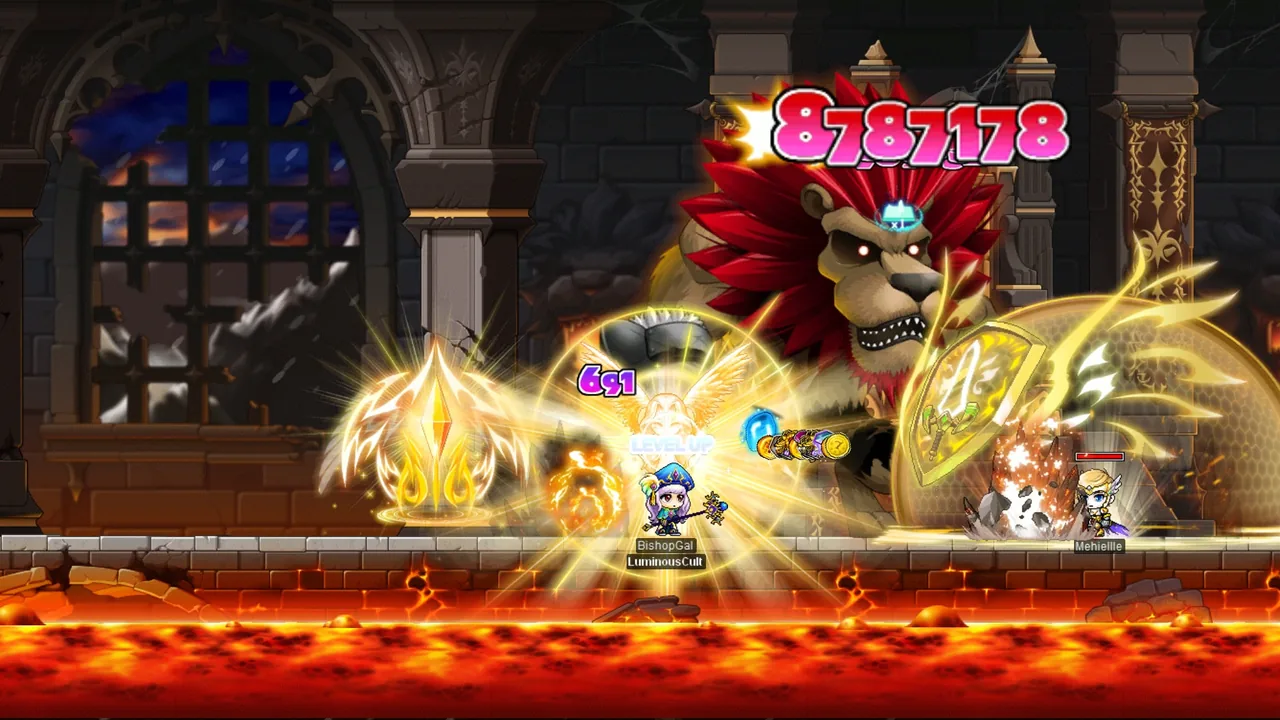
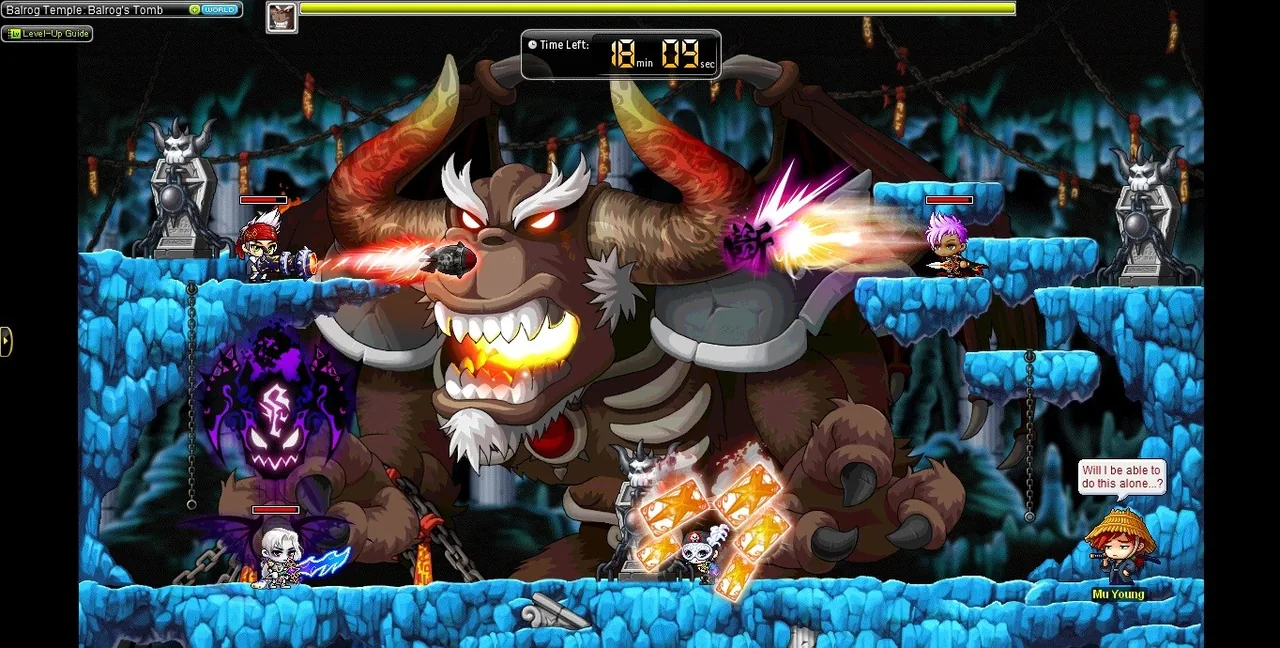
Strip away everything else and MapleStory is still a 2D platformer wearing an MMO's clothes. Characters jump, double-jump, climb ropes and swing skills across side-scrolling maps rather than navigating open 3D terrain, and that structural choice is still the single thing that makes this game feel different from almost anything else in the genre. Combat reads more like an action platformer than a tab-target MMO, and it has aged into something closer to a niche strength than a technical limitation — nothing else at this scale plays quite like it.
What's grown around that foundation over two decades is genuinely large. Explorer classes — the original Warriors, Magicians, Bowmen, Thieves and Pirates — sit alongside dozens of non-Explorer classes added over the years, each with a distinct resource system, skill progression and often a unique starting story. Picking a new class rarely feels like reskinning an existing rotation; skill kits, animation timing and even core movement options can differ enough between classes that switching one out for another is a genuine change of pace rather than a cosmetic swap. For a player who enjoys collecting characters as much as levelling one to the cap, that variety is close to unmatched in the genre.
Two servers, two different games
This is the fact a review of MapleStory cannot skip past, because it changes almost everything else in this article depending on which one applies. Regular servers are the original, continuous version of the game: full player trading, a Free Market and Auction House, and a cash shop where NX Cash — bought at roughly 1,000 units per dollar or local-currency equivalent — buys cosmetics, storage, quality-of-life conveniences, and Cubes and Star Force catalysts that accelerate the gear-enhancement grind described below. Money spent here can be converted, directly or through the player economy, into faster gear progression.
Reboot servers, introduced in 2018, are Nexon's answer to the obvious problem with that model. Reboot bans player trading entirely — no direct trades, no Free Market, no Auction House, no Meso Market — and strips the cash shop of every item that would buy power outright. In exchange, monsters drop meso and items at a heavily boosted rate, and the handful of enhancement consumables that would normally come from the cash shop are instead sold from in-game vendors for meso earned through play. The result is a genuinely self-funded economy: a Reboot character's gear comes entirely from that character's own farming, at a slower pace than a well-funded Regular-server spender but with no purchase able to skip the line. Judging "MapleStory's monetisation" without naming which of these two games is under discussion is close to meaningless — they are the same content running on two entirely different economic rule sets.
The Cube affair
The system both server types are built around is Cube enhancement, and it's the reason this review can't treat MapleStory's monetisation as an abstract genre complaint. Cubes reroll the random secondary stats — called Potential — on a piece of equipment, and since their 2010 introduction they've been one of the most consistently purchased items in the cash shop, because better Potential lines are close to mandatory for competitive endgame gear.
South Korea's Fair Trade Commission found that after Cubes launched with even odds across their possible outcomes, Nexon altered those odds later the same year so that the options players actually wanted appeared less often — in some cases, the regulator said, with functionally zero chance of certain desirable results — without disclosing the change. The KFTC fined Nexon 11.642 billion won (reported at the time as roughly US$8.9 million), describing it as the largest penalty ever issued under Korea's e-commerce consumer protection law and noting this was Nexon's second offense of this kind, following an earlier case involving a different game. Nexon has contested the fine through the Korean courts. Whatever the final legal outcome, the finding itself is a matter of public record from a national regulator, not a community rumour, and it belongs in any honest account of what buying a Cube in this game actually is: a purchase whose odds a regulator has already found reason to distrust once.
Star Force: the grind wearing a UI
Cubes reroll what a piece of gear can do; Star Force decides how strong it is. Enhancing an item through Star Force raises its stats incrementally, and the success chance for each attempt falls as the star count climbs — cheap and reliable at low tiers, expensive and genuinely risky at the tiers current endgame content actually calls for. A failed attempt at higher tiers doesn't just waste the meso and materials spent on it; past certain thresholds a failure can destroy the equipment outright, turning what might represent real hours of farming, or real money converted into farming shortcuts, into nothing beyond a small boost to the next attempt's odds. Nexon has periodically run events supplying free enhancement catalysts and safety nets to soften this, and 2026's event calendar has leaned harder on giving away Black Cubes and White Additional Cubes than in past years — a tacit admission that the base system, left alone, asks too much. It's a better system than it was several years ago. It is still, at its core, a gambling mechanic sitting between a player and the gear that content is balanced around.
What's actually free
None of the above erases how much of MapleStory a player can reach without spending anything. The core Explorer and non-Explorer classes, the overwhelming majority of story content, the leveling path through dozens of zones, and access to both Regular and Reboot worlds cost nothing beyond the download. Reboot in particular is a complete, functioning answer to "can I play this without paying" — its entire design is built around the assumption that the player won't. What isn't free, on Regular servers specifically, is competitive endgame gear on a fast timeline; Cubes and premium Star Force catalysts are priced to be bought repeatedly, and a Regular-server player chasing top Potential lines and high Star Force on multiple equipment slots can spend real, non-trivial money without ever reaching a hard ceiling where the game says "that's enough." Nothing in the endgame is strictly unobtainable free — Reboot proves that on its own — but "obtainable free" and "obtainable free on a reasonable timeline while also playing Regular servers" are very different promises, and MapleStory's cash shop is built around blurring the difference between them.
Steam is the side door, not the front door
It's worth being precise about what Steam data can and can't say about this game, because the numbers look strange until that's explained. MapleStory's Steam page lists a release date of 9 August 2012 — the date Nexon added a Steam listing, seven years after the game actually launched in North America, not a meaningful release milestone. Steam review volume is similarly a poor proxy for the game's real size: total review count sits at roughly 15,300 across all languages, tiny next to Nexon's own marketing claim of over 260 million registered accounts worldwide, because the overwhelming majority of MapleStory's playerbase installs through Nexon's own launcher rather than Steam. The aggregate score — Mixed, 61.3% positive, checked 2 August 2026 — is real, but current player feedback specifically (rather than the archived cluster of largely 2017-dated negative reviews still sitting in the corpus) tracks closely with everything above: complaints about Star Force costs, weekly maintenance windows, server instability and the difficulty of returning after a long break dominate the reviews posted in the last few weeks, alongside genuinely enthusiastic long-time players logging thousands of hours and defending the class variety and community. Read only the old reviews and the picture looks dated; read only this month's and the picture is current and still mixed for reasons that have nothing to do with Steam's small sample size.
Where Nexon is spending its attention now
The clearest signal about where this game's developers think its future lies isn't a patch note, it's a beta test. MapleStory Classic World — a pre-Big Bang server recreating the original 2003–4 Victoria Island and Ossyria experience, level-capped at 50 with only the four founding Explorer archetypes — ran its second closed test from 4 to 12 August 2026, following an initial test that drew roughly 5,000 players in April. Building and testing a deliberately smaller, deliberately less mechanically bloated version of the game most of this review has been describing is a real acknowledgment that a large part of MapleStory's current audience wants less system, not more — fewer Star Force tiers, fewer Cube outcomes, fewer competing currencies. Whether Classic World ships as a permanent option or stays a nostalgia experiment, it's a more honest response to twenty years of accumulated complexity than another round of enhancement events layered onto the existing server structure.
Verdict
MapleStory is a genuine pioneer that has kept enough of its original identity to still be worth recommending, and it is also a live case study in exactly the enhancement-gambling problem that makes progression-focused MMOs hard to trust with real money. Both statements are true of the same game running on two different server types, and pretending otherwise would flatter one side or condemn the other unfairly. Reboot is the honest way to experience the class variety, the world and twenty-three years of accumulated content without touching the part of this review that scores lowest; Regular servers are the version most of the game's history, cash shop design and — per Korea's own regulator — some of its past business decisions were actually built around. Six and a half out of ten reflects a game whose bones are still genuinely good and whose business model has been formally found wanting at least once, with nothing in 2026's roadmap suggesting that second half of the story is finished.
Readers who like the sound of long, class-diverse MMO progression but want to see exactly what gear-enhancement gambling costs before touching it might also want to read Wanderer's coverage of Lost Ark and Black Desert Online, two other MMOs built around RNG-driven equipment upgrades, or Old School RuneScape for a skill-grind MMO that has deliberately kept gear progression away from a cash shop entirely. Anyone who likes the idea of a long climb without a Cube sitting at the top of it might also enjoy how Wanderer handles gear — a much smaller game, built without an enhancement gamble in its equipment system at all.
Pros and cons
Pros
- Reboot servers genuinely remove pay-to-win pressure by banning trading and cash-shop power items outright, funding progression through boosted meso and drop rates instead
- Over forty explorer and non-explorer classes each carry a distinct skill kit and playstyle, so trying a new job is a real change of pace rather than a reskinned rotation
- Free-to-play access covers the overwhelming majority of the story, zones, classes and bosses with no subscription wall anywhere in the game
- Twenty-three years of accumulated content gives a committed player years of bosses, events and side systems to work through
- An August 2026 Classic World closed beta shows Nexon is still willing to build something other than another cash shop tier for this game
Cons
- Regular-server progression past the midgame runs through Star Force and Cube enhancement, randomised systems severe enough that South Korea's Fair Trade Commission fined Nexon over undisclosed odds manipulation
- A single failed high-tier Star Force attempt can destroy the equipment being enhanced, converting real hours or real money into nothing with only a small consolation toward the next try
- The interface and underlying engine still show their mid-2000s origins even after repeated visual and UI passes
- Server stability and lengthy weekly maintenance windows are a live, current complaint in player feedback, not just a legacy grievance from years ago
- Steam is a minor side door into a much bigger game most veterans play through Nexon's own launcher, so its small, mixed review score neither fairly represents nor fully explains the wider game
Screenshots
-
MapleStoryImage: Nexon America Inc. via Steam -
MapleStoryImage: Nexon America Inc. via Steam -
MapleStoryImage: Nexon America Inc. via Steam -
How the review scores each part of the gameWanderer Editorial -
The short versionWanderer Editorial