Game review
Idle Hero TD - Tower Defense RPG
6.5 / 10
- Developer
- Swell Games LLC
- Publisher
- Swell Games LLC
- Released
- 3 May 2024
- Platforms
- Windows, macOS, iOS, Android
- Genre
- Idle Tower Defense RPG
- Monetisation
- Free to play with in-app purchases, a recurring battle pass and multiple "one-time" upgrade tiers that repeat at higher prices
- Players
- Asynchronous PvP tournaments and leaderboards; no direct co-op or real-time multiplayer
The short version
Idle Hero TD is a tower-defense idler where a squad of fantasy heroes holds a lane against endless monster waves while you decide who stands where, what they synergise with, and how hard to lean on auto-battle. It has been in Early Access since 3 May 2024, sits at Very Positive across 1,258 Steam reviews (83% positive, 75% of the last 30 days), and its own achievement data backs up what players say: about a third of players unlock the first tier of the game's mid-game systems, and fewer than one in fifty reach the "supreme" endgame bosses.
The English negative sample is short -- seven reviews out of 213 negatives, most feedback clearly living outside English-language Steam -- but it converges hard on one thing: monetisation. Reviewers who have put in hundreds and even thousands of hours still call it "a money pit" where supposedly "one-time" purchases repeat at each new tier, and where a battle pass, direct IAP and premium currency all compete for the same wallet. A minority flag rough PC performance and a handful of AI-generated promotional images, though neither is a majority complaint.
Biggest strengths
- Genuine cross-play between Steam, iOS and Android keeps one save current everywhere, which reviewers repeatedly call out as the reason they stuck around
- Hero placement and synergy discovery give the tower-defense layer real decisions instead of being pure spectacle, and stay relevant well past the early game
- Weekly content updates and a developer who reviewers describe as transparent and responsive keep the Early Access label from feeling like an excuse to stall
Biggest weaknesses
- Multiple "one-time" purchase tiers that repeat at every rank, on top of a battle pass and direct IAP, is the single most common complaint from players who otherwise like the game
- A design choice to reward live, connected play over offline idling cuts against the genre's core promise for players who wanted to walk away and come back later
- PC performance reports include a game pinning a GPU at 100% for what is, at its core, a simple idle-battler
Who it's for: Idle and incremental fans who want a tower-defense chassis instead of another clicker, especially anyone who plays across both a phone and a PC and wants their progress to follow them. Not for anyone who wants a premium, one-price idle game free of upgrade-tier monetisation.
Our recommendation: Worth trying for free given the genuinely generous cross-play and automation systems, but budget nothing for it until you have played long enough to see how the "one-time" upgrade tiers actually work -- that is where most of the goodwill in the review section runs out.
6.5 / 10
The pitch: tower defense that never stops running
Idle Hero TD sits at the intersection of two genres Wanderer's readers already know well: idle progression and tower defense. You recruit heroes, place them along a lane, and let them auto-battle an endless stream of monster waves. Where a pure clicker asks you to keep tapping and a pure idler asks you to walk away, Idle Hero TD asks for something in between: set up your formation, pick your synergies, and check back in to reposition, rank up and spend whatever resources have piled up. It has been free to play in Early Access on Steam since 3 May 2024 -- the store page's own "Early Access Release Date" field confirms that date, and as of this review it has not exited to a 1.0 release. It arrived on Steam roughly a year after its mobile debut on iOS and Android, where the developer, Swell Games LLC, says the game has passed a million players.
That cross-play history matters more than it might first appear. Reviewers on Steam consistently cite it as the reason they stayed: start a run on the train, keep managing it on a desktop monitor at home, and never lose progress switching between them. "Bonus that you can play on mobile as well as steam meaning you don't lose progress while you are away with work/holiday," reads one representative review with nearly 700 hours logged. That is a real, concrete piece of design generosity that a lot of idle games -- including some of the genre's biggest names -- still don't offer cleanly.
The loop: synergy over spectacle
The 45-achievement list doubles as a surprisingly honest map of the game's structure, and it is worth reading as evidence rather than just a checklist. Early milestones cluster around discovering hero synergies (34.2% of players), unlocking new heroes (30.2%) and clearing the first wave tier (28.8%) -- normal onboarding numbers for a free idle game. What is more interesting is the shape of the drop-off after that: each subsequent tier loses roughly a third to a half of the previous tier's players, all the way down to sub-2% completion on the "supreme" boss achievements. There is no single wall where the game visibly turns hostile; instead there is a long, gradual thinning that matches what a healthy idle-progression curve is supposed to look like, even if it also means the genuinely deep late-game systems -- automation research, PvP tournaments, "mimic" and "golden boss" hunts -- are seen by only the most committed sliver of the player base.
Where the game distinguishes itself from a straight clicker is that positioning and synergy actually matter throughout, not just in a tutorial. Heroes have overlapping skill sets that reward specific formations, and the store page's claim that "none of them ever become obsolete" holds up against the achievement data: rank-up achievements for early heroes exist at every tier, meaning the systems keep giving reasons to revisit choices made hours earlier rather than obsoleting them the moment a shinier hero unlocks.
Where it strains: monetisation, not mechanics
The seven available English-language negative reviews are not a large sample against 213 total negatives -- most of the game's dissatisfied players are clearly writing in other languages -- but what is there is consistent, and it echoes complaints buried inside otherwise positive reviews too. The recurring shape of the criticism is not "the game is bad," it's "the game asks for money too often, in ways that are hard to predict." One reviewer with 262 hours logged put it plainly: "this would be perfect if it was at least one time purchase. But there are more than one so called 'one time' upgrades that are each a game worth amount." Another, at 2,785 hours -- someone who has clearly gotten real value from the game -- still called it "another money pit" where reasonable progress is "locked behind either a crazy amount of time or money."
That is a genuinely useful distinction for evaluating monetisation fairly, and the brief's own standard applies well here: is it pay-to-win, or is it pay-to-skip? The evidence leans toward the latter. Several long-playtime positive reviewers explicitly note the game is "not pay to win," with spending providing "permanent boosts" rather than exclusive power, and PvP is tournament- and leaderboard-based rather than a direct arena where a paying player can lock a free one out of content. The friction is less about competitive fairness and more about transparency: a battle pass, direct in-app purchases and a premium currency all draw from the same wallet at once, and the labelling of upgrade tiers as "one-time" when they in fact repeat at every rank is the specific complaint that shows up hardest. It is a design choice that technically delivers what it promises, tier by tier, while reading as misleading in the aggregate -- exactly the kind of thing a single-line "monetisation is aggressive" verdict would flatten and a closer read explains.
One more wrinkle worth naming plainly rather than amplifying: a single recent English review claims the game is "starting to use more and more IA generated images" in its marketing material. That is one specific, checkable-sounding claim from one player rather than a pattern across the sample, and this review has no independent way to verify which specific assets it refers to -- it is recorded here as exactly what it is, an isolated allegation, not a confirmed practice.
Performance and presentation
The tower-defense encounters use a cartoon fantasy art style that is bright and legible in the official screenshots -- readable hero silhouettes, clear wave indicators, uncluttered upgrade menus -- and it does the job a genre built around parsing dozens of stat panels needs it to do. It won't turn heads next to a premium release, but it isn't trying to.
The more concrete technical complaint is performance on PC: one reviewer specifically flags the game pinning a GPU at 100% utilisation, and a couple of others describe the Steam version as feeling like an under-optimised mobile port rather than a build made for desktop hardware. For a 2D idle battler with no demanding physics or lighting, that is a legitimate red flag, though it appears in only a handful of the available reviews rather than as a dominant pattern -- worth weighing rather than treating as universal.
The Wanderer angle
Readers who idle-grind Wanderer's own gathering skills between other sessions will recognise the shape of what Idle Hero TD is trying to do: give you something to check in on rather than something you have to sit and watch. Where the two diverge is monetisation structure -- Wanderer sells convenience and cosmetics without repeating "limited-time" purchase tiers at every milestone, which is precisely the pattern that keeps showing up as this game's sorest point.
Verdict
Idle Hero TD earns its Very Positive tag honestly. The tower-defense synergy layer has real depth, the cross-play between phone and PC is exactly the kind of respect for a player's time that this genre so often promises and fails to deliver, and the achievement curve shows a game that loses players gradually rather than walling them off. But the monetisation structure -- stacked "one-time" tiers, a battle pass, and IAP all competing for attention -- is the thing even its most invested fans keep bringing up unprompted, and a handful of performance complaints suggest the PC build hasn't had the same polish pass as the systems underneath it. Free to try, worth the download, but go in with your wallet closed until you have seen a full upgrade tier repeat on you.
Pros and cons
Pros
- Genuine cross-play between Steam, iOS and Android keeps one save current everywhere, which reviewers repeatedly call out as the reason they stuck around
- Hero placement and synergy discovery give the tower-defense layer real decisions instead of being pure spectacle, and stay relevant well past the early game
- Weekly content updates and a developer who reviewers describe as transparent and responsive keep the Early Access label from feeling like an excuse to stall
- Achievement data shows a smooth, non-cliff difficulty curve -- players fall away gradually across dozens of milestones rather than hitting one hard wall
Cons
- Multiple "one-time" purchase tiers that repeat at every rank, on top of a battle pass and direct IAP, is the single most common complaint from players who otherwise like the game
- A design choice to reward live, connected play over offline idling cuts against the genre's core promise for players who wanted to walk away and come back later
- PC performance reports include a game pinning a GPU at 100% for what is, at its core, a simple idle-battler
- No pity system or guaranteed floor is visible on the premium currency side, so spending outcomes are opaque even to reviewers who are otherwise positive
Screenshots
-
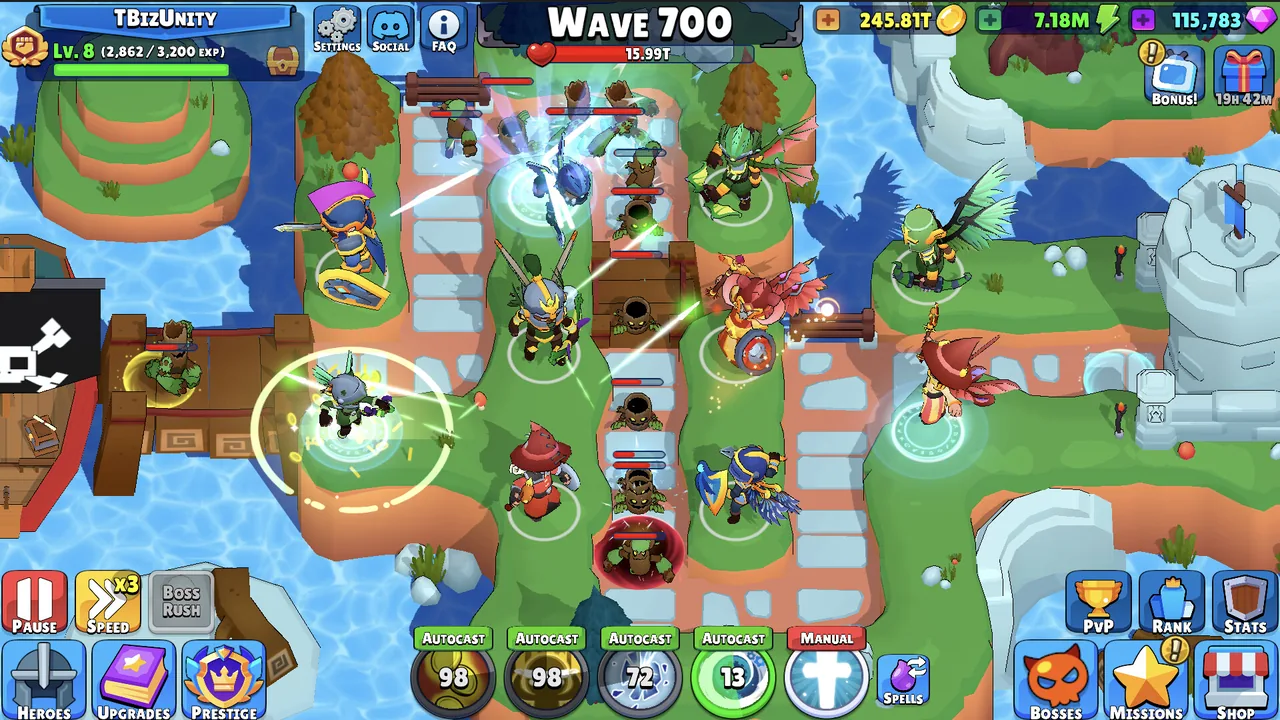
By Wave 700 the formation has spread across a multi-lane map, with autocast abilities doing most of the workImage: Swell Games LLC via Steam -
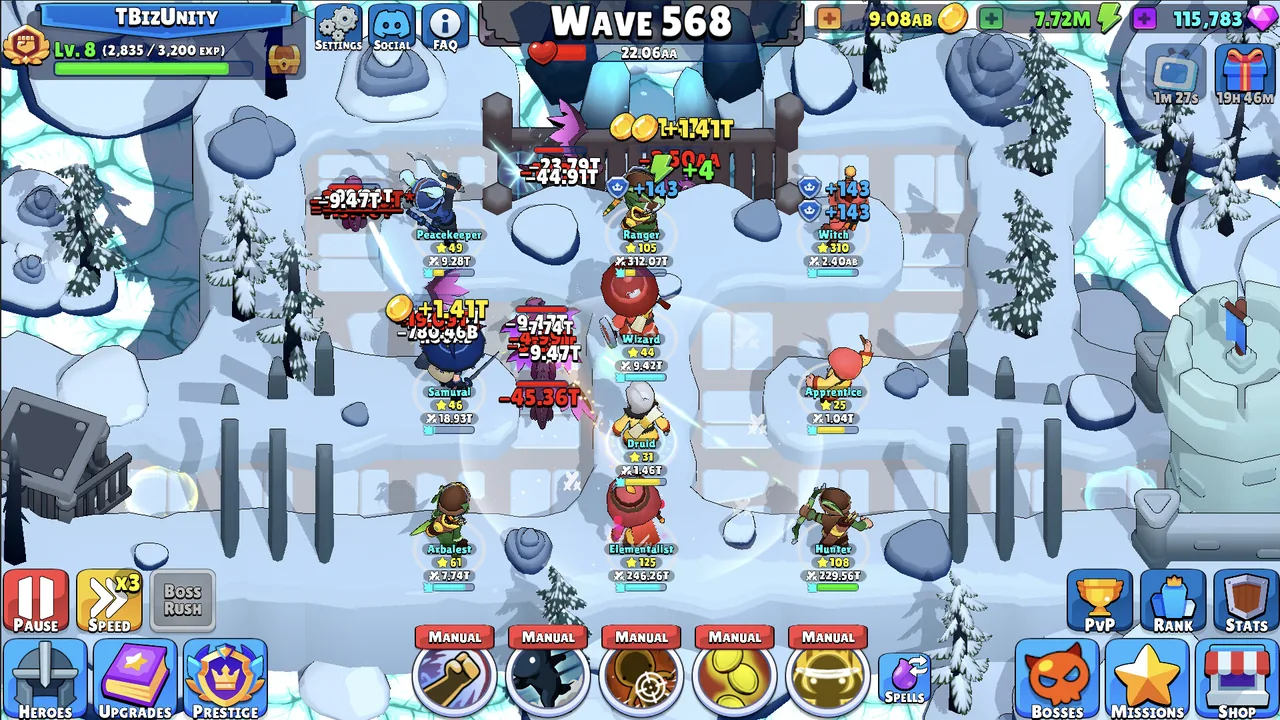
Named, individually levelled heroes -- not just tower slots -- are the core of the synergy layerImage: Swell Games LLC via Steam -
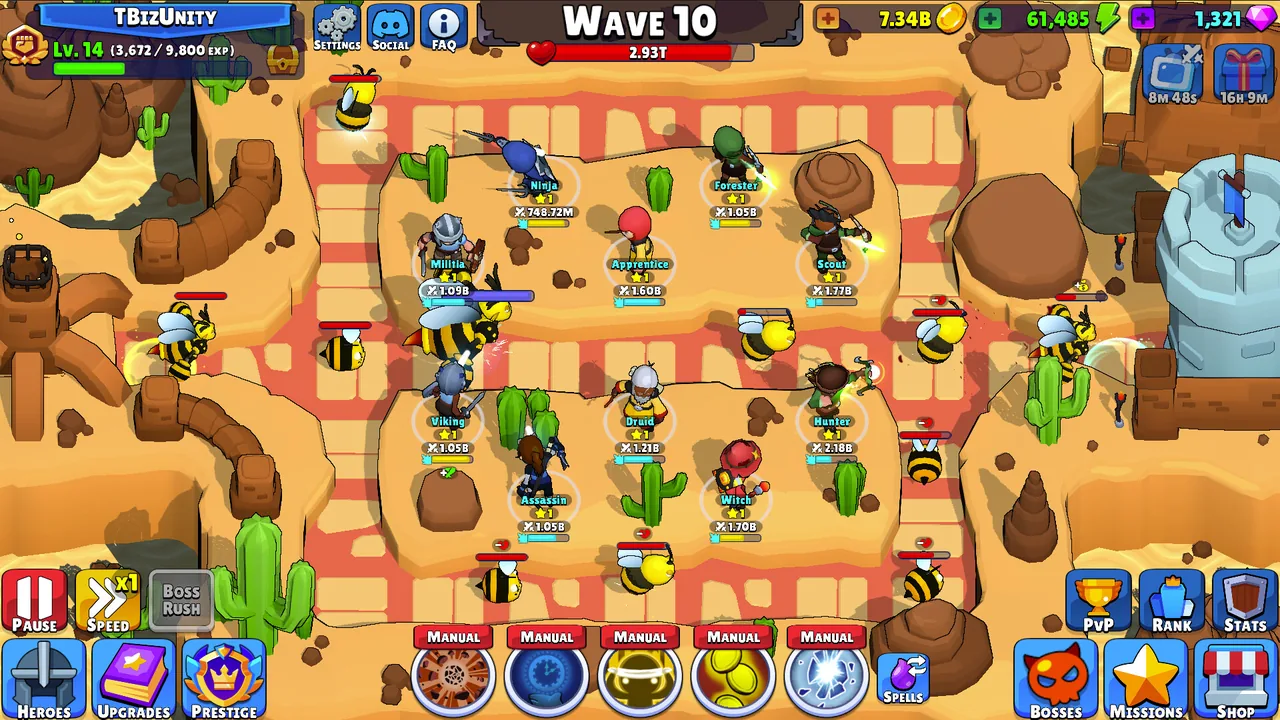
A much earlier account on the same desert map -- the formation and numbers scale enormously between the early and late gameImage: Swell Games LLC via Steam -
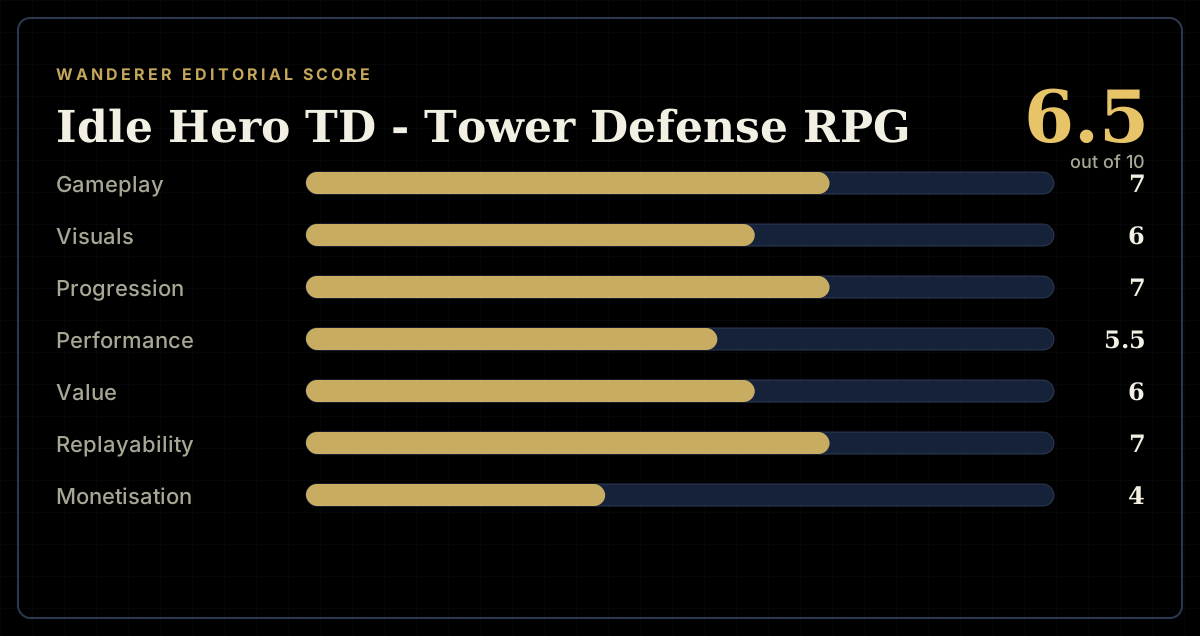
How the review scores each part of the gameWanderer Editorial -
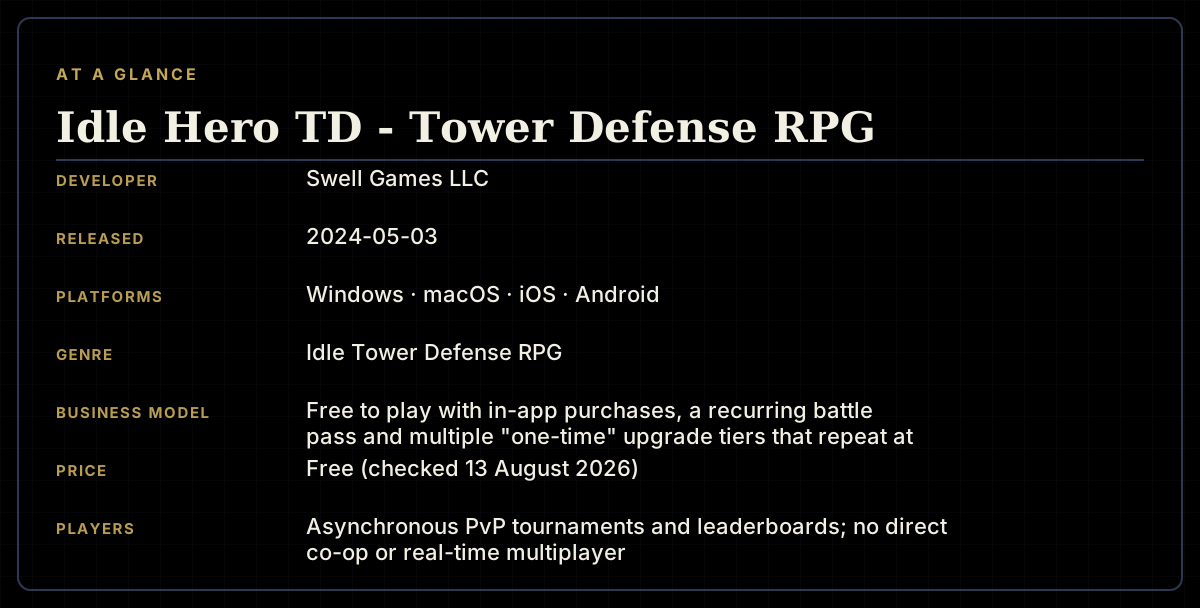
The game at a glanceWanderer Editorial -
The short versionWanderer Editorial