
Game review
Cultist Simulator
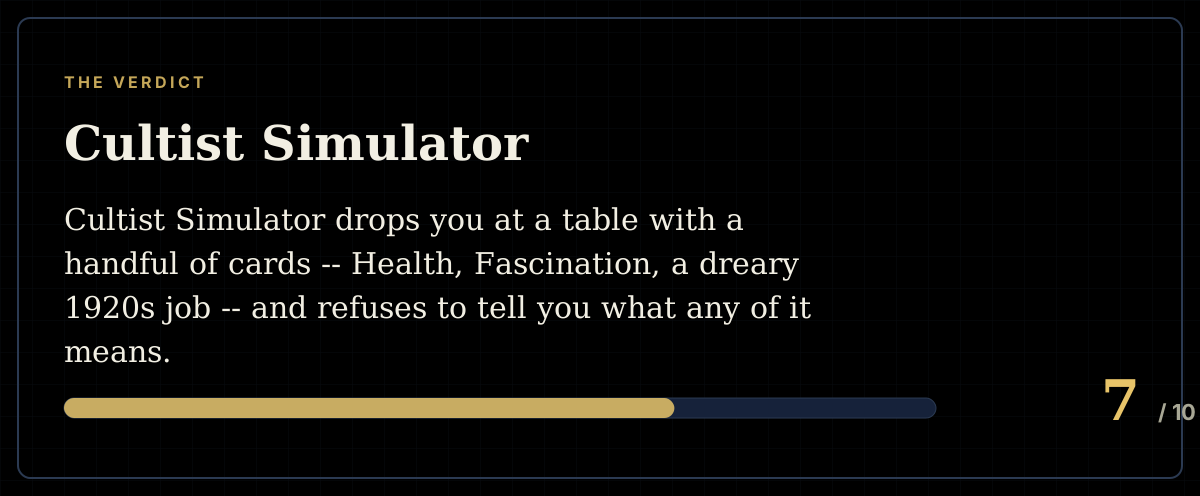
7 / 10
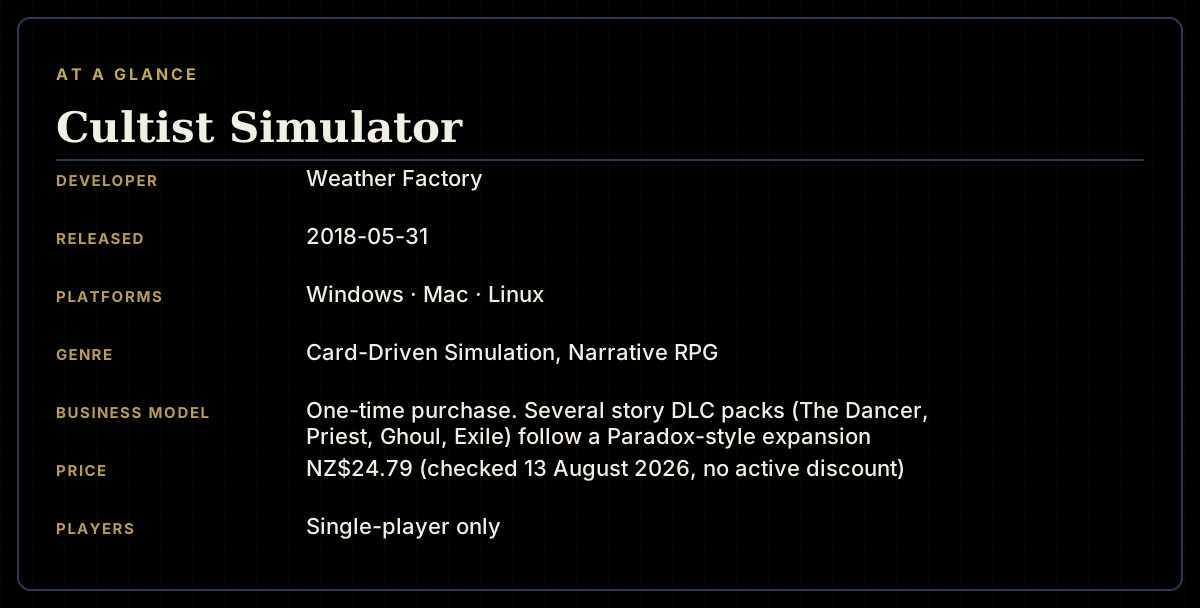
- Developer
- Weather Factory
- Publisher
- Humble Bundle
- Released
- 31 May 2018
- Platforms
- Windows, Mac, Linux
- Genre
- Card-Driven Simulation, Narrative RPG
- Monetisation
- One-time purchase. Several story DLC packs (The Dancer, Priest, Ghoul, Exile) follow a Paradox-style expansion model; a free January 2019 update added New Game+ content. No in-game purchases.
- Players
- Single-player only
The short version
Cultist Simulator drops you at a table with a handful of cards -- Health, Fascination, a dreary 1920s job -- and refuses to tell you what any of it means. You build an occult cult, chase forbidden knowledge and eventually try to ascend to godhood or worse, entirely by dragging cards onto slots and watching timers count down, with founder Alexis Kennedy's explicit design goal of making cosmic horror's unknowability something the player actually feels rather than reads about. It launched to warm-if-mixed critical notice (71 on Metacritic) and sits at Mostly Positive on Steam eight years later, 79.9% of 14,034 reviews -- notably lower than most games this site covers, and the review sample explains exactly why.
The writing, lore and atmosphere draw close to universal praise, including from reviewers giving the game a thumbs-down overall. Set against that is a real, specific and frequently repeated set of complaints about the game itself: a near-total absence of guidance that a large share of players say tips from "intriguing mystery" into "confusing mess," RNG-heavy mechanics some describe as more luck than skill, and a punishing pace -- single runs can take 40 real hours, lost instantly to one bad card draw. Weather Factory's own 2023 successor, Book of Hours, deliberately softened almost all of this, which is as clear a signal as any that the friction here was real rather than merely a matter of taste.
Biggest strengths
- Genuinely excellent, dense Lovecraftian writing and worldbuilding that draws praise across nearly the entire review sample, including from reviewers who dislike the gameplay
- A distinctive, still largely unimitated core mechanic -- building a cult and its rituals entirely through card interactions and countdown timers -- that some players find deeply compelling once it clicks
- Strong art direction and an atmospheric soundtrack that reviewers consistently single out
Biggest weaknesses
- A near-total absence of tutorial or in-game guidance that a large share of reviewers say makes the game confusing rather than intriguingly mysterious, with many reporting they needed a wiki open to make any progress at all
- RNG-heavy mechanics, particularly the expedition system, that a meaningful number of reviewers describe as luck-driven rather than skill-driven
- Long individual runs -- up to 40 real hours by some accounts -- that can be lost to a single mistake or bad draw, which many reviewers call punishing rather than tense
Who it's for: Players who enjoy trial-and-error discovery as a core mechanic, love dense Lovecraftian lore and don't mind losing hours of progress to a single mistake. Less good for anyone who wants clear systems and fair failure states, or who bounces off games that expect a wiki open in a second window.
Our recommendation: Worth it specifically for the writing and atmosphere if punishing, opaque systems sound appealing rather than off-putting -- and worth trying the demo first, since the review sample splits almost exactly along whether players found the early confusion thrilling or simply frustrating. If that split sounds unappealing, Weather Factory's own gentler 2023 successor Book of Hours is worth considering instead.
7 / 10
Cultist Simulator opens with almost nothing: a table, a handful of unlabelled cards, and a job you hate. From there, founder Alexis Kennedy's design goal was explicit — cosmic horror is supposed to feel unknowable, so the game itself gives you close to no explanation of its own systems, forcing you to drag cards onto slots, watch timers tick down, and work out what "Fascination" or "Dread" or "the Bright Door" actually do through trial, error and, for most players, an open wiki tab. It's a genuinely unusual design choice for a commercial game, and eight years on it's still the single thing every review, positive or negative, is really about.
The writing almost nobody disputes
Start with what's not in question. Cultist Simulator's prose — dense, allusive, closer to weird fiction than typical game text — draws consistently strong praise across the review sample, including from reviewers who otherwise recommend against buying the game. "It's a good worldbuilding exercise and might be a good book," reads one representative negative review, and that's a common shape: real admiration for the writing sitting right next to real frustration with everything wrapped around it. One reviewer, only half joking, says they "would read shopping lists written by Alexis Kennedy." The Lovecraftian 1920s setting, the sense of dread the game builds around ordinary domestic objects turning sinister, and the music all draw similar consistent praise. Whatever else divides the review sample, the game's atmosphere and prose aren't really part of the argument.
Confusion as design, and where it stops working
The argument is almost entirely about the systems underneath that writing. Kennedy's deliberate choice to withhold explanation is exactly the thing a large share of the negative sample singles out as the game's core problem — not as an aesthetic complaint, but a practical one: reviewers report spending hours without a clear sense of what they're meant to be doing, needing external wikis to make basic progress, and dying repeatedly to mechanics they had no way to anticipate. "I literally have no idea on how this game works," reads one review; "cards and icons popping up like poisonous mushrooms, no clear indication of what does what." Crucially, this isn't a complaint from players unwilling to engage with a learning curve — several explicitly say they love steep learning curves in other games and still bounced off this one, distinguishing "hard to learn" from "designed to withhold information past the point of being fun to discover." Set against that, a real number of other reviewers describe exactly the opposite experience: the moment things click, five or ten hours in, as one of the most satisfying "aha" feelings in any game they've played. This is the clearest, most consistent split in the whole review sample, and it doesn't obviously correlate with anything predictable about the reviewer — it reads as a genuine, roughly even divide in what kind of confusion different players find rewarding versus simply frustrating.
Timers, RNG, and losing forty hours to one card
A second, related complaint concerns pacing and randomness. Runs can stretch to 40 real hours, and several specific mechanics — the "expedition" system above all — are described by a meaningful number of reviewers as governed more by chance than by skill or preparation, meaning a well-planned run can still fail for reasons the player couldn't have controlled for. Combined with punishing failure states and a Dread/Contentment cycle several reviewers call "annoying" busywork rather than tense management, this is where "punishing on purpose" tips over into "wastes your time" for a meaningful share of the sample — distinct from, but compounding, the opacity complaint above.
A factor some buyers weigh separately
Worth noting plainly, since a number of reviewers raise it unprompted: in 2019, Weather Factory co-founder Alexis Kennedy was publicly accused by two former colleagues at his previous studio, Failbetter Games, of crossing professional boundaries in relationships with junior colleagues. Kennedy denied the allegations; Failbetter distanced itself from him publicly at the time, and the two parties settled a related legal dispute in 2023. It's a genuinely separate question from the game's quality, and this review scores the game rather than the studio, but it's the kind of documented, reported context — not a fringe rumour — that a number of reviewers say they factor into a purchase decision, and readers deciding whether to support Weather Factory directly may want to weigh it for themselves.
A studio that heard it
The clearest evidence that these complaints reflect something real rather than a mismatch between the game and the wrong audience is what Weather Factory did next. The studio's 2023 successor, Book of Hours, was explicitly designed to be a gentler, more relaxed experience built on similar card-and-table mechanics but without Cultist Simulator's time pressure and much of its opacity — and it went on to sell more copies with a markedly higher Steam review percentage. That's not proof the original game was wrong to be difficult on purpose; plenty of its fans specifically love that about it. But it is a clear signal from the people who understand the design best that the friction reviewers describe here wasn't accidental, and that softening it measurably widened the audience willing to enjoy what Weather Factory does.
Verdict
7 out of 10. Cultist Simulator is a genuinely distinctive, beautifully written game built around a design philosophy — confusion as an emotional tool, not just a difficulty setting — that works exactly as intended for a real share of its players and simply doesn't for another, almost equally large share. Its Mostly Positive rating, lower than most games covered here, is an honest reflection of that split rather than a sign of broad mediocrity. If dense Lovecraftian writing and figuring out opaque systems entirely on your own sounds appealing rather than exhausting, it's worth the price. If you're unsure, the demo is the right way to find out before committing to a run that might cost you forty hours to a single unlucky card.
Pros and cons
Pros
- Genuinely excellent, dense Lovecraftian writing and worldbuilding that draws praise across nearly the entire review sample, including from reviewers who dislike the gameplay
- A distinctive, still largely unimitated core mechanic -- building a cult and its rituals entirely through card interactions and countdown timers -- that some players find deeply compelling once it clicks
- Strong art direction and an atmospheric soundtrack that reviewers consistently single out
- A real sense of discovery and payoff for players willing to invest the time to learn its systems without external help
Cons
- A near-total absence of tutorial or in-game guidance that a large share of reviewers say makes the game confusing rather than intriguingly mysterious, with many reporting they needed a wiki open to make any progress at all
- RNG-heavy mechanics, particularly the expedition system, that a meaningful number of reviewers describe as luck-driven rather than skill-driven
- Long individual runs -- up to 40 real hours by some accounts -- that can be lost to a single mistake or bad draw, which many reviewers call punishing rather than tense
- A physically uncomfortable interface, with several reviewers specifically criticising card text displayed at an angle and information that's hard to track as the board fills up
Screenshots
-
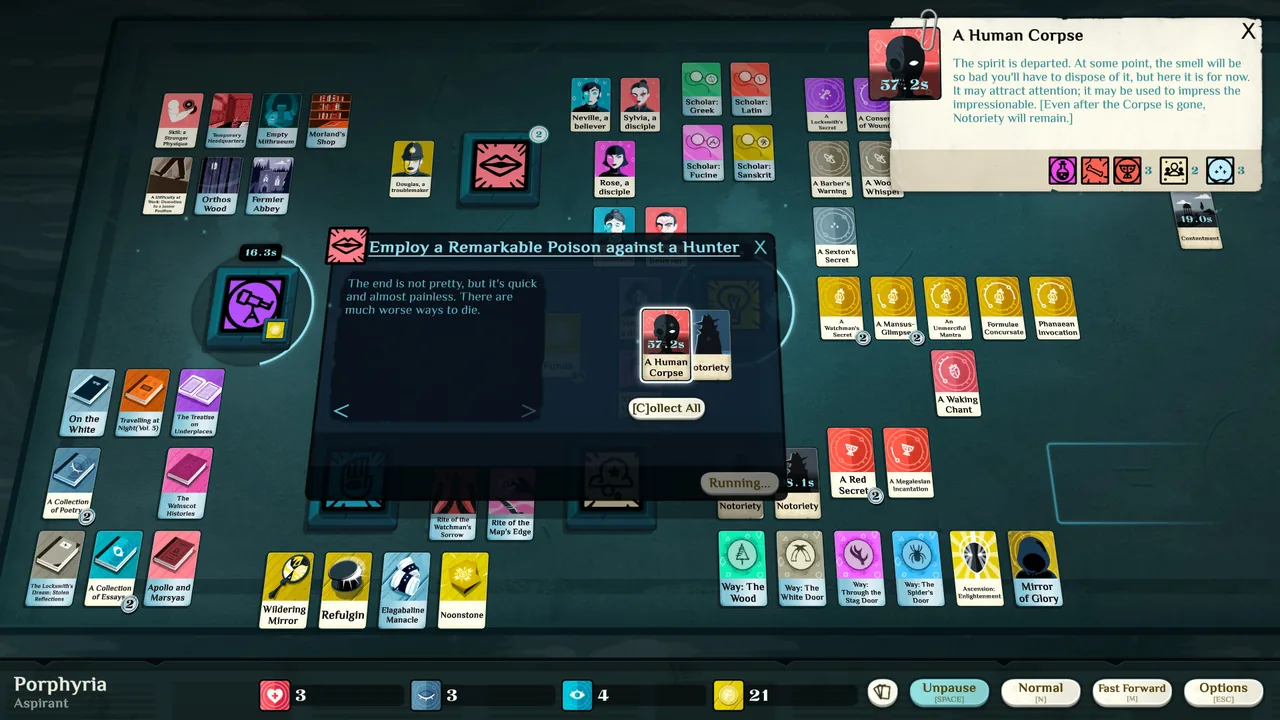
Cultist SimulatorImage: Weather Factory via Steam -
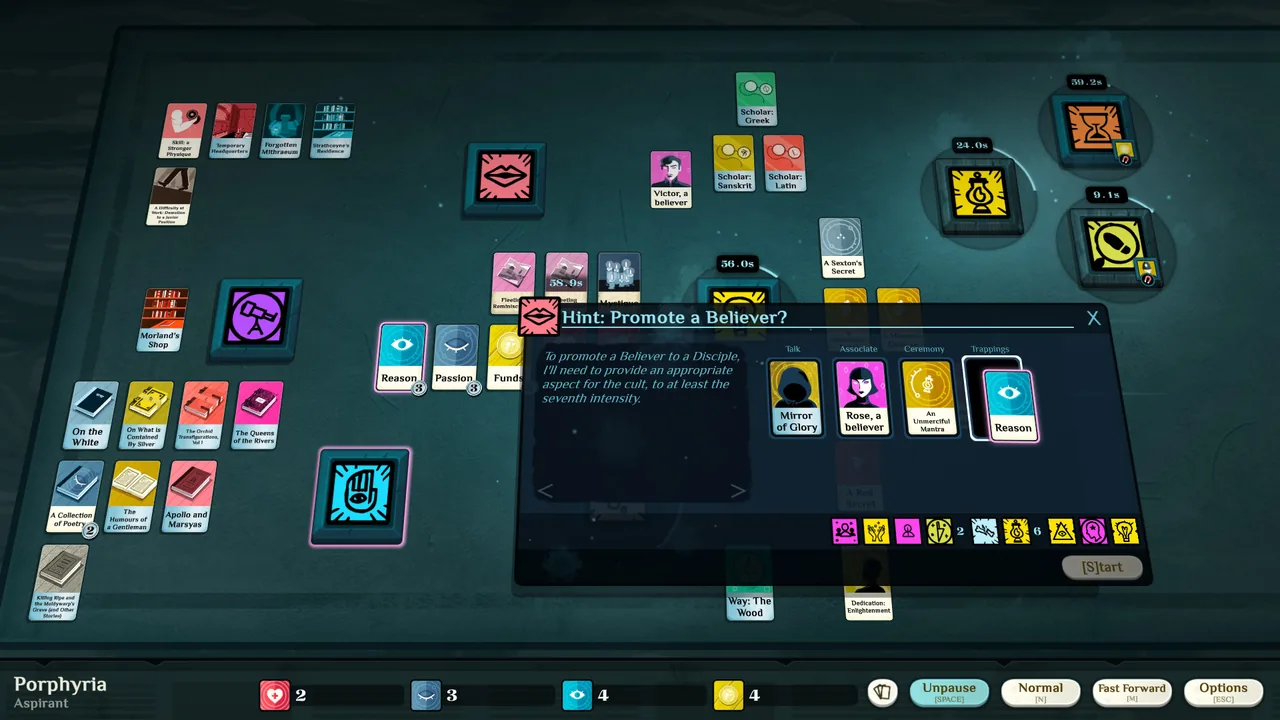
Cultist SimulatorImage: Weather Factory via Steam -
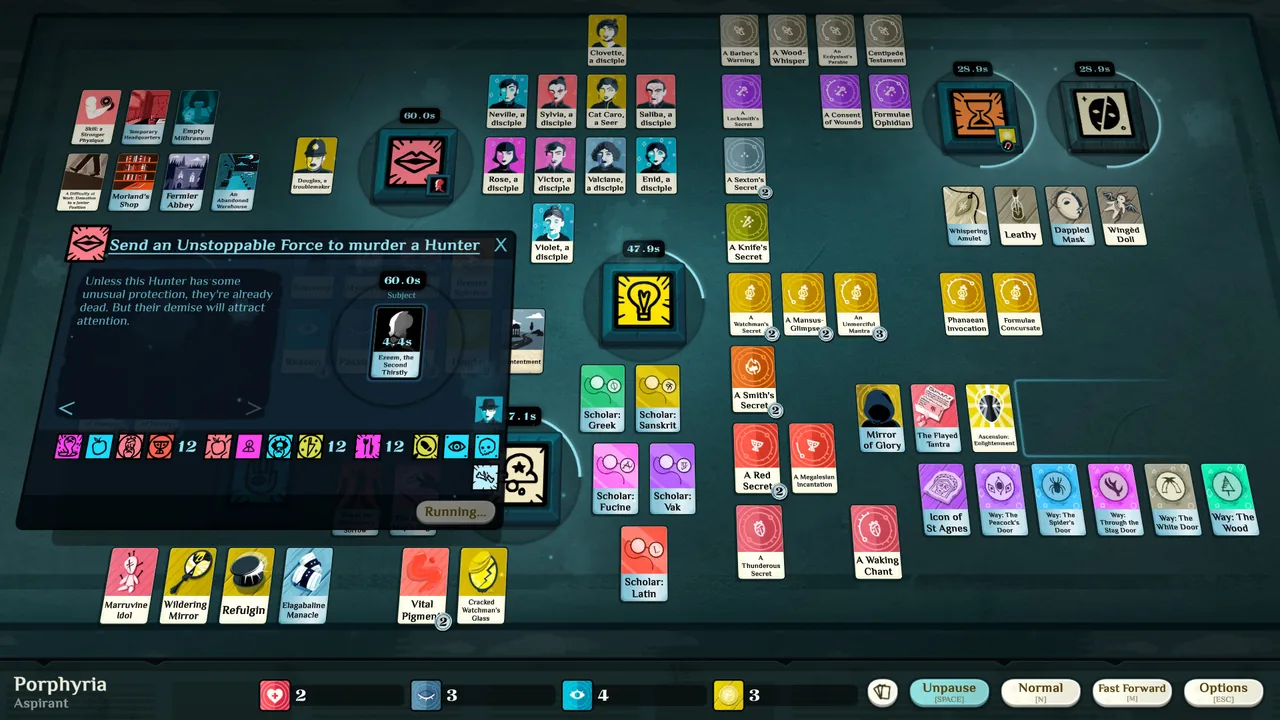
Cultist SimulatorImage: Weather Factory via Steam -
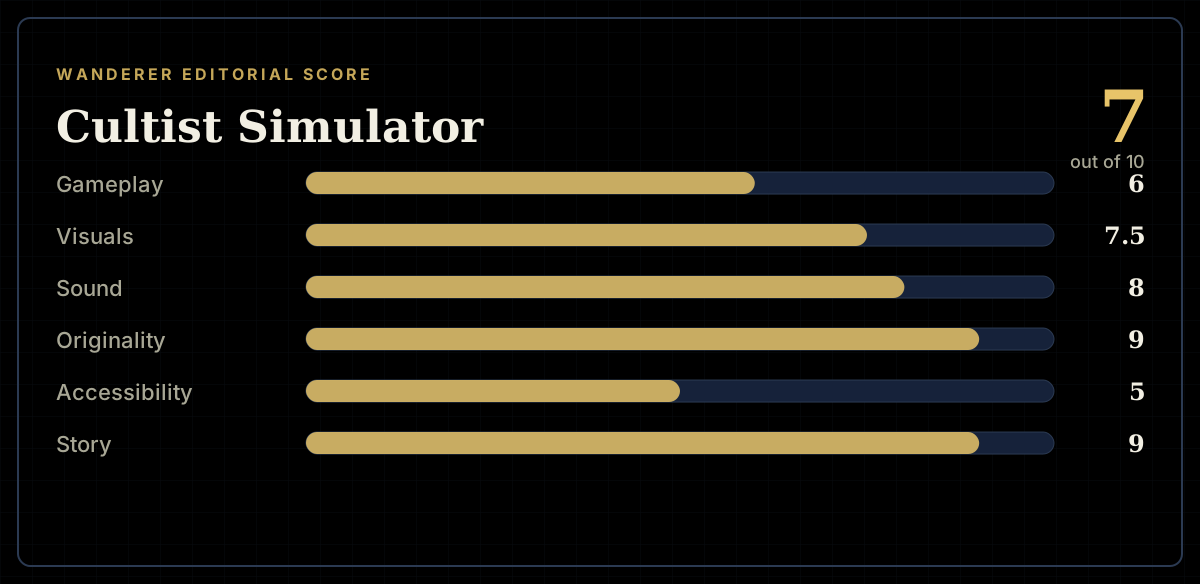
How the review scores each part of the gameWanderer Editorial -
The essentialsWanderer Editorial -
The short versionWanderer Editorial