
Game review
Thronebreaker: The Witcher Tales
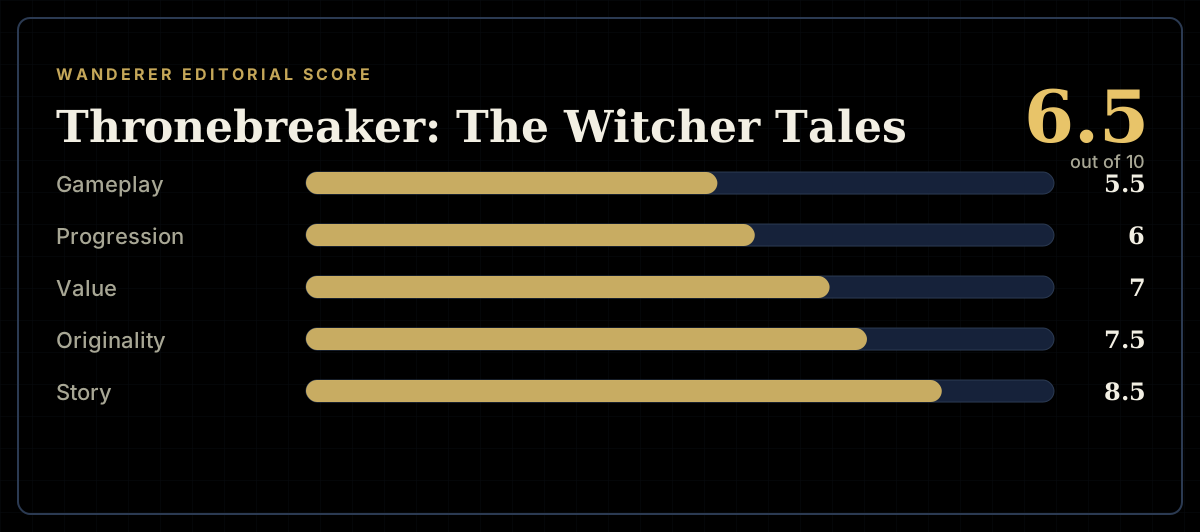
6.5 / 10
- Developer
- CD PROJEKT RED
- Publisher
- CD PROJEKT RED
- Released
- 23 October 2018
- Platforms
- Windows, macOS
- Genre
- Card-Based RPG
- Monetisation
- Paid, one-time purchase. No in-app purchases; standalone Gwent rewards are tied to a separate GOG account.
- Players
- Single-player only.
The short version
Thronebreaker follows Meve, "war-veteran and Queen of Lyria and Rivia," on a dark revenge campaign built from the same CD Projekt Red writing and art direction that made The Witcher 3 beloved, and Very Positive across more than 15,000 reviews reflects real appreciation for both. What tempers that praise, consistently and specifically, is the game's core combat system: rather than the flexible, strategic Gwent matches the card game is known for, more than half the negative reviews checked for this piece describe most battles as fixed-solution puzzles with one correct answer, frustrating players who came in wanting to actually build and pilot a deck.
Biggest strengths
- Genuinely strong writing, voice acting and painted-illustration presentation that reviewers consistently credit as among CD Projekt Red's best outside the mainline Witcher trilogy.
- Meve's story offers real moral weight and consequence, with choices that meaningfully shape the war campaign around her.
- A distinctive hybrid of RPG exploration, resource management and card-based combat rarely attempted at this scale.
Biggest weaknesses
- A dominant, well-corroborated complaint describes most battles as fixed-solution "Gwent puzzles" with one correct approach, rather than genuine strategic deck-building matches.
- Global achievement data shows a real, gradual completion drop-off consistent with several reviewers' claims that a meaningful share of buyers never finish the campaign.
- RPG resource scarcity is reported as punishing for players who want to explore fully rather than proceed efficiently through the main path.
Who it's for: Witcher fans drawn primarily to story and world-building who don't mind puzzle-like combat encounters over genuine card-strategy depth, and who are prepared for real resource scarcity in the RPG layer around it.
Our recommendation: A strong pick for the writing and presentation alone; go in expecting most battles to function as scripted puzzles rather than freeform Gwent matches.
6.5 / 10
A Witcher story built on real writing strength
Thronebreaker's premise centres on a specific, compelling angle the mainline Witcher games never fully explored: "facing an imminent invasion, Meve — war-veteran and Queen of Lyria and Rivia — is forced to once again enter the warpath and set out on a dark journey of destruction and revenge." The official cutscene screenshot shows exactly the visual register that story is told in — a weathered, scarred face rendered in painted, comic-panel style, lit in tense red and green, conveying weight and consequence without needing full 3D cinematics. Reviewers across the board credit this presentation and the underlying writing as genuinely strong, consistent with CD Projekt Red's reputation. A 2019 review, even while ultimately critical of the gameplay, concedes plainly: "The story is pretty good, the voice acting is well done, and the graphics are involving." A 2019 review calls the game as a whole one that "reeks of quality in its story, art and sound," using that praise specifically to set up its central complaint about everything built on top of it.
A recurring, specific complaint about what "Gwent" actually means here
That central complaint, repeated with striking consistency across the review sample, concerns combat design. "I just wanted to build decks and play Gwent with a cool story. There are far too many Gwent puzzles to actual matches," reads a June 2026 review, "every time I'm given a 'Gwent Puzzle', I felt annoyed." A 2019 review makes the same point more sharply: the game is "completely ruined by gating its great writing behind boring [nonsense] puzzles and repetitive battles," arguing that fixed- solution scenarios undercut the deck-building strategy the Gwent name implies. A 2018 review frames the core mismatch precisely: "It is neither the 'real' Gwent nor enough RPG. It is just a world map on which you can click, puzzles that have only one exact solution." Checking a broad sample of negative reviews, well over half raise this same specific complaint independently — not simply "the combat is hard" or "the combat is boring" in the abstract, but a consistent, structural objection that many encounters function as authored logic puzzles rather than the emergent, strategic card battles the Gwent brand promises. One 2022 review adds a data point worth taking seriously: "it is telling that only 25% of players get to the end." This review's own check of Steam's global achievement statistics shows a real, gradual drop-off in completion across the game's achievement list, broadly consistent with — though not an exact independent confirmation of — that specific figure.
Real consequences, sometimes too real
Two further, more specific complaints round out the picture. A November 2024 review argues the RPG resource layer actively punishes thorough, exploratory play: "resources are finite and very hard to" manage if a player engages with every side path the map offers, pushing toward a more efficient, less curious playstyle than the game's open structure seems to invite. More seriously, a July 2026 review describes a specific, high-stakes failure mode: "accidentally miss click and choose a wrong dialogue option to recruit a character? Well [that's unfortunate], because you're locked out of getting that character" permanently, with the game's save system offering no reliable way to undo the mistake. That's a genuinely harsh design choice for a story-driven RPG, where a single misclick can permanently alter a playthrough's roster in a way many players won't discover until much later.
A defensible response from reviewers who liked the earlier chapters
Several reviewers make clear that the puzzle-heavy design isn't a launch-hour problem that eases with familiarity — it's a structural choice that persists throughout, and multiple detailed accounts describe genuine enjoyment early on curdling into fatigue well before the credits. A 2020 review captures this arc specifically: "The story and Decision making in this game are very interesting and Intriguing, but sadly the Gameplay gets repetitive and boring real fast," describing a pattern of "go there, pick that, pick this" that wears thin regardless of how compelling the surrounding narrative remains. A 2022 review adds an unusually candid detail about how some players cope with that fatigue: "Thank god for the 'Skip Battle' function!", explaining that a large share of their own logged hours came from leaving the game running in the background rather than actively engaging with combat they'd grown tired of. That's a telling admission — it suggests a meaningful number of players resolve the tension between wanting the story and disliking the battles not by finishing strong, but by disengaging from the very system the game is nominally built around, which reinforces rather than undercuts the core complaint above.
Weighing the GOG rewards complaint
One further, narrower issue is worth a brief mention for completeness: a 2020 review notes that players who purchase Thronebreaker on Steam are "locked out from getting rewards for playing" in the separate, free-to-play standalone Gwent card game, because those specific cross-promotional rewards are tied to a GOG account rather than a Steam one. This is a minor, easily overlooked friction point rather than a serious flaw in Thronebreaker itself, but it's worth knowing about for anyone who plans to play both the single-player campaign here and the standalone competitive card game afterward, since the platform choice made for this purchase has a small, concrete effect on that separate experience.
Final verdict
Thronebreaker's writing, world-building and presentation remain genuinely strong, and this review has no hesitation recommending it to Witcher fans on those grounds. What keeps the score short of full enthusiasm is a specific, well-corroborated and structurally consistent complaint about the core combat loop — battles built as fixed-solution puzzles rather than the flexible, strategic card matches "Gwent" leads players to expect — compounded by a resource system and a save design that both punish exploratory or imperfect play more harshly than a story-focused RPG typically should. This is a strong pick for players who prioritise narrative above all else, and a fair skip for anyone specifically hoping for genuine Gwent deck-building depth.
Pros and cons
Pros
- Genuinely strong writing, voice acting and painted-illustration presentation that reviewers consistently credit as among CD Projekt Red's best outside the mainline Witcher trilogy.
- Meve's story offers real moral weight and consequence, with choices that meaningfully shape the war campaign around her.
- A distinctive hybrid of RPG exploration, resource management and card-based combat rarely attempted at this scale.
- Frequently discounted to a price that reflects fair value for the length and quality of its narrative content.
Cons
- A dominant, well-corroborated complaint describes most battles as fixed-solution "Gwent puzzles" with one correct approach, rather than genuine strategic deck-building matches.
- Global achievement data shows a real, gradual completion drop-off consistent with several reviewers' claims that a meaningful share of buyers never finish the campaign.
- RPG resource scarcity is reported as punishing for players who want to explore fully rather than proceed efficiently through the main path.
- A specific, serious complaint describes a misclicked dialogue option permanently locking a recruitable character, with no way to undo the choice given the save system.
Screenshots
-

Thronebreaker: The Witcher TalesImage: CD PROJEKT RED via Steam -

Thronebreaker: The Witcher TalesImage: CD PROJEKT RED via Steam -

Thronebreaker: The Witcher TalesImage: CD PROJEKT RED via Steam -
How the review scores each part of the gameWanderer Editorial -
The short versionWanderer Editorial