Game review
The Stanley Parable: Ultra Deluxe
8.5 / 10
- Developer
- Crows Crows Crows
- Publisher
- Crows Crows Crows
- Released
- 27 April 2022
- Platforms
- Windows, macOS
- Genre
- Narrative, Walking Simulator, Comedy
- Monetisation
- One-time purchase, no DLC, no in-app purchases; existing owners of the 2013 original received a discount at launch
- Players
- Single-player only
The short version
The Stanley Parable: Ultra Deluxe rebuilds and expands 2013's landmark narrative game — an office worker following, or refusing to follow, a narrator's account of his own story — adding new branches, endings and a self-aware new wing of content that comments directly on the act of re-releasing a beloved indie game nine years later. Developed and published by Crows Crows Crows, it released 27 April 2022 and sits at Very Positive, 94.2% across 25,481 English-language reviews. The overwhelming majority of that reception, including a striking number of reviews written entirely in the narrator's own voice as part of the joke, treats this as a genuine, era-defining piece of interactive writing. Underneath the humour sits one real, substantive complaint worth taking seriously: longtime owners of the original report the new content amounts to a few hours added onto a doubled price, and several argue it would have been fairer as DLC than a full-price standalone re-release.
Biggest strengths
- Writing and narration remain, by near-universal consensus, some of the most original and cleverly constructed in the medium, with the narrator's voice performance singled out constantly as the game's defining strength
- New content genuinely expands the game's central ideas rather than simply padding it out, with several reviewers specifically praising how the additions comment on the act of returning to a beloved older game rather than existing purely as bonus material
- A rebuilt engine and substantially reworked presentation modernise the experience without losing the tonal identity that made the original beloved
Biggest weaknesses
- The most substantive, recurring criticism comes specifically from owners of the 2013 original: several detailed reviews estimate the genuinely new content at only two to three hours, sold at roughly double the original's price, and argue it would have been fairer released as DLC for existing owners rather than a full-price standalone product
- A number of longtime fans specifically mourn the loss of Source-engine-era mod support and community-discovered technical quirks that came with the original's engine, which the Unity rebuild doesn't preserve
- The review corpus for this game is unusually saturated with in-character joke reviews written in the narrator's voice, which makes filtering genuine critical feedback from bit-driven humour more effortful than for most games
Who it's for: Newcomers who never played the 2013 original should buy this without hesitation; owners of that original weighing whether the new content justifies repurchasing at full price should read the value section below first.
Our recommendation: One of the most original, cleverly written interactive experiences available, and an easy recommendation for anyone who hasn't played the 2013 version — the only real question mark is pricing for the people who already have.
8.5 / 10
Introduction
The Stanley Parable: Ultra Deluxe follows office worker Stanley through a story narrated, contradicted, and occasionally sabotaged by its own narrator, using the act of obeying or defying that narration as its central mechanic. It's an expanded, engine-rebuilt reimagining of The Stanley Parable, which began as a free Source-engine mod in 2011 before its acclaimed standalone 2013 release. Developed and published by Crows Crows Crows, this version released 27 April 2022 and sits at Very Positive, 94.2% across the 25,481 English-language reviews this review draws from. That's a genuinely large corpus, and it comes with an unusual quirk worth flagging up front: a striking share of it is written entirely in character, as jokes voiced through the narrator's own persona, which this review filters carefully to separate genuine critical feedback from bit-driven humour — itself a fitting complication for a game about the unreliability of narration.
Still one of the most original things in the medium
Start with what the overwhelming majority of this corpus agrees on, jokes aside: the writing and narration remain genuinely, specifically exceptional. Reviewers describe individual moments — a narrator openly frustrated by the player's choices, entire branches built around subverting a "true ending," self-aware commentary on video game tropes — with real precision rather than vague enthusiasm. One reviewer summarised the whole project's ambition memorably: "From the ashes of depravity rises the phoenix of quality... such a revolutionary step forward in the lineage of one of the most beloved video game properties of all time." Even reviewers using the review itself as a joke vehicle — writing in the third person as though narrating Stanley's own act of leaving a review — are demonstrating, in their own way, just how deeply the game's specific voice and structure has embedded itself in how its audience thinks and talks about it years later.
New content that extends the idea rather than just adding to it
The new material in Ultra Deluxe draws real, specific praise for doing more than padding out the original's runtime. Several detailed reviews credit the additions with directly engaging the premise of returning to a beloved older game nine years later — the new content is described as genuinely self-aware about its own status as an expanded re-release, rather than existing as disconnected bonus material bolted onto the original structure. That reflexive quality is consistent with what made the original distinctive in the first place, and reviewers who've played both versions generally credit Crows Crows Crows with extending rather than simply repeating the joke.
The one substantive criticism worth taking seriously
Here's the genuine, recurring complaint underneath all the in-character humour, and it's worth stating plainly because it's specific and fair rather than a generic gripe. Several detailed reviews, written by people who own and clearly love the 2013 original, estimate the amount of genuinely new content at roughly two to three hours, much of it in the form of new or altered endings rather than entirely new systems. Set against a price that roughly doubles the original's — one detailed review noted the 2013 game cost around £10 while this asks around double that, with a discount for existing owners that several argue doesn't fully close the gap — a meaningful number of longtime fans conclude this would have been fairer released as paid DLC for people who already owned the base game, rather than a full-price standalone re-release. One reviewer put the emotional core of the complaint plainly: "This game makes me so sad. I loved the original Stanley Parable. It's one of my favorite games... I also expected it 3 years ago and for half the price." That's not a complaint about quality — it's specifically about what existing fans are being asked to pay for content that, by several honest accounts, amounts to a meaningful but not sweeping expansion.
A closely related, smaller complaint concerns the technical transition itself: some longtime fans specifically mourn the loss of Source-engine-era mod support and community-discovered technical quirks that came with the original's engine, which the Unity rebuild doesn't carry forward. That's a real, if narrower, loss for players who valued that specific community culture around the original.
Reading the corpus honestly
It's worth being explicit about how unusual this game's review page is to analyse, because the in-character joke reviews aren't simply noise — they're evidence of exactly how thoroughly this game's voice has colonised its own fan culture, which is itself a form of praise. But they do make this review's job harder: distinguishing "Stanley pressed the wrong button on purpose to make a point about honest reviews" from an actual substantive critique requires reading past the bit to what, if anything, a given review is actually arguing. The genuine, recurring complaint that survives that filtering — value for returning owners — appears across enough independently written, clearly sincere reviews that this review treats it as real feedback rather than part of the game's own performance.
Where players actually get to
Steam's achievement data shows a healthy, broad engagement curve entirely appropriate to a game built around exploring multiple branches: the top achievements sit in the 84-94% range, tapering through a real midgame before the most obscure, easter-egg-hunting achievements drop into single digits — consistent with a game whose main branches are widely experienced while its deepest, most hidden content is reserved for the most dedicated explorers, exactly the shape this kind of game should have.
Final Verdict
The Stanley Parable: Ultra Deluxe remains, by the overwhelming and often creatively expressed consensus of its own players, one of the most original and carefully written pieces of interactive storytelling available on any platform, and its new content genuinely extends rather than pads the ideas that made the original beloved. For anyone who hasn't played the 2013 version, this is close to an unqualified recommendation. The one real, substantive question mark — whether the new content justifies a doubled price for people who already own the original — is worth taking seriously rather than dismissing as fan nostalgia, since it's raised specifically and repeatedly by reviewers who clearly love the underlying work and simply feel the arithmetic doesn't quite add up for them. Everyone else should stop reading reviews, in-character or otherwise, and go press the button.
Pros and cons
Pros
- Writing and narration remain, by near-universal consensus, some of the most original and cleverly constructed in the medium, with the narrator's voice performance singled out constantly as the game's defining strength
- New content genuinely expands the game's central ideas rather than simply padding it out, with several reviewers specifically praising how the additions comment on the act of returning to a beloved older game rather than existing purely as bonus material
- A rebuilt engine and substantially reworked presentation modernise the experience without losing the tonal identity that made the original beloved
- Endlessly replayable by design, with branching structure genuinely rewarding repeated playthroughs rather than offering a single fixed path dressed up as choice
Cons
- The most substantive, recurring criticism comes specifically from owners of the 2013 original: several detailed reviews estimate the genuinely new content at only two to three hours, sold at roughly double the original's price, and argue it would have been fairer released as DLC for existing owners rather than a full-price standalone product
- A number of longtime fans specifically mourn the loss of Source-engine-era mod support and community-discovered technical quirks that came with the original's engine, which the Unity rebuild doesn't preserve
- The review corpus for this game is unusually saturated with in-character joke reviews written in the narrator's voice, which makes filtering genuine critical feedback from bit-driven humour more effortful than for most games
- Newcomers going in expecting a conventional game with clear objectives may find the format itself, deliberately built around subverting exactly that expectation, an odd fit regardless of how well it's executed
Screenshots
-
The Stanley Parable: Ultra DeluxeImage: Crows Crows Crows via Steam -
The Stanley Parable: Ultra DeluxeImage: Crows Crows Crows via Steam -
The Stanley Parable: Ultra DeluxeImage: Crows Crows Crows via Steam -
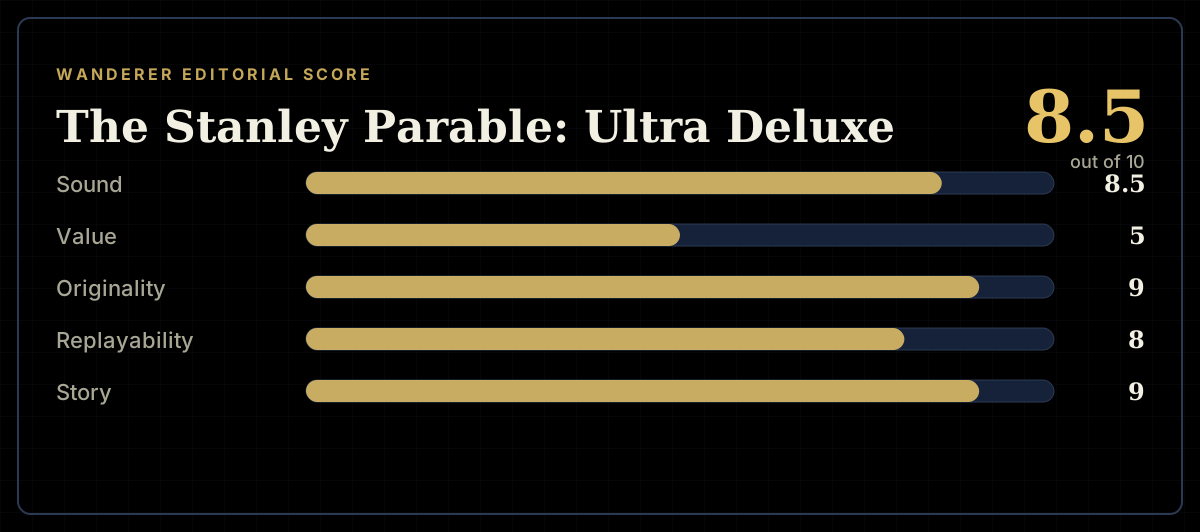
How the review scores each part of the gameWanderer Editorial -
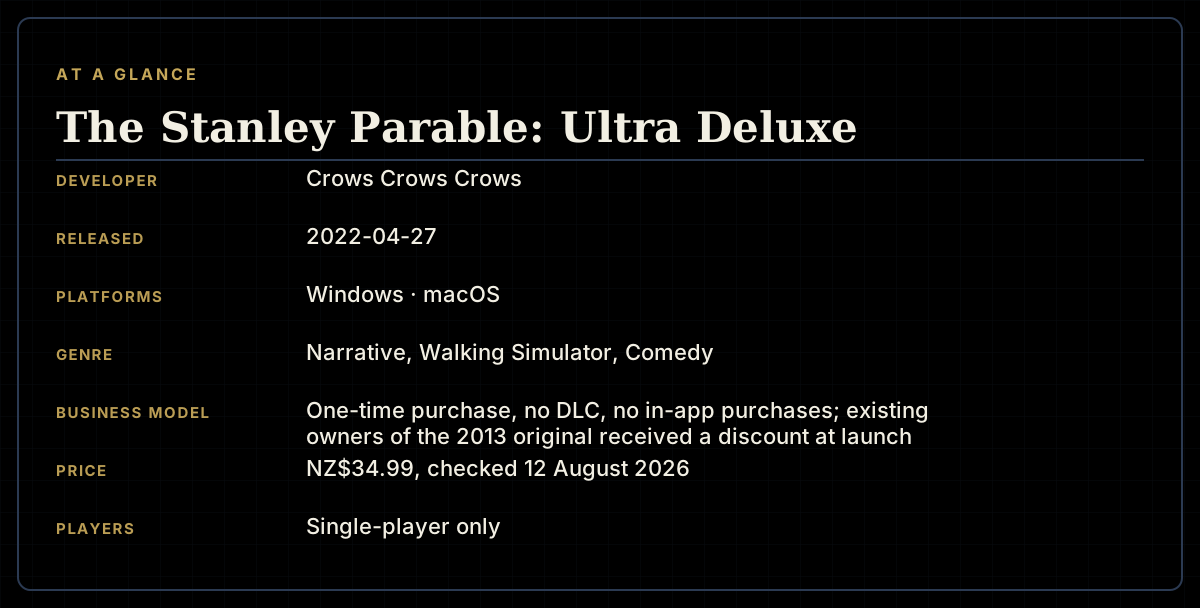
The essentials at a glanceWanderer Editorial -
The short versionWanderer Editorial