
Game review
What Remains of Edith Finch
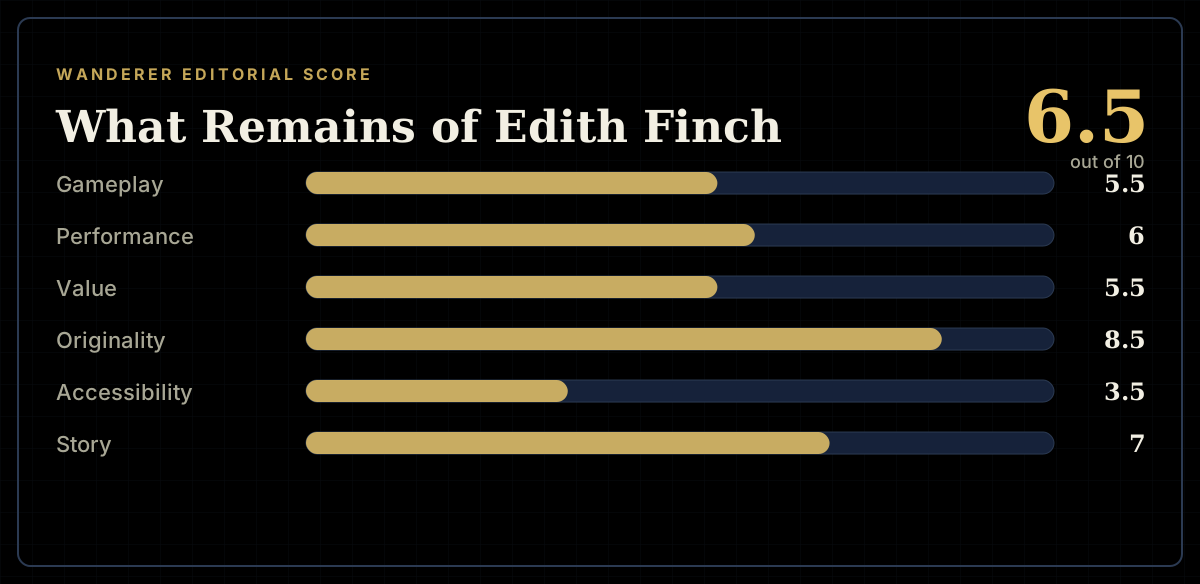
6.5 / 10
- Developer
- Giant Sparrow
- Publisher
- Annapurna Interactive
- Released
- 24 April 2017
- Platforms
- Windows, macOS
- Genre
- Narrative Anthology
- Monetisation
- Paid, one-time purchase. No in-app purchases.
- Players
- Single-player only.
The short version
What Remains of Edith Finch tells the story of a cursed family's many strange deaths through a sequence of short, mechanically distinct vignettes, and its Very Positive rating across more than 18,400 reviews reflects genuine, widely shared admiration for how inventively it uses gameplay itself as a storytelling tool. This review found a specific, extensively documented accessibility problem dominating a meaningful share of its negative reviews: a narrow, fixed field of view with no in-game adjustment option, which multiple reviewers describe causing real motion sickness and headaches within minutes of play, and which this review found no evidence was ever addressed via patch. A separate, consistent complaint concerns the roughly two-hour runtime relative to price, and a recurring critique that individual vignettes vary sharply in narrative depth.
Biggest strengths
- A genuinely inventive, widely admired approach to storytelling, using distinct gameplay mechanics for each family member's vignette to reflect the tone and content of their story.
- Strong voice acting and a distinctive, melancholic Pacific Northwest atmosphere that reviewers consistently credit as immersive and well-crafted.
- Several individual vignettes praised as genuinely haunting and memorable, even by reviewers who found the overall experience uneven.
Biggest weaknesses
- A specific, extensively documented field-of-view problem is reported by multiple reviewers as causing genuine motion sickness and headaches within minutes, with no in-game option to adjust it and, per affected reviewers, no developer acknowledgment that FOV was considered during development.
- A consistent complaint describes the roughly two-hour campaign as short relative to its asking price, with limited replay incentive once the stories are known.
- A recurring criticism describes the anthology's individual vignettes as uneven in depth, with several reviewers feeling most character backstories could be summarised in only a few lines despite the runtime spent on them.
Who it's for: Fans of inventive, mechanically expressive narrative games who value creative storytelling techniques above traditional interactivity; players prone to motion sickness from narrow or fixed fields of view should be aware of a specific, well-documented risk before buying.
Our recommendation: A genuinely inventive piece of narrative game design worth experiencing at a discount; check the field-of-view issue carefully first if you're prone to motion sickness in first-person games.
6.5 / 10
A genuinely inventive approach to narrative game design
What Remains of Edith Finch's central achievement is structural: rather than telling every family member's story the same way, each vignette uses a distinct gameplay mechanic tailored to its content and tone. Reviewers consistently credit this approach as genuinely novel, even those who ultimately can't recommend the full experience. "The major plus is that the game does a beautiful and innovative job of using gameplay as an immersive storytelling technique," reads a 2023 review, one of several that credits this specific structural achievement before raising other reservations. A 2020 review frames the broader reputation directly: "3D Visual novel, innovative way of narration, immersive gameplay," acknowledging the game's genuinely distinctive place within the wider narrative-game landscape. That structural inventiveness — treating mechanics themselves as an expressive storytelling tool rather than a separate system layered onto narrative — is the throughline of praise across this review base, and a meaningful part of why the game remains critically influential years after release.
A specific, extensively documented field-of-view problem
What this review found most concerning is a specific, repeatedly and consistently documented technical complaint: a narrow, fixed field of view with no in-game adjustment option, reported by multiple reviewers as causing genuine physical discomfort rather than ordinary visual dislike. "After playing for 25 minutes, I had to stop because of motion sickness. I had the reticule turned on, but it didn't help enough for me. Sadly, there is no option to adjust the FOV," reads a 2021 review. A 2019 review reports the same problem independently, years earlier: "Probably the strangest review on this site with 16 min of played time. But there is a good reason for it. The FOV is the worst I've ever" experienced in a first-person game. A 2021 review adds a specific, concerning detail: "Looking through forums the devs say they didn't develop the game with fov in mind. I'm begging devs to keep motion sickness in mind" for future projects. This review checked available update history and found no evidence this specific issue was ever resolved via patch on PC. Given how consistently and specifically this complaint recurs across years of reviews, this review treats it as a serious, currently unresolved accessibility risk worth flagging directly and prominently for any prospective buyer sensitive to motion sickness in first-person games.
A consistent length and value complaint
Separate from the FOV issue, a consistent complaint concerns how much the roughly two-hour runtime justifies the asking price. "Honestly can't recommend spending $20 on something that only lasts two hours," reads a 2020 review. A 2023 review reaches a similar practical conclusion: "This is not a bad game! It's a lovely walking simulator... I bought it on sale, and that is what I suggest you do too." This review treats the complaint as a fair, specific value consideration rather than dismissing it — a two-hour completion time with minimal replay incentive is genuinely useful information for a prospective buyer weighing the current asking price.
A related, sharper version of this complaint frames the low interactivity itself as the core problem rather than simply the runtime. "This isn't a game, in the sense that there's" very little the player actually does beyond walking forward and occasionally triggering a scripted sequence, reads a 2026 review. Several reviewers who share this view distinguish it from the length complaint specifically: their objection isn't that the experience is short, but that even within that short runtime, player agency feels minimal enough that some describe it as closer to a guided tour through a diorama than a game they were actively playing. That's a legitimate genre-expectations disagreement rather than a technical flaw, but it's worth naming separately from the value complaint since it concerns the nature of the interaction itself, not just its duration.
A recurring critique of uneven storytelling depth
A further, more subjective but consistently repeated complaint concerns the depth of individual family stories. "If you take a step back, you realize you can summarize most character's background story with only five or six lines. You're paying 20 dollars for" a series of brief, sometimes underdeveloped vignettes rather than a single sustained narrative, reads a 2021 review. A 2022 review makes a related point about the game's central mystery specifically: "The game consists around a central mystery of a vague curse which is said to affect the Finch family... If you expect this myster[y to resolve satisfyingly, it doesn't]." This is a genuine, recurring point of disagreement even among reviewers who admire the game's structural inventiveness — several credit individual standout vignettes as genuinely excellent while feeling the anthology format leaves others underdeveloped by comparison.
Weighing the FOV complaint's real-world impact
It's worth being explicit about why this review treats the field-of-view issue as more than a minor technical footnote. Motion sickness from restrictive FOV is a well-documented phenomenon in first-person games generally, and the absence of an adjustment option is a specific, correctable design choice many other games in the genre address as standard practice. The consistency of reviewers reporting genuine physical symptoms — not just visual displeasure — within the game's first 20-30 minutes, combined with this review's finding no evidence of a subsequent fix, makes this a legitimate, actionable warning rather than an edge-case complaint, and it's worth weighing seriously against the game's otherwise strong critical reputation.
Final verdict
What Remains of Edith Finch remains a genuinely inventive, historically significant piece of narrative game design, and this review credits its structural ambition without reservation. What keeps the score moderate is a specific, extensively documented field-of-view problem this review found no evidence was ever resolved, compounded by consistent length-for-price and story-depth complaints. This is a worthwhile, influential experience for players unaffected by the FOV issue, ideally at a discount; anyone prone to motion sickness in first-person games should weigh that specific, well-corroborated risk carefully before buying.
Pros and cons
Pros
- A genuinely inventive, widely admired approach to storytelling, using distinct gameplay mechanics for each family member's vignette to reflect the tone and content of their story.
- Strong voice acting and a distinctive, melancholic Pacific Northwest atmosphere that reviewers consistently credit as immersive and well-crafted.
- Several individual vignettes praised as genuinely haunting and memorable, even by reviewers who found the overall experience uneven.
- A historically significant, award-winning release credited with expanding what narrative-driven games can do mechanically, influencing the wider genre since.
Cons
- A specific, extensively documented field-of-view problem is reported by multiple reviewers as causing genuine motion sickness and headaches within minutes, with no in-game option to adjust it and, per affected reviewers, no developer acknowledgment that FOV was considered during development.
- A consistent complaint describes the roughly two-hour campaign as short relative to its asking price, with limited replay incentive once the stories are known.
- A recurring criticism describes the anthology's individual vignettes as uneven in depth, with several reviewers feeling most character backstories could be summarised in only a few lines despite the runtime spent on them.
- Several reviewers describe the experience as closer to an interactive story or "3D visual novel" than a traditional game, a framing some found alienating given the asking price.
Screenshots
-

What Remains of Edith FinchImage: Annapurna Interactive via Steam -

What Remains of Edith FinchImage: Annapurna Interactive via Steam -

What Remains of Edith FinchImage: Annapurna Interactive via Steam -
How the review scores each part of the gameWanderer Editorial -
The short versionWanderer Editorial