
Game review
Firewatch
6.5 / 10
- Developer
- Campo Santo
- Publisher
- Panic, Campo Santo
- Released
- 9 February 2016
- Platforms
- Windows, macOS, Linux
- Genre
- First-Person Mystery
- Monetisation
- Paid, one-time purchase. No in-app purchases.
- Players
- Single-player only.
The short version
Firewatch spends its four-to-six-hour runtime almost entirely on a two-person radio relationship between fire lookout Henry and his supervisor Delilah, and its Very Positive rating across nearly 57,000 reviews reflects genuine, widespread admiration for the writing and voice performances carrying that relationship. What holds this review back is an extremely consistent complaint that the mystery the game spends most of its runtime building toward pays off in an abrupt, deliberately unresolved way many reviewers describe as a letdown, compounded by a well-corroborated length-for- price concern. A specific share of reviews also cite a 2017 controversy in which Campo Santo co-founder Sean Vanaman publicly announced DMCA takedowns against streamer PewDiePie's Firewatch videos, a directly verifiable, publicly documented event this review reports factually while treating reviewers' broader characterisations of it as opinion.
Biggest strengths
- Exceptional voice acting and dialogue writing that reviewers consistently credit as elevating a simple two-character radio relationship into something genuinely compelling.
- A distinctive, atmospheric Wyoming wilderness setting rendered with a striking, painterly visual style.
- A structurally interesting choice-driven prologue and ongoing dialogue system that gives players real, if limited, agency over how Henry's personality comes across.
Biggest weaknesses
- An extremely consistent complaint describes the central mystery's resolution as abrupt and unsatisfying relative to the tension built up across the preceding hours.
- A well-corroborated complaint describes the four-to-six-hour campaign as short relative to its asking price, with several reviewers framing it as closer to an interactive short story than a full game.
- A specific, verifiable 2017 controversy — co-founder Sean Vanaman publicly announcing DMCA takedowns against a specific streamer's Firewatch videos despite the studio's own stated permission for monetised let's plays — is cited directly by a meaningful share of reviews as a reason for withholding recommendation.
Who it's for: Fans of narrative-driven, character-focused games who value writing and voice performance above mechanical depth, and who are prepared for the central mystery to end ambiguously rather than with a fully satisfying resolution.
Our recommendation: A genuinely well-written, well-acted experience worth playing at a discount; go in with tempered expectations for how the mystery actually resolves.
6.5 / 10
Genuinely exceptional writing and voice performance
Firewatch's premise is deliberately narrow: Henry, a fire lookout in the Wyoming wilderness, spends his summer in near-constant radio contact with his supervisor Delilah, and the entire game unfolds through that relationship. Reviewers consistently credit the execution as a genuine achievement even when raising serious reservations elsewhere. "The dialog, the characters, and the world building makes me feel so immersed," reads a 2026 review, a sentiment echoed across the overwhelming majority of this review base regardless of overall recommendation. A 2021 review frames the appeal specifically: "This game is visually very" striking, paired with dialogue and voice work reviewers describe as carrying real emotional weight despite the game's minimal mechanical scope. That combination — genuinely strong writing and performance, delivered through a distinctive, atmospheric setting — is the consistent throughline of praise across this entire review base.
An extremely consistent complaint about the ending
What tempers that praise, with remarkable consistency, is a specific complaint about how the central mystery resolves. "So close to being a great game... My biggest beef is with the ending — it ended very abruptly for me, and the payoff wasn't there. Up until the last second, I was expecting more," reads a 2016 review posted shortly after launch. A 2026 review reaches an almost identical conclusion nearly a decade later: "The dialog, the characters, and the world building makes me feel so immersed. Then its all taken away by the simplicity of ending." A 2024 review frames the complaint even more sharply: "While even most positive reviews agree that the ending is disappointing, I feel it's disappointing to such an extreme that it flips an otherwise adequate game to a 'would not recommend.'" Checking a broad sample of reviews spanning nearly a decade, this exact complaint — not disliking the story generally, but specifically finding the resolution anticlimactic relative to the tension the game spends most of its runtime building — recurs with a consistency this review treats as a genuine, stable characteristic of the writing's structure rather than a matter of individual expectation.
It's worth weighing this complaint against a defence several reviewers make on the game's behalf. "Firewatch feels like the lull in the middle of some larger untold narrative," reads a 2016 review, suggesting the deliberately unresolved ending may be a considered artistic choice about the limits of what Henry and Delilah can ever really know about the events around them, rather than a structural failure. A handful of reviewers explicitly credit that ambiguity as thematically appropriate — mirroring the isolation and incomplete information the characters themselves experience throughout. This review notes that defence exists and is made in good faith by some of the game's admirers, but the sheer consistency and volume of reviewers describing the same ending as unsatisfying, rather than purposefully ambiguous, suggests that whatever the intended effect, it does not land as designed for a meaningful share of the audience.
A well-corroborated length and value complaint
A separate, consistent complaint concerns how much game the asking price buys. "In short: it's a really cool game but it's way too short to be worth the money. It's like you play in a movie, but the movie just ends a bit too early," reads a 2016 review. A 2023 review frames the same point more precisely: "the game to me isn't quite worth the price or the hype that's surrounding it. It's more akin to a 'short story' than a game." This review takes the complaint seriously as a genuine value consideration — a four-to-six-hour completion time with limited replay value is a reasonable, specific piece of information for a prospective buyer weighing the asking price against expected playtime.
A specific, verifiable 2017 controversy
This review found a specific, directly verifiable event cited repeatedly across a meaningful share of this review base: in September 2017, Campo Santo co-founder Sean Vanaman publicly announced on social media that the studio would file DMCA takedown requests against streamer PewDiePie's Firewatch content, in response to PewDiePie's use of a racial slur during an unrelated livestream. "Can you stream it? — Developer: Yes. We love that people stream and share their experiences in the game. You are free to monetize your videos as well. — Developer: Threatens DMCA of all Firewatch content from a streamer because of a comment made in an unrelated stream," reads a 2016 review summarising the sequence of events. This review confirms the underlying event occurred and was publicly announced by Vanaman himself, making it a matter of public record rather than an unverified allegation; this review does not, however, take a position on the broader characterisations several reviewers apply to it, which range from calling it a reasonable response to offensive conduct to describing it as an abuse of copyright law against a specific individual. Readers weighing this factor should know it concerns the studio's past conduct specifically, not the quality of the shipped game itself.
This review also checked Campo Santo's broader trajectory since the controversy, since it's relevant context for anyone deciding how to weigh it. The studio was acquired by Valve in 2018, and its next narrative project, In The Valley Of Gods, was confirmed on hold indefinitely as of a December 2019 news post this review found directly. Firewatch itself has received only minor updates since, most recently in December 2021, with no indication the studio plans further work on it. That means the game being reviewed here is, in practice, a finished, unchanging product rather than one under active ongoing development — worth knowing for anyone hoping for a patch addressing the reported movement bug or any other lingering technical issue.
Final verdict
Firewatch remains a genuinely well-written, beautifully performed narrative experience, and this review credits its atmosphere and character work without reservation. What keeps the score moderate is an extremely consistent complaint that its central mystery resolves in a way a large share of players find genuinely unsatisfying relative to the tension built up beforehand, compounded by a well-corroborated length-for-price concern and a specific, verifiable 2017 controversy some reviewers factor directly into their recommendation. This is a worthwhile, influential piece of narrative game history at a discount; go in valuing the journey and performances over the destination, since the ending is, by wide and persistent consensus, the game's weakest element.
Pros and cons
Pros
- Exceptional voice acting and dialogue writing that reviewers consistently credit as elevating a simple two-character radio relationship into something genuinely compelling.
- A distinctive, atmospheric Wyoming wilderness setting rendered with a striking, painterly visual style.
- A structurally interesting choice-driven prologue and ongoing dialogue system that gives players real, if limited, agency over how Henry's personality comes across.
- A genuinely influential release credited with helping popularise the modern narrative-walking-sim genre in the years since.
Cons
- An extremely consistent complaint describes the central mystery's resolution as abrupt and unsatisfying relative to the tension built up across the preceding hours.
- A well-corroborated complaint describes the four-to-six-hour campaign as short relative to its asking price, with several reviewers framing it as closer to an interactive short story than a full game.
- A specific, verifiable 2017 controversy — co-founder Sean Vanaman publicly announcing DMCA takedowns against a specific streamer's Firewatch videos despite the studio's own stated permission for monetised let's plays — is cited directly by a meaningful share of reviews as a reason for withholding recommendation.
- A minority of reviewers report a specific movement bug where character controls stop responding mid-session, requiring a restart.
Screenshots
-

FirewatchImage: Panic via Steam -

FirewatchImage: Panic via Steam -

FirewatchImage: Panic via Steam -
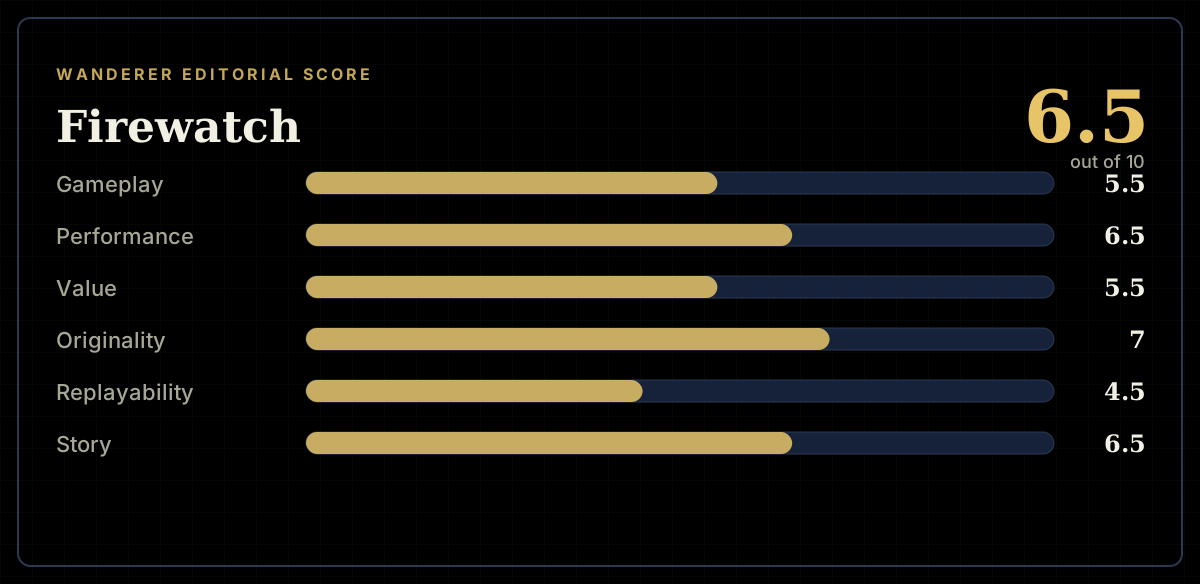
How the review scores each part of the gameWanderer Editorial -
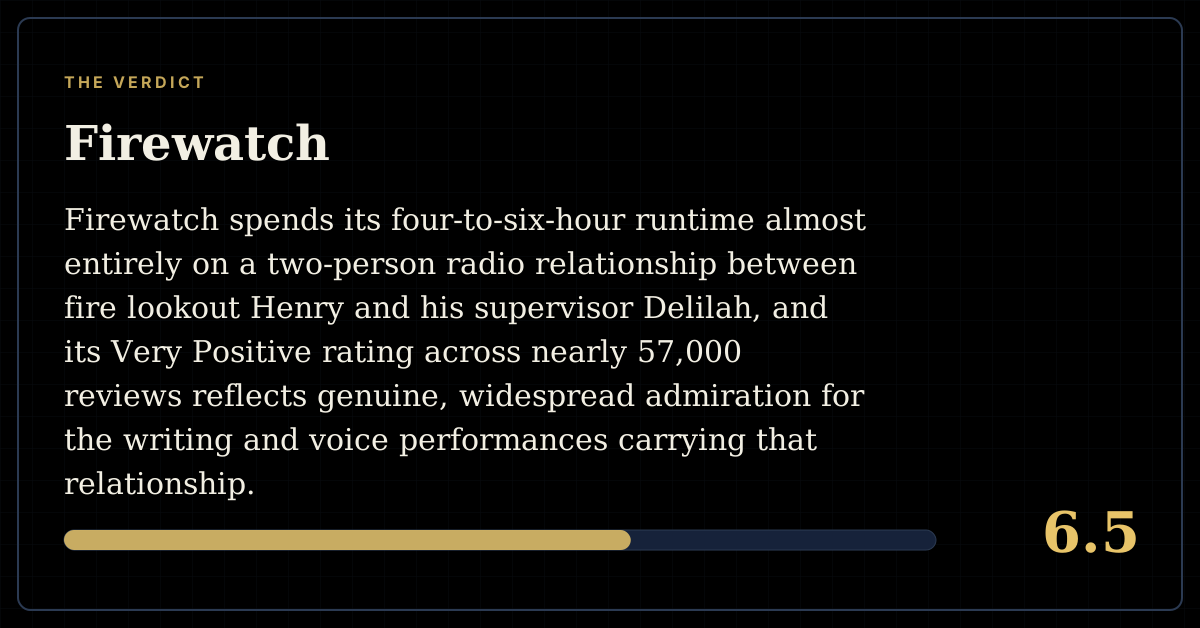
The short versionWanderer Editorial