
Game review
IMMORTALITY
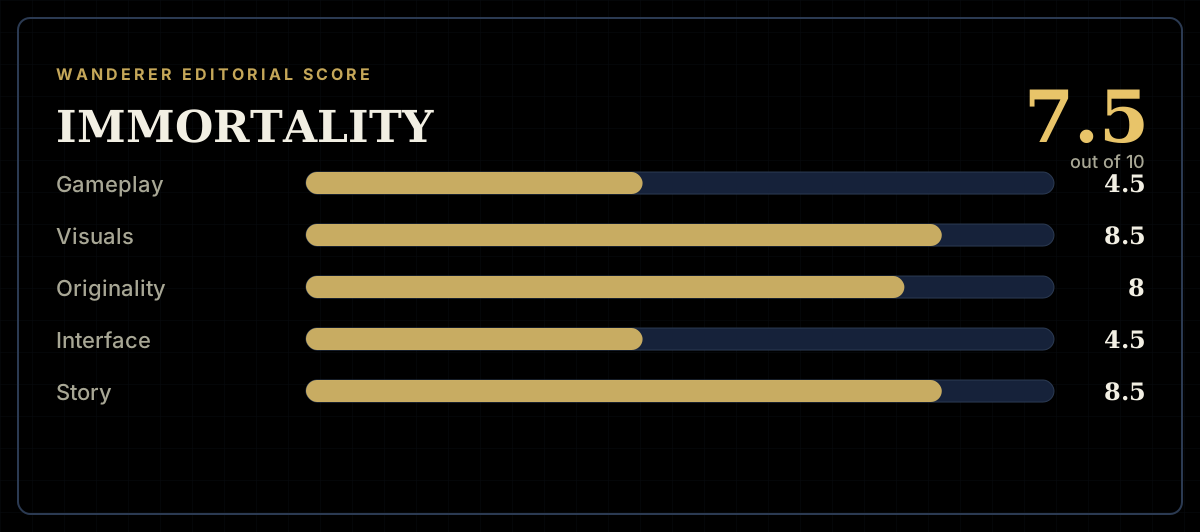
7.5 / 10
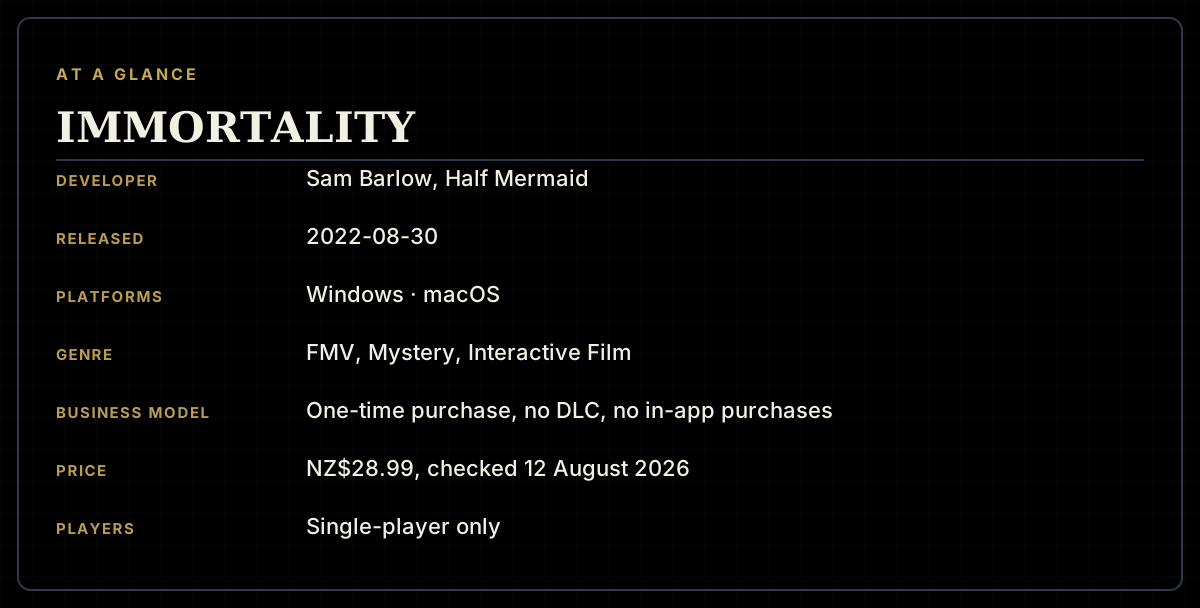
- Developer
- Sam Barlow, Half Mermaid
- Publisher
- Half Mermaid
- Released
- 30 August 2022
- Platforms
- Windows, macOS
- Genre
- FMV, Mystery, Interactive Film
- Monetisation
- One-time purchase, no DLC, no in-app purchases
- Players
- Single-player only
The short version
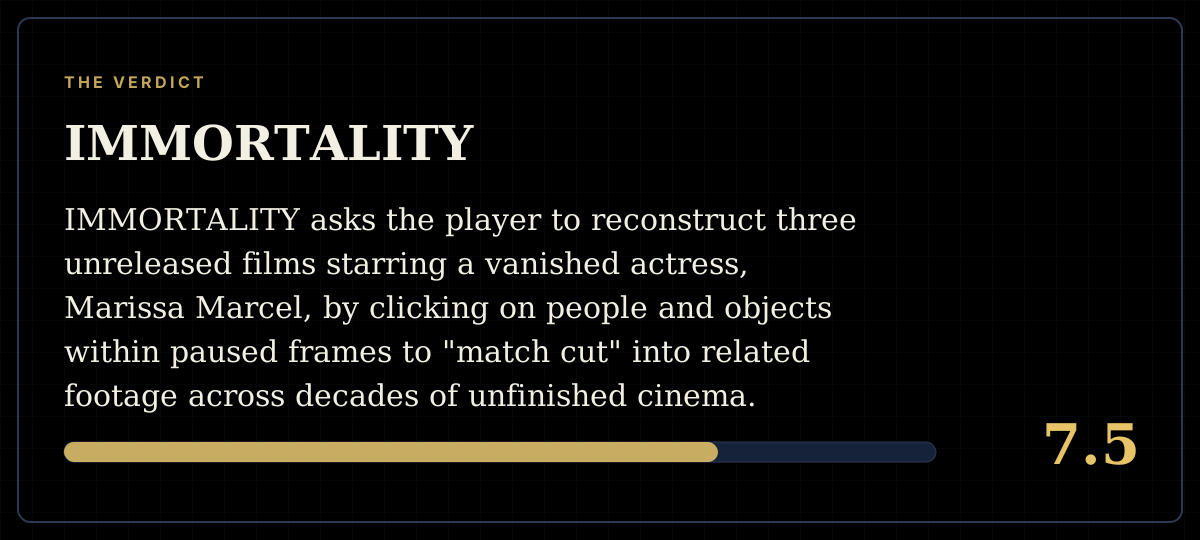
IMMORTALITY asks the player to reconstruct three unreleased films starring a vanished actress, Marissa Marcel, by clicking on people and objects within paused frames to "match cut" into related footage across decades of unfinished cinema. Developed by Sam Barlow — creator of Her Story and Telling Lies — and his studio Half Mermaid, it released 30 August 2022 and sits at Very Positive, 83.2% across 1,280 English-language reviews. The writing, acting and sheer ambition of the concept draw genuinely passionate, specific praise, with reviewers repeatedly reaching for David Lynch as the closest comparison. Set against that is an unusually consistent, detailed criticism running through most of the negative sample: the match-cut mechanic that replaces Her Story's keyword search, this review's central interaction, is widely described as directionless and repetitive compared to the deductive satisfaction of Barlow's earlier work.
Biggest strengths
- Writing, performances and production values draw consistently passionate, specific praise, with reviewers repeatedly invoking David Lynch and describing individual clips as feeling like genuine fragments of real, unreleased films rather than game footage
- The three-film structure and decades-spanning mystery are credited by a large share of reviewers as genuinely ambitious storytelling that rewards patience and attention to detail
- A distinctive, inventive premise — turning the act of filmmaking and editing itself into the core interaction — that several reviewers argue is unlike anything else in the genre
Biggest weaknesses
- The match-cut navigation system — clicking objects or faces within a paused frame to jump to a related clip — is described by a large, detailed share of the negative sample as directionless and lacking the clear deductive logic of Her Story's keyword search, with several reviewers specifically naming this as their central disappointment
- The interface gives no indication of whether a newly reached clip is one the player has already seen, which multiple reviewers say makes systematically working through the collection unnecessarily frustrating
- Several detailed reviews argue the story's momentum stalls once its central twist becomes clear, echoing a similar structural criticism some reviewers raised about Her Story
Who it's for: Fans of ambitious, auteur-driven interactive narrative who value atmosphere and performance over clear mechanical direction; a poor fit for anyone who specifically loved Her Story's investigative keyword-search structure and expects a similar feeling here.
Our recommendation: An extraordinarily ambitious, beautifully acted piece of interactive filmmaking whose core mechanic asks something genuinely different from its acclaimed predecessor — go in knowing that, and judge the trade honestly rather than assuming it's simply Her Story again.
7.5 / 10
Introduction
IMMORTALITY asks the player to piece together the mystery behind Marissa Marcel, an actress who starred in three films across four decades — none of which were ever released — by watching and navigating full-motion video footage, clicking on faces and objects within a paused frame to "match cut" into a related scene elsewhere in the archive. Developed by Sam Barlow, creator of the acclaimed FMV mystery Her Story and its follow-up Telling Lies, alongside his studio Half Mermaid, it released 30 August 2022 and sits at Very Positive, 83.2% across the 1,280 English-language reviews this review draws from. This is a genuinely ambitious, widely admired piece of interactive storytelling. What this review needs to weigh honestly is a specific, detailed criticism that recurs across a large share of its negative sample, aimed less at the writing than at the single mechanic the player spends the most time actually doing.
An auteur's most ambitious swing
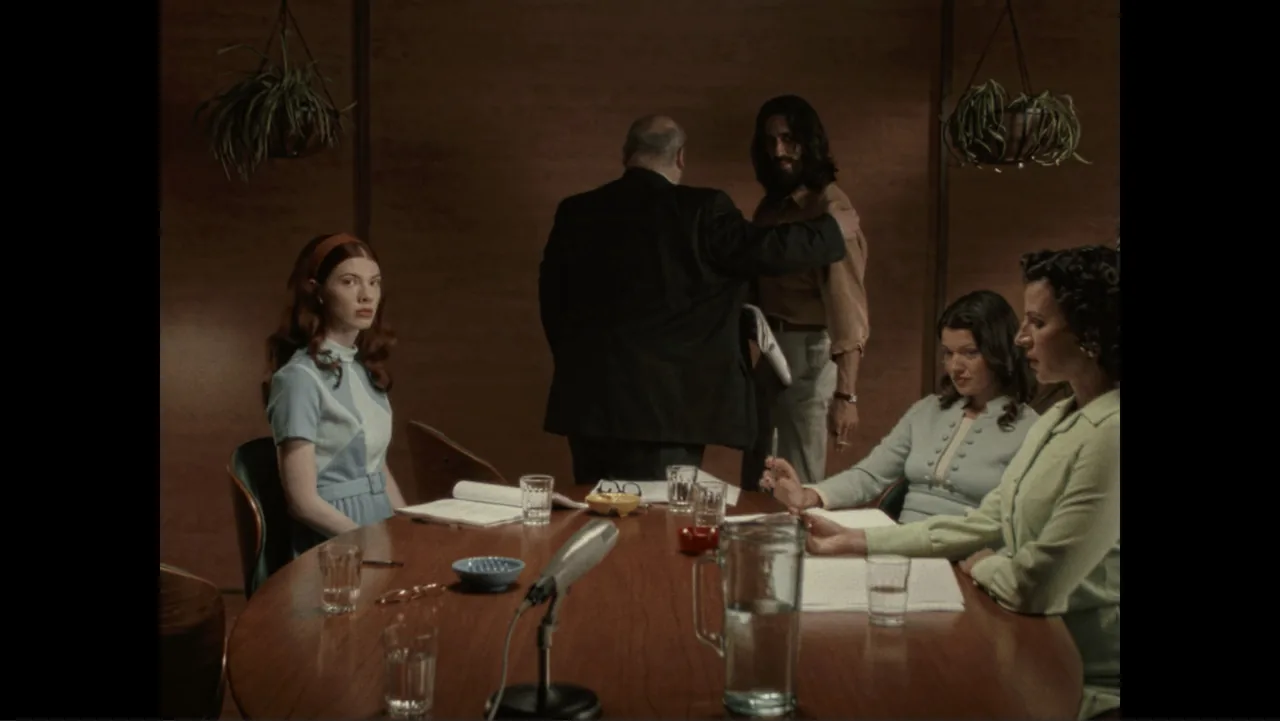
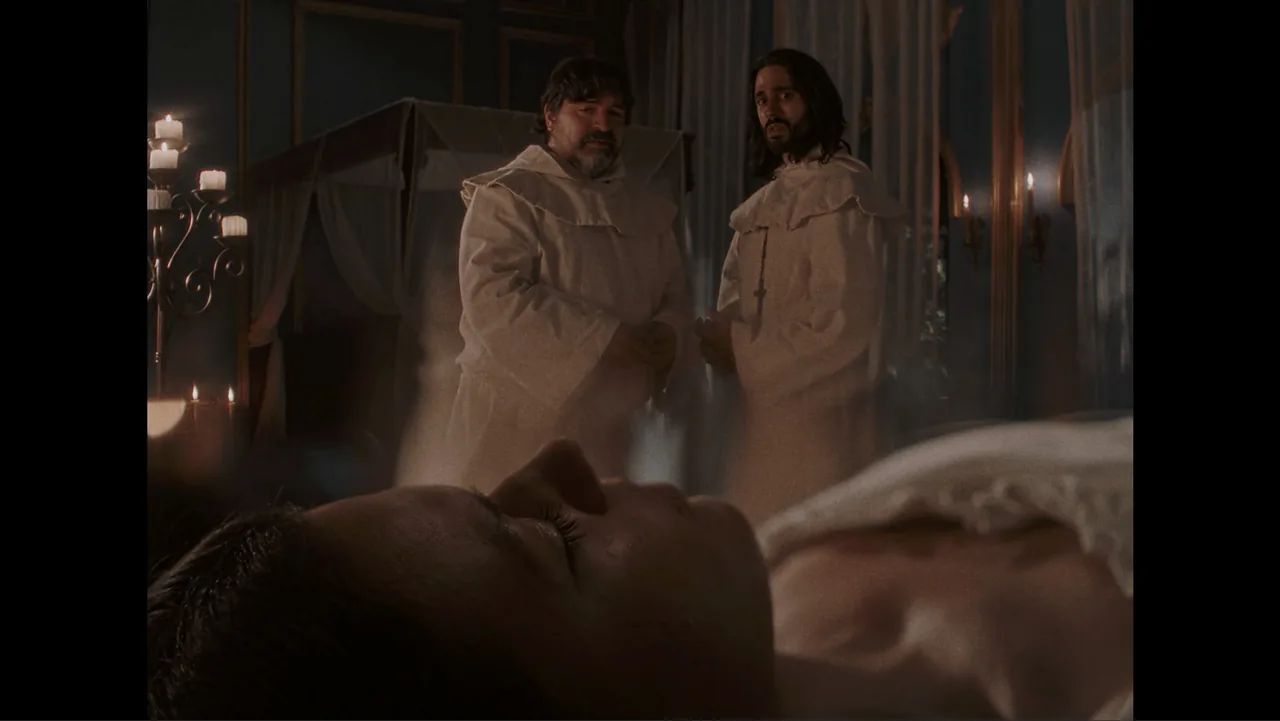
Start with what draws the clearest, most passionate praise in this corpus. Reviewers describe the acting, writing and craft of the three fictional films at IMMORTALITY's centre with real specificity, repeatedly noting that individual clips feel like genuine fragments of unreleased cinema rather than game footage assembled for the purpose. David Lynch comparisons recur so often across the positive sample that they function as a shared shorthand rather than a stretch — one reviewer, discussing the influences visible across the three in-universe films, named Black Narcissus, Basic Instinct and especially Mulholland Drive directly, describing the game's fixation on "the voyeurs behind the camera" as the clearest throughline. Another reviewer described the premise precisely: this is "the only game I've ever played that really deserves to be called an 'interactive movie,'" arguing it discards the usual choose-your-own-adventure branching structure in favour of turning the act of filmmaking and editing itself into the core gameplay. That's a genuinely distinctive pitch, and the reviewers who connect with it describe an experience that consumed their thoughts for days after finishing.
The mechanic Her Story fans keep measuring it against
Here's the specific, detailed criticism worth centring this review on, because it's raised with unusual consistency by reviewers who otherwise respect what Barlow was attempting. Her Story, Barlow's earlier and widely beloved game, was built around a keyword-search mechanic that gave the player a clear, deductive tool: type in a word, watch every clip that mentions it, form a hypothesis, refine the search. IMMORTALITY replaces that with match-cutting — clicking on visual elements within a frame to jump elsewhere — and a large share of the negative sample argues this loses exactly the thing that made the earlier game satisfying. One detailed 45-vote review put it directly: "the actual gameplay is a huge step down from Her Story," contrasting the keyword search's clear logic with match-cutting's comparatively arbitrary, trial-and-error feel. Another, 72-vote review described spending "plenty of hours" clicking through the archive while "still feeling like" progress wasn't meaningfully directed by anything the player understood, rather than building toward a hypothesis the way Her Story's searches did. A third reviewer summarised the practical frustration bluntly: "the game is too random, you just click things hoping that a new clip appears, without any logic."
A closely related, more concrete complaint concerns the interface itself: multiple reviewers report that reaching a new clip gives no indication of whether it's genuinely new or one already seen, which several describe as making any attempt at systematic, thorough exploration of the archive needlessly frustrating rather than rewarding. This is a specific, fixable interface gap distinct from the broader mechanical-design debate above, and it's worth separating the two: reviewers object both to what the mechanic asks of them and to how poorly the interface supports even engaging with it on its own terms.
Fair warning, both directions
What's notable about this corpus is how many reviewers, on both sides, explicitly try to calibrate other buyers' expectations before they purchase — a pattern this review has seen elsewhere but rarely this consistently. A 276-vote review opened with a direct framing device: "What you enjoy about Her Story (and maybe Telling Lies) will very much affect your enjoyment of this game. If you enjoyed the acting, the non-linear storytelling, and the movie part of those games, this will probably be the best in the trilogy. HOWEVER, if you enjoy the detective" aspect specifically, expectations should be different. A positive review made the identical point from the other direction, cautioning that going in "relatively blind" and judging the game on its own terms — rather than as a direct sequel to Her Story's mechanics — is the fairest way to approach it. Both framings are honest, specific, and worth passing on directly rather than resolving into a single verdict this review would be overstating its authority to make on the reader's behalf.
Where the story itself draws criticism
A smaller, separate complaint concerns narrative pacing rather than mechanics: several detailed reviewers argue the story's momentum stalls once its central conceptual twist becomes clear, echoing a criticism some of the same reviewers raise about Her Story's own late-game pacing. That's a fair, specific point about structure rather than ambition, and it's worth noting as a real, if secondary, thread in the criticism running alongside the mechanical debate above.
Final Verdict
IMMORTALITY is an extraordinarily ambitious piece of interactive filmmaking — the writing, acting and sheer craft of its three fictional films earn the David Lynch comparisons this corpus reaches for constantly, and Sam Barlow's willingness to build an entirely new interaction system rather than simply repeating Her Story's mechanics deserves real credit as an artistic choice. What keeps this from an even stronger score is that the choice itself draws detailed, specific, and remarkably consistent criticism from a meaningful share of this game's own audience, who found match-cutting a genuinely worse tool for engaging with a mystery than the keyword search that made Barlow's earlier work beloved. If you're drawn to this for the writing, atmosphere and ambition, there's something here unlike almost anything else available. If what you actually loved about Her Story was the feeling of being a detective with a working method, know going in that IMMORTALITY is asking you to feel something different instead.
Pros and cons
Pros
- Writing, performances and production values draw consistently passionate, specific praise, with reviewers repeatedly invoking David Lynch and describing individual clips as feeling like genuine fragments of real, unreleased films rather than game footage
- The three-film structure and decades-spanning mystery are credited by a large share of reviewers as genuinely ambitious storytelling that rewards patience and attention to detail
- A distinctive, inventive premise — turning the act of filmmaking and editing itself into the core interaction — that several reviewers argue is unlike anything else in the genre
- No DLC, no in-app purchases and a clean one-time price for a genuinely substantial amount of footage and content
Cons
- The match-cut navigation system — clicking objects or faces within a paused frame to jump to a related clip — is described by a large, detailed share of the negative sample as directionless and lacking the clear deductive logic of Her Story's keyword search, with several reviewers specifically naming this as their central disappointment
- The interface gives no indication of whether a newly reached clip is one the player has already seen, which multiple reviewers say makes systematically working through the collection unnecessarily frustrating
- Several detailed reviews argue the story's momentum stalls once its central twist becomes clear, echoing a similar structural criticism some reviewers raised about Her Story
- A specific, repeated warning across the positive sample cautions that going in with prior affection for Her Story's mechanics specifically, rather than its tone or ambition, sets up likely disappointment
Screenshots
-

IMMORTALITYImage: Half Mermaid via Steam -
IMMORTALITYImage: Half Mermaid via Steam -
IMMORTALITYImage: Half Mermaid via Steam -
How the review scores each part of the gameWanderer Editorial -
The essentials at a glanceWanderer Editorial -
The short versionWanderer Editorial