
Game review
Beastro
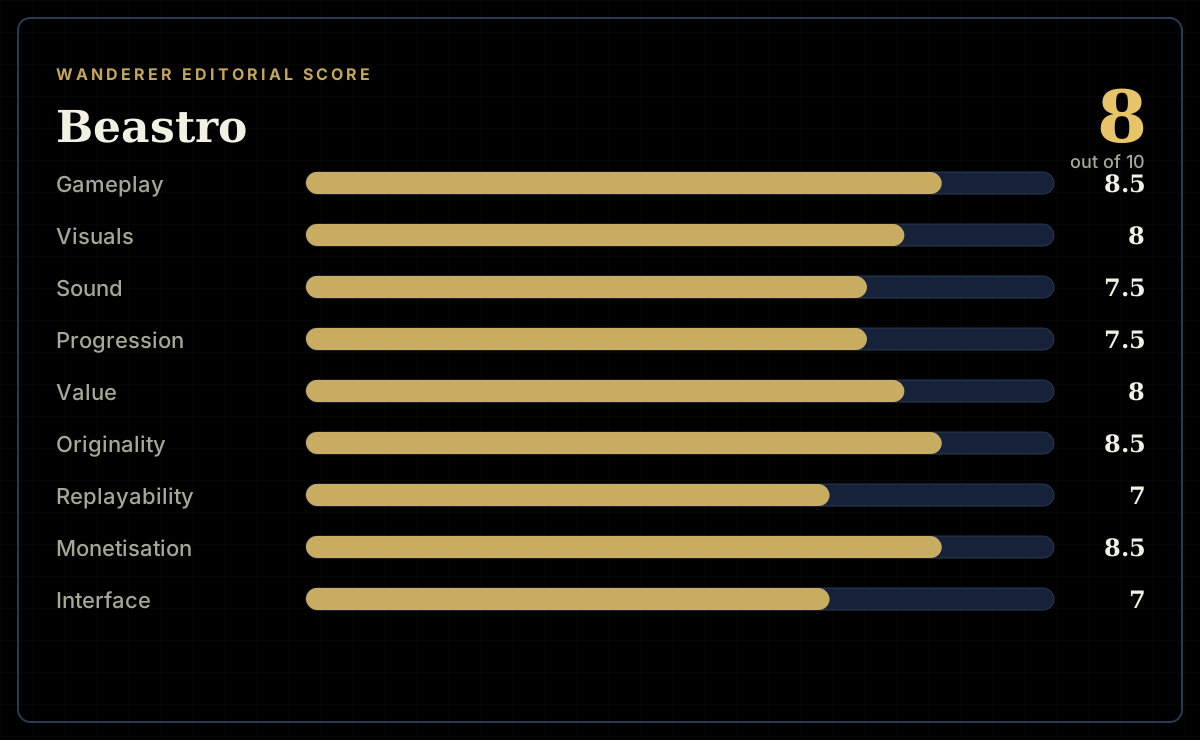
8 / 10
- Developer
- Timberline Studio
- Publisher
- Timberline Studio, Kepler Ghost
- Released
- 11 June 2026
- Platforms
- Windows, PlayStation 5, Xbox Series X|S
- Genre
- Cooking Sim / Deckbuilder RPG
- Monetisation
- Premium, one-off purchase on Steam, PlayStation and Xbox; also included at no extra cost with an active Xbox Game Pass Ultimate or PC Game Pass subscription; no in-app purchases, energy systems or loot boxes found in the base game
- Players
- Single-player only
The short version
Beastro's pitch sounds like a gimmick — grow vegetables, cook them into soup, then go fight monsters with cards made of that soup — but the mechanic underneath is real. Every ingredient maps to a flavour suit, the dominant flavour in a served meal becomes the trump suit for that fight, and a Caretaker's whole deck is whatever you decided to cook for them that morning. Restaurant choices aren't a resource tax paid before the "real" game starts; they're where the deckbuilding actually happens.
It's held back by a tutorial that teaches button prompts long before it teaches why any of this matters, a mid-game stretch where the daily gather-cook-serve routine outruns the roster's variety, and boss fights that occasionally punish an under-stocked pantry harder than a misplayed trick. None of that undoes a genuinely clever structural idea, but it stops the execution from matching it.
Biggest strengths
- Every ingredient you grow or forage maps to a specific flavour suit, and a meal's dominant flavour becomes the trump suit for that fight — restaurant decisions carry real tactical weight instead of just unlocking a shop
- Trick-taking combat, borrowed from Spades and Hearts rather than the usual lane-based deckbuilder template, gives the card layer its own identity
- Puppet-theatre recap sequences turn a Caretaker's off-screen mission into a genuine narrative payoff rather than a loading-screen results summary
Biggest weaknesses
- The early tutorial explains chopping and frying prompts well before it explains why trump suits or a Caretaker's flavour cravings matter, so the central hook takes hours to click for a lot of players
- Once the opening Caretaker roster is unlocked, the gather-cook-serve daily loop repeats for a noticeable stretch before a new flavour region adds real variety
- Some boss encounters read as a pantry check rather than a card-play test — arrive without the right flavour stocked and the fight is close to unwinnable regardless of how well the tricks are played
Who it's for: Players who want a cozy sim with actual mechanical teeth, and deckbuilder fans curious about a trick-taking structure that isn't chasing Slay the Spire's shadow.
Our recommendation: Worth buying outright at $14.99 during the current discount, and an easy call for anyone already paying for Xbox Game Pass Ultimate or PC Game Pass, where it's included at launch.
8 / 10
What's for dinner decides what's in your deck
Most games that mash a management sim into a combat system treat the first half as a tollbooth. Grow the crops, hit the daily quota, unlock the next unit, and the actual game — the fighting — starts once the busywork clears. Beastro's whole premise is that this division shouldn't exist, and for the most part it makes good on that.
You play Panko, a young chef running the kitchen in Palo Pori after her mentor vanishes and a stranger arrives warning of monsters massing beyond the village wall. The people you're actually cooking for are the Caretakers — the adventurers who go out and fight those monsters — and every dish you serve one of them becomes their deck. Not metaphorically: an ingredient's flavour profile determines which card it produces, a recipe's dominant flavour sets the trump suit for whatever fight follows, and a Caretaker who's been fed nothing but bitter greens is going to play a very different hand than one who's had three sweet courses in a row. Farming, foraging and the cooking minigames aren't feeding a separate progression currency that buys cards later. They're the card creation.
That's a stronger link than most games in this space bother building. Cult of the Lamb ties its cult-management half to its dungeon-crawling half through resource funding and buffs, which is fine but indirect — you're managing a budget, not making combat decisions. Beastro's cooking phase is closer to deck construction in the literal sense: pick the ingredients, pick the technique, and you've picked your hand before the fight begins.
Trick-taking with a flavour twist
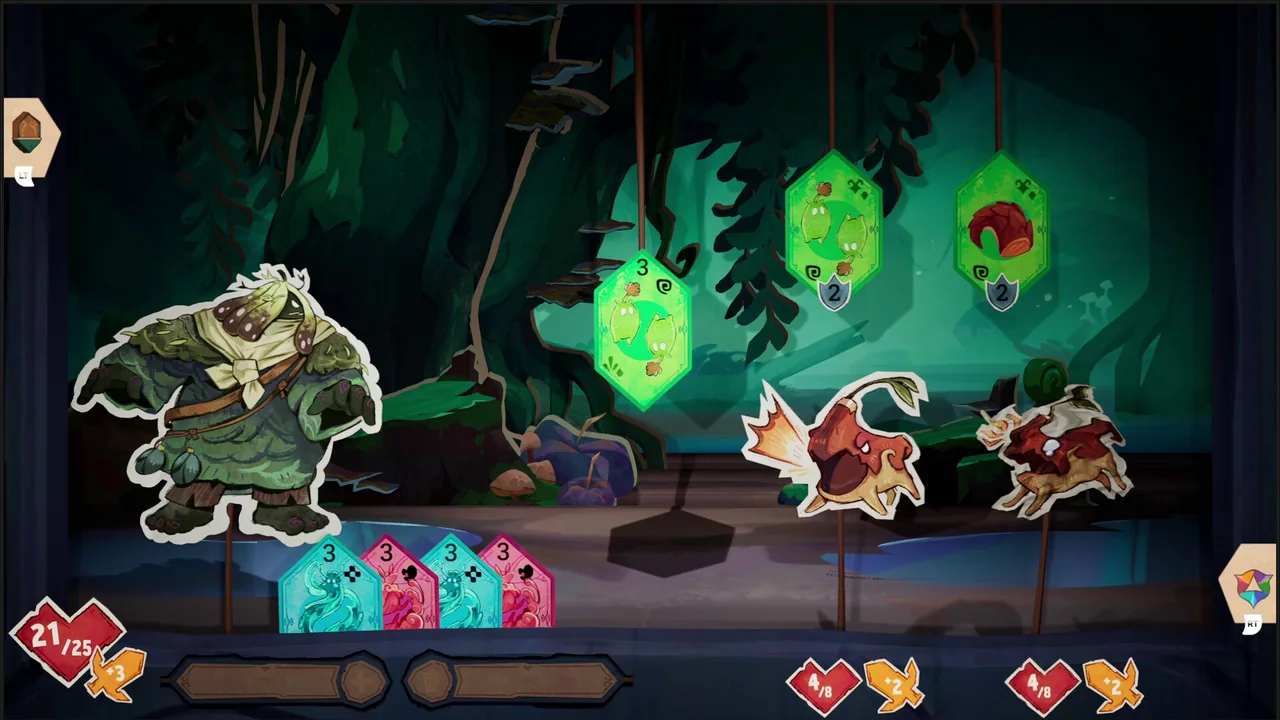
The combat layer itself skips the Slay the Spire template almost every deckbuilder since 2019 has leaned on. Instead of a mana-and-lanes system, Beastro borrows its structure from trick-taking card games like Spades and Hearts. Each round, a Caretaker and a monster both play a card into a shared trick; the highest card of the leading flavour wins it. The trump suit — set, as above, by whatever you served that morning — beats everything outside it regardless of printed value, which means a low-value trump card can outclass a monster's strongest play.
Beyond that, cards fall into three functional roles: match an opponent's flavour outright, neutralise it with a balancing card, or stack a boosting card to push a flavour's effect further. It's a tidy ruleset once it's explained — deliberately simpler on paper than most CCG-adjacent deckbuilders — and the puppet-theatre presentation that plays out each trick gives fights a personality that a stack of static card art usually can't. Where it runs into trouble is pacing: several outlets covering the game at launch noted that the actual depth of the trick-taking system doesn't surface until several hours in, once the ingredient variety and Caretaker roster have grown enough to make trump-suit planning a real decision instead of an obvious one. The opening hours play more like a light card minigame than the tactical system it eventually becomes.
The daily grind between adventures
The restaurant side runs on a familiar cozy-sim rhythm: tend crops and animals, forage the areas around the village, prep ingredients through chopping, frying and baking minigames, then serve the Caretakers who show up wanting a meal before heading out. Early on this is genuinely charming — each Caretaker hails from their own flavour region with distinct cravings, and matching a craving does more than make them happy, it unlocks abilities tied to that flavour.
The friction shows up in the middle stretch, after the opening roster is established but before new flavour regions and Caretakers arrive to refresh the ingredient list. For a run of in-game days, the loop of gather-cook-serve-repeat starts to feel like exactly the tollbooth the game is trying to avoid, because the deck-construction payoff is real but the palette you're constructing from hasn't grown yet. It's a pacing problem rather than a design one — the mechanical link between kitchen and combat never breaks down — but it means the game asks for patience through its least interesting hours before the systems fully open up.
Where the systems show their seams
Two structural issues follow from that same root cause: the game trusts players to infer connections it hasn't clearly taught yet. The tutorial spends real time on which button chops a carrot and comparatively little on why a Caretaker's flavour craving or a fight's trump suit matters, so a meaningful chunk of players report the actual hook — that cooking is deckbuilding — taking hours to land rather than the opening act it should be.
The second issue is sharper: some boss encounters can turn into a pantry check. Arrive without the right flavour stocked in sufficient quantity, and a fight stops feeling like a tactical mismatch you could have played around and starts feeling like a wall that only "doing the grind" gets you past. That's a rougher edge than the trick-taking itself deserves, since the card rules are otherwise fair and readable. A related complaint from console reviewers is power creep on the Caretaker roster — characters recruited early can fall behind as tougher regions raise the difficulty bar, which discourages exactly the roster rotation the flavour-region structure is built to reward.
None of this undoes the central idea. It's the difference between a game whose two halves are mechanically married — which Beastro clearly is — and a game that has fully smoothed out the handoff between them, which it hasn't quite managed yet.
Presentation and the puppet theatre
Beastro's visual identity leans into a warm, storybook aesthetic that suits both halves of the game — the restaurant and village scenes read like a cozy farming sim, while the puppet-theatre staging used to recap each Caretaker's mission gives the combat half its own distinct, handcrafted look rather than reusing the farm's art language wholesale. It's a smart way to signal "this is the game's other mode" without a jarring tonal swing. Character writing carries a similar warmth — Caretakers read as individuals with real preferences rather than reskinned stat blocks, which matters in a game where remembering what someone likes to eat is itself a mechanic.
Value and where to play it
At $19.99 list — currently discounted to $14.99 — Beastro sits comfortably in the price band this kind of scoped indie hybrid should occupy, and the lack of any microtransaction layer, energy system or loot box means that price is the entire transaction. The more interesting business decision is showing up day one on Xbox Game Pass Ultimate and PC Game Pass: for subscribers already paying for either service, there's no reason not to try it, and the tutorial's slow start matters a lot less when trying the game costs nothing extra. Full controller support across Steam, PlayStation 5 and Xbox Series X|S makes it comfortable on a couch regardless of platform, though PC players should note it's Windows-only for now, with no Mac or Linux build.
Verdict
Beastro earns the harder half of its premise. The cooking-to-combat pipeline isn't cosmetic dressing on a generic deckbuilder — ingredients genuinely become cards, meals genuinely set trump suits, and the restaurant half of the game is where the strategic decisions actually get made. That puts it ahead of most games that try to staple a management sim onto a combat system and hope the seam doesn't show.
What keeps it from climbing higher is execution around that idea rather than the idea itself: a tutorial that under-sells its own best mechanic, a mid-game lull before the ingredient palette catches up to the trick-taking system's real depth, and boss fights that occasionally substitute pantry stock for tactical play. Patient players who push through the opening hours get a genuinely distinctive card game wrapped in a genuinely charming restaurant sim. Players looking for either half in isolation — a pure trick-taking deckbuilder or a pure cozy farm sim — will find the other half taking up real space in the design, because that's the entire point.
Players who like progression systems that keep working while other systems are the point of focus may also want to look at Wanderer, which runs its own combat and skill progression whether or not you're actively at the keyboard.
Pros and cons
Pros
- Every ingredient you grow or forage maps to a specific flavour suit, and a meal's dominant flavour becomes the trump suit for that fight — restaurant decisions carry real tactical weight instead of just unlocking a shop
- Trick-taking combat, borrowed from Spades and Hearts rather than the usual lane-based deckbuilder template, gives the card layer its own identity
- Puppet-theatre recap sequences turn a Caretaker's off-screen mission into a genuine narrative payoff rather than a loading-screen results summary
- No microtransactions, energy timers or loot boxes anywhere in the purchase, and it's included at no extra cost for Xbox Game Pass Ultimate and PC Game Pass subscribers from day one
- Full controller support across all three platforms, with menus and minigames clearly designed for a gamepad first
Cons
- The early tutorial explains chopping and frying prompts well before it explains why trump suits or a Caretaker's flavour cravings matter, so the central hook takes hours to click for a lot of players
- Once the opening Caretaker roster is unlocked, the gather-cook-serve daily loop repeats for a noticeable stretch before a new flavour region adds real variety
- Some boss encounters read as a pantry check rather than a card-play test — arrive without the right flavour stocked and the fight is close to unwinnable regardless of how well the tricks are played
- Power creep leaves early-recruited Caretakers falling behind once tougher regions raise the bar, discouraging the roster variety the game otherwise wants you to use
- Windows only on PC, with no Mac or Linux build at launch
Screenshots
-

BeastroImage: Timberline Studio via Steam -

BeastroImage: Timberline Studio via Steam -
BeastroImage: Timberline Studio via Steam -
How the review scores each part of the gameWanderer Editorial -
The short versionWanderer Editorial