
Game review
Roach Post
7.3 / 10
- Developer
- KARP GAMES
- Publisher
- KARP GAMES
- Released
- 17 February 2026
- Platforms
- [Windows, macOS]
- Genre
- Puzzle
- Monetisation
- Paid
- Players
- Single-player only
The short version
Roach Post takes the Balatro formula of a simple core rule that hides real depth and gives it a genuinely fresh spin: Tetris-shaped stamps, colour-adjacency scoring, and a cast of hireable roach workers standing in for the usual roguelike upgrade trinkets. It's a first game from a new studio, and it shows in a few rough edges — a single music track, some unclear adjacency rules, and thinner long-term variety at lower difficulties — but the puzzle-roguelite loop itself is described almost unanimously as addictive, well-balanced, and full of ideas.
Biggest strengths
- A genuinely fresh mechanical hook — placing multi-coloured, Tetris-shaped stamps for adjacency bonuses — that multiple reviewers say offers "a unique spin" on the roguelite-puzzle genre
- Deep enough that optimising stamp placement and roach-worker choices becomes a real strategic puzzle at higher difficulties, without losing its easy-to-learn cozy charm
- A large variety of hireable roach-workers means runs play out differently depending on what's on offer, similar to trinket or relic systems in other roguelites
Biggest weaknesses
- Only one music track is currently in the game, a gap several reviewers specifically flag as needing more variety
- Some adjacency and scoring rules are described as unintuitive at first, requiring trial and error to fully understand which stamp colours synergise or clash
- Once a difficulty tier is mastered after a few runs, there isn't much new to discover without stepping up to a harder setting
Who it's for: Fans of Balatro-style "simple rules, deep systems" roguelites and pentomino/fitting puzzles who want a cozy, low-stakes wrapper around genuinely demanding strategic decisions.
Our recommendation: Highly Recommended
7.3 / 10
A Post Office Run by Roaches, and a Stamp Puzzle With Real Teeth
Roach Post casts players as the newest recruit of the Royal Postal Academy, tasked with restoring an abandoned post office one delivery at a time. The framing is charming and a little absurd — hire a growing staff of small, industrious roach-workers to help run the place, welcome customers, and pass the occasional inspector's check — but the core of the game is a tightly designed puzzle loop that reviewers describe as far more demanding than the cozy premise suggests. Players deliver packages by placing Tetris-shaped, multi-coloured stamps onto a grid, scoring points through colour adjacency: place complementary colours next to each other and scores climb, place clashing ones and the run suffers. One reviewer sums up the appeal succinctly, describing it as "Patchwork + Balatro + Super Auto Pets," a combination that captures both the shape-fitting puzzle layer and the roguelite deckbuilding-adjacent structure sitting on top of it.
That structure comes from the roach-workers themselves, who function much like the relic or trinket systems found in other roguelikes: each hired roach modifies stats or fundamentally changes how a run plays out, and with "a large variety" of them available, no two runs unfold quite the same way. Between deliveries, players choose from three available packages of varying difficulty, weighing bigger rewards against the risk of running out of "licks" (the game's resource for placing stamps) and losing reputation on a failed delivery. Enough reputation loss ends a run outright, and on harder difficulties, losing to a boss fight ends things immediately rather than allowing for a recovery — a design choice more than one reviewer recommends new players learn around by starting on easy or normal before pushing further.
Simple to Learn, Genuinely Hard to Master
The recurring theme across nearly every review in the sample is how much depth the game hides behind an approachable, cozy exterior. "Interesting game! It has a lot more depth and complexity than I expected," reads one typical reaction, while another describes the loop as "unexpectedly addictive," walking through the core tension of maximising adjacency bonuses while working within a limited set of stamps and discards. A longer, more analytical review frames it as a strong entry in the tactical-roguelike space specifically because of how its geometry and positioning systems interact: "if you have played so many roguelikes and ask yourself why you need to buy another, this one gives very good answers." Several reviewers who put double-digit hours in describe the game scaling its challenge well as difficulty increases, reaching a point where runs feel demanding without tipping into frustration — one reviewer calls that balance "a fine line" that Roach Post successfully walks.
The developer's inexperience shows up in a few places without derailing the experience. One detailed review, explicitly noting this is the studio's first game, still calls the overall result "solid," while flagging specific rough edges: only a single music track currently exists, and while the core stamp-adjacency rules are learnable, several reviewers describe an early period of trial and error before it's clear which colour combinations actually synergise and which quietly tank a score.
A Loop That Rewards Repeat Runs, But Only So Far
Longevity draws a more mixed response than the core mechanics themselves. Some reviewers who've spent 10 or more hours with the game describe higher difficulties as where it truly shines, offering "a good amount of depth to keep you coming back for more," with one self-described world record holder on the leaderboards admitting the balance isn't perfect but insisting the game "is very fun" regardless. Others are more measured, noting that after two or three runs at a given difficulty, there isn't a great deal more to discover unless a player is willing to step up to a harder tier — a fair criticism for a genre where build variety and escalating stakes are often the main draw for return visits. One reviewer's own suggestion list captures where players want to see the game grow: a proper endless mode for testing builds without a fixed end point, a log tracking recently placed stamp colours to help with achievement hunting, and a fix so that buying out every offered roach-worker doesn't still cost a reroll on the next offer.
A related complaint concerns difficulty balance rather than pure challenge. On harder settings, some reviewers report runs failing not through misplay but because the early roach-worker offers simply didn't include anything affordable enough to build an economy around, forcing restarts that feel more like bad luck than a fair loss. That kind of swinginess is common in roguelites still finding their footing post-launch, and several reviewers frame it as an area the developer can reasonably be expected to tune over time rather than a fundamental flaw in the design.
Rough Edges From a First-Time Studio
A smaller but specific complaint comes from Steam Deck players, who report mouse sensitivity set far too high for comfortable play, with no in-game setting currently available to adjust it — a fixable but currently unaddressed gap for a game that otherwise runs well on modest and portable hardware, including the Deck itself according to multiple reviewers. At NZ$18.99, value assessments in the sample lean positive: several reviewers explicitly frame the asking price as low relative to the hours they've already logged, with one Russian-language review translating roughly to "criminally few sales and reviews for how good this is," urging others to give it a try. Taken together, the rough edges here read less like fundamental design problems and more like the natural gaps of a first release from a small, new studio still supporting the game after launch.
Verdict
Roach Post is an impressively confident debut from a small studio, taking cues from Balatro's "simple rule, deep system" design philosophy and finding its own identity through a genuinely inventive stamp-placement puzzle and a charming cast of roach-worker hires. A single music track, some early unintuitive scoring rules, and a difficulty curve that can feel swingy at the top end are the main things holding it back from a stronger polish score, but the puzzle-roguelite loop itself earns the near-universal praise it's getting. Well worth a look for anyone chasing that "just one more run" feeling.
Pros and cons
Pros
- A genuinely fresh mechanical hook — placing multi-coloured, Tetris-shaped stamps for adjacency bonuses — that multiple reviewers say offers "a unique spin" on the roguelite-puzzle genre
- Deep enough that optimising stamp placement and roach-worker choices becomes a real strategic puzzle at higher difficulties, without losing its easy-to-learn cozy charm
- A large variety of hireable roach-workers means runs play out differently depending on what's on offer, similar to trinket or relic systems in other roguelites
- Runs well on modest hardware, including Steam Deck, making it an easy pick-up-and-play option
Cons
- Only one music track is currently in the game, a gap several reviewers specifically flag as needing more variety
- Some adjacency and scoring rules are described as unintuitive at first, requiring trial and error to fully understand which stamp colours synergise or clash
- Once a difficulty tier is mastered after a few runs, there isn't much new to discover without stepping up to a harder setting
- Higher difficulties can feel swingy, with reviewers noting runs sometimes fail due to a lack of affordable economic roach-workers appearing early rather than clear misplay
- Steam Deck players report excessively high, unadjustable mouse sensitivity with no dedicated control settings to fix it
Screenshots
-
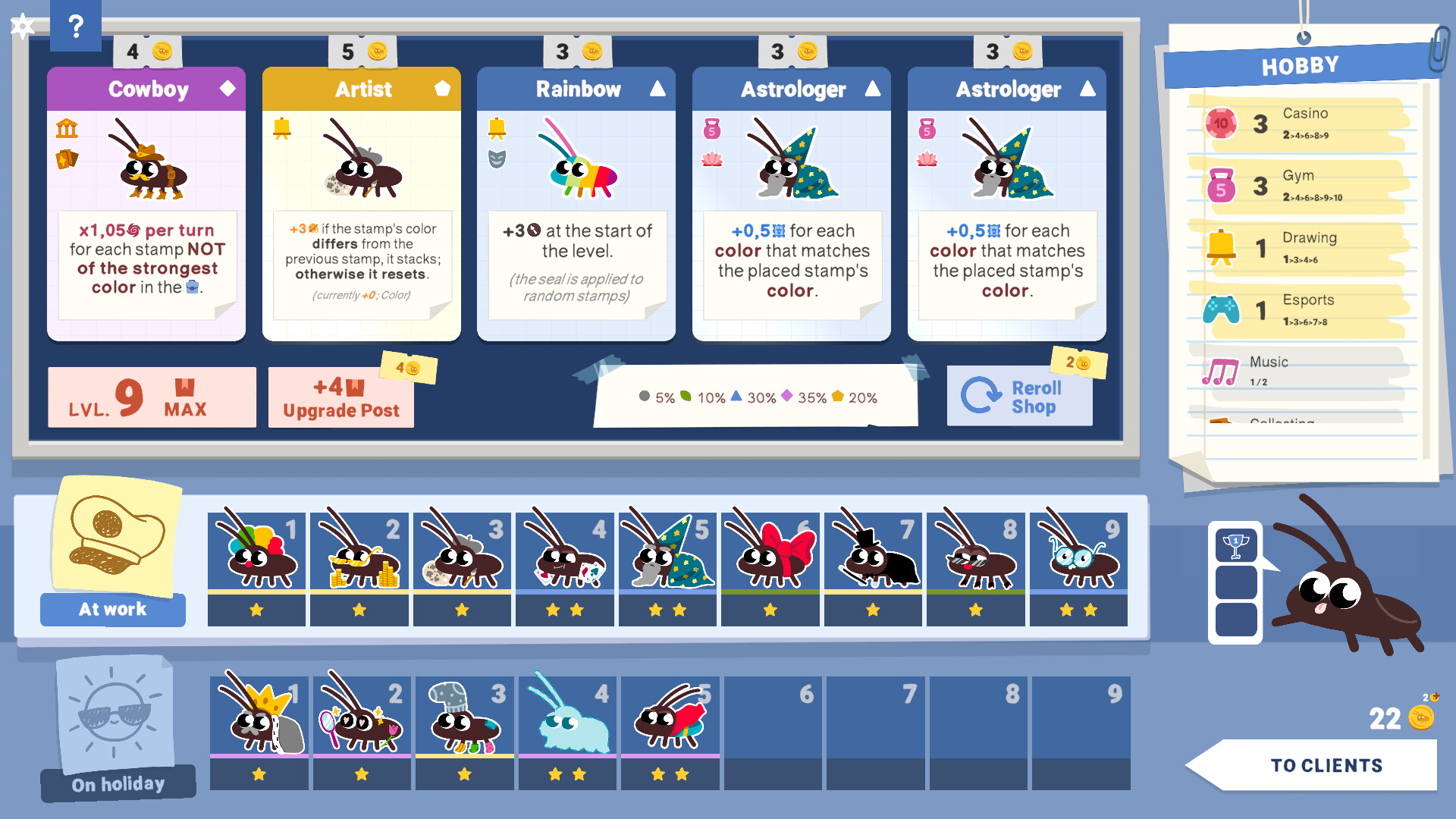
Hiring roach-workers functions much like a trinket or relic system, each one reshaping how a run plays outKARP GAMES -
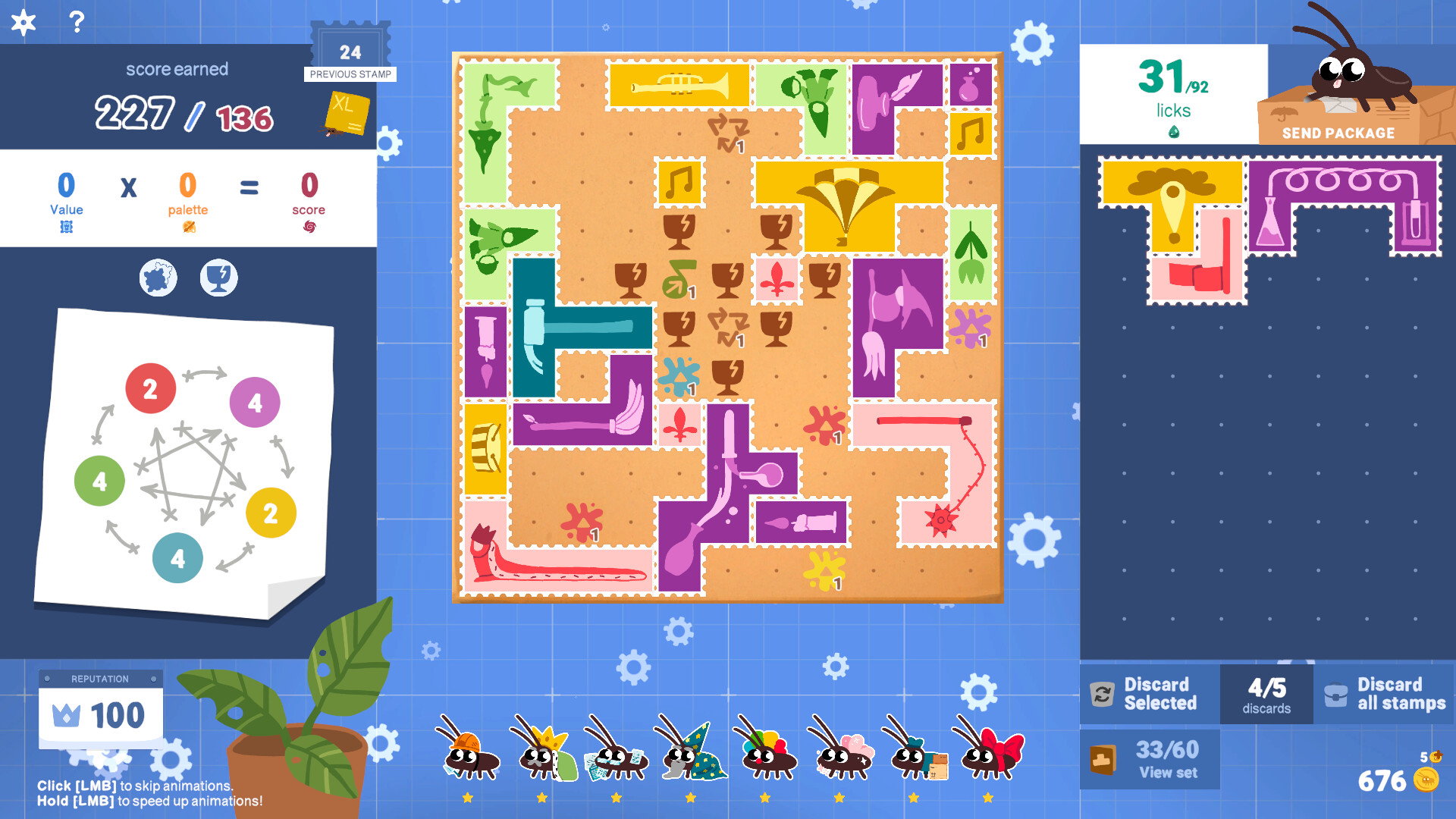
The heart of Roach Post — fitting Tetris-shaped, colour-coded stamps onto the grid for adjacency bonusesKARP GAMES -
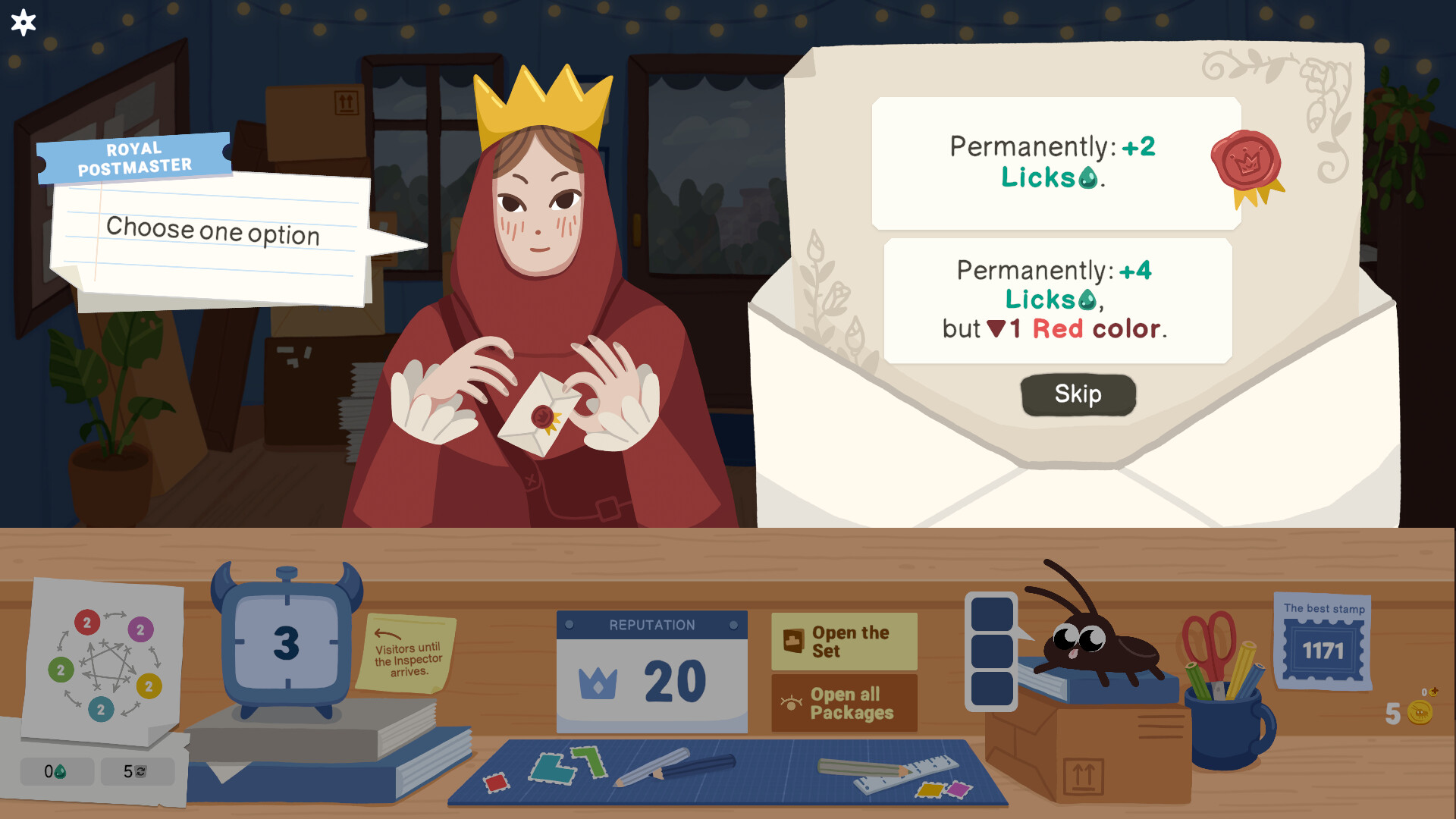
Between deliveries, the Royal Postmaster offers permanent upgrades with real trade-offs attachedKARP GAMES -
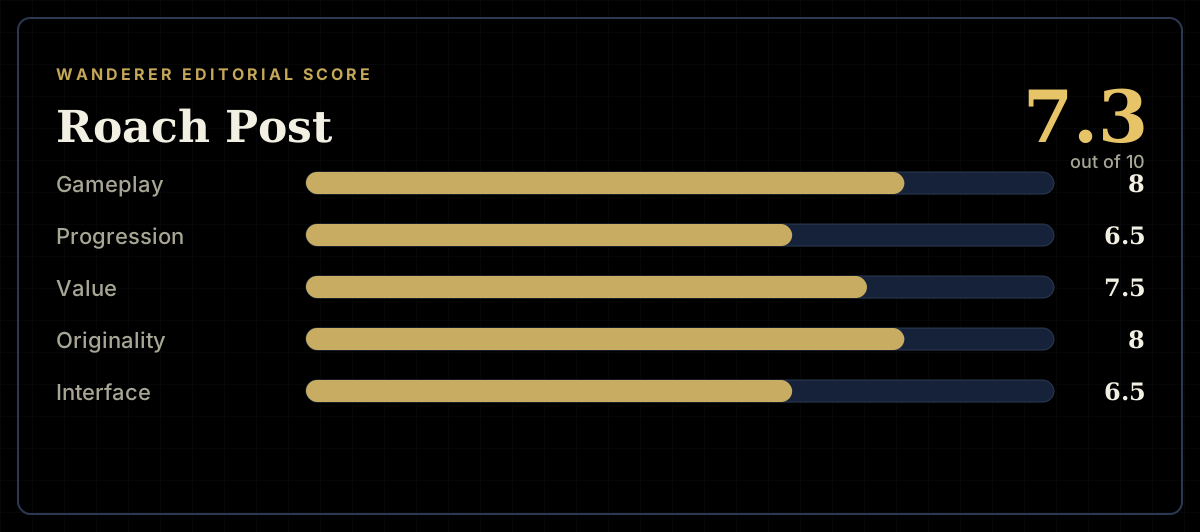
How the review scores each part of the gameWanderer Editorial -
The short versionWanderer Editorial