
Game review
Witching Stone
6 / 10
- Developer
- Alexander Taylor
- Publisher
- Alexander Taylor
- Released
- 16 September 2024
- Platforms
- Windows
- Genre
- Puzzle roguelike deckbuilder
- Monetisation
- One-time purchase, no DLC or microtransactions
- Players
- Single-player only
The short version
Witching Stone replaces the deck of cards found in most roguelike deckbuilders with a spellbook of learnable spells cast by linking matching gems on a randomly generated puzzle board. This review's sample confirms that core idea is genuinely fresh and, when it clicks, deeply satisfying to a devoted fanbase, but a remarkably consistent complaint — echoed even by many reviewers who ultimately recommend the game — describes the board's randomness as capable of leaving players with no accessible defensive options at all, a specific problem that intensifies sharply at higher difficulty tiers and with certain characters.
Biggest strengths
- The core spellbook-and-gem-board mechanic earns consistent, specific praise as a genuinely fresh alternative to standard card-drawing deckbuilders, with reviewers repeatedly describing satisfying "aha" moments when multiple spells can be chained from a single board state
- The art style and overall presentation are repeatedly singled out as charming and easy on the eyes, with several reviewers specifically praising how well the interface works with mouse controls
- The character-unlock system and hidden story elements are credited by multiple reviewers as a genuinely unique and rewarding way to expand the roster beyond a typical unlock-by-progress structure
Biggest weaknesses
- A remarkably consistent negative-review theme, echoed even by many positive reviewers, describes the board's randomness as capable of leaving players with no accessible defensive icons at all, forcing damage "through no fault of their own" rather than as a consequence of player decisions
- This review's own achievement-data check corroborates a steep difficulty spike between characters and acts directly: the second character's Act 1 completion sits at 66.0% versus 85.9% for the first, and full Act 4 completion across all characters sits at just 3.7%
- Multiple reviewers report the finished game's enemy encounters are noticeably more punishing than those in the pre-release demo, describing constant board-disrupting effects, healing, and blocking from enemies that stall out otherwise interesting fights
Who it's for: Fans of roguelike deckbuilders like Slay the Spire and Backpack Hero specifically curious about a genuinely different resource system built around puzzle-board linking rather than card draws; not a fit for players who want consistent, fair difficulty scaling free of harsh randomness spikes.
Our recommendation: Worth a purchase for deckbuilder fans specifically drawn to its inventive core mechanic, with clear expectations that later acts and certain character starts can feel unfairly punishing due to board randomness.
6 / 10
Witching Stone replaces the familiar deck-of-cards resource system found in most roguelike deckbuilders with a spellbook of learnable spells, each cast by linking matching gems across a randomly generated puzzle board. This review's sample confirms that idea is genuinely fresh and often deeply satisfying — and identifies a remarkably consistent complaint about exactly how that randomness can turn against players.
A genuinely fresh mechanic, well executed
Reviewers consistently praise the core concept as something new within a crowded genre. "This game is so charming and good, it feels like a classic. It's so easy on the eyes and ears, and is so satisfying when your build is working for you," one reviewer with over 5,400 minutes logged writes. Another draws a specific, apt comparison: "reminds me a lot of backpack hero, lots of options, cute art." A third reviewer with over 3,200 minutes describes the mechanic in detail: "Instead of a deck, you have a spellbook. You start with 2 spells and can go up to 6. They all start as available — no shuffling and drawing cards required. There is a gem grid that corresponds to the costs required to cast the spells." That level of specific, sustained engagement across the sample suggests the core idea genuinely delivers on its promise.
A remarkably consistent complaint about board randomness
Set against that praise, the single most repeated criticism in this review's sample describes the same specific frustration, appearing almost identically across independent reviews. "Extremely unbalanced and heavily dependent on RNG. On so many occasions you will be forced to take damage because there isn't even a single block icon on the board... If you don't get a healing spell or block spell early on, you're pretty much screwed through no fault of your own," one reviewer writes. Another confirms the same structural issue: "Without any consistent way of building defense or sustain, enemy encounters feel way too punishing and RNG-dependent. An unfavorable stone board can just mean eating 6 out of your 20 life before you really have an opportunity to do anything about it." Crucially, this complaint isn't confined to the negative sample: one reviewer who ultimately recommends the game states plainly that "adding the modifiers needed to get to Act 4 turns the game into an RNG slog where you die over and over until you get a sufficiently broken build."
Achievement data confirms specific difficulty spikes
This review's own check of Steam's achievement data supports these complaints with concrete numbers. The first playable character's Act 1 completion sits at 85.9%, but the second character's equivalent milestone falls to 66.0% — a specific, measurable gap consistent with reviewer reports that certain characters start in a considerably weaker position. Full Act 4 completion across all characters sits at just 3.7%, directly corroborating the "RNG slog" characterization of the game's later content.
A specific complaint about demo-versus-release difficulty
Several reviewers separately raise a pointed comparison between the pre-release demo and the finished product. "The foes I encountered in the demo were fun to fight, while those in the full version are exhausting. They will constantly disable tiles on the field, summon cannon fodder, heal themselves and block. The constant disrupting and stalling is a frustrating experience," one reviewer writes. That's a specific, checkable claim about a deliberate difficulty increase between the demo and the shipped game, and it's fair to flag directly for players who tried the demo and expect the same balance in the full release.
Character unlocks and hidden story
Beyond the core combat loop, several reviewers single out the way additional playable characters and story beats are uncovered as a genuine strength. Rather than a simple linear unlock-by-progress ladder, reviewers describe finding hidden narrative fragments and character motivations tucked into specific run outcomes, rewarding curiosity and repeated attempts with more than just mechanical variety. One reviewer specifically credits this structure with giving otherwise punishing failed runs a sense of forward momentum: even a run that ends badly can surface a piece of the wider story, which softens the sting of the randomness complaints raised elsewhere in this review's sample. That said, this same structure means the character roster most affected by the RNG-dependent difficulty spikes — particularly the second unlockable character discussed above — is also the roster gating some of that hidden narrative content, compounding frustration for players who feel locked out of story content by an unfair starting position rather than a skill gap.
What players have asked the developer to change
Across both samples, the specific fixes players request are strikingly consistent, which suggests the solo developer has a clear, actionable list rather than a vague morale problem. Reviewers repeatedly ask for a guaranteed minimum of defensive options generated per board layout, rather than the current fully unrestricted randomness; a rebalancing pass specifically for the second character's opening moves; and a difficulty curve between Acts 3 and 4 that ramps more gradually instead of the sharp wall reflected in the 3.7% full-clear achievement rate. None of these are vague "make it more fun" complaints — they are specific, implementable balance requests aimed at preserving the puzzle-board concept while smoothing its harshest edges, which is worth noting for a solo project still receiving active updates years after launch.
What the update record shows
Steam's own partner-events feed confirms genuinely sustained solo-developer support: 16 documented posts span a 2024 demo period through the September 2024 launch and continue with a substantial "Major Update! Story!" roughly two and a half years later, alongside a permanent price reduction reflecting the game's ongoing lifecycle. That level of continued investment is real, though this review found no post confirming whether the specific board-randomness and character-balance issues raised throughout this review's sample were directly reworked.
Final verdict
Witching Stone succeeds at delivering a genuinely inventive spin on the roguelike deckbuilder formula, and this review's sample confirms real, sustained devotion to its core mechanic and presentation. But a remarkably consistent complaint about punishing board randomness — corroborated directly by a steep, measurable difficulty spike in Steam's own achievement data — describes real friction between the game's clever design and its current balance. Deckbuilder fans specifically drawn to its fresh mechanic should find real value here; players who prioritize consistent, fair difficulty scaling should temper expectations for the later acts.
Pros and cons
Pros
- The core spellbook-and-gem-board mechanic earns consistent, specific praise as a genuinely fresh alternative to standard card-drawing deckbuilders, with reviewers repeatedly describing satisfying "aha" moments when multiple spells can be chained from a single board state
- The art style and overall presentation are repeatedly singled out as charming and easy on the eyes, with several reviewers specifically praising how well the interface works with mouse controls
- The character-unlock system and hidden story elements are credited by multiple reviewers as a genuinely unique and rewarding way to expand the roster beyond a typical unlock-by-progress structure
- Several reviewers describe genuine build freedom, noting that removing or changing spells carries no resource cost, encouraging experimentation distinct from more restrictive deckbuilders
- Steam's own partner-events feed documents sustained solo-developer support, including a substantial "Major Update! Story!" adding new content roughly two and a half years after launch, alongside a permanent price reduction reflecting continued investment in the game's long-term life
Cons
- A remarkably consistent negative-review theme, echoed even by many positive reviewers, describes the board's randomness as capable of leaving players with no accessible defensive icons at all, forcing damage "through no fault of their own" rather than as a consequence of player decisions
- This review's own achievement-data check corroborates a steep difficulty spike between characters and acts directly: the second character's Act 1 completion sits at 66.0% versus 85.9% for the first, and full Act 4 completion across all characters sits at just 3.7%
- Multiple reviewers report the finished game's enemy encounters are noticeably more punishing than those in the pre-release demo, describing constant board-disrupting effects, healing, and blocking from enemies that stall out otherwise interesting fights
- Several reviewers describe specific characters, particularly the second unlockable one, as borderline unplayable at the start of a run unless the player gets fortunate early board draws
- At least one reviewer who otherwise recommends the game states plainly that reaching the game's later content "turns the game into an RNG slog where you die over and over until you get a sufficiently broken build to trivialize" the challenge, rather than through skill-based improvement
Screenshots
-

Witching StoneImage: Alexander Taylor via Steam -

Witching StoneImage: Alexander Taylor via Steam -

Witching StoneImage: Alexander Taylor via Steam -
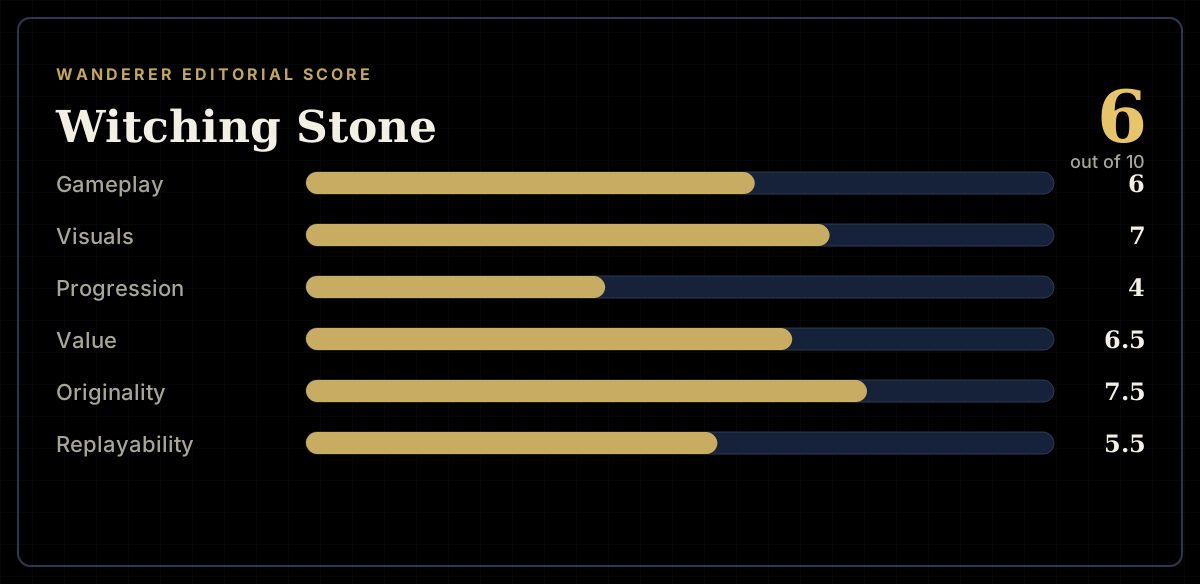
How the review scores each part of the gameWanderer Editorial -
The short versionWanderer Editorial