
Game review
20 Minutes Till Dawn
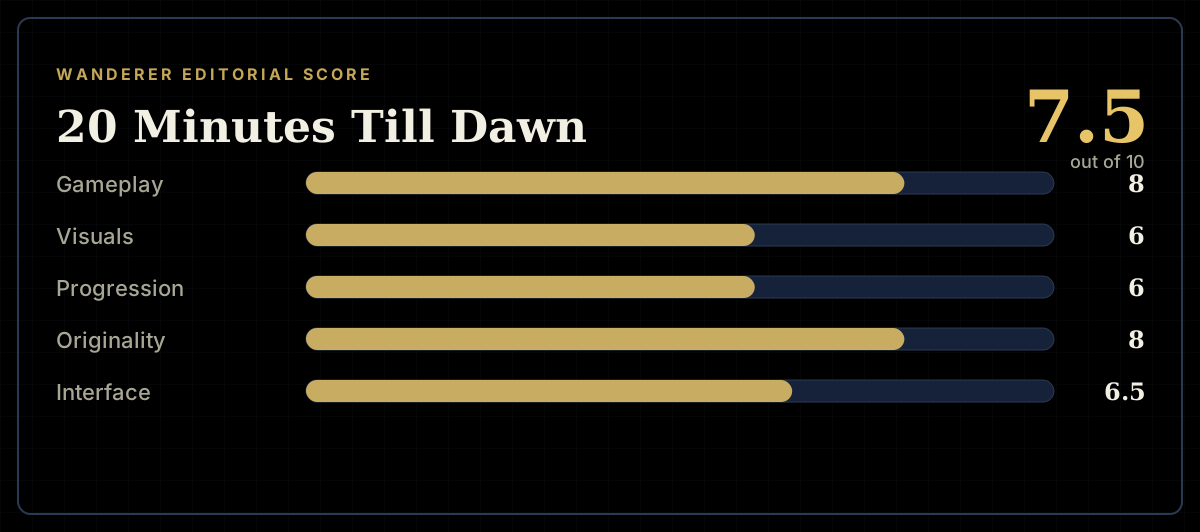
7.5 / 10
- Developer
- flanne
- Publisher
- flanne
- Released
- 8 June 2023
- Platforms
- Windows, macOS
- Genre
- Fantasy Horror Survivor-Like Roguelite
- Monetisation
- One-time premium purchase; free content updates during Early Access and after 1.0, with the developer's later attention shifting toward a separate, newer game using the same characters
- Players
- Single-player only; no online, co-op or PvP modes
The short version
20 Minutes Till Dawn takes the Vampire Survivors formula and gives the player direct, twin-stick- style aiming instead of purely automatic attacks, and reviewers consistently credit that single change with producing the survivor-like genre's first genuine evolution rather than another clone. At a low price point, with a roster of distinct characters and weapons, it's widely described as excellent value and a worthy alternative for players who want more direct control over combat than the genre typically offers.
Two specific, well-documented complaints keep the reception from being higher. First, a heavily reported visibility problem: the game's limited, largely monochrome color palette makes the player character difficult to distinguish from enemies and effects during busy fights, and this review's research confirms the developer acknowledged this complaint directly during Early Access without it being reported as fully resolved. Second, a build-variety complaint this review's research confirms the developer began a substantial update to address, before shifting primary attention to a new, separate game using the same cast rather than shipping it to the original.
Biggest strengths
- An active, twin-stick-style aiming system reviewers consistently credit as the genre's first genuine mechanical evolution beyond Vampire Survivors' auto-attack formula
- A distinct character and weapon roster giving real reason to experiment with different playstyles, expanded further with weapon mutations added at the 1.0 launch
- Genuinely excellent value at a low price point, drawing consistent praise even from reviewers who raise other specific complaints
Biggest weaknesses
- A heavily reported, persistent complaint that the game's largely monochrome color palette and flashing effects make the player character difficult to track during busy fights, with some reviewers reporting genuine eye strain
- This review's research found no confirmed colorblind mode or flash-reduction option addressing that visibility complaint beyond an earlier, partial contrast update
- A build-variety complaint is widely repeated: with enough playtime, most runs converge toward similar builds regardless of starting choices, and meta-progression is described as grindy relative to its impact
Who it's for: Survivor-like fans who want more direct combat control than the genre's typical auto- attack formula, and horror-themed roguelite fans generally, at a genuinely low price point.
Our recommendation: A strong, inexpensive pickup for fans of the genre specifically for its active- aiming twist, though buyers sensitive to flashing lights or low-contrast visuals should be aware of that specific, persistent complaint first.
7.5 / 10
20 Minutes Till Dawn takes the survivor-like formula Vampire Survivors popularized and adds one significant twist: instead of watching your character auto-attack while you focus purely on movement and upgrade choices, you aim and fire directly, twin-stick-shooter style, against endless waves of horror-themed monsters. Reviewers consistently describe that single change as more than a gimmick — a genuine evolution of the format that gives players real agency the genre otherwise lacks.
An active-aiming twist reviewers call a genuine evolution
The strongest, most consistent praise concerns the game's core combat feel. Reviewers repeatedly describe 20 Minutes Till Dawn as "Vampire Survivors 2" in spirit, crediting its direct-aim system with adding a layer of moment-to-moment skill and positioning that pure auto-attack survivor-likes don't offer. That's paired with a distinct roster of characters and weapons, expanded further at the 1.0 launch with weapon mutations offering three variants per weapon, giving reviewers real reason to keep experimenting well past their first few runs.
A visibility complaint reviewers report as genuinely disruptive
Set against that praise, the single most heavily reported complaint in the review base concerns the game's visual clarity. Reviewers describe a largely monochrome color palette combined with flashing effects that make the player character difficult to distinguish from the swarm of enemies, bullets, and summoned allies filling the screen during later, busier fights — with some reviewers describing genuine eye strain or physical discomfort rather than simply finding it a minor annoyance. This review's research confirms the developer directly acknowledged this complaint during Early Access, shipping a dedicated visibility update increasing contrast between enemies and the environment and explicitly stating "there are many more improvements to visibility to come." That the same complaint remained prominent in reviews well after the full 1.0 release suggests those further improvements either didn't fully materialize or didn't go far enough to satisfy affected players.
A build-variety complaint the developer began addressing, then set aside
A second common complaint concerns depth: several reviewers describe runs converging toward similar builds regardless of starting choices once a player has unlocked most of the game's content, with meta-progression described as grindy relative to how much it actually changes moment-to-moment play. This review's research confirms the developer took that complaint seriously: a major update called "Blessings & Curses," explicitly framed around adding "more variety and replayability between different runs," reached closed beta testing in October 2024, introducing new blessing and curse systems alongside a full enemy and rune rework. What this review's research did not find is confirmation that update ever shipped to the base game — instead, the developer's public communications show attention shifting toward a new, separate title, "20MTD: Emberpath," using the same cast of characters in late 2023.
An accusation this review's research can't confirm or refute
At least one detailed negative review makes a specific, serious claim: that a mobile port of the game continues receiving updates while the PC version has effectively stopped. This review's research is limited to the PC version's own public Steam patch and announcement history, which does show a real, multi-year slowdown in visible activity after 2024 — but confirming or refuting activity on a separate mobile release sits outside what this research channel can verify. Readers concerned about platform parity should treat that specific claim as reported, not confirmed.
Where the achievement data shows genuine accessibility
Global achievement data shows the base game is genuinely, meaningfully completable: 73.2% of the playerbase has survived a full base run, a notably high figure for the genre. Difficulty-tier progression through the game's "Darkness" levels shows a more typical roguelite decline — 57.9% at the first tier down to 11.8% by the fifth — consistent with a game whose core objective is accessible to most players who try it, with escalating optional difficulty for those who want more of a challenge. That pattern lines up with reviewer complaints about insufficient difficulty and build variety for experienced players, even as it confirms the base experience works well for a broad audience.
A long, transparent Early Access run before 1.0
20 Minutes Till Dawn spent exactly one year in Early Access, launching in June 2022 and reaching full 1.0 release in June 2023, and the patch history across that stretch shows a genuinely active, communicative development process: new characters and weapons added roughly monthly, an Endless Mode introduced and then substantially rebalanced based on player feedback, and macOS support added partway through. Reviewers who followed the game through that period consistently describe steady, visible improvement rather than a long silence followed by a rushed full release — context worth weighing alongside the more recent slowdown discussed above, since it shows the same developer capable of sustained, responsive support for a meaningful stretch of the game's life.
A low price point that changes how some complaints land
Several reviewers explicitly frame their overall recommendation around the game's low asking price, arguing that complaints about build variety or long-term depth matter less when the entry cost is this low compared to a full-price release making the same promises. That's a legitimate framing worth naming directly: the same specific criticisms raised above would likely weigh more heavily in a review of a $40-60 title, and readers should calibrate how much those complaints matter against what this particular game actually costs.
Where it lands
20 Minutes Till Dawn earns its Very Positive reception through a genuinely meaningful evolution of the survivor-like formula and real value at a low price point, and its specific complaints — visual clarity and build variety — are well-documented rather than exaggerated by a vocal minority. The developer's engagement with both complaints is real, if incomplete: a genuine early response to visibility concerns that didn't fully resolve the issue, and a substantial variety-focused update that appears to have been redirected into a new game rather than delivered to this one. For fans of the genre wanting more active combat, this remains a strong, inexpensive recommendation.
Pros and cons
Pros
- An active, twin-stick-style aiming system reviewers consistently credit as the genre's first genuine mechanical evolution beyond Vampire Survivors' auto-attack formula
- A distinct character and weapon roster giving real reason to experiment with different playstyles, expanded further with weapon mutations added at the 1.0 launch
- Genuinely excellent value at a low price point, drawing consistent praise even from reviewers who raise other specific complaints
- An optional auto-aim toggle added during development for players who want a more relaxed, accessible playstyle without abandoning the game's core loop
- A confirmed direct developer response to visibility complaints during Early Access, including a dedicated update increasing contrast between enemies and the environment
Cons
- A heavily reported, persistent complaint that the game's largely monochrome color palette and flashing effects make the player character difficult to track during busy fights, with some reviewers reporting genuine eye strain
- This review's research found no confirmed colorblind mode or flash-reduction option addressing that visibility complaint beyond an earlier, partial contrast update
- A build-variety complaint is widely repeated: with enough playtime, most runs converge toward similar builds regardless of starting choices, and meta-progression is described as grindy relative to its impact
- This review's research confirms a substantial update directly addressing that variety complaint reached closed beta testing but does not appear to have shipped to the base game before the developer's attention shifted to a new, separate title
- A specific reviewer accusation that a mobile port continues receiving updates while the PC version has gone quiet could not be verified or refuted by this review's research, which is limited to the PC version's own public patch record
Screenshots
-

20 Minutes Till DawnImage: flanne via Steam -

20 Minutes Till DawnImage: flanne via Steam -

20 Minutes Till DawnImage: flanne via Steam -
How the review scores each part of the gameWanderer Editorial -
The short versionWanderer Editorial