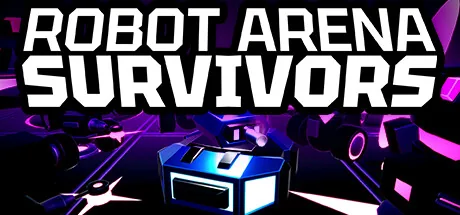
Game review
Robot Arena Survivors
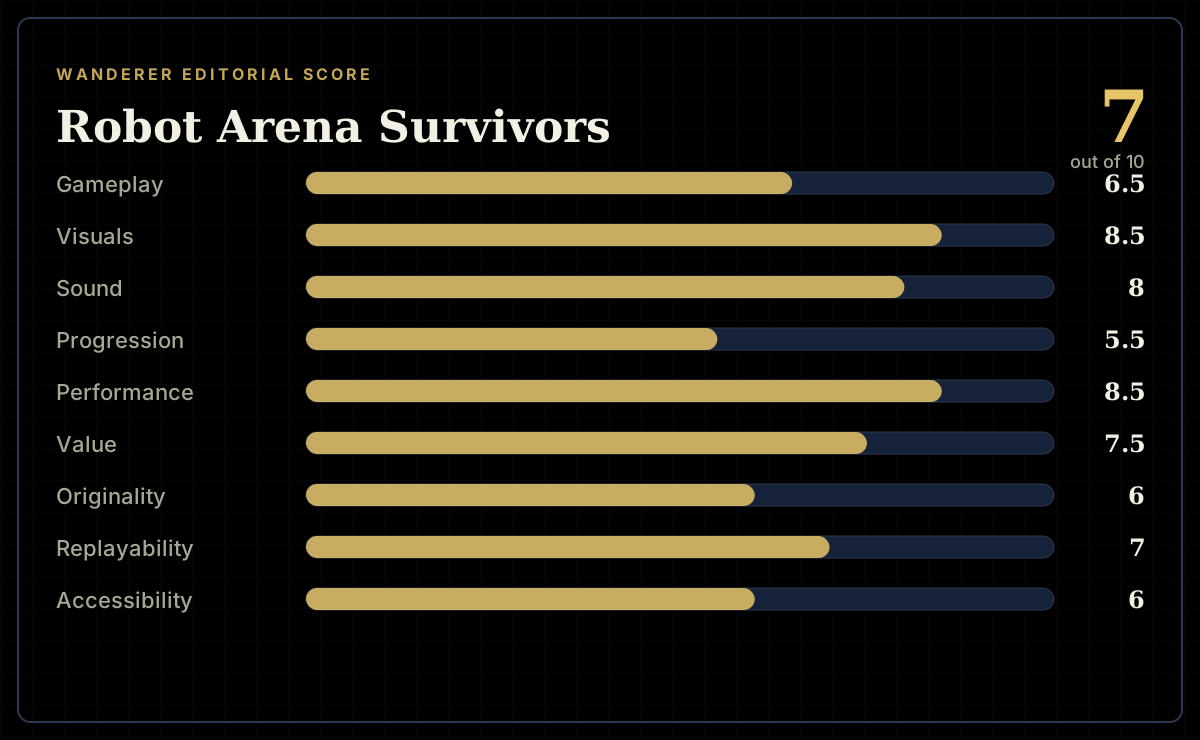
7 / 10
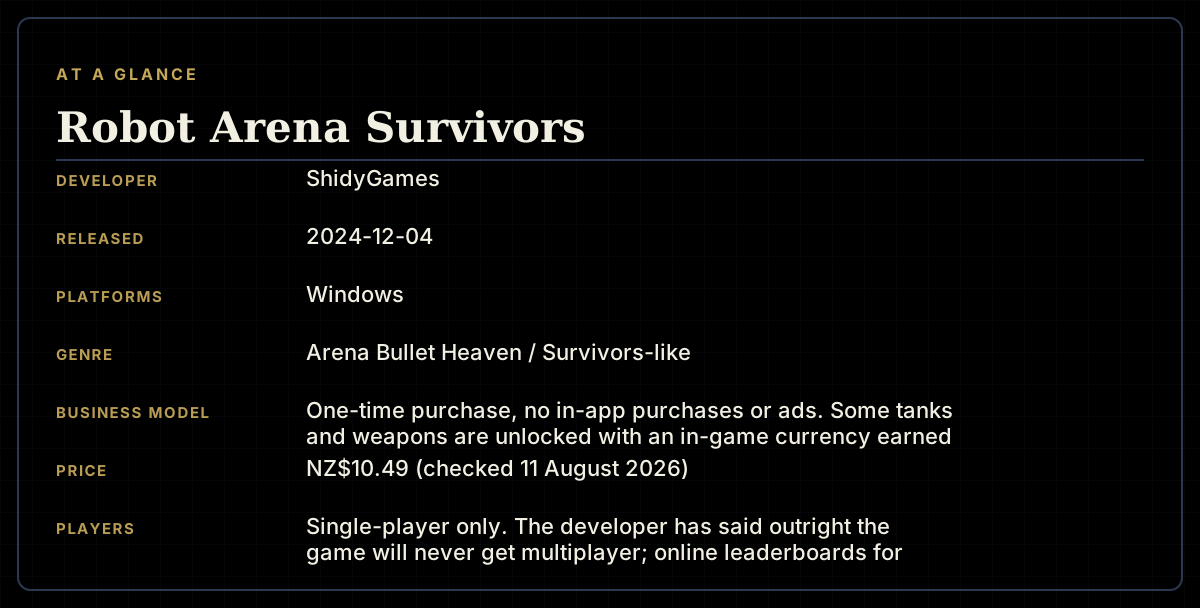
- Developer
- ShidyGames
- Publisher
- ShidyGames
- Released
- 4 December 2024
- Platforms
- Windows
- Genre
- Arena Bullet Heaven / Survivors-like
- Monetisation
- One-time purchase, no in-app purchases or ads. Some tanks and weapons are unlocked with an in-game currency earned by playing rather than bought, which a handful of reviewers still describe as a grind wall.
- Players
- Single-player only. The developer has said outright the game will never get multiplayer; online leaderboards for Endless and Protect the Core are the only way to compare runs with anyone else.
The short version
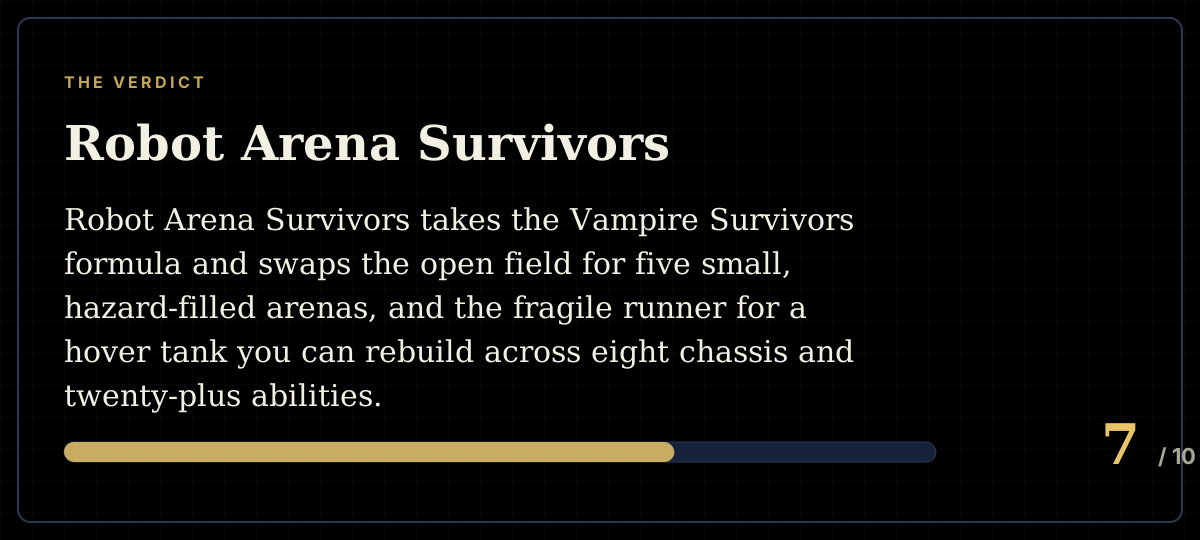
Robot Arena Survivors takes the Vampire Survivors formula and swaps the open field for five small, hazard-filled arenas, and the fragile runner for a hover tank you can rebuild across eight chassis and twenty-plus abilities. The Tron-lit aesthetic and the soundtrack are the two things almost nobody disputes, and the arena hazards give fights a shape the genre's endless fields usually lack. Set against that: the permanent upgrade tree resolves into damage, fire rate, crit chance and crit damage with little to actually differentiate a build, several tanks and weapons sit behind a currency grind, and more than one reviewer calls the moment-to-moment loop boring once the initial hook wears off.
It's a well-made, honestly small game from a one-person studio, at a price that matches its ambitions. The leaderboard-chasing crowd will get real mileage out of it; anyone hoping for Vampire Survivors' avalanche of build variety will hit the ceiling fast.
Biggest strengths
- A distinctive Tron/neon-cyberpunk look that reviewers single out unprompted, and a soundtrack multiple people call the best part of the game
- Arena hazards that can hurt you or the enemies give fights a tactical shape the genre's open-field games usually don't have
- Runs cleanly — reviewers report no major bugs, strong performance on a mid-range GPU, and a good experience on Steam Deck specifically
Biggest weaknesses
- The permanent stat tree boils down to damage, fire rate, crit chance and crit damage with little to meaningfully separate one build from another once you understand the math
- Some tanks and weapons are locked behind a flat-priced in-game currency grind, which multiple negative reviews call out specifically
- Early runs can be dull or lethal in equal measure — starting weapons are weak and there are no pickups to smooth the gap before upgrades come online
Who it's for: Score-chasers and Vampire Survivors fans who want a tighter, more tactical arena in place of an endless field, and anyone who wants a good-looking, controller-friendly bullet heaven they can finish in an evening rather than live inside for months.
Our recommendation: Worth the ten dollars if the Endless mode leaderboard is a hook for you — that's where the reviewers with 50+ hours logged are spending their time. If deep build variety and a long meta-progression tail are what you want from the genre, temper expectations; the upgrade system is the part most reviewers agree is thin.
7 / 10
Robot Arena Survivors is a small release with a thin public record — 27 Steam reviews at the time of writing, no press coverage worth citing. This review draws on the developer's own store-page description, Steam's achievement completion data, and the game's entire review corpus: all 22 positive write-ups and, since there are few enough to cover in full, every one of the 5 negative ones too. Those five turn out to repeat the same handful of complaints almost word for word, which is itself worth taking seriously.
The pitch: a tank in an arena, not a runner in a field
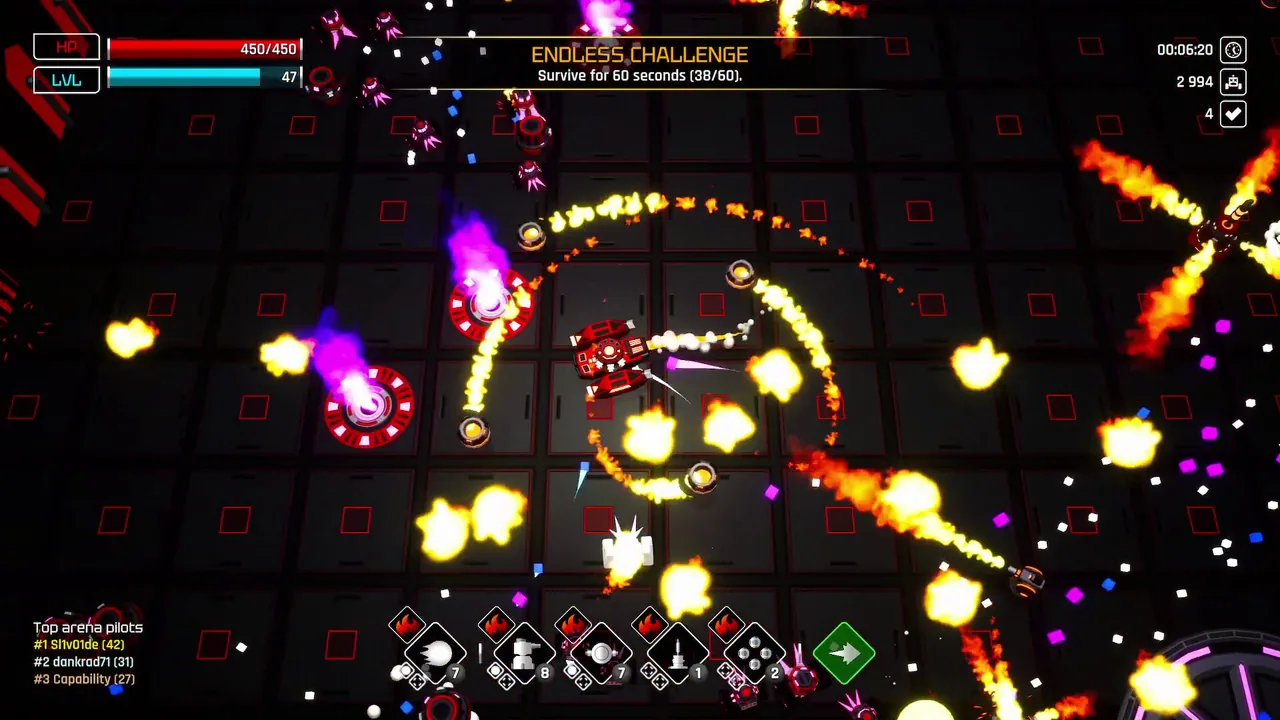
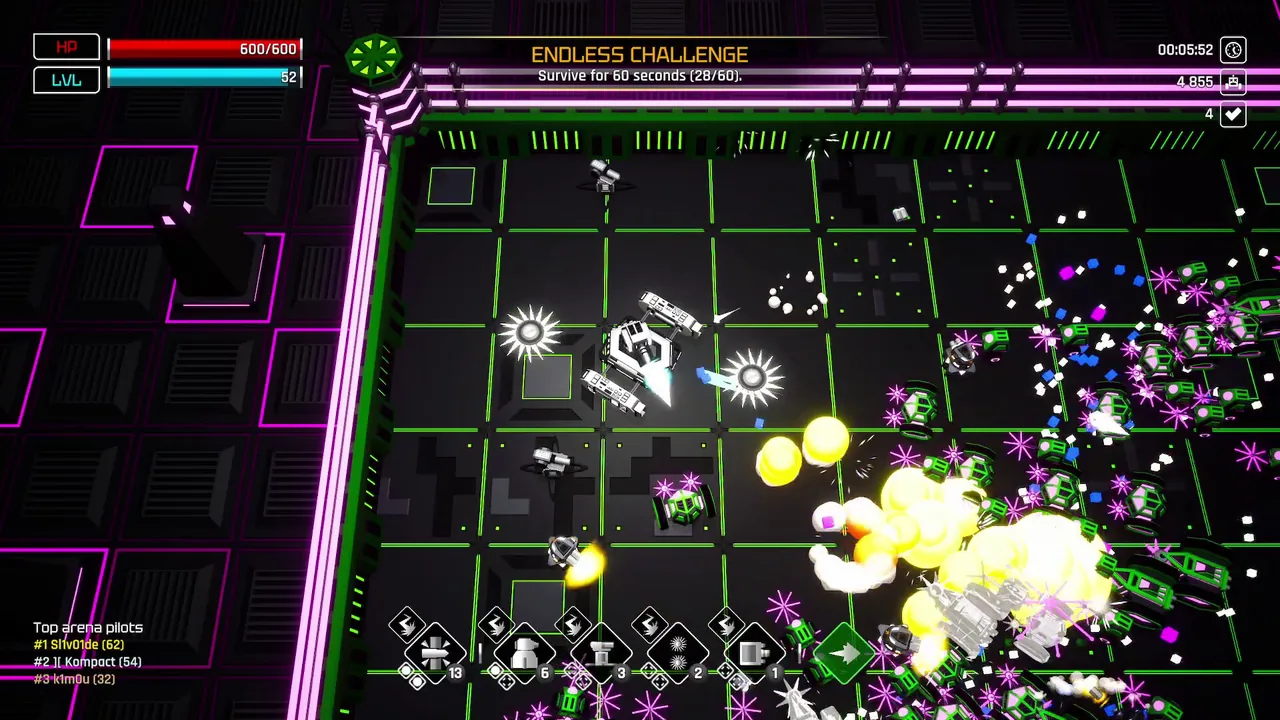
Robot Arena Survivors is a dual-stick, auto-firing bullet heaven — no manual aiming, no weapon activation, just movement and a build. What separates it from the Vampire Survivors template it's clearly descended from is the arena: instead of an outward-scrolling field that eventually becomes featureless, you fight inside one of five bounded arenas, each with its own hazards that can hurt you, the enemies, or both. Reviewers who've logged serious hours single this out as the game's best structural idea — it gives fights a shape and a set of environmental options that the genre's endless-field games generally lack.
You pilot one of eight hover tank units, each with its own weaponry and stat leanings, and build an ability deck from more than twenty unlockable abilities. Three modes sit on top of each arena: a standard unranked mode, and two ranked modes — Endless and Protect the Core — each with its own online leaderboard. There's no story to speak of and no multiplayer; the developer has stated plainly that multiplayer isn't coming, and the leaderboards are the only comparison to other players the game offers.
Where the upgrade tree runs out of ideas
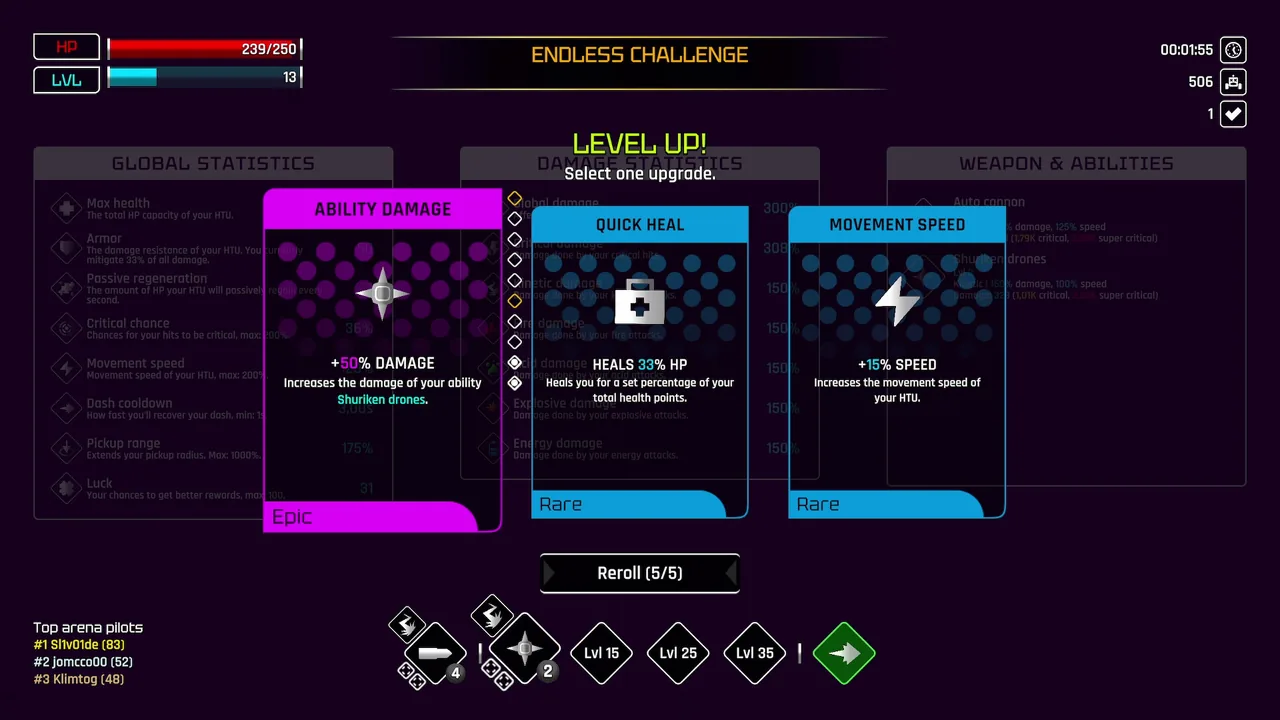
The recurring complaint across the negative reviews, and even inside some of the positive ones, is the permanent progression layer. There are 13 base stats to upgrade over time, but reviewers who've put in the hours describe them converging on the same four levers familiar from any ARPG: damage, rate of fire, crit chance and crit damage. Because your effective output is roughly the product of all four, the optimal strategy is to invest in everything evenly rather than choose a build — which several reviewers point out removes the decision-making that makes a stat tree interesting in the first place. One negative review lays this out in detail and concludes the game isn't bad, just "rather boring" once the math is understood.
Compounding that: some of the eight tanks and their weapons are gated behind an in-game currency earned through play, all priced the same regardless of tier, which two of the five negative reviews call out as a grind wall rather than a reward. One reviewer speculates, only half joking, that the most expensive unlock must be the best simply because of how the pricing scales — a sign the unlock curve isn't communicating its own logic well.
The achievement data backs up a genre-standard steep drop-off. Just over half of players (53%) finish the first arena, the Robotic Nest, and about the same share unlock the second tank chassis. By the third tank that's down to 42%, and the fourth arena and fourth tank sit in the low 30s. Deep-cut stat and ability achievements — maxing a specific damage type, a specific ability build — sit at 1–2% completion. That's a normal shape for the genre, but it lines up with the review complaints: most players see the early game, a meaningful minority push into the mid-game, and the build diversity the deep achievements imply isn't where most people end up spending their time.
What actually earns the praise
Set the upgrade tree aside and the reception turns consistently warm. The Tron-lit, neon-cyberpunk visual identity comes up in nearly every positive review, often as the very first thing mentioned, and the soundtrack draws unprompted praise often enough — "gorgeous," "incredible quality" — that it's clearly one of the game's real strengths rather than a footnote. Performance is a second consistent point: reviewers report no major bugs, strong results on mid-range GPUs, and a good experience on Steam Deck specifically, including one who plays it as their go-to Deck game "on a regular basis." A separate reviewer notes it runs well even outside Windows, via Proton — worth flagging since the store page only lists Windows as an officially supported platform.
The replay hook is real for the audience it's built for. Several of the longest reviews come from players well past fifty hours — one at 144 hours, another past 100 — almost all citing the Endless mode leaderboard as the reason they keep coming back. Across all 27 reviews the median playtime logged is about five hours, but ten of the twenty-seven have more than ten hours in, which for a ten-dollar game with this little marketing reach is a healthy long tail.
Accessibility and the one real outlier complaint
The Steam store page lists a genuinely good spread of accessibility categories for a solo project — Camera Comfort, Custom Volume Controls, a Keyboard Only option, and play that doesn't require timed input. Full controller support is also confirmed. The one accessibility gap that surfaces in the reviews themselves is real, though: a player who suffers migraines specifically asks for brightness and contrast options, or an alternate colour palette, given how bright and high-contrast the arena visuals are by design. That's a fair complaint about a game whose signature aesthetic is exactly the kind of saturated neon that can be a genuine problem for some players, and there's currently no in-game way to soften it.
Verdict
Robot Arena Survivors takes a crowded genre and finds one real structural idea — bounded, hazard- laden arenas instead of an endless field — and executes it with a visual identity and soundtrack that punch well above a ten-dollar price tag. What it doesn't have yet is a progression system that rewards the kind of build experimentation the genre's best entries thrive on; the permanent stat tree and the currency-gated unlocks are the two things reviewers agree need work, and the achievement curve backs up that most players don't push far past the point where that starts to matter.
Seven out of ten: strong marks for presentation, performance and a genuinely tactical arena structure, held back by a shallow upgrade tree and a grind gate that several reviewers hit before the game had fully shown them what it can do. For the leaderboard-chasing crowd this is an easy recommendation at the price; for anyone hoping for Vampire Survivors' sprawling build variety, it's a smaller, tighter, less generous game than that comparison suggests.
Pros and cons
Pros
- A distinctive Tron/neon-cyberpunk look that reviewers single out unprompted, and a soundtrack multiple people call the best part of the game
- Arena hazards that can hurt you or the enemies give fights a tactical shape the genre's open-field games usually don't have
- Runs cleanly — reviewers report no major bugs, strong performance on a mid-range GPU, and a good experience on Steam Deck specifically
- Eight tanks and 20+ abilities give real build variety at the start of a run, even if the permanent upgrade tree behind them is shallow
- A solo developer who reviewers say ships regular updates and responds to feedback, carried over from an active Early Access period
Cons
- The permanent stat tree boils down to damage, fire rate, crit chance and crit damage with little to meaningfully separate one build from another once you understand the math
- Some tanks and weapons are locked behind a flat-priced in-game currency grind, which multiple negative reviews call out specifically
- Early runs can be dull or lethal in equal measure — starting weapons are weak and there are no pickups to smooth the gap before upgrades come online
- No brightness or contrast options despite consistently bright, high-contrast visuals; one reviewer flags this as a genuine migraine trigger
- A small review base — 27 reviews at time of writing — so any read on long-term sentiment should be held loosely
Screenshots
-
Robot Arena SurvivorsImage: ShidyGames via Steam -
Robot Arena SurvivorsImage: ShidyGames via Steam -
Robot Arena SurvivorsImage: ShidyGames via Steam -
How the review scores each part of the gameWanderer Editorial -
The essentials at a glanceWanderer Editorial -
The short versionWanderer Editorial