Game review
Hand of Fate: Hordes
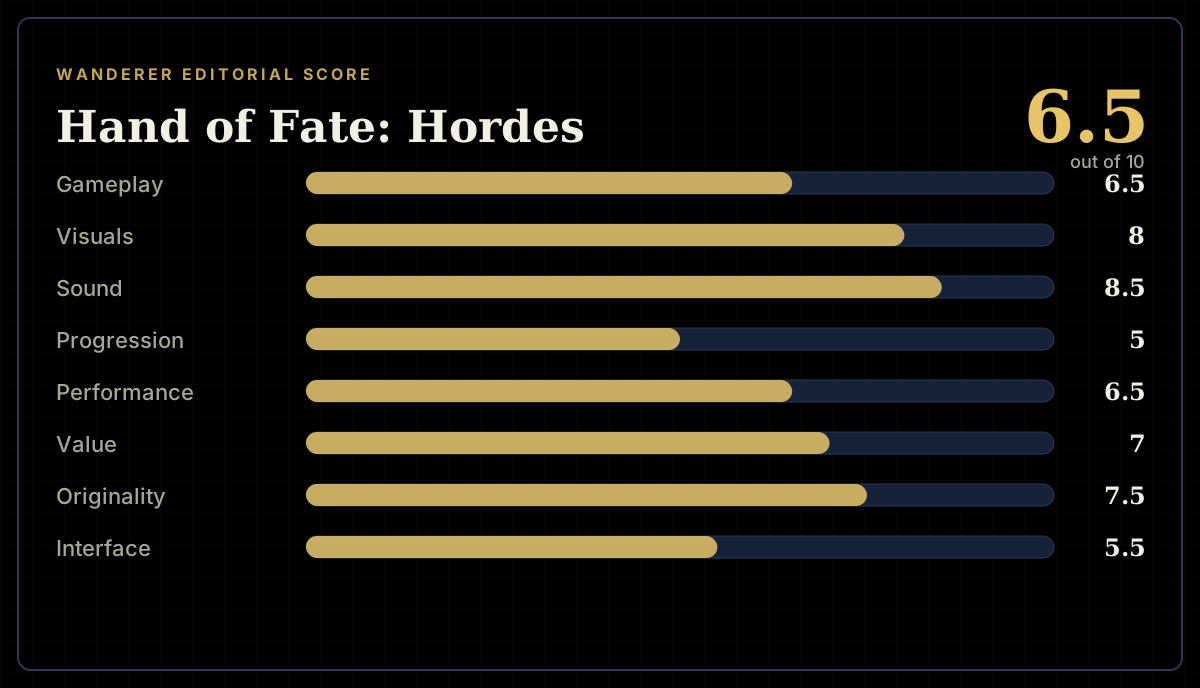
6.5 / 10
- Developer
- Spitfire Interactive
- Publisher
- Spicy Koala
- Released
- 22 July 2026
- Platforms
- Windows, macOS, Linux
- Genre
- Bullet Heaven / Roguelite
- Monetisation
- One-time purchase, no in-game spending. The only paid extra is a Supporter Pack of chrome cosmetic skins for heroes, cards and dice. The developers have said the price will rise as the game moves towards full release.
- Players
- Single-player only
The short version
Spitfire Interactive have taken the tabletop bones of Hand of Fate — the Dealer, the encounter cards, the dice rolls, the quests that turn a dungeon into a story — and built a survivors-like around them. The card half is excellent and genuinely novel. The horde half is the problem: the power curve runs backwards, so the further you get into a run the more you're fleeing rather than mowing, and the permanent upgrades between runs are one-percent stat chips instead of new toys. Two weeks of hard patching have already fixed the loudest complaints, and the deckbuilding the store page leads with hasn't even shipped yet. Interesting now, potentially very good later.
Biggest strengths
- The encounter layer is the best answer anyone has given to survivors-like emptiness — stages carry quests, objectives, chests and dice minigames instead of an unbroken field of enemies
- Anthony Skordi's Dealer is back and the writing gives him something to do; the audio and presentation are well above the genre's usual standard
- Four heroes with genuinely different ranged, melee and magic identities, plus enchantments and blessings that stack into distinct builds
Biggest weaknesses
- Permanent progression is bought in one and two percent increments — the single most repeated criticism, and it means you can't feel a hundred runs of investment
- The power fantasy inverts as a run continues; enemies scale faster than you do, so late stages become kiting and experience-collection rather than slaughter
- Every stage ends with a portal on a thirty-second timer, removing the "how long can I last" endgame the genre is built on
Who it's for: Hand of Fate fans who want the Dealer back and will forgive an unfinished action layer, and survivors-like players who are bored of pure mowing and want objectives, quests and choices inside a run. Not for anyone who plays this genre for the escalating power fantasy, and not for players who want a finished game today.
Our recommendation: Wishlist it unless you're specifically here for the Hand of Fate half. Twelve dollars is fair for what's on the disc and the studio is patching weekly, but the two systems players complain about most — the flat shard upgrades and the thirty-second exit timer that ends every stage — are design decisions rather than bugs, and there's no promise yet that either is changing. If you buy in, do it knowing the price is going up and the roadmap is where the game you actually want lives.
6.5 / 10
Defiant Development shut down in 2019 and took the Hand of Fate series with it. Most of the people who made those games are still in Brisbane, still working together, now under the name Spitfire Interactive — and after a superhero tactics game in between, they've gone back for the Dealer. Anthony Skordi is back in the chair. The cards are back. The dice are back.
What's changed is everything under them. Hand of Fate: Hordes is a bullet heaven, and the fight between those two halves is the whole story of this Early Access build.
The half that works
Survivors-likes have an emptiness problem. Once you've internalised the loop — walk in circles, collect gems, take the upgrade — a stage is thirty minutes of scenery. The good ones paper over it with build depth; Deep Rock Galactic: Survivor papered over it by giving you something to do, in the form of mining objectives, and it worked.
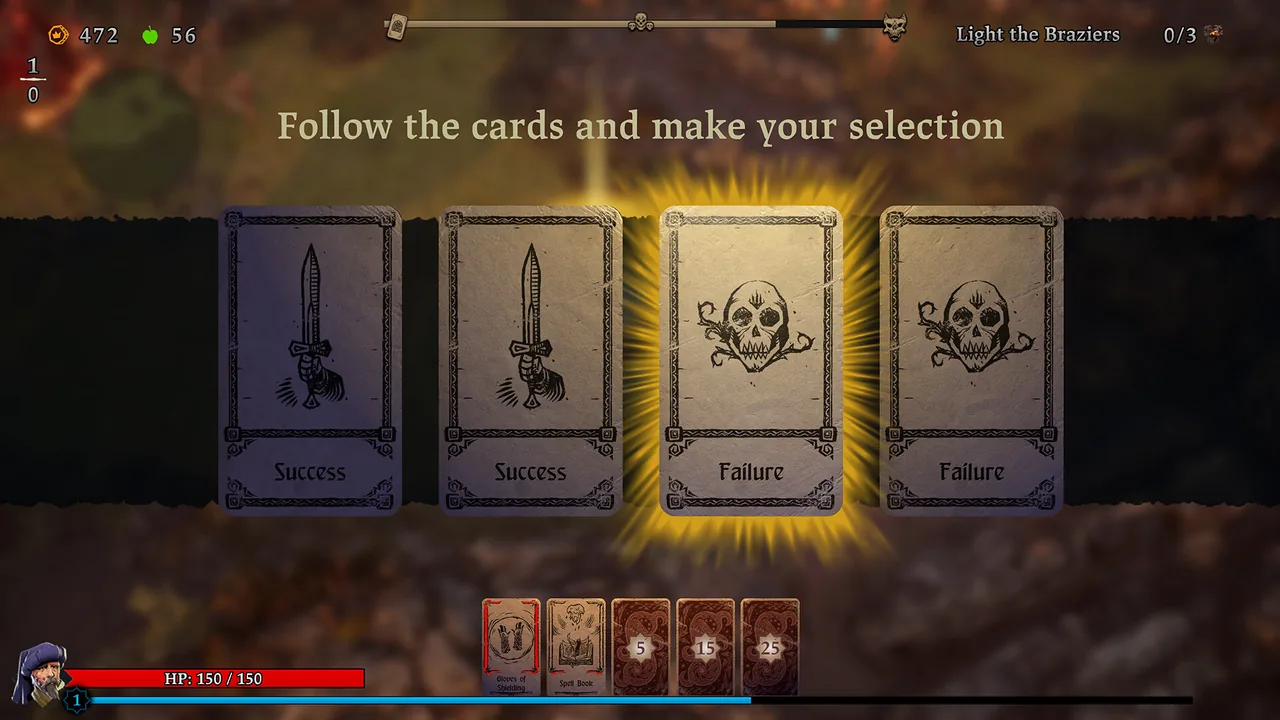
Hordes takes that much further. A stage isn't a field, it's a dungeon with jobs in it. There are quest objectives, breakables that matter, chests, shrines, encounter cards that fire mid-run and hand you a text choice, and dice minigames that resolve them. You're feeding a hungry Yaoguai one minute and negotiating a fox spirit's problem the next, and the outcome changes what you're carrying when the next wave arrives. The Dealer narrates over the top of it, and Skordi is as good as he was a decade ago — dry, amused, faintly disgusted by your choices.
This is a real idea. Nobody else in the genre is doing it, and when it clicks it produces the thing Vampire Survivors never had: a run you could describe afterwards as a sequence of events rather than a sequence of numbers.
It also has an obvious cost, and the reviews are split down the middle on it. If you loved Hand of Fate, the encounters are the game and the horde is the delivery mechanism. If you came for a bullet heaven, you are being stopped every ninety seconds to read. One player put it as well as anyone: imagine someone sitting next to you hitting escape every few seconds while you play. Both readings are correct. The design hasn't decided which audience it's for.
The half that doesn't
Here's where it comes apart. In a survivors-like, the contract is that you start weak and end the run as a walking apocalypse. The whole genre is a thirty-minute crescendo.
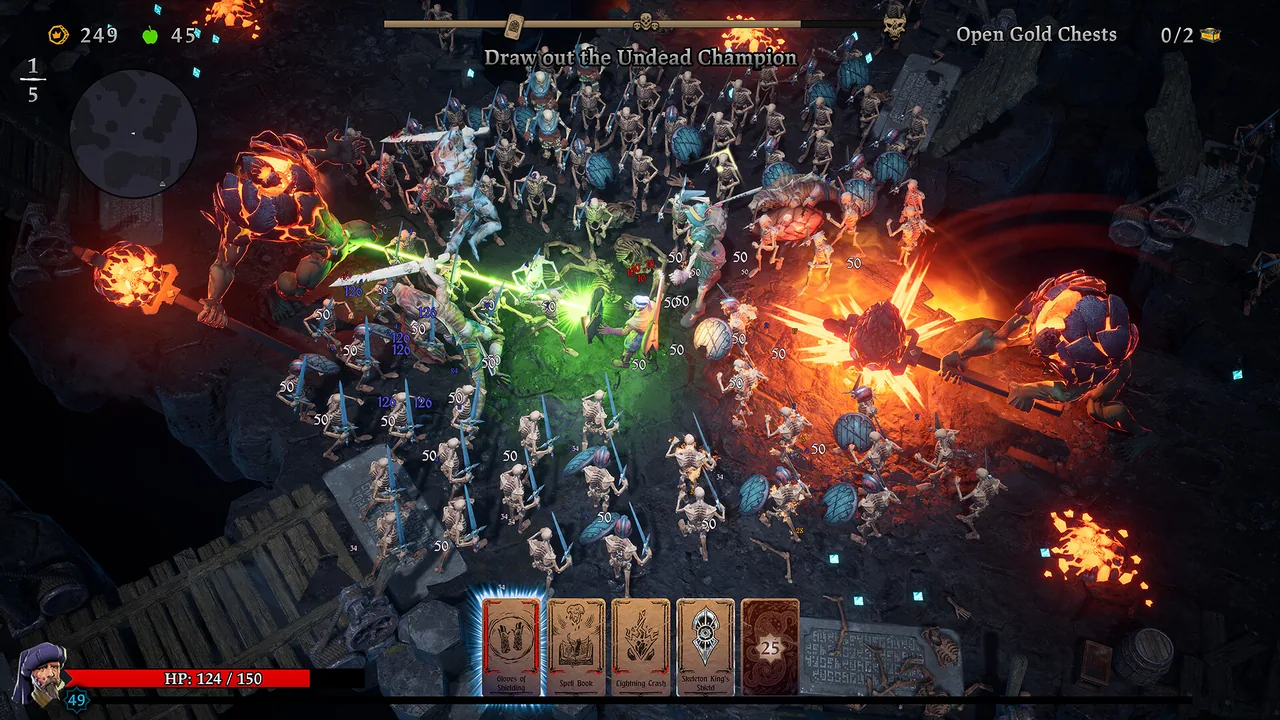
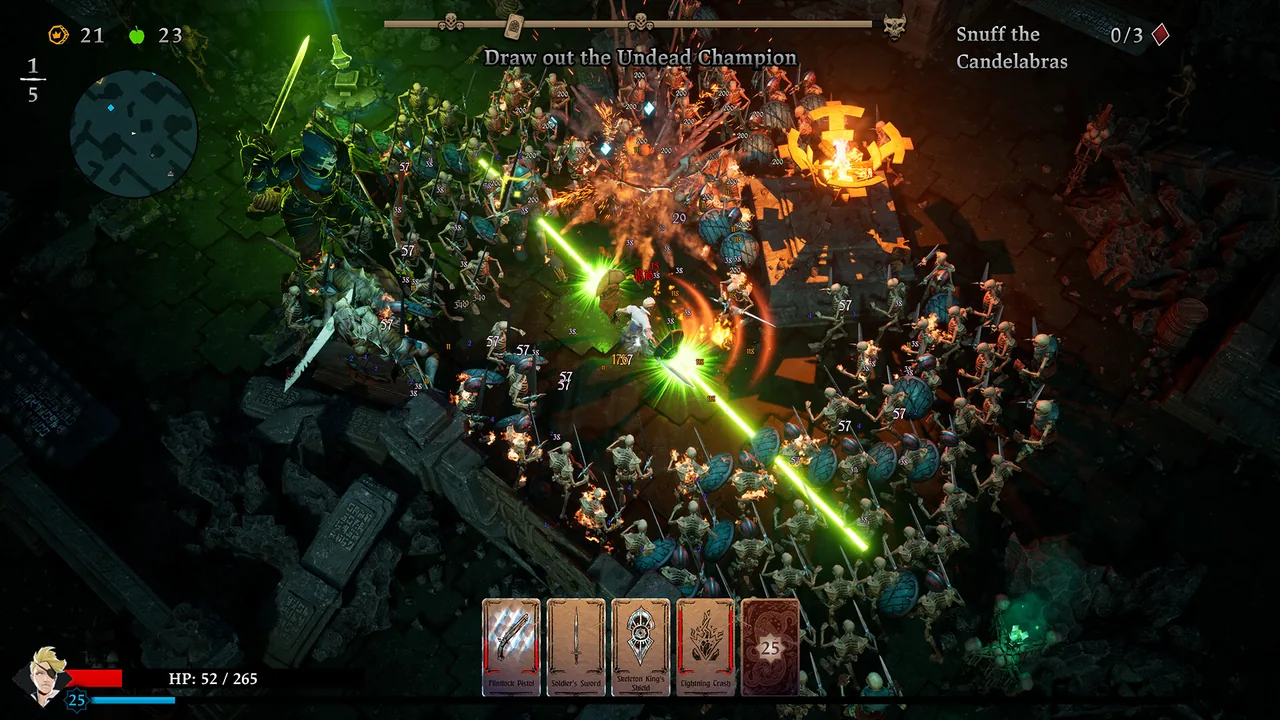
Hordes runs that backwards. Enemies scale faster than your upgrades do, so the further into a stage you get, the more of your time is spent running away and doubling back to pick up the experience you left behind. Cooldowns stay long. Weapons stay basic. Maps are tight, corridor-shaped and maze -like, which means there's no space to outrun the crowd you've just failed to kill. Several players describe the most reliable way to clear a pack as luring a barrel-carrying skeleton into it and getting clear before he detonates — and when the best weapon in your arsenal is an enemy, the weapons are the problem.
Then there's the exit. Every stage ends with a portal that spawns beside you on a thirty-second timer, and you either take it or die. That's not a small thing. The endgame of this genre is "how long can I last", and Hordes deliberately removes it — no pushing a good build to see where it breaks, no final glorious minute against a screen of enemies. You beat the boss, you get thirty seconds, you leave. Risk versus reward has nowhere to go.
One percent at a time
The permanent progression is the most-criticised thing in the game, and it deserves to be.
You earn shards, you spend them between runs, and what they buy is plus one percent health regeneration, plus two percent pickup radius, plus two defence. That's it. It's the meta-progression model that survivors-likes shipped with in 2022 and that the good ones have been quietly abandoning ever since, because the arithmetic is unarguable: a player who has ground fifty runs cannot feel fifty runs of investment in a stack of one-percent modifiers. Halls of Torment buys you new characters and new abilities. Brotato buys you new starting kits. Those are decisions. This is a slider.
The frustrating part is that the game already knows what the better answer looks like. Cards. Tokens. Encounters. Unlocking a new event, a new weapon, a new enchantment — the currency exists, the content exists, and there is a system sitting right there that could be the reward track. Player after player says the same thing without coordinating: make the shards buy cards.
The achievement data tells the same story from the other end. The tutorial completion sits at 93%. The first adventure's clear is at 68%. The second drops to 48%, the third to 20%. Unlocking the second hero sits at 35% and the third at 16.5%, and reaching level 50 at 16%. Achievements shipped with this build rather than being bolted on later, so that curve is a genuine map of where players stop — and they stop early, at exactly the point where the reward for continuing becomes another two percent.
The feature that isn't here yet
The store page's one-line pitch describes a bullet heaven "powered by your strategic deckbuilding mastery". The roadmap published on 1 August lists "Deckbuilding v1" as upcoming content.
Cards are everywhere in the current build — the Dealer plays them at you, encounters resolve through them, tokens unlock them. What isn't in yet is the part where you assemble the deck, which in the original games was the entire strategic layer and the reason the series had a reputation. Launch-week reviewers noticed immediately, and to their credit most of them are cheerful about it; several say plainly that they expect to like the game considerably more once it arrives.
They're probably right. But it means the version on sale today is missing the mechanic its own marketing leads with, and that belongs at the front of a purchasing decision rather than buried in an Early Access disclaimer.
Rough edges, and a studio that's moving
Presentation is the least of the worries. Animation is strong, the dark-fantasy art holds together, and the audio work — Skordi especially — is well past what twelve dollars normally buys. Most players report clean performance, including one running maxed settings at 5K and another on an i5 with a GTX 1650 Super. One Steam Deck review reports being unable to hold 60fps at low settings, which is worth flagging if the Deck is your machine, but it's a single account against several positive ones.
The interface is the weak point. The tutorial doesn't teach the systems well, the collection and upgrade screens take longer to read than they should, card and dialogue prompts still demand the mouse, and — the sharpest one — movement keys can't be rebound, so anyone on an AZERTY keyboard is switching layouts every time they launch the game. That's a two-line fix that shouldn't have shipped unfixed.
Against that, the patch record is genuinely impressive. Inside eight days the team shipped a manual aim toggle in direct response to the "everything fires where I'm facing" complaints, camera-shake and vignette strength sliders for players who were struggling physically with the screen effects, a Mac startup crash fix, a workaround and then a fix for a Linux AMDGPU crash, and dozens of quest and token corrections — each one credited by name to the player who reported it. There are still bugs worth knowing about, including progress-blocking quest failures reported in the final adventure. But this is a studio reading its forums and acting the same week, which is not a given.
The score
6.5 out of 10. Rated 6.5 out of 10.
That's a score for what's playable today, and it's held down by three specific things rather than a general sense of unfinishedness: a power curve that goes the wrong way, permanent upgrades that don't reward the grind they demand, and a stage-exit timer that deletes the genre's best moment. None of those are Early Access content gaps. They're design choices, and the game will live or die on whether the studio treats them as feedback or as vision.
Everything around them is better than the score suggests. The encounter layer is the freshest idea this genre has had in two years, the Dealer is a real character in a genre with none, and twelve dollars is honest money for it — though note the developers have said that price is going up as full release approaches, so "wait and see" has a cost attached.
If you're here because you loved Hand of Fate and want the Dealer's voice in your ears again, buy it; the thing you liked is intact and the action wrapped around it will improve. If you're here because you want the next great survivors-like, this isn't it yet, and the roadmap tells you roughly when to look again: a new hero, new adventures, new equipment, a new location, and the deckbuilding that was supposed to be the point. Come back in the autumn.
Players who'd rather their progress accumulate steadily than reset with every run — and who'd prefer a percentage-point upgrade to at least be permanent — may find Wanderer's slower ladder a better fit for the same evening.
Pros and cons
Pros
- The encounter layer is the best answer anyone has given to survivors-like emptiness — stages carry quests, objectives, chests and dice minigames instead of an unbroken field of enemies
- Anthony Skordi's Dealer is back and the writing gives him something to do; the audio and presentation are well above the genre's usual standard
- Four heroes with genuinely different ranged, melee and magic identities, plus enchantments and blessings that stack into distinct builds
- Patch cadence is serious — an optional manual-aim mode, camera-shake and vignette sliders and dozens of fixes all landed inside the first eight days, each credited to the players who reported them
- Runs well on modest hardware for most players, with one review reporting maxed settings at 5K and another reporting a clean experience on an i5 and a GTX 1650 Super
Cons
- Permanent progression is bought in one and two percent increments — the single most repeated criticism, and it means you can't feel a hundred runs of investment
- The power fantasy inverts as a run continues; enemies scale faster than you do, so late stages become kiting and experience-collection rather than slaughter
- Every stage ends with a portal on a thirty-second timer, removing the "how long can I last" endgame the genre is built on
- The card and dice interludes pause the action constantly, which is the whole appeal for Hand of Fate fans and an interruption to everyone else
- Deckbuilding — the feature named in the game's own one-line pitch — is listed on the roadmap as still to come
- Movement keys can't be rebound yet, an outright barrier on non-QWERTY keyboards, and card and dialogue screens still require the mouse
Screenshots
-
Hand of Fate: HordesImage: Spicy Koala via Steam -
Hand of Fate: HordesImage: Spicy Koala via Steam -
Hand of Fate: HordesImage: Spicy Koala via Steam -
How the review scores each part of the gameWanderer Editorial -
The short versionWanderer Editorial