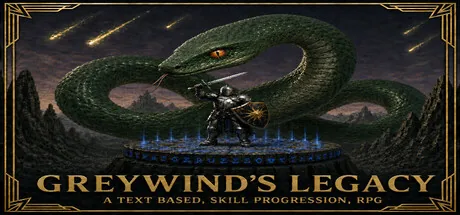
Game review
Greywind's Legacy
7.5 / 10
- Developer
- Lansdolli
- Publisher
- Lansdolli
- Released
- 29 May 2026
- Platforms
- Windows
- Genre
- RPG
- Monetisation
- One-time purchase; no microtransactions, no ads, no DLC
- Players
- Single-player
The short version
Greywind's Legacy is a bare-bones text RPG in the truest sense — a WASD-driven ASCII map, a numbered-menu combat screen and, by its own store page, no music or sound effects whatsoever. Underneath that austere shell is a genuinely large skill-and-class system: 328 skills that level through use, 190 classes spread across seven tiers, an evolve-or-merge choice every time a skill caps out, and over 400 abilities to collect along the way. It launched into Early Access on 29 May 2026 and left it on 13 August with ten straight weekly patches in between — a rare, well-documented case of a solo developer doing exactly what an Early Access badge is supposed to promise.
The catch is the same thing that makes it distinctive: everything is keyboard-only text and ASCII grids, with no mouse support and no concession to players who want a modern interface. The handful of players who have reviewed it so far love it for precisely that reason, several comparing it to decades-old text adventures and to Warsim. It is not for everyone, but at NZ$7.89 with no microtransactions anywhere on the page, it is an easy, low-risk way to find out if it is for you.
Biggest strengths
- 328 skills that level through use and 190 classes across seven tiers, reached through a genuine evolve-or-merge choice rather than a fixed skill tree
- Over 400 abilities, 15 zones, 192 catalogued enemies and a reclaimable, upgradeable home base give the systems somewhere real to go
- A disciplined, fully public Early Access record — ten straight weekly patches from 29 May to the announced 13 August 1.0 date, hit on schedule
Biggest weaknesses
- Keyboard-only, mouse-free ASCII menus and grid maps are a real barrier for players expecting a conventional interface
- No music or sound effects at all, by the store page's own description
- The review sample is still very small (8 English-language reviews at time of writing) and Steam has not generated a percentage score yet
Who it's for: Players who grew up on text adventures and old-school ASCII roguelikes, or who want a skill-by-use progression system with real depth and don't mind reading their way through it. Not for anyone who wants voice, music, mouse-driven menus or a conventional graphical RPG.
Our recommendation: Recommended for genre fans at NZ$7.89 — a huge, honestly priced skill-and-class system wrapped in a deliberately austere text interface, built by a solo developer who shipped ten weekly Early Access patches on schedule and landed 1.0 exactly when promised.
7.5 / 10
Steam is full of games that call themselves "text-based" while leaning on full art, voice acting and orchestral scores to do the actual selling. Greywind's Legacy is not one of those games. Its own store page opens with a warning rather than a pitch — "This Game Has No Audio" — and the screen underneath is a WASD-driven grid of ASCII tiles and numbered menus that would look completely at home on a terminal from decades ago. It launched into Early Access on 29 May 2026 and, as of yesterday, isn't in Early Access any more: ten consecutive weekly patches later, its 1.0 release landed exactly on the date its solo developer announced three weeks in advance. That is a rarer story in Early Access than it should be, and it is worth telling properly before getting into what the game actually does.
No audio, no popups, no mouse
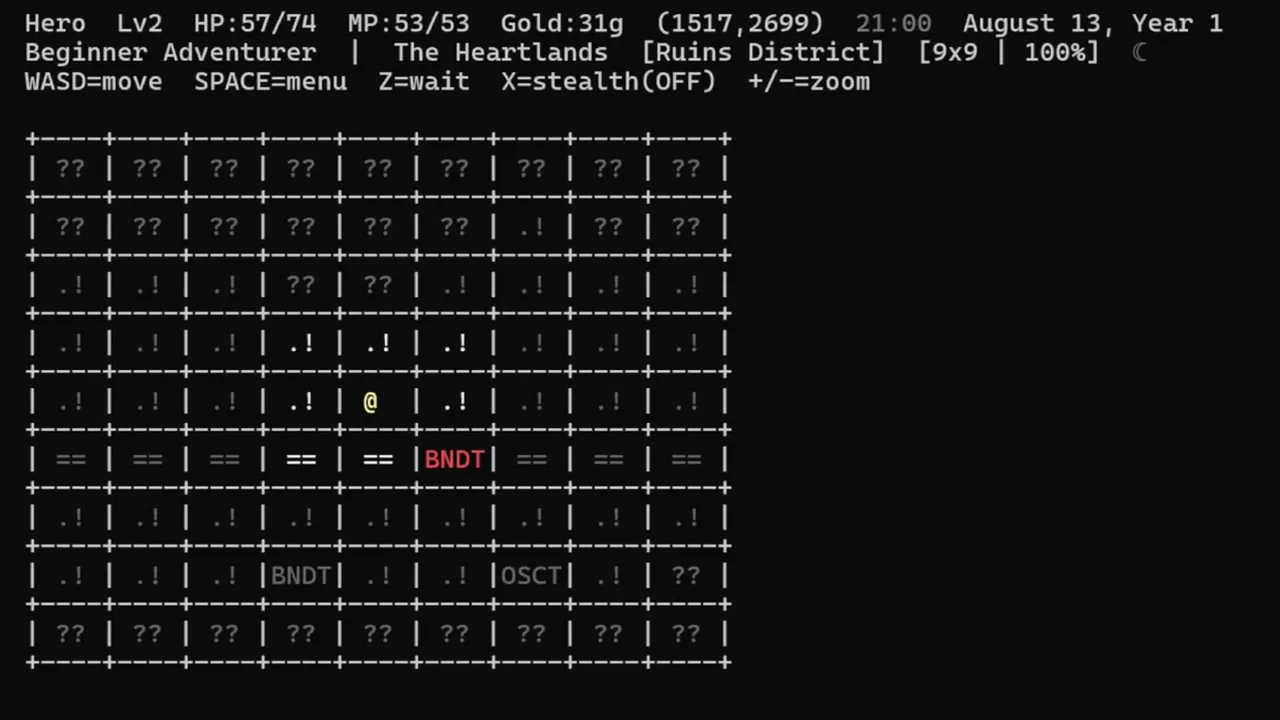
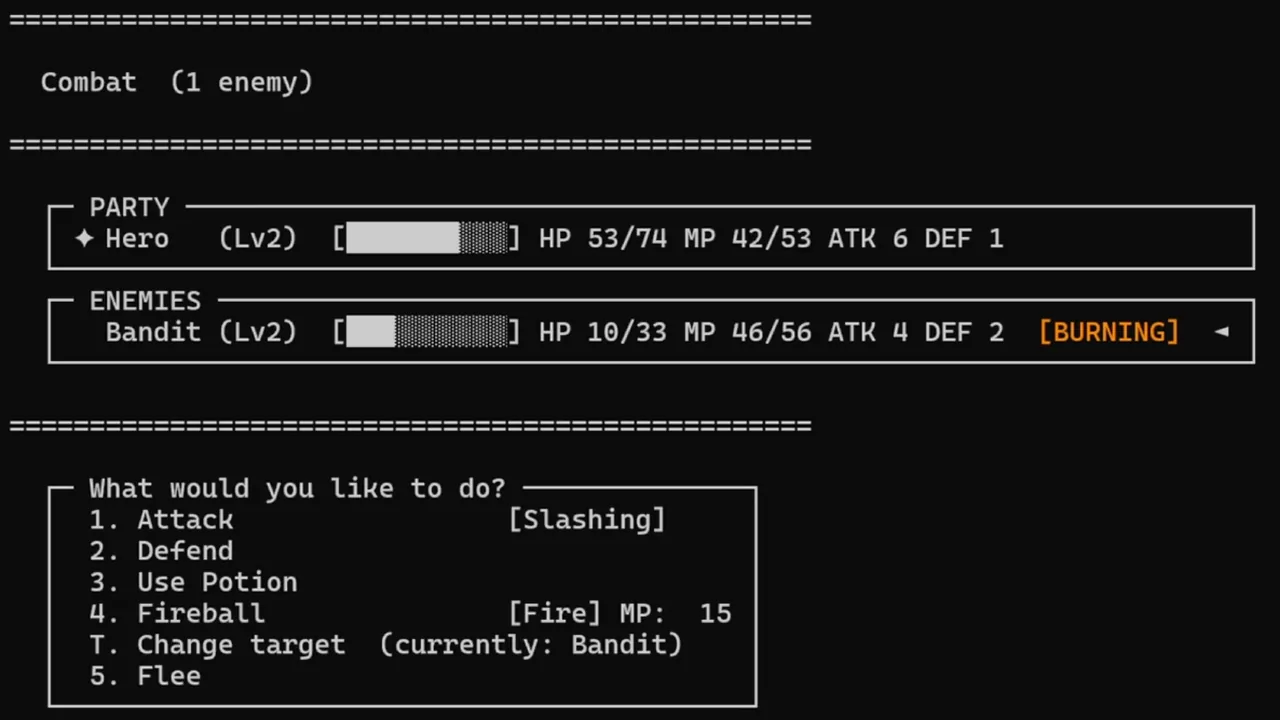
The interface is the first thing anyone encounters, and it will decide the sale for most players before the systems underneath even get a chance. Movement happens on an ASCII grid map — a block of ?? tiles for unexplored ground, .! and similar glyphs for terrain, a yellow @ for the player — controlled entirely with WASD, a menu key and a handful of single-letter toggles. Combat drops into a numbered list: Attack, Defend, Use Potion, whatever spells or abilities are currently available, a target-cycle option, Flee. Shops, crafting, skill evolution and class choices all follow the same numbered-menu logic. There is no mouse support to speak of and, per the store page's own account, no music and no sound effects anywhere in the game.
That is a deliberate stance, not an oversight. The store description frames it directly: "You will find no flashing popups, messages trying to drive engagement, or yellow paint in this game." One of the few written reviews — from a player who says the game reminded them of something they played "40 years ago" — makes the appeal explicit: no music at the start screen, nothing that overheats a laptop, no time pressure, playable with the sound off entirely because there is nothing to mute. It is a legitimately unusual pitch in a market saturated with engagement design, and the minimum system requirements back it up — Steam lists a Pentium M processor and 500MB of RAM as sufficient, hardware old enough that most players reading this won't own anything close to it any more.
328 skills, 190 classes, and a merge system instead of a skill tree
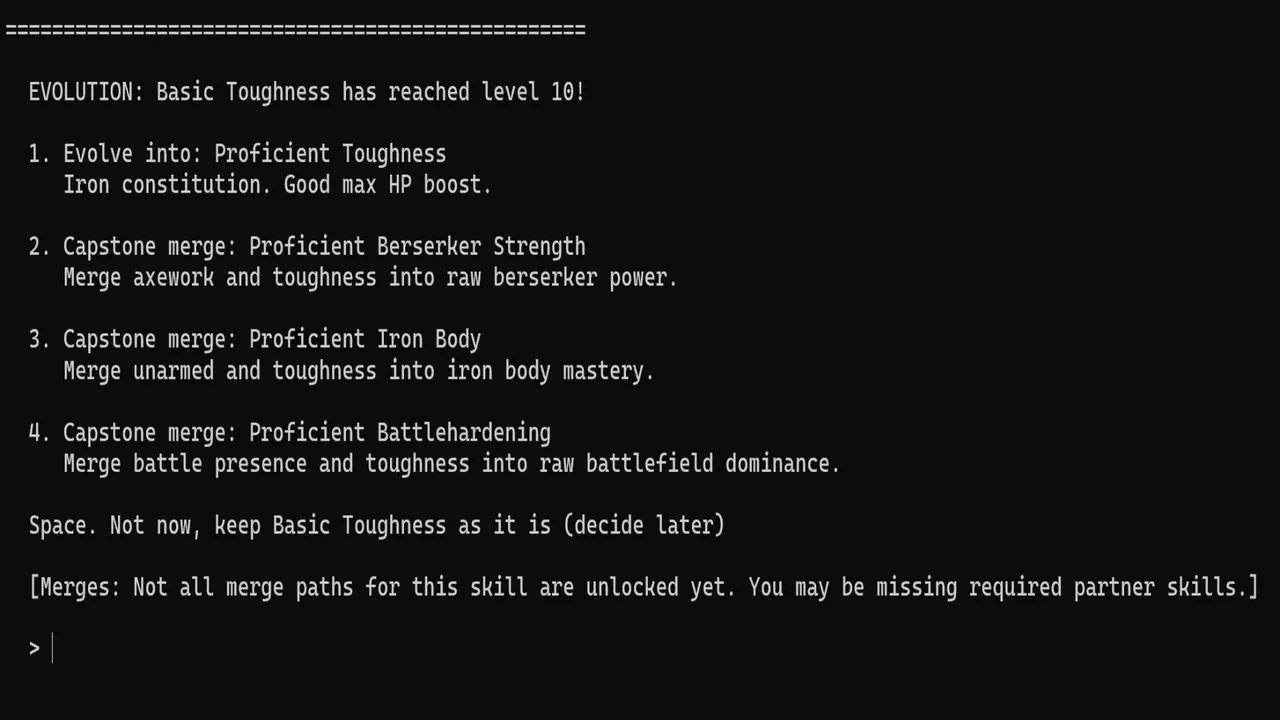
Underneath that stripped interface is a much bigger game than the presentation suggests. Every action in Greywind's Legacy trains a specific skill: swinging a sword levels swordsmanship, mining ore levels mining, reading a book levels arcana. The store page counts 328 skills across the full game. When a skill hits level 10, the player is offered a choice rather than an automatic upgrade — evolve it into a stronger version of the same skill, merge it with a compatible skill of the same tier into something new entirely, or leave it as-is and keep levelling something else. A promotional screenshot shows exactly this decision point: Basic Toughness at level 10 offered a straightforward evolution into Proficient Toughness, alongside three separate capstone merges (with axework, unarmed combat or battle presence) that the player hadn't unlocked the prerequisites for yet.
Classes layer on top of that skill system rather than replacing it. There are 190 classes spread across seven tiers, and which ones are available to evolve into depends on which skills a player has actually trained — a screenshot of the first class evolution shows five Tier 2 melee options (Warrior, Rogue, Swordsman, Spearman, Archer), each gated behind a specific weapon or defensive skill and each offering genuinely different stat growth per level. Class levels climb by earning XP from combat and quests rather than resetting on evolution the way skills do, and every two class levels the player picks from three offered abilities out of a pool the store page puts at "over 400." The whole loop runs from Class Level 1 to a cap of 70 and Tier 1 to Tier 7, and a later-game combat screenshot shows what that looks like at the far end: a level 70 hero and a level 65 companion trading five-figure hit points and choosing between blunt attacks, utility spells and elemental nukes with names like Astral Barrage and Frost Nova.
A world built for players who go looking
The rest of the feature list reads like it was written for players who like systems more than spectacle: 15 zones from the starting Heartlands out to Dragon's Domain, 192 enemies each with their own levels and abilities recorded automatically in a Monster Grimoire as they're encountered, a Home Base the player can reclaim and upgrade, shops with finite inventories that refresh on a timer rather than restocking infinitely, and 70 crafting recipes for tempering weapons and etching wards into armour. Companions can be recruited out in the world or hired at any Adventurer Guild, and the store page says each one has "their own voice, their own personal quest, and their own class evolutions that you choose for them" — a claim a later screenshot backs up, showing a named companion with her own independent level, ability list and equipment. An equipment screen from the same late-game character shows just how far the gear chase goes, too: dragonbone weapon and armour pieces, starstone gauntlets, and a mount slot filled with a young dragon.
The single main objective — avenge Greywind by killing the god who killed him — is explicitly optional, and the store page leans into that as the whole design philosophy: want to be an Adventurer taking Guild quests, an Arena fighter climbing a leaderboard, a mage chasing every school of magic, or just someone who swings one weapon and explores? All of those are described as fully supported paths rather than side content bolted onto a main quest.
Ten weekly patches, then 1.0 exactly on schedule
What makes this worth a closer look than most niche text RPGs is how transparently the development played out. Greywind's Legacy went into Early Access on 29 May 2026, and its news feed reads like a syllabus: a beta branch on 6 June, then ten straight "Weekly Update" posts on a Thursday/Friday cadence from early June through early August, each one rolling the previous week's beta into the default branch. Update #8, posted 24 July, announced a firm 1.0 date of 13 August — three weeks out — and the developer hit it. The 1.0 patch notes, published the day before this review, call it "the biggest update the game has ever had," headlined by a day/night cycle that costs the player visibility between 20:00 and 06:00, a companion overhaul, two new item tiers, a rebuilt merge system, Steam achievements added for the first time, a balance pass touching almost every ability in the game, and dragon riding.
That cadence shows up directly in the handful of reviews the game has earned. One player updated their own review after several patches specifically to raise their score, crediting "the developer is truly top-notch when fixing bugs, listening to feedback, and implementing new stuff." Another calls it "the RPG equivalent of Warsim" and praises the total character freedom of an open world with skills that level from use. A third focuses on exactly the skill-evolution system covered above, saying it "satisfies my need for skill grinding with the added fun of discovering class paths and new skill combinations."
What the early reviews actually say
Steam shows exactly 8 English-language user reviews for Greywind's Legacy as of this writing, all of them positive, and the badge itself reads "Need more user reviews to generate a score" — this is genuinely a small, early audience rather than a hidden gem with a large silent fanbase, and it is worth saying so plainly rather than dressing up eight reviews as a verdict. All eight were read in full for this review. None are negative, but a couple flag real friction rather than pure praise: a Ukrainian-language review calls the controls "quite specific" and mentions some bugs while still recommending it, and a German reviewer notes explicitly that players expecting familiar shortcuts like F5 to quicksave will need to relearn the game's own WASD-and-number-key conventions, since there's no mouse to fall back on. That tracks with the interface being the one real barrier to entry here — the systems get consistent praise, the presentation is the thing reviewers had to adjust to first.
Supported language is listed as English only, which makes the German and Ukrainian reviews notable on their own: this is a text-heavy game clearly being played by people working outside their first language, which says something about how strong the pull of the underlying systems is for genre fans.
Price, monetisation, and one disclosure worth knowing
Greywind's Legacy costs NZ$7.89 as a one-time purchase, with no DLC, no in-app purchases and no advertising anywhere on the store page — as clean a monetisation model as this library ever covers, and squarely in line with its solo-developer, Early-Access-done-right presentation. The one thing worth flagging before buying is the store page's own AI Generated Content Disclosure, which states plainly: "this game has used AI to help with generating artwork and some of the python code." That's the developer's own wording, not an allegation raised by players, and it is reported here exactly as written rather than characterised further — buyers who care about that distinction now have the fact needed to make the call themselves.
Final verdict
Greywind's Legacy is not going to convert anyone who wants a conventional graphical RPG, and it doesn't try to — no mouse, no sound, no concession to players who'd rather look at art than read menus. For the audience it is actually built for, though, it offers something with real depth: 328 skills that level through genuine use, 190 classes reached through meaningful evolve-or-merge choices, and a huge amount of world to explore for the price of a cheap lunch. What separates it from countless other small Early Access RPGs is the paper trail behind it — ten weekly patches, delivered on a public schedule, culminating in a 1.0 that landed on the exact date its solo developer promised three weeks earlier. The review sample is still tiny and entirely positive, which is a fact about how new this is rather than proof of anything larger, but everything visible here — the systems, the pricing, the development discipline — points toward a game worth watching closely as its audience grows.
Pros and cons
Pros
- 328 skills that level through use and 190 classes across seven tiers, reached through a genuine evolve-or-merge choice rather than a fixed skill tree
- Over 400 abilities, 15 zones, 192 catalogued enemies and a reclaimable, upgradeable home base give the systems somewhere real to go
- A disciplined, fully public Early Access record — ten straight weekly patches from 29 May to the announced 13 August 1.0 date, hit on schedule
- NZ$7.89 one time, no microtransactions, no ads, no DLC on the store page
- Every review so far is positive, including reviewers who returned after several updates to raise their own score
Cons
- Keyboard-only, mouse-free ASCII menus and grid maps are a real barrier for players expecting a conventional interface
- No music or sound effects at all, by the store page's own description
- The review sample is still very small (8 English-language reviews at time of writing) and Steam has not generated a percentage score yet
- English is the only supported language despite reviews already arriving in German and Ukrainian
- A store page disclosure states AI assistance was used for some artwork and Python code, worth knowing before buying
Screenshots
-
Greywind's Legacy - A Text Based, Skill Progression, RPGImage: Lansdolli via Steam -
Greywind's Legacy - A Text Based, Skill Progression, RPGImage: Lansdolli via Steam -
Greywind's Legacy - A Text Based, Skill Progression, RPGImage: Lansdolli via Steam -
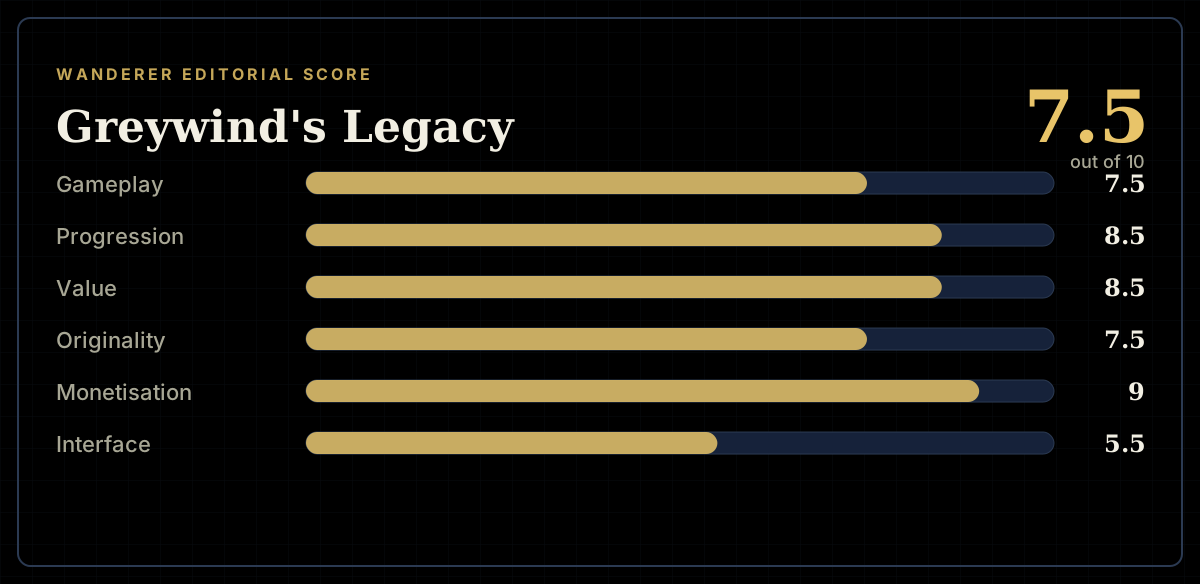
How the review scores each part of the gameWanderer Editorial -
The short versionWanderer Editorial