
Game review
Yars Rising
6 / 10
- Developer
- WayForward
- Publisher
- Atari
- Released
- 9 September 2024
- Platforms
- Windows, PlayStation 5, Xbox Series X|S, Nintendo Switch
- Genre
- Metroidvania
- Monetisation
- One-time purchase, no DLC or in-game currency
- Players
- Single-player
The short version
Yars Rising reimagines Atari's 1982 arcade classic Yar's Revenge as a 2D metroidvania, casting a young hacker named Emi Kimura who gains Yars-like powers while investigating a shadowy corporation, with old-school shoot-em-up hacking minigames standing in for the original game's core mechanic between platforming sections. Critics were genuinely mixed, with Metacritic scores ranging from 75 on Switch down to 59 on PS5 and 63 on PC, and reviewers across the board singled out the same specific weakness Steam's own smaller player base would go on to describe in far more detail: dialogue widely criticised as forced, corny and unfunny, delivered by characters who never stop quipping. A second, structural complaint recurs almost as consistently — several detailed reviews describe a metroidvania stripped of much of its genre's core exploration and secret-finding, replaced by comparatively linear platforming, at a price several reviewers explicitly call out of step with what similarly-scoped genre peers charge.
Biggest strengths
- Visual presentation is vibrant and consistently praised, even by the game's harshest critics, with WayForward's usual strong art direction on clear display
- The soundtrack draws specific, repeated praise across nearly the entire review spectrum
- The Yar's Revenge-inspired hacking minigames are a genuinely novel structural idea, giving the game a distinct identity from typical metroidvania combat and drawing specific credit from several critics as the experience's high point
Biggest weaknesses
- Dialogue and character writing are the single most consistently criticised element across both critics and players, described repeatedly as forced, "hip and relatable" in a way that reads as embarrassing rather than charming, with characters that rarely stop quipping
- Multiple detailed reviews describe the metroidvania structure as stripped of much of the genre's core exploration and secret-finding, with new paths and secrets made too obvious to require real investigation
- Critics were genuinely split rather than warmly positive, with platform Metacritic scores ranging from a low of 59 on PS5 up to 75 on Switch, PC landing at 63
Who it's for: Fans of WayForward's visual and audio craft, and players specifically curious about the Yar's Revenge-inspired hacking minigames as their own distinct hook, will find real value here. Genre purists looking for the exploration-and-secrets depth the metroidvania label usually promises, or anyone sensitive to constant, quip-heavy dialogue, should sample before buying at full price — both are the most consistently repeated complaints across reviews.
Our recommendation: A cautious recommendation, best taken at a discount given the price-to-depth mismatch several detailed reviewers flag directly. The hacking minigames and presentation are genuinely worth experiencing; go in ready to skip through or tolerate dialogue that critics and players alike agree is the game's weakest element by a wide margin.
6 / 10
A genuinely obscure Atari classic gets a modern platform
Yar's Revenge is one of Atari's best-selling 2600 games, but it's also a genuinely obscure reference point for most of today's audience — a 1982 shoot-em-up largely unknown outside retro-gaming circles. WayForward, the studio behind the beloved Shantae series, took on the unusual challenge of reintroducing that specific IP through a 2D metroidvania, casting hacker Emi Kimura as the protagonist who gains Yars-like transformation powers while uncovering a corporate conspiracy. It's a genuinely ambitious structural choice — folding the original arcade game's core shoot-em-up mechanic into old-school-styled hacking minigames scattered through an otherwise standard platforming metroidvania — and critics responded with real but divided enthusiasm: Metacritic scores range from 75 on Switch down to a considerably less enthusiastic 59 on PS5, with PC landing in between at 63.
What earns consistent praise
Nobody disputes WayForward's craft on the audiovisual side. Vibrant, expressive art direction and a strong soundtrack draw consistent praise across virtually every review this piece drew from, including the most critical ones, and full voice acting throughout gives the story more production polish than most metroidvanias attempt on a comparable budget. The hacking minigames themselves — old-school, Yar's Revenge-inspired shoot-em-up sequences that punctuate the platforming — are credited by several critics as the game's genuine highlight, a distinctive mechanical idea that gives Yars Rising an identity separate from the crowded metroidvania field it otherwise sits within.
The dialogue problem
Where critics and players land on almost identical ground is the writing. Reviewers across the entire spectrum, professional and player alike, describe the dialogue in strikingly similar terms: forced, self-consciously "hip" and "relatable" in a way that reads as cringeworthy rather than charming, with characters who rarely let a scene pass without another quip. One reviewer's blunt framing — that it makes them "feel old," not from nostalgia but from secondhand embarrassment at how the characters talk — is echoed independently across multiple other reviews using almost identical language. This isn't a matter of a few jokes landing awkwardly; it's a sustained, structural criticism of the writing throughout the entire campaign, serious enough that several reviewers who otherwise liked the mechanics say it actively pushed them toward skipping cutscenes rather than engaging with the story WayForward built the whole premise around.
A metroidvania with the exploration dialed down
A second, more structural complaint concerns the genre label itself. Several detailed reviews describe Yars Rising as a metroidvania with much of the genre's defining exploration and secret-hunting stripped out — new paths and hidden areas made obvious enough that discovering them requires little real investigation, and platforming sections reviewers describe as comparatively simple next to the genre's better examples. One reviewer summarised the structural mismatch bluntly: "a metroidvania with all the secret finding removed," repurposed instead as more straightforward action-platforming interrupted by the hacking sequences. That's a fair criticism to weigh against the asking price specifically — at NZ$43.59, several reviewers explicitly argue the depth on offer doesn't match what comparable, often cheaper, genre peers deliver, with more than one drawing a direct, unfavourable comparison to WayForward's own Shantae games.
The technical rough edges add up
A handful of smaller, more conventional complaints round out the picture. Several reviewers describe an unusually high frequency of loading screens, with one comparing it unfavourably to the load times of a PS1-era game, and at least one detailed review reports a persistent, intermittent movement bug that prevented full-speed leftward movement, serious enough that the reviewer abandoned the game around 75% completion rather than continue fighting it. Checkpoint placement draws its own specific frustration too — at least one reviewer notes that checkpoints before boss fights are placed after the boss's introductory monologue and animation rather than before it, meaning a lost fight means sitting through the same unskippable cutscene again before another attempt. None of these are individually disqualifying, but they compound with the writing and depth complaints above to leave a meaningfully rougher overall impression than WayForward's reputation for polish would suggest.
Boss design and the minigames' double edge
Boss encounters draw a specific, if less consistent, complaint of their own: several reviewers describe them as swinging between two extremes, either dispatched with little real challenge or requiring solutions that feel obtuse rather than clearly telegraphed, with little middle ground between the two. The hacking minigames that critics singled out as a highlight receive a more genuinely divided reception once player reviews are weighed alongside professional ones — several detailed accounts describe them growing tedious as the campaign progresses, since the specific objective changes with each new console hacked without always building meaningfully on what came before, and at least one reviewer flags a late difficulty spike involving a targeting beam that can kill the player unexpectedly if its behaviour isn't anticipated in advance. That gap between critical and player reception on the minigames specifically is worth knowing about before assuming the format's biggest praised feature will land the same way for everyone.
Verdict
Yars Rising is a genuinely ambitious, visually accomplished attempt to bring an obscure Atari classic to a modern audience, and the hacking-minigame concept at its centre is inventive enough to have earned real critical praise on its own terms. Where it consistently falls short — across critics and players alike, in remarkably matching language — is writing that a wide consensus describes as actively grating, and a metroidvania structure that trims away much of the exploration the genre is usually built around. At full price, several detailed reviewers make a fair case that the depth on offer doesn't match the cost. Buy it at a discount for the presentation, the hacking minigames, and a genuine curiosity about an underused piece of Atari history, and go in ready to tune out dialogue that even the game's fans agree is its weakest link.
Pros and cons
Pros
- Visual presentation is vibrant and consistently praised, even by the game's harshest critics, with WayForward's usual strong art direction on clear display
- The soundtrack draws specific, repeated praise across nearly the entire review spectrum
- The Yar's Revenge-inspired hacking minigames are a genuinely novel structural idea, giving the game a distinct identity from typical metroidvania combat and drawing specific credit from several critics as the experience's high point
- Full voice acting throughout gives the story more production value than most genre peers attempt, whatever reviewers think of the writing itself
- As a tribute to a genuinely obscure Atari classic, it succeeds at introducing Yar's Revenge's core concept to an audience who likely never encountered the 1982 original
Cons
- Dialogue and character writing are the single most consistently criticised element across both critics and players, described repeatedly as forced, "hip and relatable" in a way that reads as embarrassing rather than charming, with characters that rarely stop quipping
- Multiple detailed reviews describe the metroidvania structure as stripped of much of the genre's core exploration and secret-finding, with new paths and secrets made too obvious to require real investigation
- Critics were genuinely split rather than warmly positive, with platform Metacritic scores ranging from a low of 59 on PS5 up to 75 on Switch, PC landing at 63
- Several reviewers explicitly call the NZ$43.59 asking price excessive relative to the game's scope and length, drawing unfavourable comparisons to WayForward's own, cheaper Shantae series and to other genre peers offering considerably more content for less
- Reception to the hacking minigames is genuinely divided rather than uniformly positive — while some critics call them the highlight, several player reviews describe them as increasingly tedious, with at least one detailed review flagging a difficulty spike involving a targeting beam that can unexpectedly kill the player
Screenshots
-

Yars RisingImage: Atari via Steam -

Yars RisingImage: Atari via Steam -

Yars RisingImage: Atari via Steam -
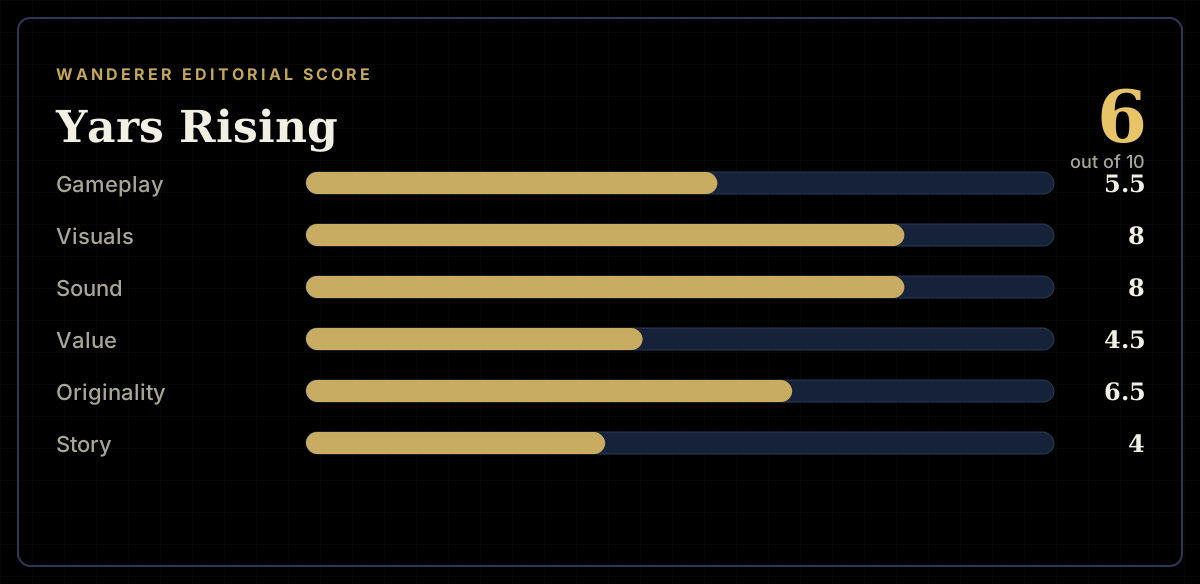
How the review scores each part of the gameWanderer Editorial -
The short versionWanderer Editorial