
Game review
Tales of Kenzera: ZAU
6.5 / 10
- Developer
- Surgent Studios
- Publisher
- Electronic Arts
- Released
- 23 April 2024
- Platforms
- Windows, PlayStation 4, PlayStation 5, Xbox One, Xbox Series X|S, Nintendo Switch
- Genre
- Action-Adventure Platformer
- Monetisation
- One-time purchase, no DLC or in-game currency
- Players
- Single-player
The short version
Tales of Kenzera: ZAU tells a heartfelt story about grief through a shaman named Zau who trades favours with the God of Death to reach his late father's spirit, and on presentation alone — voice acting, music, a striking painted-fantasy art style — it earns the 76 Metacritic score critics gave it. Steam's own userbase is far more divided at 82% positive across roughly 900 reviews: a large, specific and repeated complaint is that the combat and movement feel floaty and imprecise for a genre that demands tight platforming, and that a game marketed as a Metroidvania is, in practice, a mostly linear side-scroller with occasional dead-end backtracking rather than an interconnected map worth exploring. A launch-week backlash tied to the writer-director's connection to narrative studio Sweet Baby Inc. and the game's use of Denuvo DRM further muddies how much of the Steam score reflects the game itself, but the gameplay complaints exist independently of that controversy and are corroborated by achievement data showing under half of buyers ever finish the first act.
Biggest strengths
- The story of Zau bargaining with the God of Death Kalunga to return his father's spirit is genuinely affecting, and voice acting across the cast draws specific, repeated praise even from critical reviewers
- Switching between the melee-focused Mask of the Sun and the ranged, cooldown-limited Mask of the Moon mid-combo gives fights a real rhythm once the player has both unlocked
- The painted, high-contrast fantasy art style and its African-folklore-inspired setting stand out from the genre's usual medieval-European default
Biggest weaknesses
- The most-upvoted Steam review specifically calls out floaty, unresponsive movement and combat where the player's own character is sometimes hard to see mid-fight — a serious problem for a genre built on precision platforming
- Instant-kill spikes combined with imprecise movement are a repeated, specific complaint, especially in the game's later, harder platforming sections
- Despite marketing itself as a Metroidvania, multiple detailed reviews report a mostly linear structure with few meaningful backtracking rewards, no in-game map-completion tracking, and sparse fast travel
Who it's for: Players drawn in primarily for story, voice acting and a distinctive African-folklore-inspired fantasy setting will likely find plenty to like, especially played at a relaxed pace on Easy or Story mode. Genre purists who want Metroidvania-grade exploration, backtracking and precise combat should look elsewhere first — several of the biggest names in that genre do all three better, and ZAU itself is closer to a linear action-platformer with light exploration than the interconnected map its own marketing promised.
Our recommendation: A cautious recommendation at its NZ$29.95 asking price, mainly for players who prioritise narrative and atmosphere over combat precision. Wait for a sale if tight platforming and a genuinely non-linear map matter more to you than story, since that's exactly where the game's own player base is most consistently critical.
6.5 / 10
A story worth telling, wrapped around a platformer that doesn't quite hold up its end
Tales of Kenzera: ZAU opens with a framing device: a grieving son named Zuberi, mourning his own father, reading a story his dad wrote about a shaman named Zau who strikes a bargain with Kalunga, the God of Death, to reach his father's spirit one more time. It's a deliberately layered piece of writing — a story about grief, told as a story within a story about grief — and it's the strongest thing about the game by a wide margin. Critics agreed: ZAU sits at 76 on Metacritic across PC, PlayStation 5 and Xbox Series X|S, with reviewers consistently praising the writing, the voice cast and a painted, high-contrast art style drawn from African folklore rather than the genre's usual well-worn fantasy iconography. Steam's own userbase tells a more complicated story, sitting at 82% positive across roughly 900 reviews — solidly "Very Positive" by Steam's own labelling, but with specific, detailed complaints running through a large share of the negative fifth that are worth taking seriously rather than waving away as noise.
Two masks, one rhythm, and the ceiling that comes with linear design
Zau fights wearing two masks he can swap between mid-combat: the Mask of the Sun, which turns him into a close-range melee fighter wielding paired spears, and the Mask of the Moon, a ranged option limited by a short cooldown between volleys. The idea, once both masks and their supporting abilities are unlocked, is a rhythm of stepping into melee range, retreating to plink away at range while the cooldown resets, and chaining the transition between the two into what the game calls pirouettes — a reasonable, Ori-adjacent structure that several reviews single out as the game's best mechanical idea.
The problem several of the most-detailed negative reviews raise isn't the mask concept itself, it's the movement and combat feel underneath it. The single most-upvoted Steam review (532 votes) leads with exactly this: actions feel slow to respond, the character continues drifting in the air when the player tries to change direction, and combat clutter can make it genuinely hard to track where Zau is on screen mid-fight. That's a serious complaint for any platformer, and a more serious one for a game asking to be judged as a Metroidvania, a genre where tight, readable movement is close to non-negotiable. Multiple independent reviews add a second, compounding problem: instant-kill spikes paired with that same imprecise movement, which turns some platforming sections into repeated cheap deaths rather than skill-testing challenges.
The genre-label complaint runs even deeper than combat feel. Several long, detailed reviews — including one from a player who fully completed the game — report that ZAU markets itself as a Metroidvania but plays as a linear side-scroller with occasional short backtracking detours, most combat resolved in dedicated arena encounters rather than open exploration, no in-game system for tracking which parts of the map remain unexplored, and few fast-travel points to soften the backtracking that does exist. One reviewer put it bluntly: most of the new abilities the game hands out function as literal keys for specific obstacles rather than tools that meaningfully reopen the map, which is close to the opposite of what the genre's best examples do with their own ability gates.
Enemy variety backs up a related complaint about content depth: several reviews independently count only three or four regular enemy types and four bosses across the whole run, with later areas frequently described as the same biome with a different colour grade rather than a new environment. None of this makes ZAU a bad game — critics who focused on the story and atmosphere had a fair point that it's a handsome, well-performed experience — but it does mean the "solid Metroidvania" framing in some of the marketing sets an expectation the actual moment-to-moment design doesn't deliver on.
What the achievement data adds
Global Steam achievement stats offer a useful, unbiased cross-check on how far players actually get. 80.2% of players triggered the game's opening achievement, which is normal for any game's earliest milestone. By the time the tracked achievement for completing Act 1 comes around, that number has fallen to 43.6% — meaning a majority of people who started ZAU never got past its first act. Completion-focused achievements fall further still: only 14–17% of players collected every trinket, unlocked every spirit pip, or completed every combat trial. None of this proves the movement and combat complaints are the specific reason people stopped — a linear five-to-eight-hour game will always shed some of its audience partway through — but a fall from 80% to 44% between the tutorial and the end of Act 1 is a genuinely steep early drop, and it lines up with a userbase whose most detailed complaints are about exactly the mechanics that would frustrate players earliest: movement, combat clarity and instant-death platforming.
The controversy that isn't really about the game
No honest account of ZAU's Steam reception can skip the other thing that happened at launch. Writer and director Abubakar Salim has a prior business connection to Sweet Baby Inc., a narrative consultancy that became a lightning rod in a broader 2024 argument over diversity consulting in game development; a large Steam curator list built specifically to flag games with any perceived Sweet Baby Inc. connection added ZAU to its roughly 380,000 followers within days of launch, and the game's use of Denuvo anti-tamper DRM became a second, separate target for the same wave of review activity. Several of the game's most-upvoted negative Steam reviews name Denuvo and Sweet Baby Inc. specifically and explicitly say they are voting with their wallet rather than describing anything about how the game plays. SteamDB's concurrent-player data shows the game peaking at only 287 concurrent players on launch day, a genuinely small number for an EA-published, console-day-one release, and it's reasonable to read the backlash as a real factor in that outcome alongside ordinary market forces for a mid-length narrative platformer. This review isn't the place to adjudicate that argument — it's a documented, verifiable fact about how the game arrived on Steam, and it sits alongside, not in place of, the specific mechanical complaints detailed above.
Verdict
Tales of Kenzera: ZAU has a story worth experiencing — a genuinely well-written meditation on grief, wrapped in strong voice work and a distinctive visual identity that critics were right to single out. But it asks to be judged as a Metroidvania, and on that specific promise it comes up short: floaty movement, occasional visibility problems in combat, a linear structure with little of the genre's signature interconnected exploration, and enemy variety thin enough that several detailed, high-playtime reviews noticed and said so independently of each other. A launch-week controversy over its director's studio ties and its DRM choice makes the Steam score harder to read cleanly than most games', but the achievement data showing a majority of players never finishing Act 1 doesn't need that controversy to explain it — it lines up with complaints about the moment-to-moment feel that long predate any of it. Go in for the story, on a sale if precise platforming matters to you, and adjust your expectations for the "Metroidvania" label before you do.
Pros and cons
Pros
- The story of Zau bargaining with the God of Death Kalunga to return his father's spirit is genuinely affecting, and voice acting across the cast draws specific, repeated praise even from critical reviewers
- Switching between the melee-focused Mask of the Sun and the ranged, cooldown-limited Mask of the Moon mid-combo gives fights a real rhythm once the player has both unlocked
- The painted, high-contrast fantasy art style and its African-folklore-inspired setting stand out from the genre's usual medieval-European default
- New mechanics and abilities are introduced at a deliberate, well-paced clip that keeps the early hours from feeling overwhelming
- Critics were considerably more positive than the Steam userbase (76 Metacritic versus 82% of a much smaller, more mixed Steam sample), so players who bounce off user-review complaints about combat feel may still find the story worth the trip
Cons
- The most-upvoted Steam review specifically calls out floaty, unresponsive movement and combat where the player's own character is sometimes hard to see mid-fight — a serious problem for a genre built on precision platforming
- Instant-kill spikes combined with imprecise movement are a repeated, specific complaint, especially in the game's later, harder platforming sections
- Despite marketing itself as a Metroidvania, multiple detailed reviews report a mostly linear structure with few meaningful backtracking rewards, no in-game map-completion tracking, and sparse fast travel
- Enemy variety is thin — several reviews independently count roughly three to four regular enemy types plus four bosses across the whole game, with later biomes described as reused environments with a different colour palette rather than genuinely new areas
- Achievement data shows only 43.6% of players ever complete Act 1, a real, measurable sign that a meaningful share of buyers stop well before the story pays off, whatever the reason
- The writer-director's prior business ties to narrative consultancy Sweet Baby Inc., combined with the game's use of Denuvo DRM, triggered a launch-week backlash and a large "detected" curator list being applied to the game, a documented factor in Steam's review composition that reviewers themselves flag as separate from any complaint about gameplay
Screenshots
-

Tales of Kenzera™: ZAUImage: Electronic Arts via Steam -

Tales of Kenzera™: ZAUImage: Electronic Arts via Steam -

Tales of Kenzera™: ZAUImage: Electronic Arts via Steam -
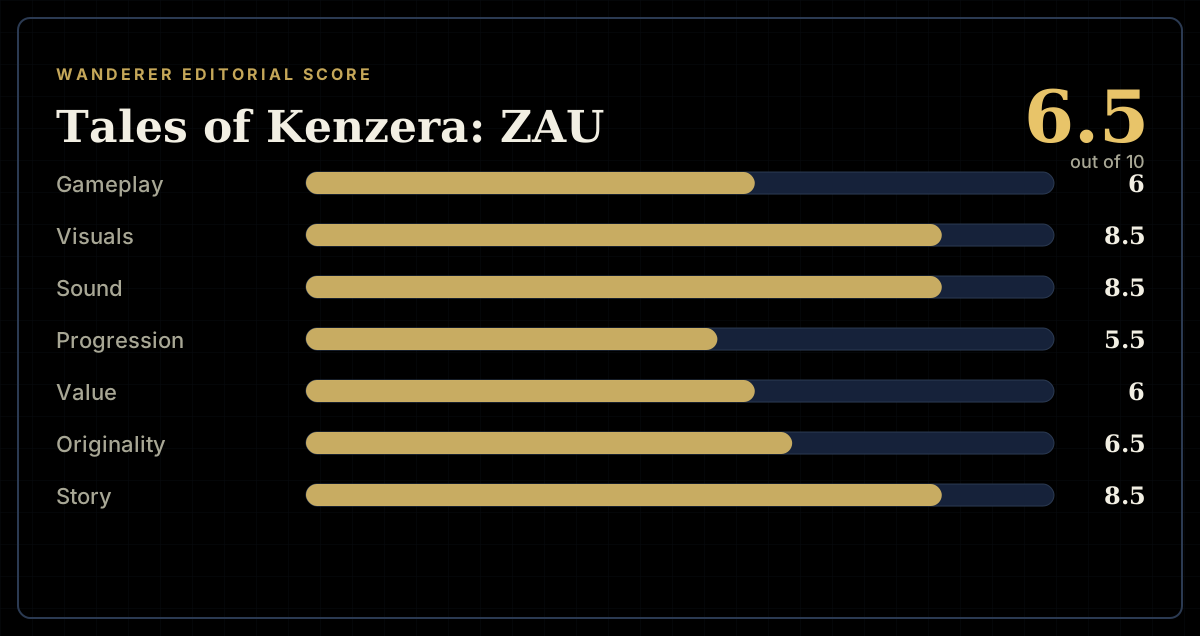
How the review scores each part of the gameWanderer Editorial -
The short versionWanderer Editorial