
Game review
DeepDig: Together
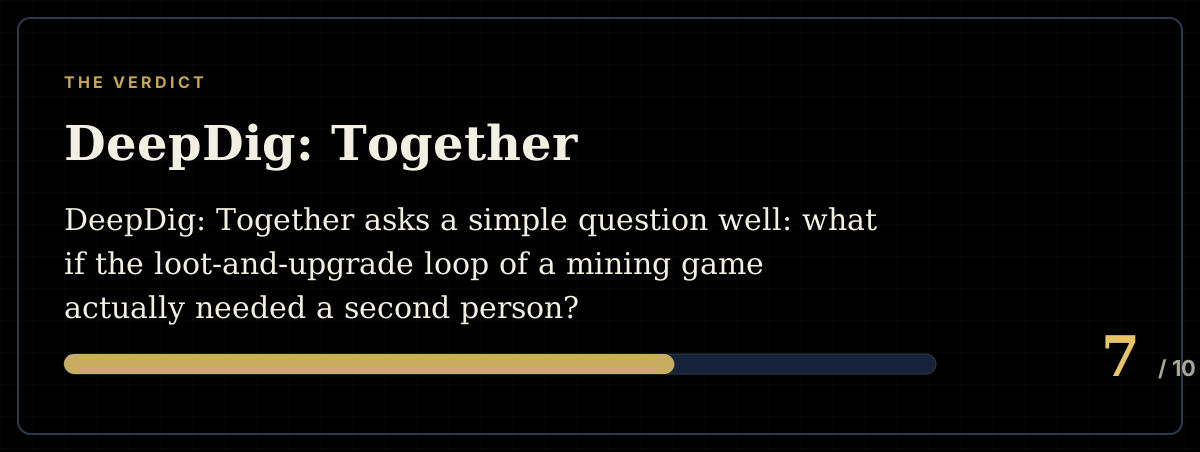
7 / 10
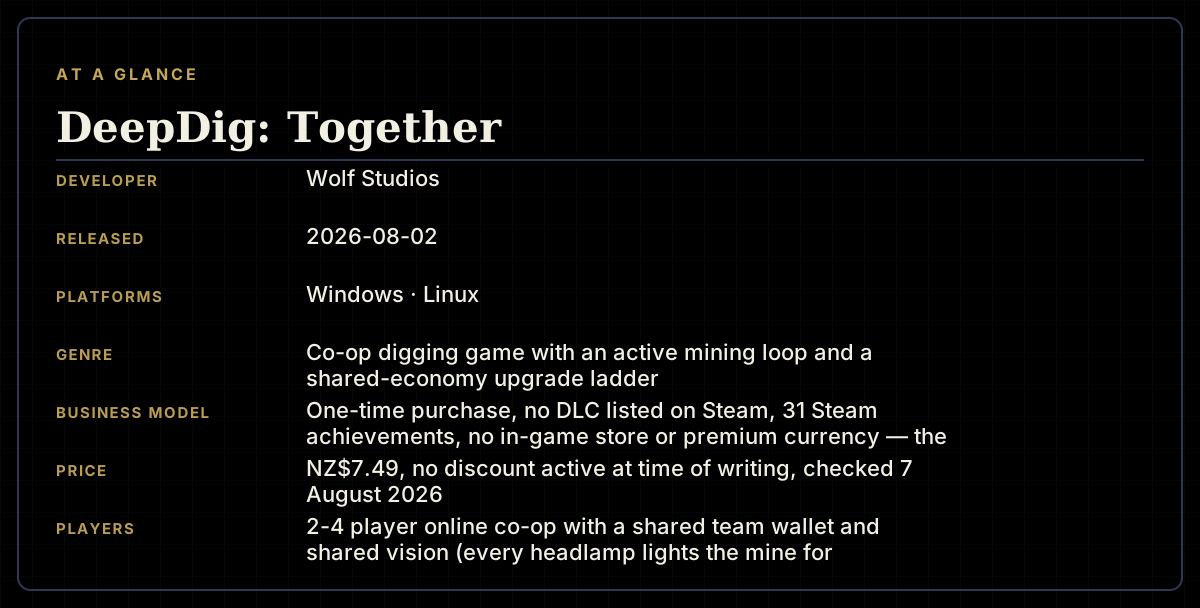
- Developer
- Wolf Studios
- Publisher
- Wolf Studios
- Released
- 2 August 2026
- Platforms
- Windows, Linux
- Genre
- Co-op digging game with an active mining loop and a shared-economy upgrade ladder
- Monetisation
- One-time purchase, no DLC listed on Steam, 31 Steam achievements, no in-game store or premium currency — the Surface Shop spends only the gold your crew digs up
- Players
- 2-4 player online co-op with a shared team wallet and shared vision (every headlamp lights the mine for everyone); the full descent also plays solo
The short version
DeepDig: Together asks a simple question well: what if the loot-and-upgrade loop of a mining game actually needed a second person? The answer it builds is a shared wallet, a shared pool of light, and hazards — gas pockets, cave-ins, earthquakes, a radiation layer deep down — that reward a crew working a shaft together far more than one miner grinding it alone. It's also a game five days into release with almost no player base to check any of that against yet, and the developer's own early tag votes suggest the small crowd that has shown up is filing it as a cozy digging game first and a multiplayer game second.
Biggest strengths
- Shared vision genuinely changes co-op play — every headlamp adds to the team's lit radius, so splitting up to strip-mine two veins at once is a real tactical choice, not just parallel play
- Hazards scale with depth in a way that punishes bringing the wrong gear rather than just bad luck — an open-flame lantern near a gas pocket, a hard-rock wall your Hand Drill can't break, a mid-run earthquake that reshapes the shaft around you
- Getting downed costs you your own cargo and nobody else's, which keeps a crew's shared wallet from being one careless player's problem to fix
Biggest weaknesses
- Three days after launch the tag votes from the small crowd that has shown up rank Co-op, Multiplayer and Online Co-Op as the three least-endorsed tags on the store page, well behind Adventure, Casual, Action and Cozy — a strange result for a game whose own pitch is "co-op is the whole game"
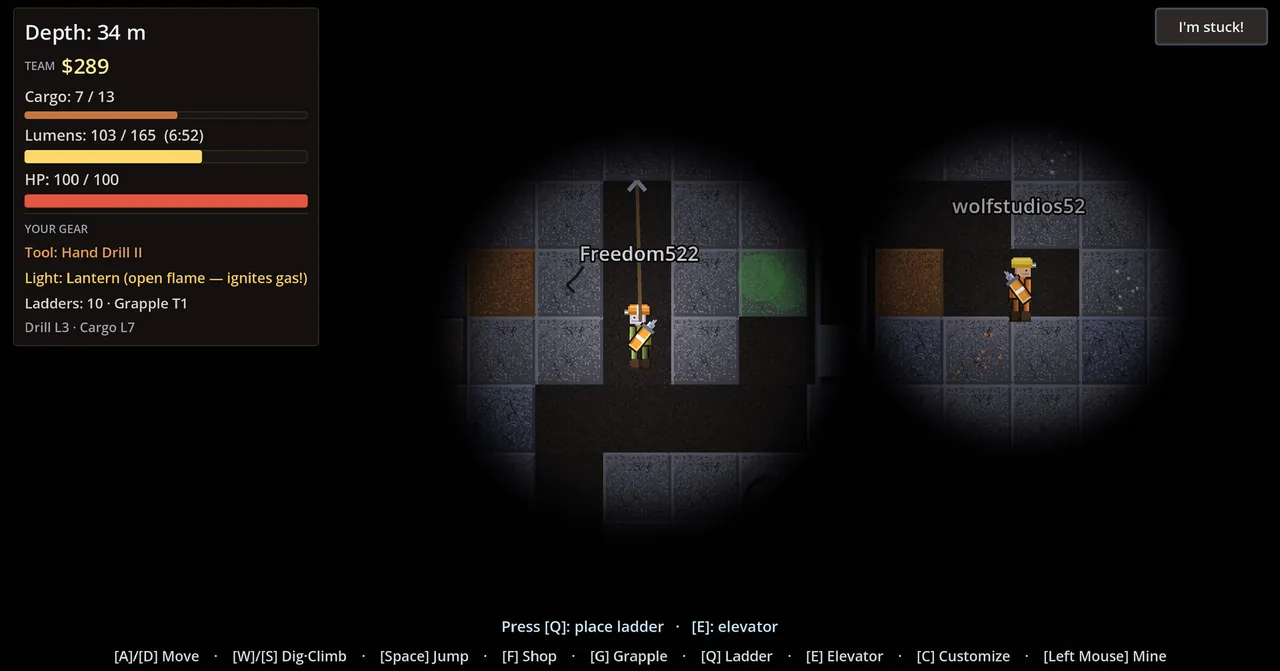
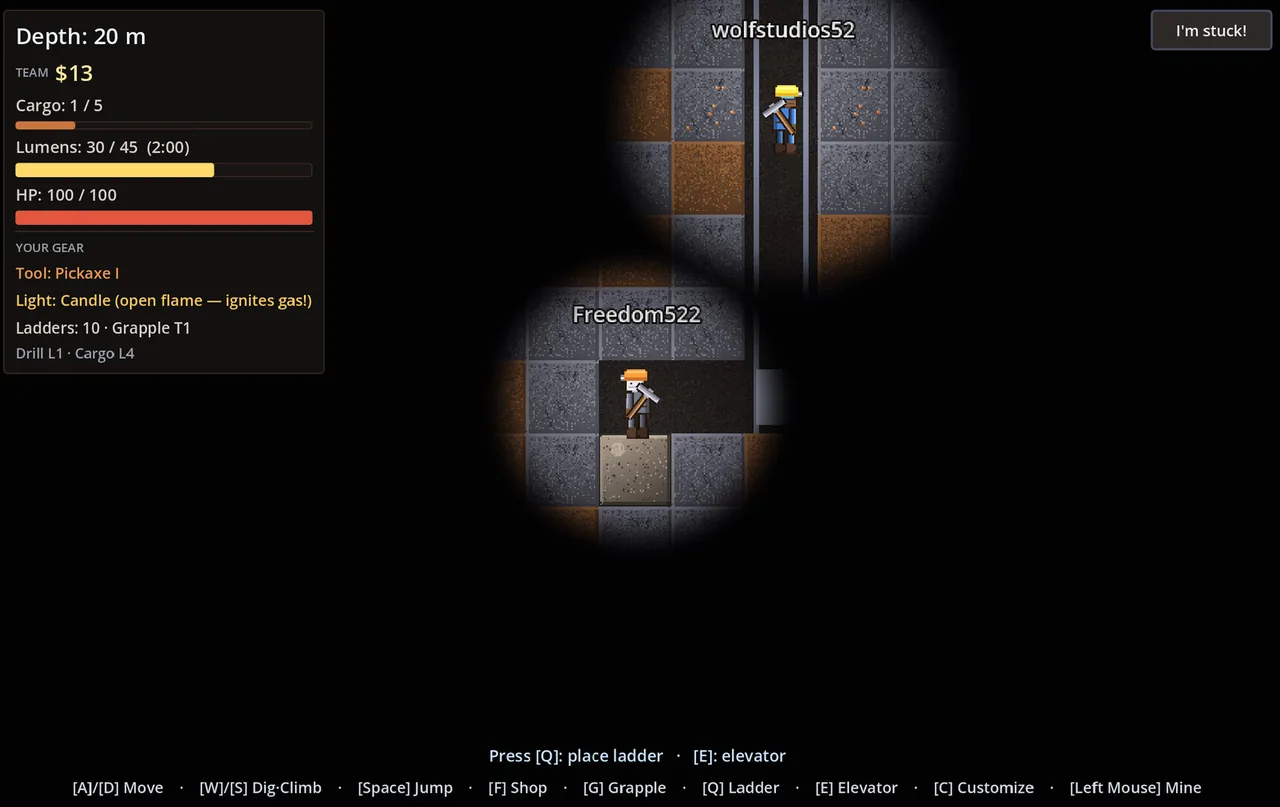
- The mid-run HUD stacks depth, team gold, cargo capacity, a burning-down light meter, an HP bar and a full gear readout into one corner at once, which is a lot to parse while also watching for a patrol of falling rock
- With so few players tracked so far, the game's own achievement stats put nobody — solo or co-op — at the bottom of the mine yet, so there's no way to say whether the endgame the marketing teases is actually reachable in a normal session
Who it's for: Small co-op groups who want a session built around genuine interdependence rather than four people digging in the same general direction, and players happy to be early enough that the developer is still actively patching the multiplayer layer in response to what they report.
Our recommendation: At NZ$7.49 for a one-time purchase with no DLC and no premium currency, and with a free content update landing two days after launch, the downside of trying it with a friend is small. Go in expecting a quiet lobby scene this early and a HUD that wants a second look before it makes sense solo.
7 / 10
Most co-op mining games hand every player their own pickaxe, their own inventory and their own progress bar, then trust the social contract to keep everyone digging toward roughly the same place. DeepDig: Together doesn't trust the social contract. It gives a crew of up to four one mine site, one wallet and — more interestingly — one pool of light, so that a decision to split up and strip-mine two veins at once is a decision to leave someone in the dark. That single mechanic does more to make the co-op feel load-bearing than anything else in the pitch.
Digging is a resource fight, not a puzzle
The loop underneath the co-op dressing is straightforward: carve down through dirt, rock and reinforced stone, chase the copper, iron and gold veins glinting in the walls, fill a shared cargo hold, then climb or elevator back to the surface to cash out and gear up before the next descent. What keeps it from being a pure number-go-up incremental is that every resource on screen is also a countdown. Cargo space runs out — the official screenshots show a "Backpack is full: Go sell things at the store up top!" prompt firing mid-shaft. Light runs out on a visible timer next to its meter, measured in minutes rather than an abstract percentage. And the tiles themselves get harder than a starting Pickaxe I can break, forcing a trip home for a Hand Drill upgrade rather than just more patience.
Depth adds its own escalating hazard list on top of the resource clock. A screenshot from roughly 20 metres down shows a stock Candle for light, flagged in its own tooltip as an "open flame — ignites gas!" — strike a hidden gas pocket with it and the pocket detonates, taking the rock and the miner holding it with it. Deeper runs bring earthquakes that visibly warn before reshaping the shaft around you ("EARTHQUAKE — the mine is shifting!" reads one promotional shot, ladders and cleared paths included in the shuffle), and by 400-plus metres a radiation meter appears alongside a Gas Drill III and an electric Headlamp IV, the game's own way of telling you an open flame won't cut it down here at all. None of that reads as scripted difficulty spikes so much as a gear checklist: bring the wrong tool for the depth you're at, and the mine finds a way to make you pay for it.
What actually makes this a co-op game, and what doesn't
The strongest evidence that co-op isn't bolted onto a solo loop is the shared-vision mechanic: every player's headlamp contributes to what the whole team can see, so a crew that spreads out across two veins is lighting up more of the mine collectively than any one of them could alone. The developer has also been actively engineering around 3-4 player sessions specifically — "The Builder Update," posted two days after launch, calls out and fixes a case where clients in a three- or four-person lobby couldn't see each other move, which only shows up once real four-person lobbies are being run and reported on. And getting knocked out costs you your own cargo, not the team's, which is a small design choice that keeps one reckless miner's mistake from being everyone's problem to absorb.
Set against that: DeepDig explicitly supports solo play too ("Prefer it quiet? The whole descent works solo, too," says the store page), and the earliest signal from actual players cuts the other way from the marketing. Steam's user-tag votes — the only crowd-sourced signal available on a game this new — rank Co-op, Multiplayer and Online Co-Op dead last of eighteen tags, at 16, 14 and 12 votes respectively, well behind Adventure (73), Casual (67), Action (64) and even Cozy (24) and Relaxing (22). That's a tiny sample and not remotely a verdict, but it's a genuine tension worth naming: the game is built to reward a crew, and the handful of people who've tagged it so far are filing it as something you'd play by yourself with a cup of tea. Worth remembering that the shared wallet cuts both ways in practice, too — one official screenshot of a three-player run shows the team's individual earn/spend totals openly displayed, and one player had spent nearly $15,500 against roughly $9,700 earned in that same session, almost triple what a teammate spent for a smaller haul. A shared purse with no per-player spending limit is exactly the kind of thing that turns into a house rule the first time a group plays it seriously.
A shop that reads like a real ladder
The Surface Shop, visible in full in one of the promotional screenshots, prices its upgrades in a way that suggests real balancing thought rather than arbitrary numbers: a Hand Drill II sits at "x1.24 dig · breaks hard rock," with the next tier gated behind a further $549 on top of what's already banked; a Lantern upgrade runs $340; ten ladders cost $40 and a Grappling Hook's second tier is $900. Reaching Gas Drill III and Headlamp IV by 400 metres down, as another screenshot shows, implies a ladder with real length to it rather than two or three token upgrades standing in for progression. The character customization screen — suit, helmet, skin tone and accessory colour, with a randomize button — is a nice touch for a co-op game where telling your crewmates apart down a dark shaft actually matters, though it's cosmetic rather than a system with its own economy.
Presentation and the one honest caveat
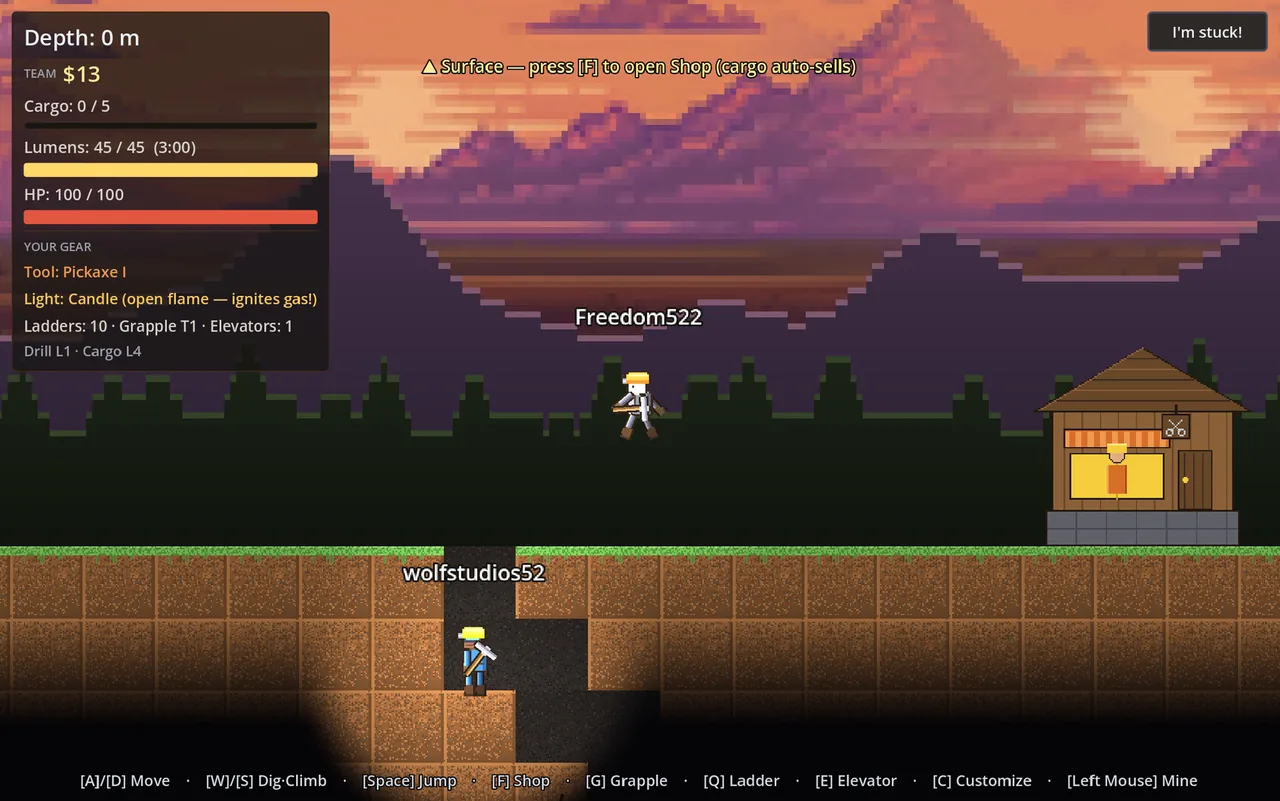
The pixel art holds up in every promotional shot: warm surface sunsets over a low shop building, convincing rock-face texture variation between dirt, stone and ore veins, and character sprites readable even inside a small lamp-lit circle. Where the interface earns its lower score is legibility under pressure — the always-on HUD panel stacks depth, team gold, cargo fill, a light-with-countdown bar, an HP bar and a full gear readout into one corner, all visible at once even while three players' name tags and light circles are also on screen. It's a lot of concurrent information for a game whose core moment-to-moment tension is watching a lamp burn down while judging whether a wall is about to give.
The honest caveat is timing, not design. Five days after its 2 August launch, DeepDig: Together has exactly two Steam reviews, both positive, both written by players who logged one to three hours and liked what they found — one specifically describes a two-player session settling into distinct roles, one player pushing depth while the other optimised the return route and dropped speed buffs, which is precisely the kind of division of labour the shared-vision design is built to produce. But the game's own achievement stats, tracked against a population of roughly nineteen players, put the three "reach the core" achievements — the solo variant, the co-op variant and the plain version the store page's "something hums at the bottom" line is teasing — at a flat 0.0%. Nobody, in either mode, has gotten there yet. That's not a mark against the design; it's what a brand-new release with a shallow player pool looks like, and it means anyone buying in this week is genuinely early rather than catching up to a settled meta.
Final verdict
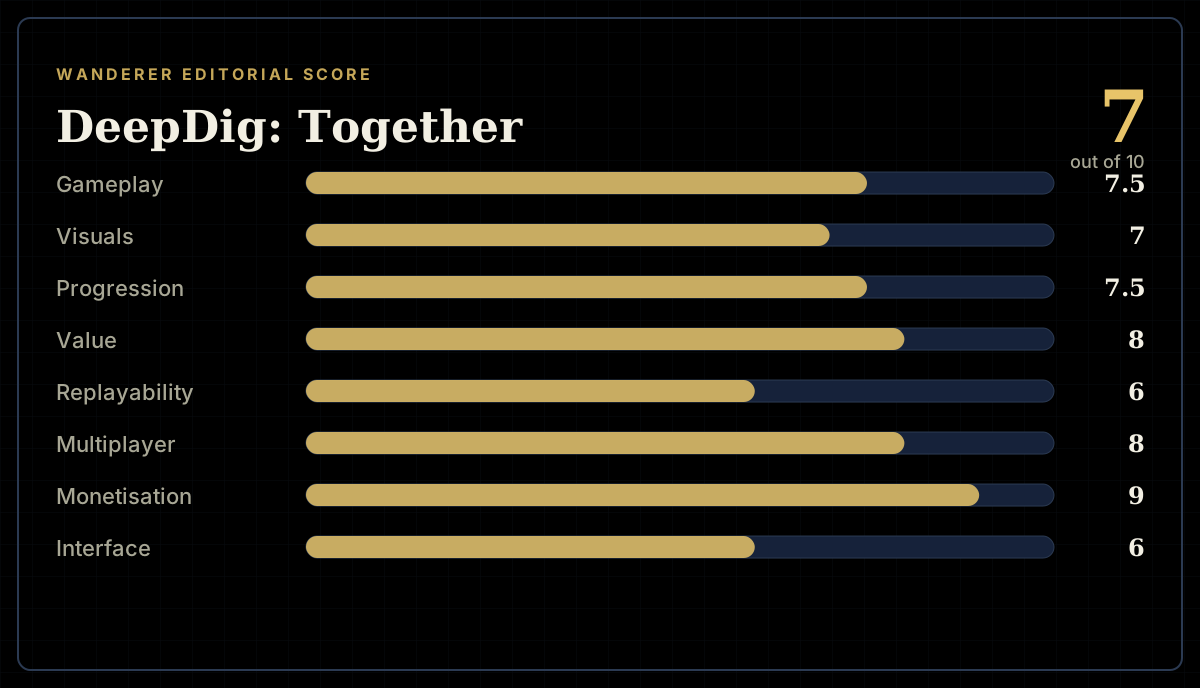
DeepDig: Together earns its 7.0 for building a co-op mining loop where the multiplayer actually does something mechanically — shared light, a shared purse, hazards that punish undergeared crews rather than unlucky ones — backed by a developer shipping a substantial free update within 48 hours of launch. It doesn't score higher because the interface gets crowded exactly when a player most needs to read it fast, because the shared wallet has no guardrail against one player massively outspending the group, and because there's no way yet to check the marketing's co-op pitch against a real player base — the tag votes from the few people who have shown up actually lean the other way. At NZ$7.49 with no DLC and no premium currency behind it, that's a small bet either way: worth making with a regular co-op partner who likes their multiplayer games to need each other, and worth going in with the expectation that you may be the one finding out whether the lobbies fill up.
Pros and cons
Pros
- Shared vision genuinely changes co-op play — every headlamp adds to the team's lit radius, so splitting up to strip-mine two veins at once is a real tactical choice, not just parallel play
- Hazards scale with depth in a way that punishes bringing the wrong gear rather than just bad luck — an open-flame lantern near a gas pocket, a hard-rock wall your Hand Drill can't break, a mid-run earthquake that reshapes the shaft around you
- Getting downed costs you your own cargo and nobody else's, which keeps a crew's shared wallet from being one careless player's problem to fix
- A free update two days after launch added a full twelve-item build system (ladders, cushioned platforms, dynamite, permanent lamps, elevator shafts) built directly from patch-notes-cited player reports
- A clean NZ$7.49 one-time purchase with no DLC, no premium currency and no in-game store of any kind
Cons
- Three days after launch the tag votes from the small crowd that has shown up rank Co-op, Multiplayer and Online Co-Op as the three least-endorsed tags on the store page, well behind Adventure, Casual, Action and Cozy — a strange result for a game whose own pitch is "co-op is the whole game"
- The mid-run HUD stacks depth, team gold, cargo capacity, a burning-down light meter, an HP bar and a full gear readout into one corner at once, which is a lot to parse while also watching for a patrol of falling rock
- With so few players tracked so far, the game's own achievement stats put nobody — solo or co-op — at the bottom of the mine yet, so there's no way to say whether the endgame the marketing teases is actually reachable in a normal session
- The shared-wallet design means one player's spending can outpace the whole crew's income; the official screenshots themselves show a three-player team where one member had spent nearly triple what the group had earned in that run
Screenshots
-
DeepDig: TogetherImage: Wolf Studios via Steam -
DeepDig: TogetherImage: Wolf Studios via Steam -
DeepDig: TogetherImage: Wolf Studios via Steam -
How the review scores each part of the gameWanderer Editorial -
The game at a glanceWanderer Editorial -
The short versionWanderer Editorial