
Game review
The Rogue Prince of Persia
7 / 10
- Developer
- Evil Empire
- Publisher
- Ubisoft
- Released
- 27 May 2024
- Platforms
- Windows, PlayStation 5, Xbox Series X|S
- Genre
- Action Roguelite
- Monetisation
- One-time purchase, no in-game currency
- Players
- Single-player
The short version
The Rogue Prince of Persia comes from Evil Empire, the studio Motion Twin handed Dead Cells to for years of post-launch content, and it applies that same team's expertise in fast, acrobatic 2D action to a new Prince of Persia story. It spent 15 months in Early Access, from a 27 May 2024 launch delayed a week specifically to avoid colliding with Hades II's own Early Access debut, to a full 1.0 release on 20 August 2025 that added a final biome and boss to complete the story. Steam sentiment has held Very Positive throughout, 89.1% across roughly 2,350 reviews with recent sentiment even higher at 92%. What's kept a meaningful slice of players from fully embracing it is a persistent, specific complaint that shows up in reviews from both its Early Access days and its full 1.0 release: weapons, encounters and runs don't vary enough from each other, an inevitable point of comparison given who made this game and what they made before it.
Biggest strengths
- Movement and combat are fluid and satisfying to chain together, with multiple reviewers specifically praising how naturally parkour flows into combat rather than feeling like two separate systems
- Evil Empire's post-launch support record with Dead Cells gives real confidence the game will continue receiving content and balance updates rather than being abandoned
- The 1.0 release completed the story properly, adding a final biome, a final boss (King Nogai), and resolving plot threads Early Access had left open
Biggest weaknesses
- Weapon variety is a specific, repeated complaint across the review timeline — many reviewers say weapons feel too similar to each other in practice, undermining the build-crafting variety the roguelite genre is usually built around
- Enemy and room variety draw the same criticism: several detailed reviews, including ones posted well after the 1.0 release, describe runs as monotonous and predictable rather than meaningfully randomised
- The comparison to Dead Cells is close to unavoidable given the shared developer, and multiple reviewers explicitly describe this game as a weaker version of that formula rather than its own distinct take
Who it's for: Fans of fast, momentum-driven 2D combat and platforming who haven't already burned out on Dead Cells-style roguelites are the best audience, especially now that the full story (including its final biome and boss, added at 1.0) is complete. Players who specifically want deep build variety and meaningfully different runs each time, which is the genre's usual core promise, should read the detailed variety complaints below — they're echoed by players from the game's earliest weeks right through to reviews posted after 1.0.
Our recommendation: Recommended at its current discounted price, especially for players drawn to the movement and combat feel rather than deep roguelite build-crafting. It's a well-made, well-supported game from a studio with real pedigree in the genre; just go in expecting movement and combat flow to be the main draw rather than build variety, since that's specifically where its own reviewers, across 15 months of updates, keep landing the same complaint.
7 / 10
From Dead Cells' caretakers to a new Prince
Evil Empire earned its reputation the hard way: Motion Twin handed the studio Dead Cells after its own launch, and Evil Empire spent years turning it into one of the most respected, continuously-supported roguelites on the market through free updates, paid expansions and constant balance work. The Rogue Prince of Persia is their first major original project built on that same foundation — fast, acrobatic 2D movement and combat, procedurally structured runs, permadeath with meta-progression between attempts — applied to a new story starring a nameless Prince trying to undo a betrayal that's already cost Persia its king. It launched into Early Access on 27 May 2024, deliberately delayed a week from its original date specifically to avoid landing in the same week as Hades II's own Early Access debut, and spent 15 months in that state before a full 1.0 release on 20 August 2025 completed the story with a final biome and a final boss, King Nogai. Steam's reception has stayed remarkably consistent across that entire span: Very Positive throughout, 89.1% across roughly 2,350 lifetime reviews, and recent sentiment actually higher at 92%.
The movement earns its comparisons on its own terms
Where the game most clearly justifies its pedigree is in how it feels to move. Parkour and combat aren't separate systems bolted together — wall-runs, dashes and acrobatic traversal chain directly into attacks and evasion in a way multiple reviewers specifically single out as the game's best quality, distinct from simply copying Dead Cells' feel wholesale. It's the kind of tight, responsive design that comes from a studio that has spent years living inside exactly this kind of moment-to-moment combat, and it shows in ways that are hard to fake. Performance backs this up too: reviewers across a range of hardware report the game running comfortably, a genuinely welcome contrast to several other 2024 releases whose technical problems dominate their own review pages.
The variety complaint that outlasted Early Access
What keeps a meaningful slice of the review base from fully recommending the game is one specific, recurring criticism, and its persistence is the notable part: it shows up in reviews from the very first weeks of Early Access in 2024, and it still shows up in reviews posted well after the completed 1.0 release in 2025. Weapons, several detailed reviewers say, don't differentiate themselves enough from each other in actual play — a roguelite's core promise is that different runs should feel meaningfully different depending on what you find, and multiple reviews describe encountering the same handful of enemy compositions and room layouts regardless of how many runs they attempt. One recent, detailed review posted after 1.0 puts it directly: identical enemies, no varied compositions, predictable pacing, weapons that barely differ, and medallions that mostly provide flat stat boosts rather than build-altering choices. That's not a launch-week complaint that quietly resolved — it's a two-year throughline, and it's specific enough, and consistent enough across that whole span, to be treated as a real design limitation rather than a phase the game grew out of.
The unavoidable comparison compounds this. Because Evil Empire's reputation is built entirely on Dead Cells, reviewers naturally measure this game against it, and several do so explicitly and unfavourably — describing The Rogue Prince of Persia as competent but derivative, hitting familiar beats without finding its own distinct identity within them. It's a harder standard than most new IPs face, but it's the standard this specific studio's back catalogue invites, and the variety complaints above are exactly where that comparison bites hardest.
A story that finally got to finish itself
It's worth crediting what the 1.0 update actually did, since Early Access reviews and post-launch reviews aren't always describing the same game. Players who tried The Rogue Prince of Persia in its first months were explicitly playing an unfinished story with no ending in sight — several 2024 reviews say as much directly, framing their thumbs-down as a "wait for 1.0" placeholder rather than a final verdict. The August 2025 release resolved that specific gap: a new final biome, a final boss in King Nogai, and a story that actually concludes rather than trailing off at whatever the current content ceiling happened to be. That's a meaningfully different, more complete product than the one several of the harsher early reviews were reacting to, even though the variety complaints detailed above persisted through the transition largely unchanged. Judging the finished game fairly means crediting Evil Empire for following through on the ending while being honest that finishing the story didn't fix the specific mechanical repetition many players had already flagged more than a year earlier.
Verdict
The Rogue Prince of Persia is a well-made, well-supported roguelite from a studio that genuinely knows this genre, and its movement and combat flow earn every bit of praise reviewers give them. Where it falls short of its own pedigree is variety — a specific, repeated complaint about weapons, enemies and run composition that shows up consistently from Early Access through to well after its completed 1.0 release, rather than a rough patch the game grew out of. At its current discounted price, it's an easy recommendation for players drawn to the movement and combat feel specifically. Players hoping for Dead Cells-level build variety should adjust expectations accordingly, since that's exactly where this game's own long-term reviewers keep landing the same verdict.
Pros and cons
Pros
- Movement and combat are fluid and satisfying to chain together, with multiple reviewers specifically praising how naturally parkour flows into combat rather than feeling like two separate systems
- Evil Empire's post-launch support record with Dead Cells gives real confidence the game will continue receiving content and balance updates rather than being abandoned
- The 1.0 release completed the story properly, adding a final biome, a final boss (King Nogai), and resolving plot threads Early Access had left open
- Recent Steam sentiment sits at 92% positive, a real improvement over the 89.1% lifetime figure, suggesting the game has gotten better rather than stagnated since Early Access
- Runs comfortably well even on modest hardware, according to multiple reviewers, with none of the stuttering or optimisation problems that plague several other 2024 releases
Cons
- Weapon variety is a specific, repeated complaint across the review timeline — many reviewers say weapons feel too similar to each other in practice, undermining the build-crafting variety the roguelite genre is usually built around
- Enemy and room variety draw the same criticism: several detailed reviews, including ones posted well after the 1.0 release, describe runs as monotonous and predictable rather than meaningfully randomised
- The comparison to Dead Cells is close to unavoidable given the shared developer, and multiple reviewers explicitly describe this game as a weaker version of that formula rather than its own distinct take
- At least one detailed 1.0-era review reports ongoing UI bugs, specifically a health bar that doesn't sync correctly with actual remaining health, describing it as "a running" problem rather than an isolated incident
- The talent and medallion progression systems are criticised as offering mostly flat stat increases rather than the build-altering choices that make the genre's best examples feel different run to run
Screenshots
-

The Rogue Prince of PersiaImage: Ubisoft via Steam -

The Rogue Prince of PersiaImage: Ubisoft via Steam -

The Rogue Prince of PersiaImage: Ubisoft via Steam -
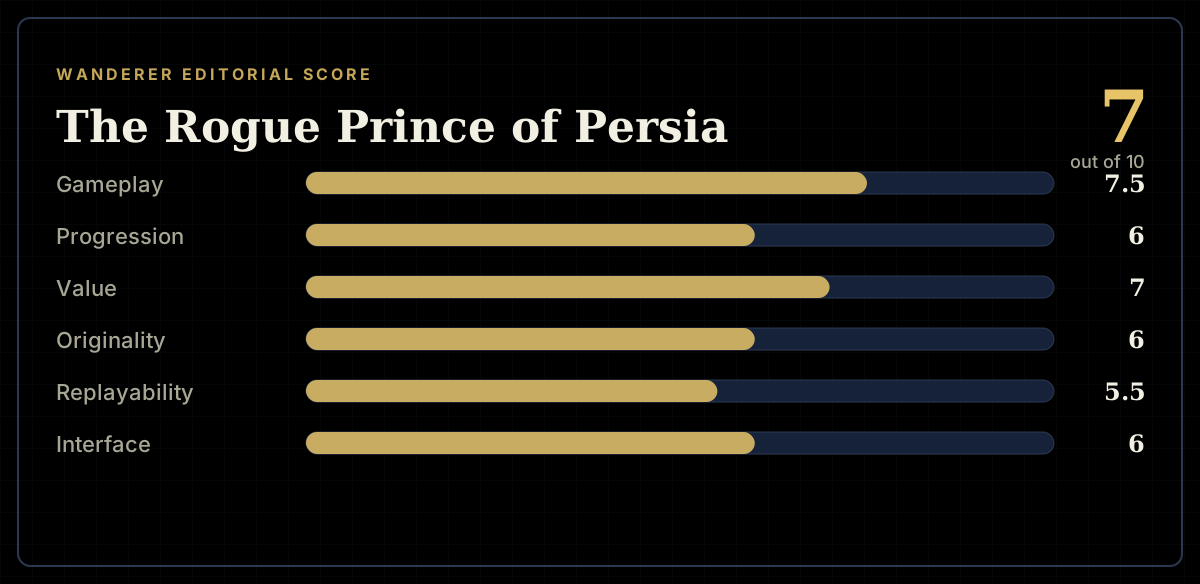
How the review scores each part of the gameWanderer Editorial -
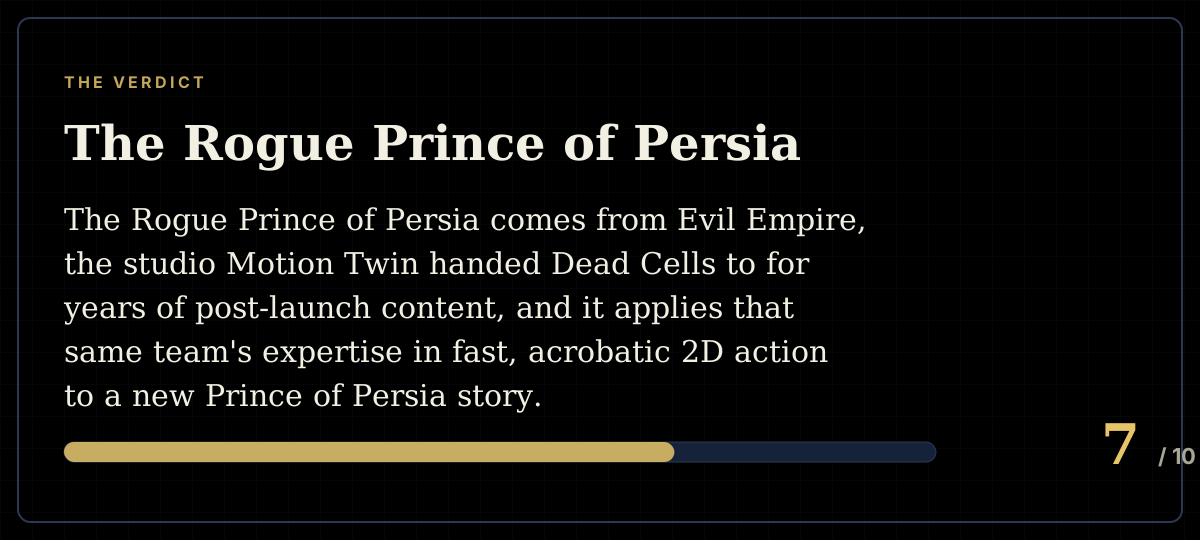
The short versionWanderer Editorial