
Game review
Kingsgrave
6 / 10
- Developer
- Egg or Chicken Games
- Publisher
- Alawar
- Released
- 17 April 2024
- Platforms
- Windows
- Genre
- Metroidvania-style action-adventure RPG with kingdom restoration
- Monetisation
- One-time purchase, no in-game store or additional currency purchases
- Players
- Single-player only
The short version
Kingsgrave sends a monarch back into a plague-ruined kingdom to gather resources, restore villages, and unlock new abilities that open further parts of a handcrafted, interconnected world — a structure reviewers consistently compare to Zelda: A Link to the Past filtered through metroidvania ability-gating. That comparison is mostly earned by the exploration and puzzle design, which draw real, specific praise. Combat is a different story: a reticle-locked facing system, weapon-type immunities, and generally "damage sponge" enemies are among the most consistently repeated complaints in the review sample, and a handful of real bugs — including a reported save-deletion issue and buggy, sometimes mislabeled achievements — appear to have gone unaddressed since the developer's support cadence dropped off two months after launch.
Biggest strengths
- The puzzle-gated exploration structure — unlock an ability, access more of the interconnected map, find the resources for the next ability — draws consistent, specific praise for being satisfying without a large map-marker holding the player's hand
- Hand-drawn art and a soundtrack multiple reviewers single out favourably give the game a distinctive visual identity well above what its price point typically buys
- The developer responded quickly to early feedback, shipping six patches in the first two weeks after launch addressing save functionality and controller keybinds specifically, plus a further "Major Update 1.5" in June 2024
Biggest weaknesses
- Combat draws the most consistent negative feedback in the sample: the character's facing direction is locked to the aim reticle rather than movement, several enemy types are effectively immune to all but one specific weapon type, and multiple reviewers independently call the resulting feel "bad," "rough," or simply "terrible"
- No keybinding remapping exists for keyboard and mouse controls even at the time of this review, a basic accessibility gap multiple reviewers request directly, including left-handed players specifically
- A late-game resource-gating issue causes an unusually sharp late power spike for some players — one reviewer describes going from a single base upgrade to four entire upgrade tiers in less than an hour of play, right before the final boss
Who it's for: Players who want a short, cheap, visually striking exploration-and-puzzle game with light combat they can tolerate rather than enjoy, and who are comfortable with a four-to-twelve-hour experience rather than a long-tail RPG.
Our recommendation: A reasonable pick at its regular price and an easy one on sale, provided combat expectations stay low. Save frequently and expect to look up a specific damage-type-related achievement quirk if full completion matters, since at least one reported bug can force a restart.
6 / 10
A plague has hollowed out your kingdom, monsters made from the fragments of dead souls have taken the place of your fled subjects, and it's your job as the newly-woken monarch to fix all of it — one restored village, one new ability, and one unlocked section of map at a time. Kingsgrave wears its influences plainly: reviewer after reviewer reaches for the same comparison, an "indie Zelda-clone" built on A Link to the Past's structure of ability-gated overworld exploration, filtered through a metroidvania lens. That comparison is mostly earned, and mostly a compliment. What keeps this from being an easy recommendation is a much more specific, much more consistent complaint about the one thing that structure is supposed to be built around: fighting.
Restoration as the actual game loop
The core progression system asks you to gather resources by fighting monsters and exploring, then spend those resources rebuilding houses and structures that unlock new traversal abilities, which in turn open up more of the map to explore for more resources. Reviewers who like the game describe this loop specifically and favourably: one calls it "a rather unique experience" mixing "exploration, puzzle solving, resource collection, adventure, and metroidvania advancement," while a curator review quoted by another player scores the mix "equal parts Twin stick A-RPG / Metroidvania / puzzle game" at 9/10, praising how none of the three elements dominates the others. The puzzle design specifically draws praise for being satisfying without excessive hand-holding — no oversized waypoint marker constantly pointing the way, just environmental and skill-tree logic the player has to piece together, which several reviewers explicitly appreciate compared to more modern, over-signposted design.
Combat is where almost everyone gets off the train
Set against that well-liked exploration loop is a combat system that draws some of the most pointed, specific criticism in the entire sample — and it's specific in a way that's worth quoting directly rather than paraphrasing. "Your character always faces the direction of the target reticle which has no neutral setting," one reviewer writes, arguing "you should face the direction you're walking in if you're not actively holding the right stick." Another, more blunt, states "some reviewers claim it's like Zelda. IT IS NOT!!!" specifically because of this same reticle-locked facing mechanic combined with a timed-cooldown block. A third describes specific weapon-type immunities compounding the problem: certain enemies are immune to everything except axe damage, and "the axe is the worst thing of all to use," turning encounters into a frustrating process of elimination rather than tactical combat. None of these are vague "combat feels off" complaints — they're specific, technical descriptions of the same underlying control scheme, repeated independently by reviewers who otherwise disagree about how much they liked the rest of the game.
Short, and mostly fine with that
Length is the other recurring topic, and here the review sample is notably more forgiving. Most reviewers report finishing the game in four to twelve hours, and rather than treating this as a shortfall, a majority explicitly frame it as appropriate given the price. "It's only around 8h long, but that's ok, not everything has to be 100hrs+," one reviewer writes; another calls it "a good little indie game... Not a game of the year, but something I had fun with," recommending it specifically as a palate-cleanser between longer titles. This pattern — short runtime treated as a feature rather than a flaw, because the price matches the length — comes up often enough that it's clearly baked into how this game's audience is choosing to evaluate it, rather than an isolated defense from a few forgiving reviewers.
A pacing wrinkle right before the ending
One more specific complaint deserves attention because of how precisely it's described: a resource-gating design that causes a sharp, late power spike rather than a smooth curve. One reviewer describes being "less than an hour from accidentally stumbling into the final boss" before gaining access to the materials behind roughly 80% of the game's upgrades, going from a single base damage upgrade to four entire upgrade tiers in a short span. That's not a difficulty complaint in the usual sense — it's a specific structural observation about how the game's late-game resources are gated, and it suggests a large chunk of the intended mid-to-late power curve is backloaded rather than spread out, whether by design or oversight.
Bugs the developer's own patch history suggests went unaddressed
A handful of specific, reproducible-sounding bugs recur across the negative sample: a reported save-file deletion issue that one reviewer says was flagged by other players "last year" and "still hasn't been fixed"; softlocks caused by consuming a resource needed later for a gated progression path with no way to obtain more; and achievement tracking multiple reviewers describe as buggy, including one specific case where an achievement tied to "thorns" damage is actually tied to "spikes" damage, misleading players into skipping a required upgrade order and forcing a full restart to fix. Steam's own partner-events feed offers useful context here: after an active run of six patches in the first two weeks post-launch — several explicitly addressing "saves functionality" — and a further major update in June 2024, no additional Kingsgrave-specific update appears on the feed at all. That's consistent with reviewers' framing that whatever bugs remained after mid-2024 have simply stayed unresolved rather than being actively worked on.
A story that mostly stays out of the way
Narrative ambition is modest by design, and most reviewers treat it as such without much complaint — several note there isn't much of a story at all beyond the initial setup and a closing revelation. A smaller number push back harder on this point specifically: one reviewer states plainly that "none of the 'choices' matter," and calls the ending's central revelation a let-down rather than a payoff worth the build-up. This tracks as a genre-appropriate trade-off rather than a serious flaw for most of the audience, but it's worth flagging for anyone drawn in by the store page's framing of restoring a kingdom and its people, since the promised sense of a community rebuilding is described by at least one reviewer as staying largely cosmetic rather than reflected in the world's day-to-day presentation.
Final verdict
Kingsgrave is a well-liked, cheap, visually distinctive exploration game let down by the one system that's supposed to hold its combat encounters together. The puzzle-gated metroidvania structure, hand-drawn art, and fair price-to-length ratio have earned it a genuinely positive reception, and reviewers are broadly forgiving of its short runtime because the asking price matches it honestly. But the reticle-locked combat, weapon-type immunities that turn some fights into guesswork, a late-game pacing wrinkle that front-loads too much power right before the final boss, and a small set of specific, reported bugs that the developer's own patch history suggests have gone unaddressed since mid-2024 are real, well-documented costs. Buy it for the exploration and the puzzles, tolerate the combat rather than expect to enjoy it, and don't count on further fixes arriving for whatever bugs you run into.
Pros and cons
Pros
- The puzzle-gated exploration structure — unlock an ability, access more of the interconnected map, find the resources for the next ability — draws consistent, specific praise for being satisfying without a large map-marker holding the player's hand
- Hand-drawn art and a soundtrack multiple reviewers single out favourably give the game a distinctive visual identity well above what its price point typically buys
- The developer responded quickly to early feedback, shipping six patches in the first two weeks after launch addressing save functionality and controller keybinds specifically, plus a further "Major Update 1.5" in June 2024
- Consistently described as fair value for a short, four-to-twelve-hour experience at its regular price, with several reviewers explicitly recommending it as a low-stakes "palate cleanser" between longer games
- Steam Deck verification was confirmed by the developer in July 2024, and reviewers playing on Deck report it looks and plays well on the handheld
Cons
- Combat draws the most consistent negative feedback in the sample: the character's facing direction is locked to the aim reticle rather than movement, several enemy types are effectively immune to all but one specific weapon type, and multiple reviewers independently call the resulting feel "bad," "rough," or simply "terrible"
- No keybinding remapping exists for keyboard and mouse controls even at the time of this review, a basic accessibility gap multiple reviewers request directly, including left-handed players specifically
- A late-game resource-gating issue causes an unusually sharp late power spike for some players — one reviewer describes going from a single base upgrade to four entire upgrade tiers in less than an hour of play, right before the final boss
- Real, specific bugs are reported well after launch, including a save-file deletion issue one reviewer says was reported by other players "last year" and still isn't fixed, softlocks from consuming resources needed for gated progression, and achievement tracking multiple reviewers call buggy, including one damage-type achievement reviewers say is mislabeled clearly enough to force a restart
- The story is described by a large share of the sample as thin to nonexistent, with one reviewer noting bluntly that "none of the 'choices' matter" and the ending's central revelation lands flat
Screenshots
-

KingsgraveImage: Alawar via Steam -

KingsgraveImage: Alawar via Steam -

KingsgraveImage: Alawar via Steam -
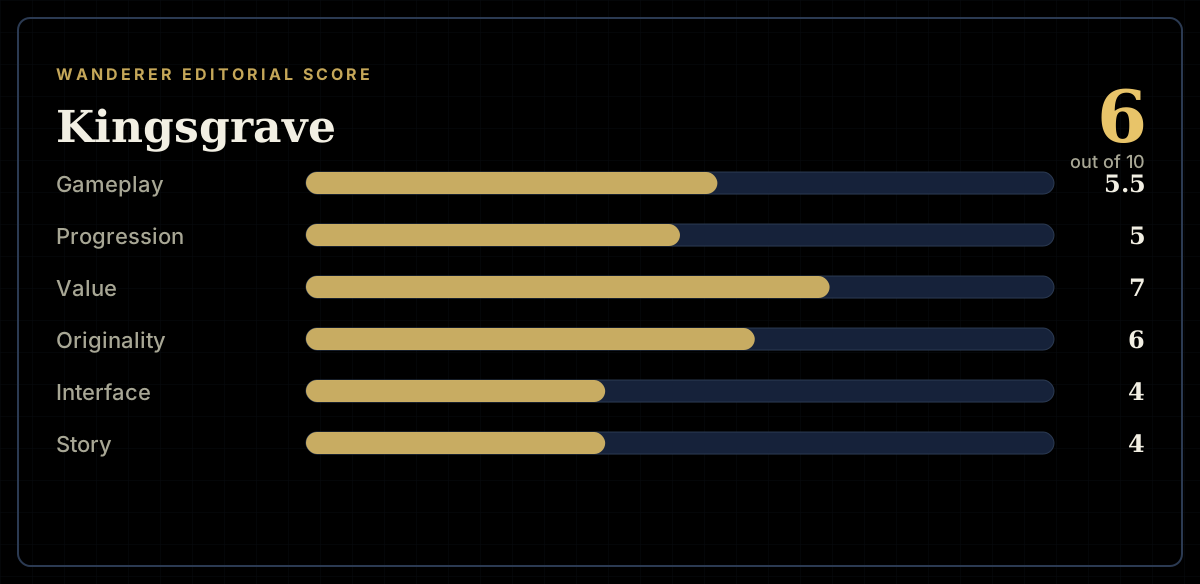
How the review scores each part of the gameWanderer Editorial -
The short versionWanderer Editorial