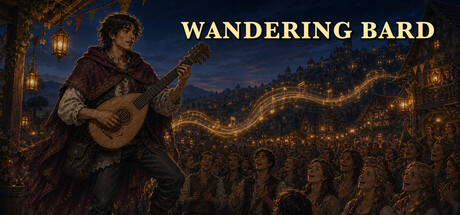
Game review
Wandering Bard
7 / 10
- Developer
- Fossil Studios
- Publisher
- Fossil Studios
- Released
- 7 September 2026
- Platforms
- Windows, macOS, Linux
- Genre
- RPG
A Forty-Ninth Consecutive Launch Without a Single Review
Wandering Bard entered Early Access on Steam on 7 September 2026 for Windows, macOS, and Linux, and at the time of writing has zero user reviews. That's an unusually quiet launch for a genre hybrid this specific — a story-led town-to-town journey wrapped around a five-instrument rhythm system needs both halves to land, and whether the narrative pacing and the timing-based performance mechanics actually reinforce each other rather than pulling against one another is exactly the kind of judgment that normally takes a chorus of players to settle.
A Travelling Musician's Story Told Through Six Towns
The premise casts the player as a wandering bard carrying a lute and songbook from town to town, listening to the people they meet, learning the melodies that matter to those characters, and carrying their songs onward. Structurally, the game is organised into six towns explored through named chapter types — People, Perform, Songbook, Workshop, and Travel — which gives the adventure a clear rhythm of its own between conversation, preparation, and performance rather than treating the rhythm gameplay as a standalone minigame bolted onto a separate story mode. Before each show, the game reads the crowd's mood and musical taste and offers song recommendations explaining why a given piece fits, but leaves the final set-building decision to the player — a meaningful layer of curation on top of the performance itself, turning "which songs to bring" into its own small strategic puzzle rather than a fixed setlist. Screenshots confirm the People chapter isn't a handful of generic dialogue trees either: a town's People tab lists four distinctly illustrated, individually named townsfolk — Old Theron, Maren the Wise, Bram Copperfield, and Little Sera — each flagged with its own "New story" tag and Talk button, suggesting the six-town journey is built from real per-character writing rather than a shared pool of filler lines.
Five Instruments, Ninety-Nine Charts, and Real Difficulty Options
The rhythm mechanics themselves follow a four-lane falling-note structure, timing taps, holds, rolls, and chords against a hit line across instrument-themed boards, with misses producing instrument-specific feedback that softens the performance rather than simply failing the song outright. The crowd-reading system promised elsewhere in the pitch turns out to be built directly into the performance screen itself: a Crowd Energy meter names the audience's actual behaviour rather than tracking an abstract score, reading "Clapping" at a 12-note streak in a candlelit tavern and escalating to "Singing" at a 17-note streak during a packed outdoor public-square show, which suggests the crowd's response state scales with both venue size and how cleanly the set is being played rather than just refilling a generic gauge. The scale on offer is substantial for an Early Access release: 33 compositions across Tavern, Roadhouse, and Masterwork arrangements add up to 99 playable charts, spread across five instruments — lute, fiddle, recorder, hurdy-gurdy, and frame drum — each with its own progression path. Three difficulty modes (Story, Standard, and Virtuoso) plus optional timing assistance suggest a deliberate effort to make the narrative accessible to players who aren't looking for a rhythm-game challenge, while still giving dedicated players room to chase clean streaks on harder arrangements. A dedicated Rehearsal Room, with adjustable practice speed from 50–100% while retaining original pitch and separately tracked personal bests for practice versus full-song runs, is a genuinely thoughtful inclusion that a lot of rhythm games skip entirely, and it signals the developer expects players to actually want to master specific passages rather than just clear songs once and move on. Separately tracking personal bests by difficulty rule, and refusing to let shortened practice runs overwrite full-song records, is a small but telling design decision — it protects the meaning of a genuine full-song clear from being diluted by practice-mode grinding, which is a distinction plenty of larger rhythm franchises still get wrong.
Progression Built From Gold, Reputation, and Instrument Mastery
What pulls this toward RPG territory rather than a pure rhythm game is the stated progression loop: performances earn gold, reputation, and instrument experience, with post-show reviews highlighting where timing struggled and linking directly back to the relevant passage for practice. That's a legible feedback loop tying mechanical skill directly to a numeric growth system, and reputation specifically ties performance quality back into the town-by-town story structure, meaning a rough performance presumably has narrative as well as score consequences. The store page is upfront that the game touches on bereavement, illness, war, and a mining accident without graphic violence, which fits the folk-tale, small-town framing better than a typical rhythm game's abstract song list, and suggests the character writing is meant to carry real emotional weight rather than serve purely as a wrapper for the charts.
An Accessible, Feature-Complete Early Access Launch
The accessibility feature list is unusually thorough for an Early Access title: adjustable text size, camera comfort options, colour alternatives, contrast controls, custom volume controls, adjustable difficulty, and the ability to play without timed input entirely, alongside Steam Achievements. That level of accessibility investment this early suggests the core rhythm and narrative systems are already considered stable enough to spend development time on refinement rather than core-feature construction. At NZ$12.49 with no discount and no stated additional monetisation, the price sits in the middle of the indie range for a game promising 99 charts and six towns of narrative content, which is a reasonable amount of content per dollar if the promised scope holds up as Early Access continues. Minimum system requirements — a dual-core 2.0GHz processor, 4GB of RAM, and OpenGL 3.3-compatible graphics — are modest, though the 10GB storage requirement is notably larger than most 2D rhythm or narrative games, likely reflecting the audio-heavy nature of 99 distinct playable charts.
Verdict
Wandering Bard pairs a story-led, six-town journey with a genuinely substantial five-instrument rhythm system — 99 charts, three difficulty tiers, and a gold-reputation-experience progression loop that ties performance skill directly to narrative consequence. The accessibility feature set and dedicated practice tools suggest a developer confident enough in the core systems to already be polishing the edges during Early Access, and screenshots back that confidence up directly: a Crowd Energy meter that names the audience's actual behaviour and escalates with venue size, plus a People tab built from individually named, individually flagged townsfolk, both confirm the pitch's crowd-reading and character-writing systems are genuinely implemented rather than store-page shorthand. It launched on 7 September 2026 with zero user reviews so far, so whether the story and the rhythm charts actually reinforce each other across a full six-town journey, and whether the difficulty curve across 33 compositions holds up for players chasing Virtuoso-tier clears, remain unverified by anyone outside the studio.
Screenshots
-
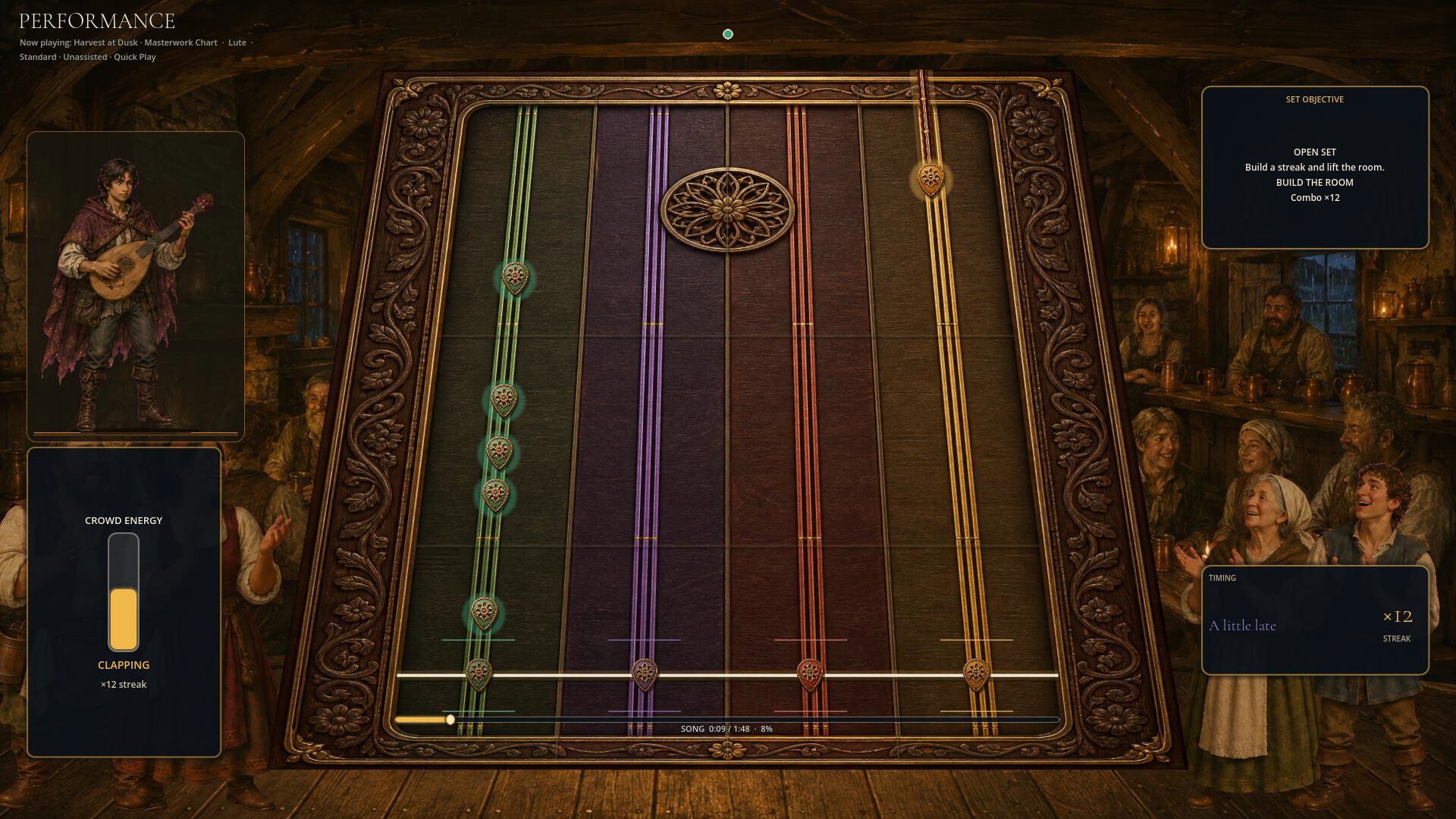
The Masterwork-difficulty tavern performance shows the Crowd Energy meter naming a specific audience behaviour, Clapping, tied directly to the player's current streak rather than an abstract score bar.Steam store page -
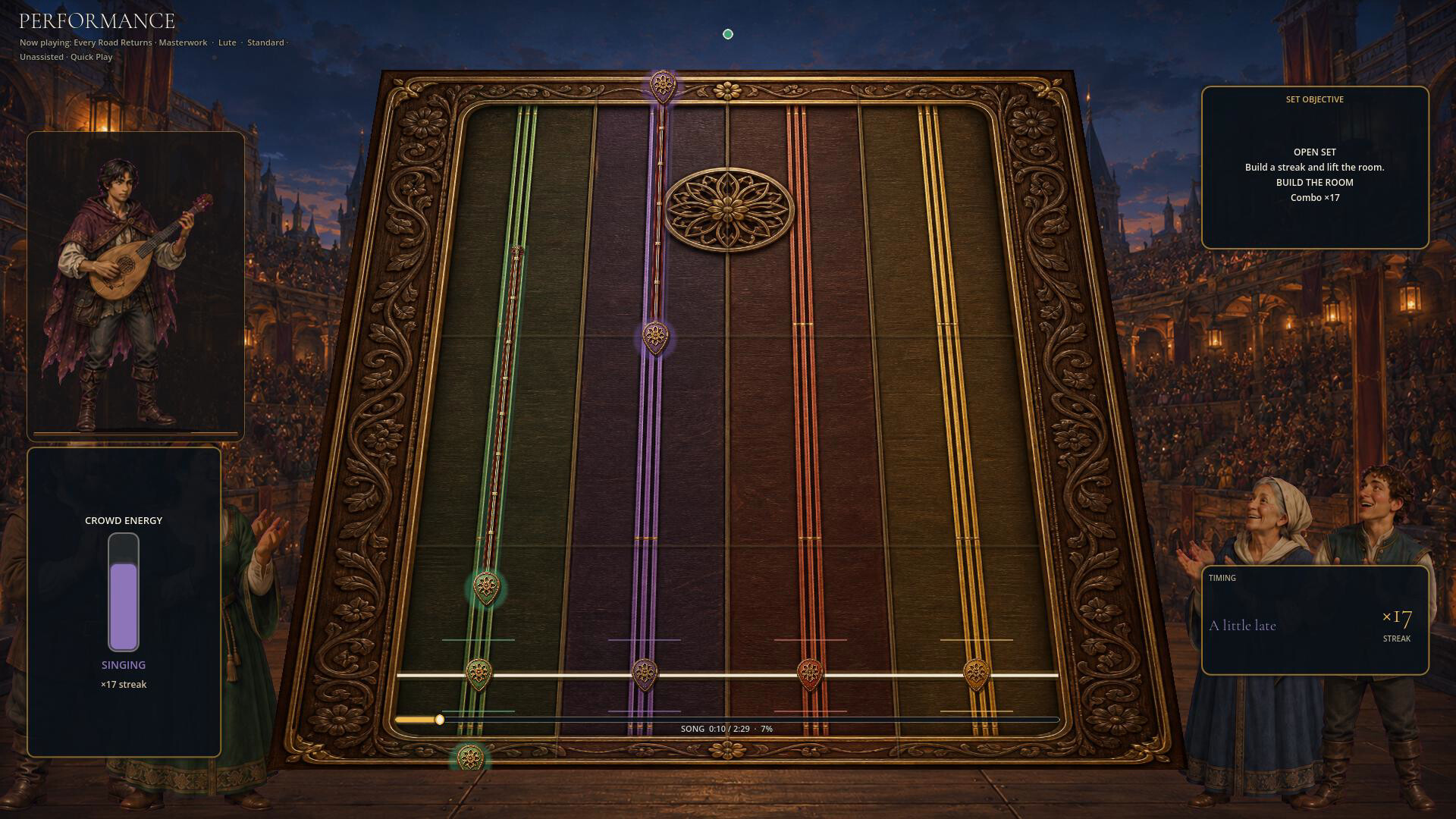
A packed public square performance with the crowd now Singing rather than Clapping suggests the audience's energy state escalates with venue size and performance quality, not just a generic meter refill.Steam store page -
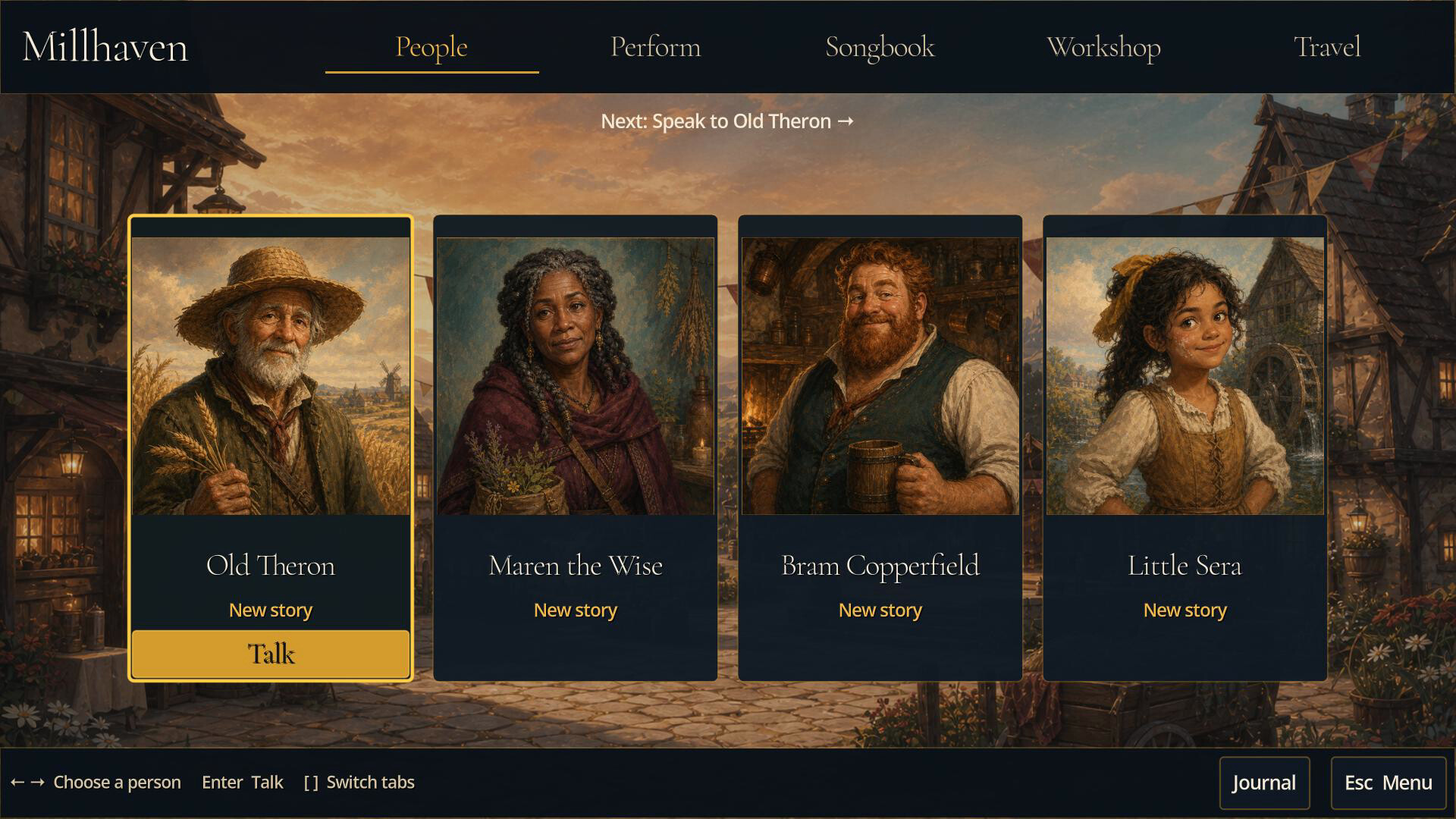
Four distinctly illustrated named townsfolk, each with their own flagged story to unlock, confirm the People chapter is built from real individual character content rather than a handful of generic dialogue trees.Steam store page