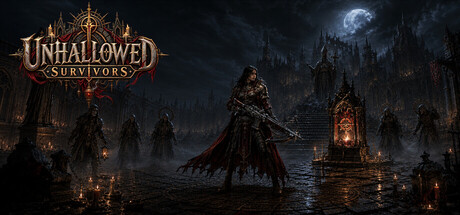
Game review
Unhallowed Survivors
6.5 / 10
- Developer
- ShoninyasTube
- Publisher
- ShoninyasTube
- Released
- 4 September 2026
- Platforms
- Windows
- Genre
- RPG
A Fiftieth Consecutive Launch Without a Single Review
Unhallowed Survivors entered Early Access on Steam on 4 September 2026 for Windows, and at the time of writing has zero user reviews. That's a striking gap for a bullet heaven roguelite specifically, since the entire genre lives or dies on whether the escalating-horde loop stays readable and satisfying across dozens of runs, and that's exactly the kind of long-session verdict that normally takes a crowd of players comparing builds to settle.
Three Heroes, Three Entirely Different Core Weapons
The pitch sets itself apart from the wave of Vampire Survivors-likes by refusing to hand every hero the same shared weapon pool. Instead, each hero carries a single signature weapon with its own mechanics, upgrade paths, and specializations: the Excommunicated Huntress fights at range, the Shadowblade carves through enemies in melee, and the Plague Doctor spreads poison, curses, and volatile alchemy. That's a meaningfully different design bet than most genre entries, which tend to differentiate heroes with minor stat tweaks while drawing from an identical shared item pool — here, switching heroes is framed as switching which weapon's mechanics you're actually building around, not just which starting stats you carry into an otherwise identical run. The store page's own control scheme reinforces the "bullet heaven" label directly: the player moves manually while the hero's weapon attacks automatically, with experience collection and leveling handling the moment-to-moment power growth inside a single run. A hero-select screenshot backs up the differentiation claim with actual numbers rather than leaving it as marketing language: the Plague Doctor's detail panel lists a named core weapon (Plague Apparatus), an unlocked specialization (Plague Brewer), and its own HP, Speed, Pickup, and Crit stat line, confirming each hero really does carry a distinct numeric identity rather than a shared template with a different portrait. That same panel's description candidly flags the Plague Doctor as an "experimental test hero" left in "for class and selection UI testing" — an unpolished label that's clearly a leftover development note rather than intentional flavour text, and a small but honest reminder of how early this Early Access build still is.
Cursed Reliquaries Force a Real Risk-Reward Decision
The most distinctive system on the store page is the cursed reliquary mechanic. Every run begins with the hero's core weapon in its most basic form, and reaching the first reliquary forces a binding choice between two paths: seal it to secure lasting map progress, or desecrate it for a powerful immediate advantage at the cost of a curse that persists for the rest of the run. That's a genuinely sharper risk-reward decision than the passive item-pickup loop most bullet heavens rely on, since it ties a single choice directly to both the current run's power curve and whatever long-term unlock structure the map progress feeds into, rather than treating every pickup as a straightforward upgrade with no downside. The specialization chosen at that first reliquary then reshapes which weapon upgrades become available for the rest of the run, meaning the build-defining decision happens early and locks in a direction — critical strikes, elemental effects, bleeding, poison, crowd control, or explosions, depending on the hero — rather than the build gradually assembling itself from whatever drops appear.
Escalating Hordes With a Stated Commitment to Readability
Structurally, the run escalates from growing waves of enemies into ranged threats, elites, mini-bosses, and corrupted stage bosses, which is the standard bullet heaven difficulty curve, but the store page makes a specific and testable claim about it: combat effects are designed around readability, meaning dangerous attacks, enemies, pickups, and boss telegraphs are meant to stay visible even as the player's own build escalates into a screen full of simultaneous effects. That's a real design problem for this entire genre — the moment a build starts firing dozens of projectiles a second, distinguishing an incoming boss telegraph from the player's own visual noise becomes the actual test of whether the game is fun or just chaotic, and it's a claim that only extended play across a fully escalated late-run build could confirm or contradict. Meta-progression sits on top of individual runs rather than each run starting from a completely blank slate: both victory and defeat are stated to leave a mark, unlocking additional heroes and specializations and expanding what's available in future attempts, which gives the roguelite structure a persistent sense of forward motion even through runs that end badly. The main menu confirms that structure has an actual home rather than living entirely inside run-end summary screens: a dedicated Sanctum option sits alongside Start New Run and Settings, suggesting the between-run unlocks and mastery tracking resolve into a real hub screen the player returns to, not just a scrolling stat readout after each defeat.
A Buy-Once Pitch With No Extraction Layer
At NZ$6.39 with no discount, Unhallowed Survivors is priced at the budget end of the bullet heaven category, and the store page is unusually blunt about its monetisation stance: no in-game shops, no premium currencies, no pay-to-win mechanics, no pay-to-progress systems, and no advertising, with characters and progression stated to be earned entirely through play. That's a direct contrast with how much of the mobile side of this genre monetises the exact same escalating-power fantasy through gacha pulls or energy timers, and a one-time-purchase pitch this explicit is worth taking at face value until proven otherwise. English is the only listed supported language, and the category list is comparatively minimal for an Early Access RPG — single-player only, Steam Achievements, Steam Cloud, and accessibility options for custom volume and playing without timed input, but no controller support listed despite the genre's frequent controller-friendly design. Minimum system requirements — a Core i3-6100 or FX-6300, 4GB of RAM, and Vulkan 1.0 or DirectX 11 support — are modest, though the jump to a recommended GTX 1050-class card for the "escalating" late-run visual load hints that the promised readability push does come with a real performance cost once a build is fully online.
Verdict
Unhallowed Survivors pitches a dark fantasy bullet heaven built around genuinely differentiated hero weapons, an early binding choice at each cursed reliquary between lasting progress and risky short-term power, and a buy-once pricing stance that explicitly rejects the genre's usual monetisation shortcuts. Screenshots back the differentiation claim with real numbers — distinct per-hero stat lines and a dedicated Sanctum hub for meta-progression — but also surface a leftover "experimental test hero" label sitting in the live hero-select screen, a small but genuine reminder of how early this Early Access build still is. The specialization-locked build system and stated commitment to keeping boss telegraphs readable during full escalation are the kind of claims that separate a genuinely tuned bullet heaven from a chaotic one, and the latter still can't be verified from the store page alone. It entered Early Access on 4 September 2026 with zero user reviews so far, so whether the three current heroes play distinctly enough to justify their separate weapon systems, and whether the readability promise holds up once a run's build is fully escalated, remain unverified by anyone outside the studio.
Screenshots
-
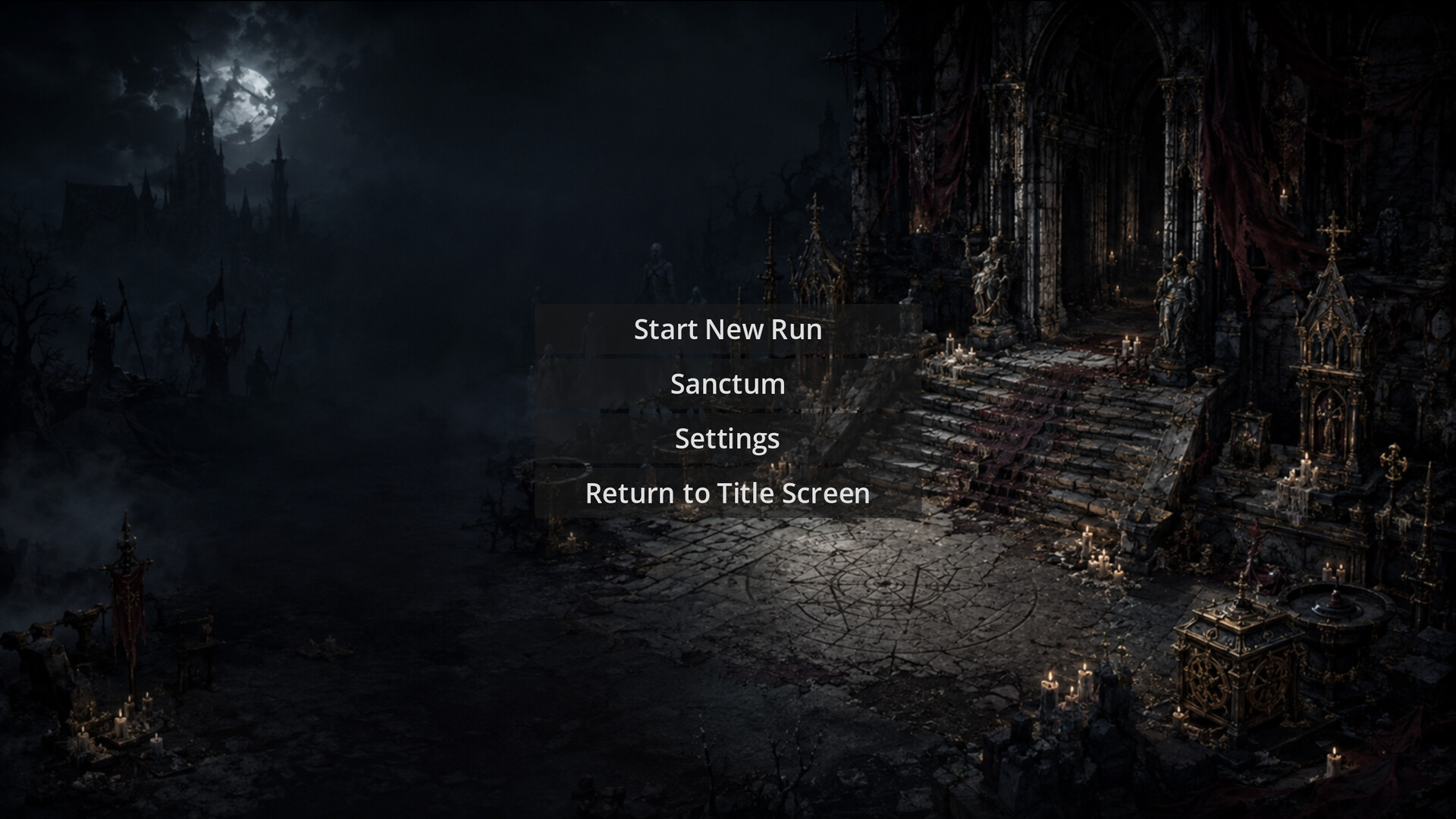
The Sanctum menu option sitting alongside Start New Run confirms the meta-progression hub promised on the store page is a real, separately accessible screen rather than a folded-in submenu.Steam store page -
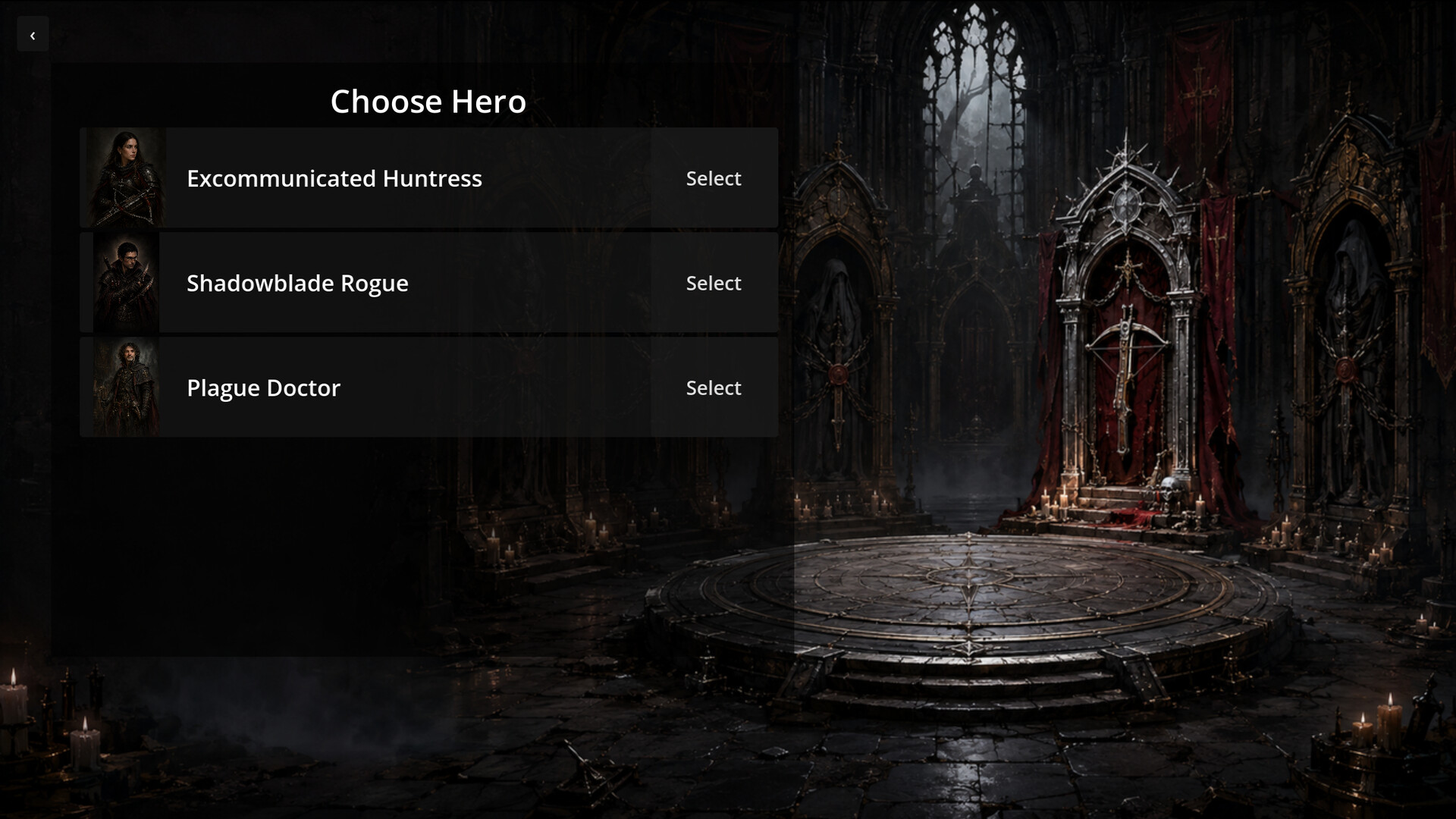
Three distinctly portrayed heroes confirm the differentiated-weapon pitch starts from three actually implemented characters, not a single hero with reskinned variants.Steam store page -
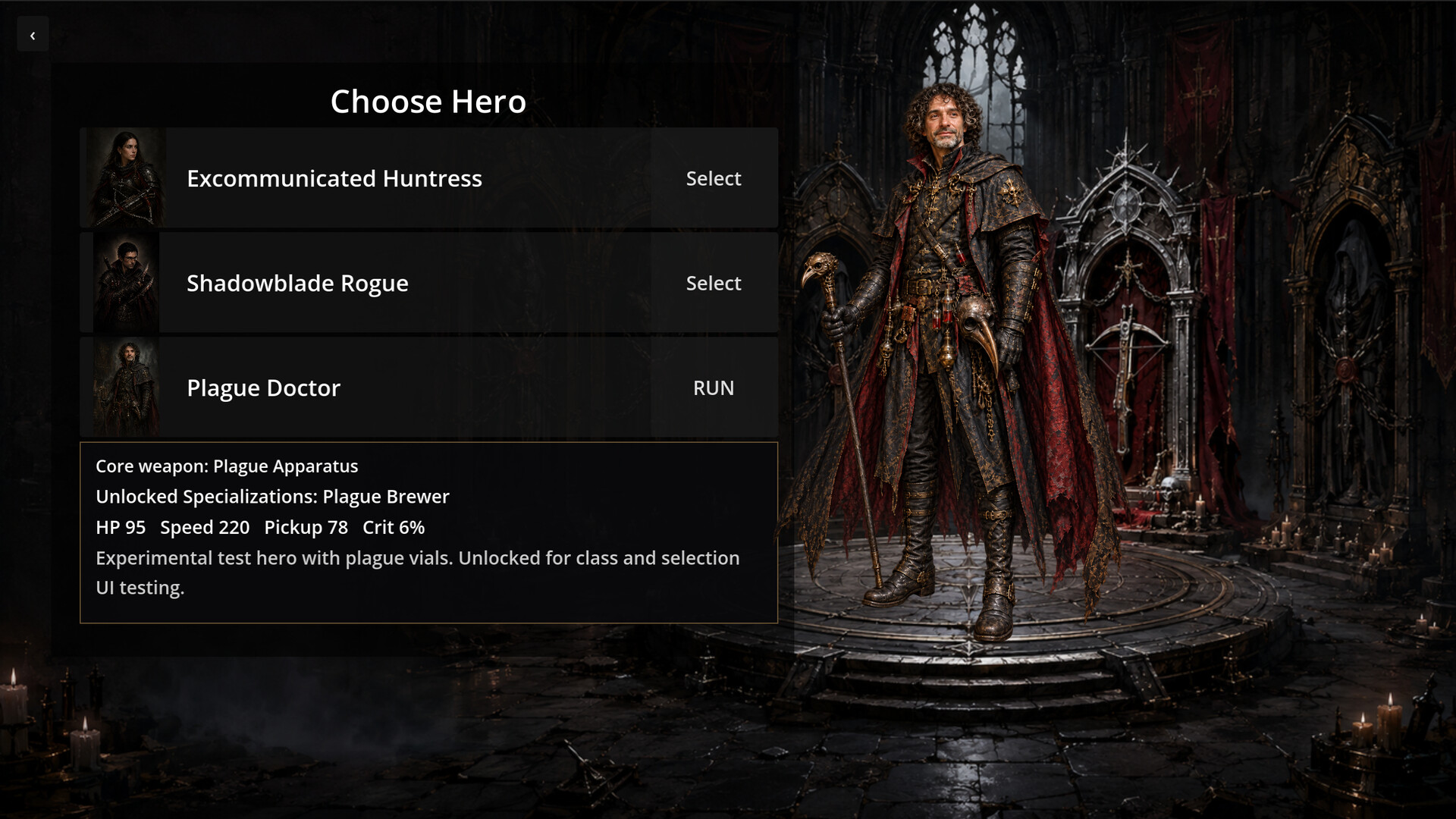
A numeric stat line of HP, Speed, Pickup, and Crit backs up the promised per-hero specialization system, though the Plague Doctor's own description candidly labels it an experimental test hero left in for UI testing — a rough edge typical of an Early Access build this early.Steam store page