
Game review
Ultra Savage
6.5 / 10
- Developer
- OneShark
- Publisher
- SakuraGame
- Released
- 25 April 2019
- Platforms
- Windows
- Genre
- RPG
- Monetisation
- Formerly paid, one-time purchase; no longer available for purchase
- Players
- false
The short version
Ultra Savage built real, lasting appeal on a simple pitch — train an anime-inspired fighter through stat allocation, skill choices, gear rarity and a prestige loop called Time Travel — and its own review corpus backs that up with an unusually high number of 30-plus-hour playtimes attached to positive reviews. Its most persistent internal argument is whether it even counts as an idle game, since fights need restarting roughly every 30 seconds rather than running unattended for hours; that argument no longer matters for new players either way, since the game was formally delisted by agreement between developer and publisher in October 2021.
Biggest strengths
- Deep-for-the-genre character building: stat point allocation, both active and passive combat skills, up to seven equipped item slots with randomized multi-stat rolls across common-to-legendary rarity tiers
- A "Time Travel" prestige system grants permanent stat, skill-point and XP bonuses, plus raises the maximum gear enhancement level and unlocks new skills — genuine long-term progression rather than a flat reset
- An unusually high number of positive reviews report playtimes in the 30-50+ hour range, a strong signal of sustained engagement rather than a short-lived novelty
Biggest weaknesses
- Officially delisted from Steam: a 19 October 2021 publisher news post confirms developer and publisher "reached an agreement to stop the distribution of the game," with existing owners promised continued support
- A real, reviewer-documented dispute over whether it qualifies as an idle game at all — fights reportedly need restarting roughly every 30 seconds even at maximum speed, meaning it cannot be left running unattended the way its genre label implies
- A specific, sharp difficulty spike is reported around the sixth planet, following an otherwise easy early game
Who it's for: Fans of anime-inspired incremental RPGs (Dragon Ball, JoJo's, One Punch Man aesthetics) who already own it or can find a copy some other way — it can no longer be purchased on Steam.
Our recommendation: Existing owners have a genuinely well-regarded game to return to; nobody else can buy it here anymore.
6.5 / 10
What it is
Ultra Savage puts the player in control of an escaped lab experiment — "a perfectly bred fighting machine," per the game's own pitch — travelling from planet to planet, defeating other fighters to grow stronger while chasing down whoever imprisoned them in the first place. It's explicitly positioned by its own developer as a spiritual successor to an earlier title, Great Hero's Beard, carrying over that game's character-building systems into a new sci-fi-flavoured anime setting and adding active skills and item enhancement on top. Reviewers who played both consistently describe Ultra Savage as the more polished, more mechanically generous of the two.
The core loop layers several systems that go well beyond a single-number clicker: stat points to distribute across a build, both active skills (used manually, with cooldowns) and passive skills that run automatically, up to seven equippable item slots where gear drops with randomized rolls across up to five stats and escalating rarity tiers from ordinary through epic to legendary, and a fusion system that converts unwanted gear into further rewards. A "Time Travel" prestige mechanic lets players reset for permanent stat, skill-point and XP bonuses once progress stalls, while also raising the ceiling on gear enhancement and unlocking additional skills — the kind of layered, genuinely additive prestige loop that distinguishes a well-designed incremental RPG from one that just multiplies numbers on reset.
It released on 25 April 2019 under publisher SakuraGame, and quietly disappeared from sale over two years later: a news post dated 19 October 2021, titled "Announcement about Retiring the Game," states plainly that "the developer and we, the publisher of Ultra Savage has reached an agreement to stop the distribution of the game on Steam," while promising continued support "for those who've already purchased the game." The Steam store page itself now confirms the listing is no longer available. This review exists for the historical record and for the owners who already have it, not as a purchase recommendation nobody can act on.
A genuinely well-regarded incremental RPG
What sets Ultra Savage apart from most of the small, low-review-count clickers in its 2019 cohort is the sheer volume of substantial, high-playtime positive reviews it accumulated before delisting. Reading through the corpus turns up a striking number of five-figure-minute playtimes attached to five-star sentiment: reviewers logging 1,914, 1,952, 2,208, 2,287, 2,584, 2,980 and 3,127 minutes — roughly 32 to 52 hours each — while calling it "one of the best if not THE best idle game I've ever played," "a gem... for the price," and "a must have" for fans of idle/clicker games with RPG elements. That kind of sustained time investment attached to unambiguous praise is a much stronger signal than star ratings alone, and it lines up with the game's own achievement-completion data: across 50 tracked achievements, the curve descends smoothly from 95.7% at the easiest down to 14.2% at the hardest, with no sharp abandonment cliff anywhere in between — the shape of a game that kept giving committed players something to chase, not one that fizzled out early.
The anime-inspired presentation gets singled out repeatedly and specifically: reviewers invoke Dragon Ball, JoJo's Bizarre Adventure, One Punch Man and Fist of the North Star as visual reference points, generally as a compliment rather than a knock, and one review calls out "funny background landmarks" as an unexpected source of charm alongside the core progression loop.
The recurring argument: is this actually an idle game?
The most interesting tension in the review corpus isn't about quality, it's about genre classification, and it's carried out by reviewers arguing directly with each other's framing. Several call it an idle game outright and praise it on those terms. But one detailed, lower-playtime review pushes back explicitly: "Some of the top reviews call Ultra Savage an idle game, which it is decidedly not... for whatever reasons the developers did not implement any idling functionality, so you have to babysit" it. A separate, much higher-playtime reviewer (2,584 minutes, clearly invested rather than bouncing off early) independently corroborates the mechanical detail behind that complaint: fights, even sped up, "last around 30 seconds at the most," meaning the game requires the player to restart or redirect activity roughly every half-minute rather than running meaningfully unattended. For a genre whose core promise is often exactly that — leave it running, come back later — this is a legitimate design gap, even from reviewers who otherwise loved the result. It's best understood not as false advertising but as a game built with idle-adjacent systems (auto-battling, stat-based scaling, prestige) wrapped around a loop that still wants active attention more often than the label implies.
On the harder complaints: one reviewer describes an unusually sharp difficulty wall on the sixth planet after an easy run through the first five, calling the overall grind "insane" once that point is reached; another, despite recommending the game, lists specific quality-of-life friction — uninterruptible animations on upgrading and item-sale actions, and a "max upgrade" option that doesn't always select the outcome a player actually wants.
Verdict
Ultra Savage earned a genuinely strong, high-engagement reputation in its time: real character-build depth, a well-received anime aesthetic, and a prestige loop players kept returning to for dozens of hours. Its own community's honest disagreement over whether it counts as a true idle game is worth knowing about rather than a mark against it outright — it's closer to an active incremental RPG that borrows idle systems than a background-progress game. None of that changes the practical reality for a 2026 reader: it was formally withdrawn from sale in October 2021 by agreement between its developer and publisher, and isn't purchasable today. A good game, kept in memory-and-owner-support purgatory rather than gone entirely.
Pros and cons
Pros
- Deep-for-the-genre character building: stat point allocation, both active and passive combat skills, up to seven equipped item slots with randomized multi-stat rolls across common-to-legendary rarity tiers
- A "Time Travel" prestige system grants permanent stat, skill-point and XP bonuses, plus raises the maximum gear enhancement level and unlocks new skills — genuine long-term progression rather than a flat reset
- An unusually high number of positive reviews report playtimes in the 30-50+ hour range, a strong signal of sustained engagement rather than a short-lived novelty
- Distinctive, well-received anime-inspired art style that multiple reviewers compare favourably to Dragon Ball, JoJo's Bizarre Adventure and One Punch Man
Cons
- Officially delisted from Steam: a 19 October 2021 publisher news post confirms developer and publisher "reached an agreement to stop the distribution of the game," with existing owners promised continued support
- A real, reviewer-documented dispute over whether it qualifies as an idle game at all — fights reportedly need restarting roughly every 30 seconds even at maximum speed, meaning it cannot be left running unattended the way its genre label implies
- A specific, sharp difficulty spike is reported around the sixth planet, following an otherwise easy early game
- Minor but repeatedly-mentioned quality-of-life friction: uninterruptible upgrade and item-sale animations, and inconsistent behaviour when using a "max upgrade" shortcut
Screenshots
-

Ultra SavageImage: SakuraGame via Steam -

Ultra SavageImage: SakuraGame via Steam -

Ultra SavageImage: SakuraGame via Steam -
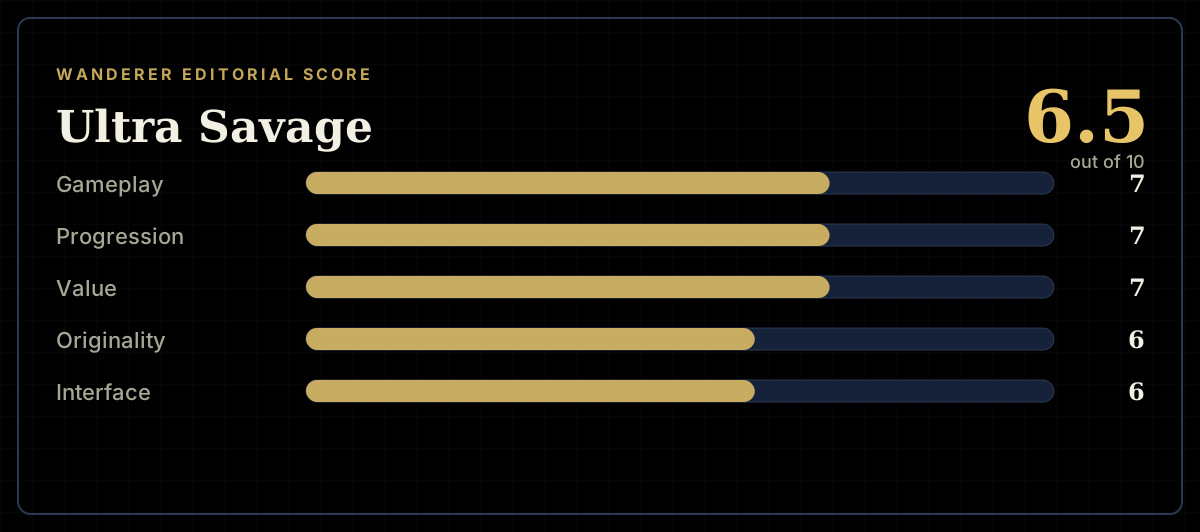
How the review scores each part of the gameWanderer Editorial -
The short versionWanderer Editorial