
Game review
Idle Portal Guardian
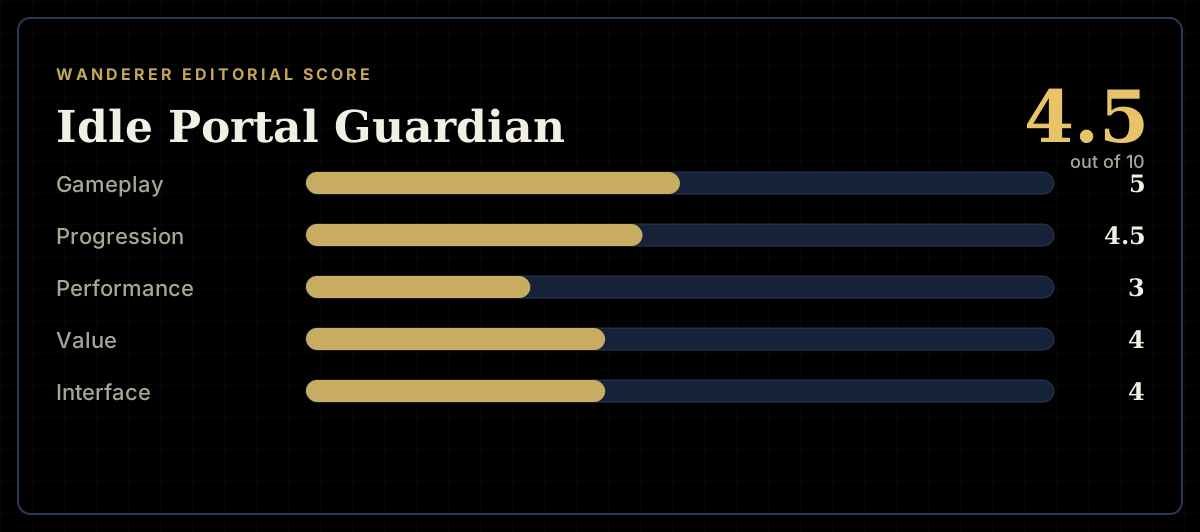
4.5 / 10
- Developer
- Thejamiryu
- Publisher
- Thejamiryu Inc.
- Released
- 20 May 2019
- Platforms
- Windows
- Genre
- RPG
- Monetisation
- Paid, no in-app purchases found
- Players
- false
The short version
A real, if threadbare, idle-clicker RPG with a skill/talent/crafting layer that kept at least one player logged for over a hundred hours — but a locked 1280x720 resolution, no offline progression while the app is closed, and a credible report of heavy CPU/GPU draw while minimised make it hard to recommend over any of the free alternatives crowding this genre.
Biggest strengths
- Skill, talent, crafting and equipment-upgrade systems go well beyond a single click-to-progress loop
- At least one long-session player logged over 1,200 hours and still calls it worth returning to
- A gradual, non-cliff-edge achievement completion curve across all 30 achievements suggests real, sustained play rather than a burst-then-quit pattern
Biggest weaknesses
- Progress reportedly only accrues while the game window is open, not while minimised or closed — a serious gap for a genre whose whole appeal is away-from-keyboard progress
- Resolution is effectively locked to 1280x720 with no meaningful options menu
- A reviewer with 165+ hours logged reports the game is riddled with bugs
Who it's for: Only for players who specifically want an idle RPG with a deeper skill/crafting layer than a pure clicker and are willing to tolerate rough technical edges for a low asking price.
Our recommendation: Wait for a deep sale, or play one of the many free idle-clicker RPGs on Steam instead.
4.5 / 10
What it is
Idle Portal Guardian is a small, paid entry in the RPG-flavoured idle/clicker space: a single character stands at a portal fending off an endless stream of monsters, earning currency and experience that feed into levelling, skills, talents, crafted equipment and unlockable bonuses. That description, lifted directly from the developer's own storefront copy, is close to the whole pitch — there is no larger narrative or setting beyond "hold your ground," and the store page's own description runs to two sentences. Thirty Steam achievements track progress through the system, and the game shipped with seven official screenshots showing a fairly plain 2D top-down arena with mobile-grade art assets.
It released on 20 May 2019, priced at NZD 3.69, Windows-only, single-player, with Steam Cloud support for saves. Five years on it has attracted only five written Steam reviews — a genuinely thin sample for a review like this to lean on, but the reviews that exist are detailed, span a wide range of playtimes, and converge on a consistent set of specific complaints rather than vague one-line dismissals, which is enough to work with.
The core loop, and where it actually goes deeper than "a clicker"
The most substantive positive review in the corpus — from a player who logged 1,256 minutes (nearly 21 hours) at review time and reports having played well past that — pushes back specifically on the idea that this is "just" a clicker: it describes skills, talents, upgrades and "in game adventures" as systems that matter and reward attention, distinct from idly bumping a number upward. That tracks with the achievement data: the global completion curve across all 30 achievements descends smoothly from 78% down to 12.5% with no sharp cliff partway through, which is the signature of a game whose systems keep giving players something to chase rather than one that front-loads its content and then goes dry. For a genre where "the game runs out of things to do after a few hours" is one of the most common failure modes, that curve is a real point in the game's favour, and it lines up with a report elsewhere in the corpus of a player logging over 165 hours.
The trouble is that "goes deeper than a clicker" and "well-executed" are different claims, and nearly every other data point available argues against the second one. The most detailed negative review in the sample — also from a high-playtime account, 9,934 minutes logged, over 165 hours — calls the game "dreadful" for how many bugs ship in a title sold rather than given away, and explicitly recommends it only if it were free. That is a difficult review to write off as a rage-quit first-hour complaint: whoever wrote it clearly kept playing through whatever it was breaking, which either means the bugs are survivable annoyances rather than blockers, or that the underlying loop was compelling enough to push through them. Either reading still lands on the same conclusion for a prospective buyer: expect friction.
The progression promise that idle games live or die on
The single most damaging complaint in the corpus, for a game in this specific genre, is the shortest one on the list: a reviewer describing it as an idler that "only grinds when the game is open." Idle and incremental games sell themselves on exactly the opposite premise — leave it running, close the client, come back later to progress that accrued while you were away. A paid entry in this genre that reportedly doesn't deliver background or offline progression is failing at the one thing its own genre label promises, and it's the kind of gap that no amount of skill-tree depth compensates for, because it changes what kind of game this actually is day to day: something you have to babysit with a window open, not something that works for you while you're doing anything else.
Layered on top of that is a specific, technical performance complaint: one reviewer reports 25-30% CPU utilisation on a Ryzen 2700X and 25-30% GPU utilisation on a GTX 1660 Ti while the game sat minimised — numbers that would be unremarkable for an actively rendering foreground game, but are hard to justify for something the player believed was idling in the background. Framed alongside the "only grinds when open" complaint, the picture that emerges is a game that behaves like it's always doing foreground work regardless of whether the player is watching, which is the worst of both worlds: real system resource draw, without the compensating benefit of real background progress.
A separate reviewer, writing in French, raises a third, more mundane technical issue: the game is effectively locked to 1280x720, and playing at any other resolution breaks the interface layout. That reviewer notes they expect no patch to fix it and marks the review down provisionally, promising to revisit if a fix ever lands — a promise that, five years on with no further reviews filed, appears to have gone unfulfilled either way.
Value at NZD 3.69
At its asking price this sits well below most premium idle RPGs, and one of the five reviews argues explicitly that the price is the whole problem: "for what this game is at this price point, I cannot suggest it when so many other free idle/clicker titles exist." That's a fair framing of the core tension here — none of what Idle Portal Guardian does (skill trees, crafting, endless-wave combat) is unique to it, and the free end of Steam's idle/clicker catalogue is enormous and mature. A handful of dollars is a low bar in absolute terms, but it's not a low bar relative to the free competition doing similar things without the offline-progression gap, the resolution lock, or the bug reports.
Verdict
Idle Portal Guardian is not a scam or an abandoned husk — it has real systems, at least one player who found hundreds of hours of value in it, and a completion curve that suggests genuine sustained engagement rather than a burst-and-abandon pattern. But a locked resolution, credible reports of serious bugs from a player who stuck around for 165+ hours anyway, and — most damaging for the genre specifically — a reported lack of real offline/background progression add up to a game that asks money for something the much larger free idle-clicker crowd on Steam generally does better. Worth a look only if the specific skill/talent/crafting combination here is one you can't find elsewhere, and only at a steep discount.
Pros and cons
Pros
- Skill, talent, crafting and equipment-upgrade systems go well beyond a single click-to-progress loop
- At least one long-session player logged over 1,200 hours and still calls it worth returning to
- A gradual, non-cliff-edge achievement completion curve across all 30 achievements suggests real, sustained play rather than a burst-then-quit pattern
Cons
- Progress reportedly only accrues while the game window is open, not while minimised or closed — a serious gap for a genre whose whole appeal is away-from-keyboard progress
- Resolution is effectively locked to 1280x720 with no meaningful options menu
- A reviewer with 165+ hours logged reports the game is riddled with bugs
- A separate reviewer reports 25-30% CPU and GPU utilisation while the game sits minimised
Screenshots
-

Idle Portal GuardianImage: Thejamiryu Inc. via Steam -

Idle Portal GuardianImage: Thejamiryu Inc. via Steam -

Idle Portal GuardianImage: Thejamiryu Inc. via Steam -
How the review scores each part of the gameWanderer Editorial -
The short versionWanderer Editorial