
Game review
Click Legends
4.5 / 10
- Developer
- Mad Labyrinth Studios LLC
- Publisher
- Mad Labyrinth Studios LLC
- Released
- 29 May 2019
- Platforms
- Windows
- Genre
- RPG
- Monetisation
- Paid, no in-app purchases or cash shop
- Players
- false
The short version
Click Legends is upfront and fair about the one thing that matters most in this genre — there's no cash shop at all, a real point in its favour — but its own review corpus is split almost down the middle on whether the underlying loop is worth the time even for free. RNG-heavy scaling makes progress feel uneven rather than earned, several reviewers argue the game demands active attention rather than delivering genuine idle progress, and development stopped years ago with no sign of the promised expansions ever arriving.
Biggest strengths
- No cash shop or microtransactions of any kind, which multiple reviewers explicitly credit as an "ethical" choice increasingly rare in this genre
- A smooth, gradual 92.1%-to-6.9% completion curve across 80 achievements shows a real committed playerbase engaged deeply with its systems
- Very low asking price, and at least two reviewers describe returning to it years after their first playthrough
Biggest weaknesses
- Heavy RNG in progression scaling means runs can be uneven and even regressive — one reviewer reports reaching a lower stage than a previous run despite having higher damage output
- A detailed reviewer argues the game "isn't an idle game" outright, since real progress reportedly requires active play rather than accruing meaningfully while away
- No meaningful content updates in over three years by the time of the most recent reviews, with an inactive community forum and requested quality-of-life fixes (a soul-cache reset option, cost-scaling balance) never delivered
Who it's for: Budget-conscious idle/clicker fans who specifically value a genuinely microtransaction-free release and don't mind rough, unfinished-feeling systems.
Our recommendation: A fair, cheap option if a cash-shop-free clicker matters more to you than depth or polish; skip it if you want the genre's better-regarded, more actively maintained entries instead.
4.5 / 10
What it is
Click Legends puts a small roster of recruitable heroes through an endless procession of enemies, zone by zone, with the familiar Clicker Heroes-style shape underneath: level up heroes, equip them with found gear, click or auto-attack your way to a wall you can't push past, then "rebirth" for a permanent bonus and start climbing again with a head start. Several reviewers who've played the genre extensively describe it accurately as "greatly inspired by" rather than a direct clone of Clicker Heroes, and multiple reviews connect it to the same developer's earlier title referred to in the corpus as "God Awe-Full Clicker," describing Click Legends as running on the same underlying systems with one meaningful change: no cash shop of any kind. That absence is worth taking seriously as a real design choice rather than an oversight — for a genre where aggressive microtransactions are close to the default, more than one reviewer specifically flags the lack of one as the game's standout, "ethical" quality.
It released on 29 May 2019 at NZD 3.69, single-player, with 80 tracked Steam achievements and no multiplayer component. Its English-language review corpus of 22 sits almost exactly split — 12 positive, 10 negative — which is a genuinely unusual distribution for a small indie clicker; most titles in this lane skew heavily one way or the other. That balance turns out to reflect a real, substantive disagreement playing out inside the reviews themselves, not noise.
The central argument: RNG, and whether this counts as idle at all
The most detailed critical review in the corpus goes after the game's random-number scaling directly: "there is too much RNG which makes your progression uneven. There are runs where you'll reach lower levels than before with higher DPS." That's a meaningful design flaw for an incremental game specifically, because the entire appeal of the genre rests on legible progress — a player needs to feel that getting stronger reliably translates into going further, or the core feedback loop that makes "one more run" appealing breaks down. A system where higher damage can produce a worse outcome than a previous, weaker run actively undermines that feedback loop rather than just making the game harder.
A second, equally detailed review raises the same genre-identity question this lane has now seen surface repeatedly in 2019 idle titles: "The game isn't an idle game. You must be active to make actual progress because the scaling of hero lvls and monster gold" doesn't reward leaving it running unattended. That reviewer pairs the complaint with specific, constructive requests — a reset option for something called the "soul cache," and rebalanced cost scaling — rather than a blanket dismissal, suggesting a player who engaged seriously with the system before concluding it needed real changes it never received. Multiple reviews independently confirm those changes never arrived: one states plainly that the game "hasnt been updated in 3 years, the forums dead," while still recommending it specifically for its lack of a cash shop despite that stagnation.
What the numbers can and can't tell you
The review corpus contains an unusually wide range of logged playtimes, including several extraordinarily high figures — one profile logs 49,196 minutes (over 800 hours), another 395,727 minutes (over 6,500 hours). Rather than treating those as straightforward evidence of an extraordinarily compelling game, it's worth noting that one reviewer flags this exact pattern directly, writing that "my playtime is kinda fake, most of it is in the background" — an explicit, first-hand acknowledgment that Steam's playtime counter for a game like this measures the window being open, not necessarily engaged attention, and undercutting any temptation to read huge logged hours as proof of depth. The achievement data offers a steadier signal: across 80 tracked achievements, completion rates descend smoothly from 92.1% down to 6.9%, with no sharp cliff — a real, engaged core audience worked through a meaningful amount of content, even if the size of that audience and the ceiling of that content are both modest by the corpus's own account (one reviewer reports reaching only "zone 150" after "a couple hours" with no visible additional content ahead).
Value against its stated inspiration
It's worth being precise about what Click Legends is being measured against, since several reviewers do exactly that themselves rather than judging it in isolation. More than one review explicitly compares it to the same developer's other release, The Magician's Research, and to other free idle titles available on Steam, generally concluding that the free competition offers more content for no cost at all: "This don't cost much maybe but still a little strange thing," writes one reviewer who otherwise recommends it cautiously, while a more critical review states flatly that "many similar games for free on Steam" outperform it and specifically names two free alternatives by name as offering more to do. That's a fair standard to hold a paid clicker to, even a cheap one — in a genre where the free tier is enormous and mature, a few dollars only buys goodwill if what's behind the paywall genuinely earns it, and the balance of opinion here leans toward "adequate for the price" rather than "worth seeking out specifically."
The achievements themselves hint at the kind of experience on offer without much ambiguity. A cluster of ten "Boss Crusher" achievements, tiered from one star up to ten, reward repeatedly defeating the same boss encounters at increasing difficulty — a structure that rewards grinding a known quantity harder rather than discovering meaningfully new content, which lines up precisely with reviewer complaints about repetitiveness and a low content ceiling.
Verdict
Click Legends earns real credit for something increasingly rare in its genre: shipping without a cash shop and staying that way. But that's close to the only unqualified positive its own community agrees on. Heavy RNG undercuts the sense of earned progress that makes incremental games satisfying, a detailed contingent of players argue it fails at being an actual idle game, and three-plus years of silence mean whatever needed fixing at launch is very unlikely to change now. Fair value for a cash-shop-free clicker at this price, but not a strong recommendation next to the genre's more actively supported alternatives.
Pros and cons
Pros
- No cash shop or microtransactions of any kind, which multiple reviewers explicitly credit as an "ethical" choice increasingly rare in this genre
- A smooth, gradual 92.1%-to-6.9% completion curve across 80 achievements shows a real committed playerbase engaged deeply with its systems
- Very low asking price, and at least two reviewers describe returning to it years after their first playthrough
- Straightforward hero-leveling, equipment and prestige ("rebirth") structure that's easy to pick up for anyone who has played a Clicker Heroes-style game before
Cons
- Heavy RNG in progression scaling means runs can be uneven and even regressive — one reviewer reports reaching a lower stage than a previous run despite having higher damage output
- A detailed reviewer argues the game "isn't an idle game" outright, since real progress reportedly requires active play rather than accruing meaningfully while away
- No meaningful content updates in over three years by the time of the most recent reviews, with an inactive community forum and requested quality-of-life fixes (a soul-cache reset option, cost-scaling balance) never delivered
- Several reviewers independently call the game repetitive and short on content, reporting they hit a content ceiling within a couple of hours of play
- Extremely high playtime figures on some Steam profiles are explicitly called into question by at least one reviewer as inflated by leaving the game open in the background rather than reflecting genuine engaged time
Screenshots
-

Click LegendsImage: Mad Labyrinth Studios LLC via Steam -

Click LegendsImage: Mad Labyrinth Studios LLC via Steam -

Click LegendsImage: Mad Labyrinth Studios LLC via Steam -
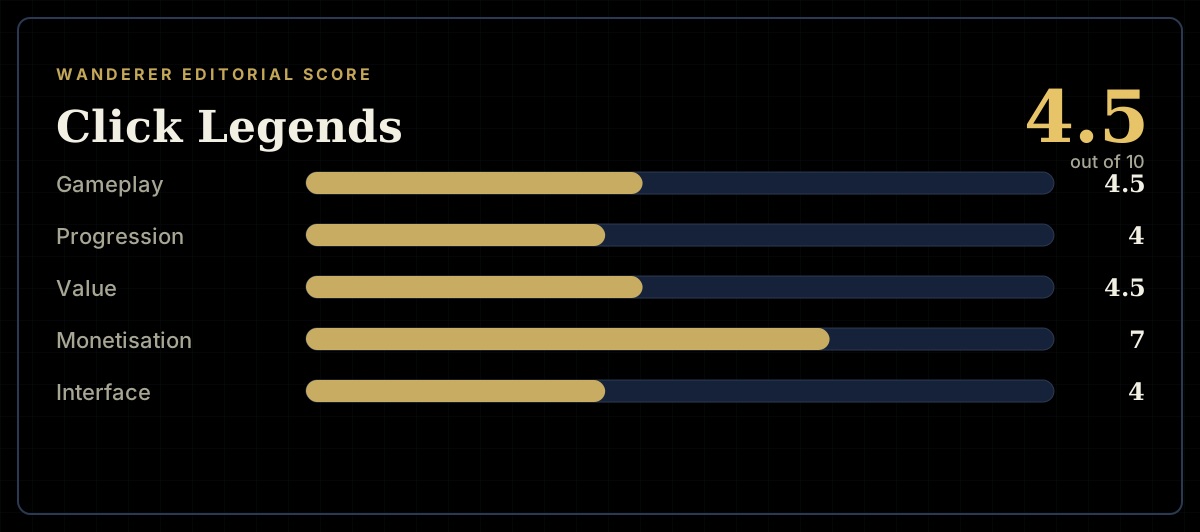
How the review scores each part of the gameWanderer Editorial -
The short versionWanderer Editorial