
Game review
Idle Taoist Mage Warrior
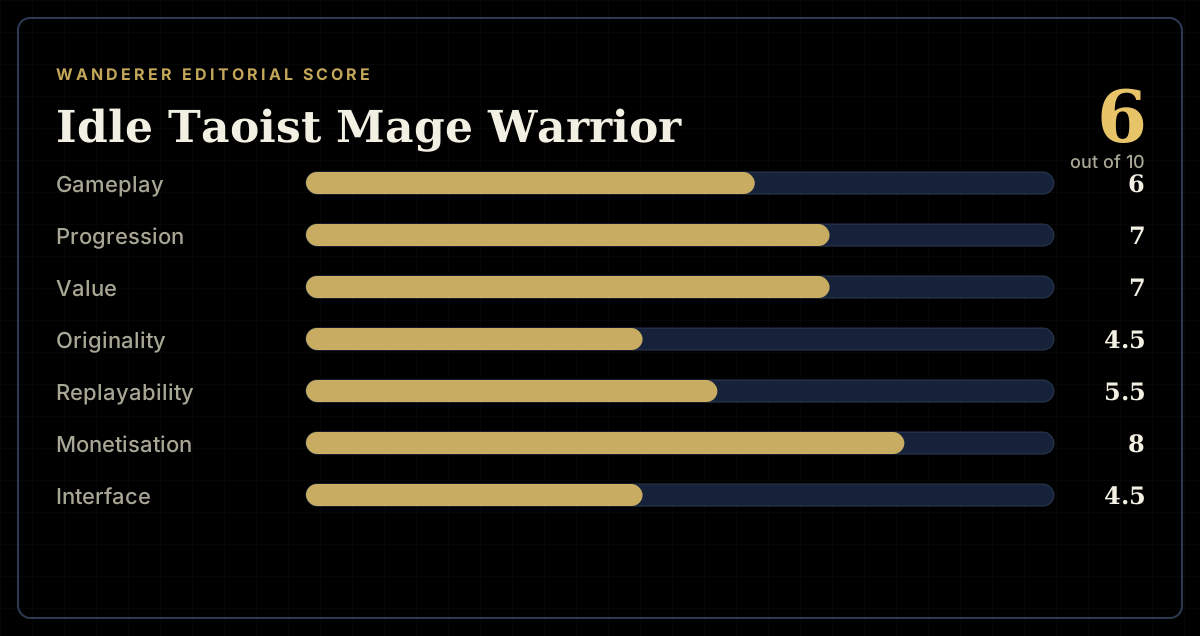
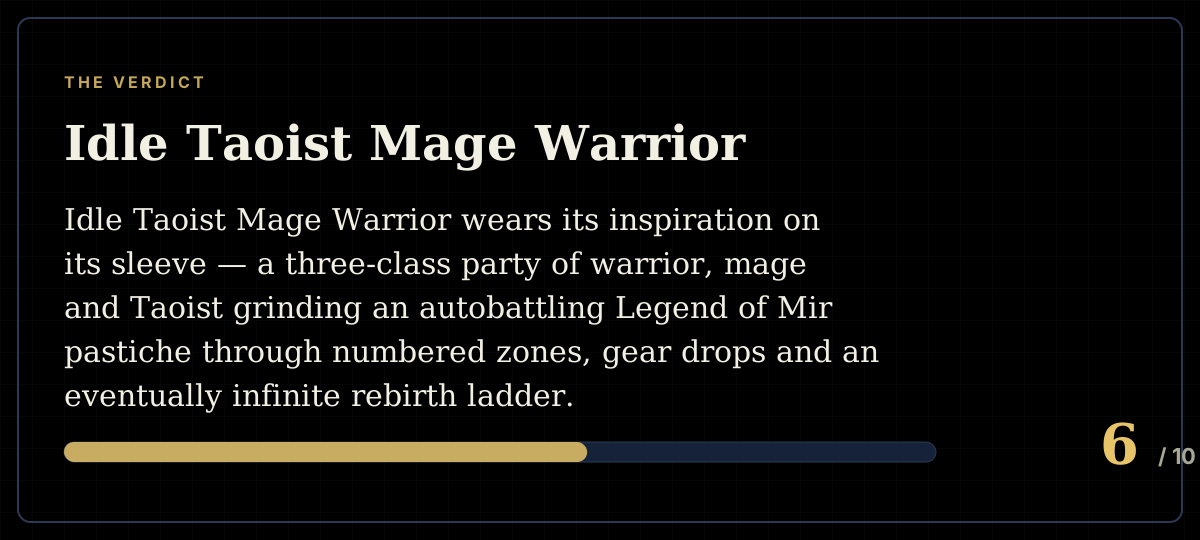
6 / 10
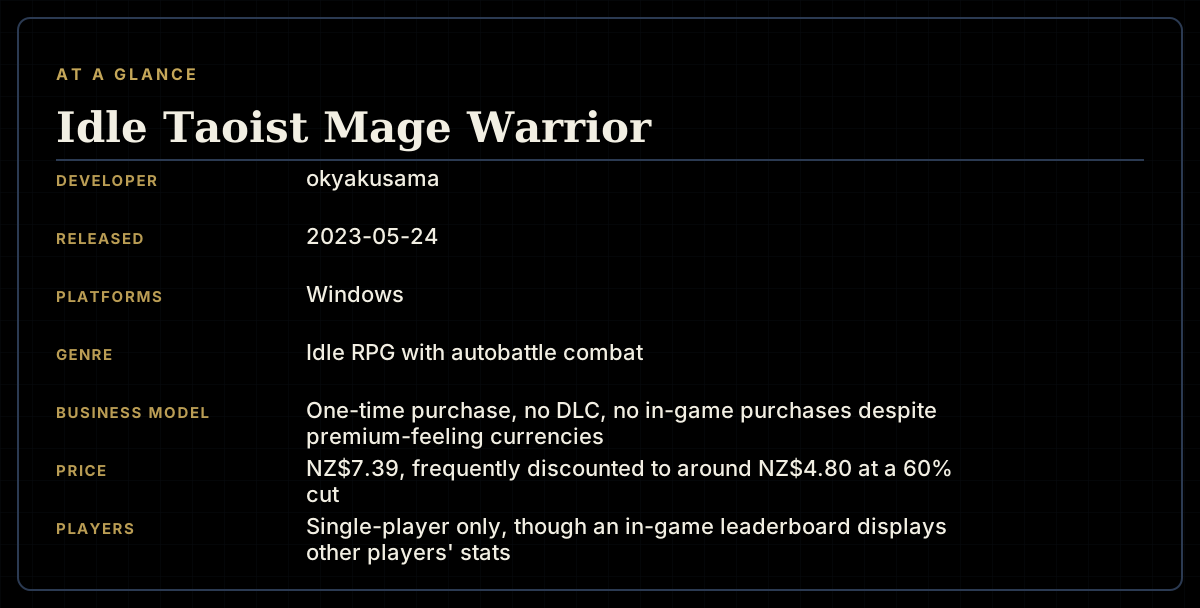
- Developer
- okyakusama
- Publisher
- okyakusama
- Released
- 24 May 2023
- Platforms
- Windows
- Genre
- Idle RPG with autobattle combat
- Monetisation
- One-time purchase, no DLC, no in-game purchases despite premium-feeling currencies
- Players
- Single-player only, though an in-game leaderboard displays other players' stats
The short version
Idle Taoist Mage Warrior wears its inspiration on its sleeve — a three-class party of warrior, mage and Taoist grinding an autobattling Legend of Mir pastiche through numbered zones, gear drops and an eventually infinite rebirth ladder. For NZ$7.39, frequently less on sale, that's a genuinely enormous amount of idling, and the complete absence of real-money spending despite a premium-feeling diamond currency is the game's strongest, most consistently praised trait. What keeps it from ranking higher is a translation that multiple reviewers, in three different languages spread across two years, all call rough going, a handful of reported bugs that eat currency and enhancement materials, and a developer whose own patch history shows real support for this specific game effectively stopping in April 2024, a year before its sequel and the studio's newer projects took over the spotlight.
Biggest strengths
- No real-money purchases exist anywhere in the game despite a premium-feeling diamond currency, a point several reviewers single out and appreciate directly
- A genuinely enormous long-tail: players report multiple hundreds of hours and rebirth counts climbing past 2,000, well beyond the advertised 40-level equipment cap
- The developer shipped daily, sometimes multiple-times-daily hotfixes for the two months immediately after launch, a real and verifiable burst of post-launch support
Biggest weaknesses
- The store page lists ten supported languages, but a German review at launch and a Russian review 18 months later both independently call the translation and interface hard to follow
- Multiple 2025 reviews describe bugs that consume resources without delivering the result, including enhancement materials disappearing without a level-up and a shop purchase that deducted in-game currency without granting the item
- The developer's own news feed for this app goes quiet after an April 2024 bugfix post, then pivots to promoting the May 2024 sequel and later entirely different projects, rather than continued support for this specific game
Who it's for: Players who grew up on Legend of Mir-style hack-and-slash idlers and want that exact feeling for less than the price of a coffee, with no gacha-style spending pressure attached. Less suited to anyone who wants a translated, polished interface or meaningful moment-to-moment decisions.
Our recommendation: At its usual discounted price this is very hard to argue with financially — reviewers routinely report hundreds of idle hours for under NZ$5. Go in expecting a rough English localisation, a system-heavy but mechanically shallow loop, and treat the deepest rebirth content as a time-sink rather than a well-tuned endgame.
6 / 10
Idle Taoist Mage Warrior doesn't pretend to be anything other than what it is. Reviewers who grew up on Legend of Mir clones call it exactly that in their own reviews — "套了个传奇皮的放置" (a Legend-of-Mir-skinned idle game), as one puts it — and the developer's own description leans into the same three-class structure that genre has run on for two decades: a warrior tanking hits, a mage casting group spells, a Taoist summoning and supporting. What's genuinely unusual for a NZ$7.39 solo-developer release is how far the systems built around that familiar shell actually go, and how consistently reviewers across seven different languages report the same thing: this is cheap, this asks for no real money at all, and it will happily eat hundreds of hours if you let it.
A three-class party doing most of the work itself
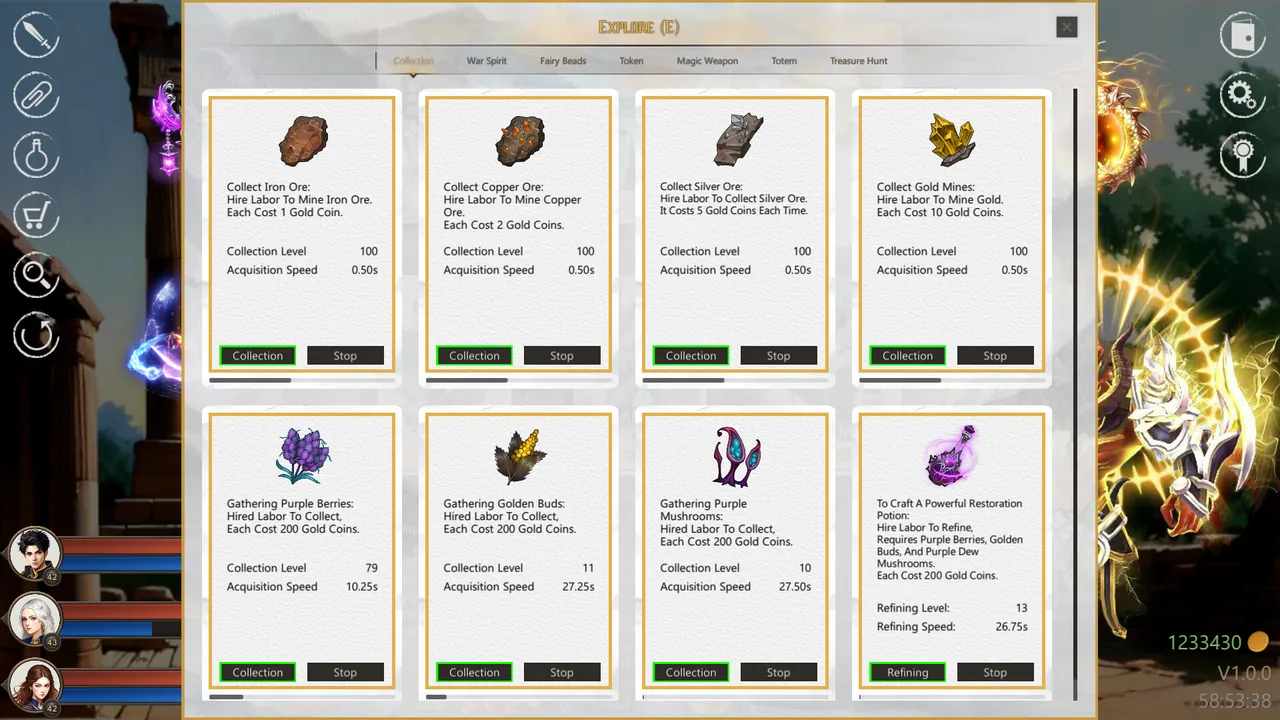
The core loop puts a warrior, a mage and a Taoist on screen together, fighting through numbered zone tiers on a literal world map — Novice Village, Lost Forest, Death Valley, and eventually an "Endless Road" and "Chaos Space" that scale indefinitely past triple-digit stage numbers. Combat runs on autopilot once you've picked a zone, with each class carrying its own active and passive skill loadout. The store page states plainly that equipment is class-restricted for the most part, with roughly 200 pieces across a level-40 cap, and that all of it drops from monsters rather than a shop. None of that is a surprising structure for the genre, but the game backs it with real systems layered on top: a gathering tab for ore and herbs that feeds crafting, an Artifact system with rarity tiers from common through legendary that change crit-trigger odds and crit damage multipliers, a Divine Pet collection with set bonuses at four, six and eight pieces, and Fairy Beads that stack a flat damage bonus per bead owned. Screenshots of these menus show genuinely large numbers — health bars in the hundreds of billions, gold counts past twenty million — the escalating-number aesthetic this genre trades in, rendered here with more moving parts than the price tag suggests.
Endless by design, and reviewers are split on whether that's the point
The advertised level cap of 40 is a soft ceiling rather than the real endgame. Past it, the game shifts into a rebirth system — 转生, "reincarnation" — that resets character level in exchange for permanent stat gains, and a small subset of dedicated reviewers describe pushing this well past 1,000 or even 2,000 rebirths, unlocking an entire second tier of Advanced Skills that only opens at the 1,000-rebirth mark, complete with its own rune-enhancement system. That's an enormous amount of designed-for content for a cheap indie idler, and it's the strongest evidence for the praise this game gets for depth relative to its price. But several of the same long-time players are explicit that the loop stops rewarding attention long before it stops running: one describes reaching attack values in the tens of millions by rebirth 149 and clearing every available zone instantly, concluding "有无上限的飞升之路,但没有对应值得刷的副本" — there's an unlimited ascension path, but no content built to match it. Another simply says the game is "not that long" to fully clear and get every achievement, after which it "gathers dust," calling it better suited to nostalgia than to players unfamiliar with the Legend of Mir formula it's imitating. Steam's own achievement data backs the second view more than the first: the completion curve tops out at 79.5% and only drops to 15.1% at its steepest, a far gentler slope than idle games typically show, and consistent with a game whose formal content is reachable in a normal number of hours even if the underlying number-climbing never technically ends.
The one thing almost nobody complains about
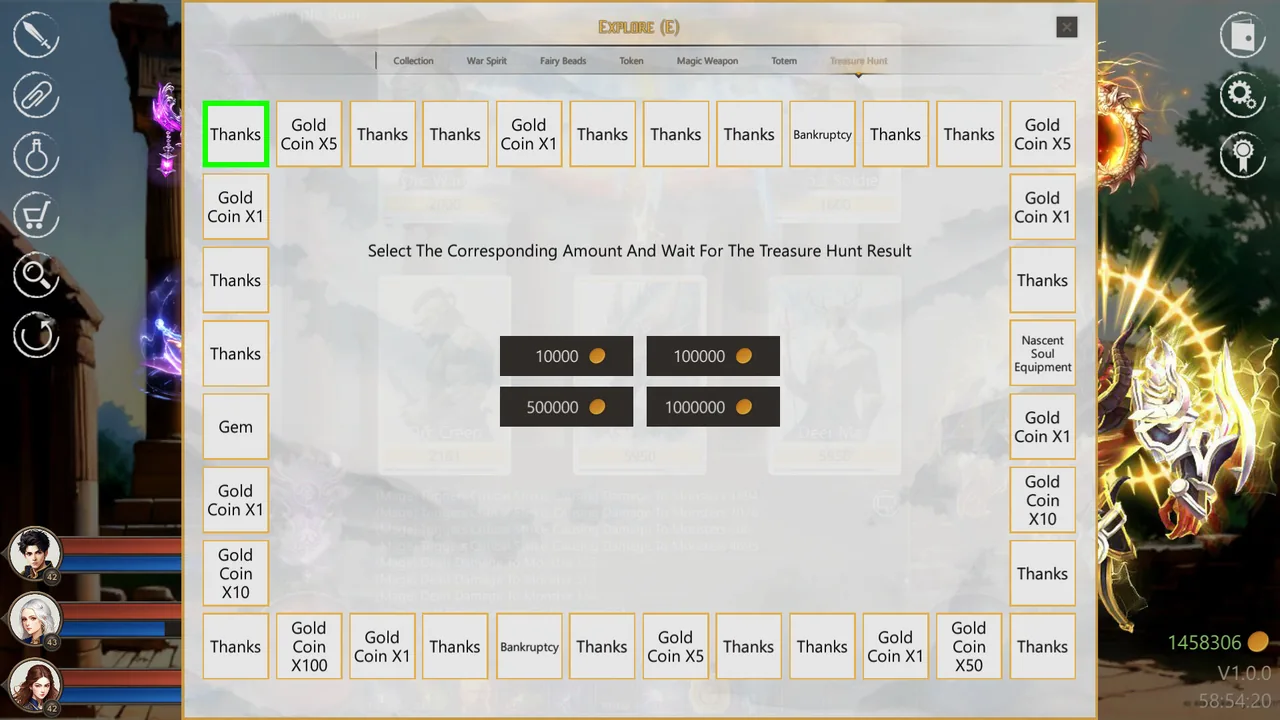
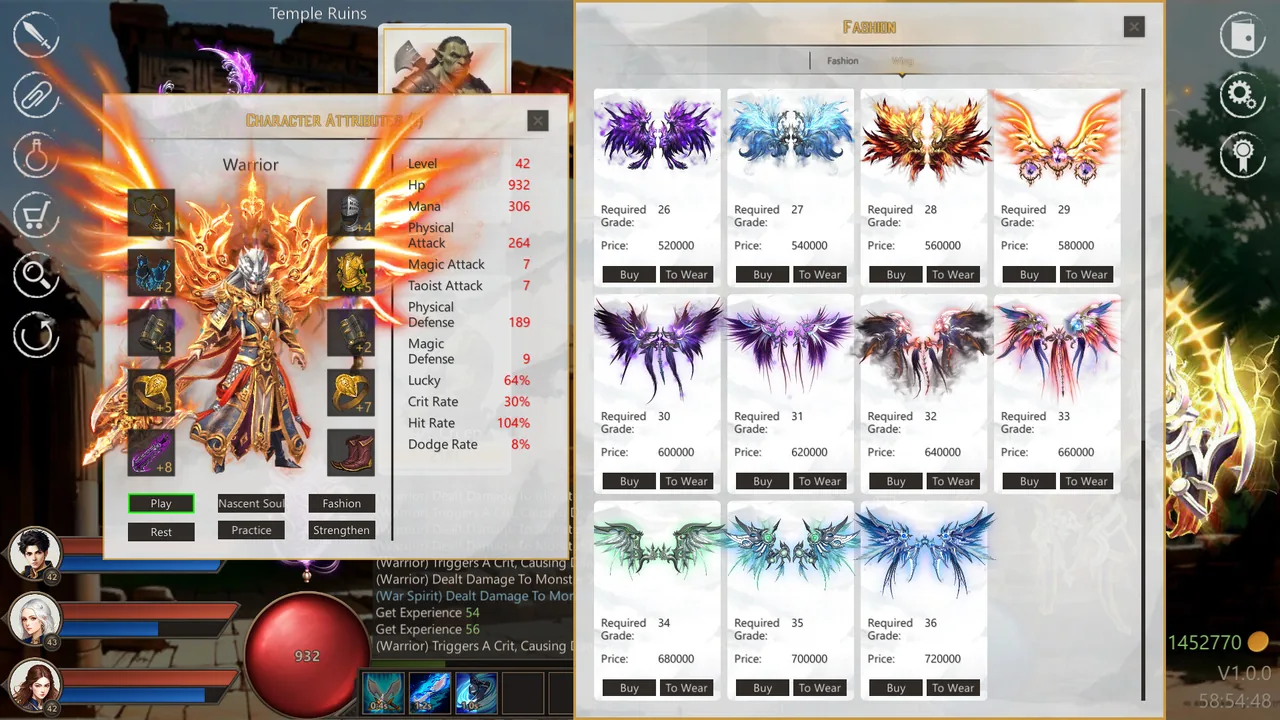
Set against the shallow-endgame criticism is a detail that comes up unprompted, in review after review, in Chinese and in English alike: there is no real-money spending anywhere in this game. It has a diamond currency and a Z-point currency that both look and behave like premium gacha resources — used for card pulls, cosmetic wings, and shop purchases — and multiple reviewers explicitly flag that despite the presence of these systems, there's no purchase button attached to any of them. One review calls this out as the single reason to trust the game with your time; another frames the entire pitch as "便宜,有传奇那味" — cheap, and it has that Legend of Mir feeling — treating the zero-monetisation design as the baseline rather than a bonus. For a genre that's frequently built to extract money through exactly these currency types, a solo developer choosing not to is worth taking at face value, and it's the clearest reason this review's monetisation score sits well above everything else on the card.
Two years of the same translation complaint
Weighed against that goodwill is a language problem that hasn't gone away. The Steam store page lists ten supported languages including English, but a German-language review from the June 2023 launch window says the translation is hard to understand and that there are no tutorials explaining the mechanics, leaving the reviewer "completely on my own." Eighteen months later, in December 2024, a Russian-language review uses almost the same language — "кривой перевод и интерфейс," a crooked translation and interface — about the same game. Two reviewers, two languages, a year and a half apart, independently landing on the same specific complaint is a stronger signal than either review alone, and the official promotional screenshots support it indirectly: several of the in-game menu captures are entirely in Chinese with no English text visible at all, despite English being one of the ten languages Steam lists as supported.
Bugs compound the friction. A handful of 2025-dated reviews describe specific, reproducible-sounding problems rather than vague instability: one reports enhancement attempts that consume materials without the item actually leveling up, another describes a shop purchase that deducted currency without delivering the promised item on three separate attempts, and a third points to a UI layering bug where the inventory panel's icons render above the panel meant to contain them once a second window is opened alongside it. None of these are catastrophic, and several long-session players report going hundreds of hours without hitting anything worse than a save-file hiccup, but they're concrete enough to weigh against the "endless and free" pitch.
A developer who moved on
The clearest picture of ongoing support comes from the game's own Steam news feed, and it tells a specific story. Between launch in late May 2023 and the end of July that year, okyakusama shipped an extraordinary run of hotfixes — multiple version bumps some days, more than twenty numbered patches in barely eight weeks. That level of responsiveness is exactly what several early reviews praise directly, one calling the update pace "腹泻式" (a torrent, literally "diarrhea-style," meant as a compliment for its sheer frequency). But the feed goes quiet after that burst, with only a single further post — an April 2024 bugfix — before May 2024 brings the announcement of Idle Taoist Mage Warrior 2, already reviewed separately by this publication and scored a mixed 5 out of 10. After that, the feed stops being about this game at all: 2025 and 2026 entries promote a different demo, "Idle Land of Exile," and most recently a tower defence title entered into a New Games Festival. None of that is unusual for a working solo developer moving between projects, and it doesn't erase the genuinely large amount of content already shipped here. But it does mean the currency-eating bugs and translation complaints reported through 2025 were logged against a game whose active development had, in practical terms, ended well over a year earlier.
One unresolved question about the art
A 2024 English-language review raises a specific, narrowly stated concern worth reporting on its own terms: the reviewer says they're "pretty sure" the game uses a large amount of AI-generated art, pointing to a roster of character and card portraits that look similar to each other despite being presented as distinct characters, and notes that Steam's disclosure requirement for AI-generated content doesn't appear to have been used here. This review checked the store page directly and found no AI Generated Content Disclosure section addressing the question either way. That absence isn't proof of anything by itself, and no other review in the full sample raises the same point, but it's a specific, checkable claim rather than a vague accusation, and it's presented here exactly as the source review framed it: a suspicion, not a finding.
Final verdict
Idle Taoist Mage Warrior earns its "Very Positive" standing honestly: it's a cheap, generous, entirely unmonetised idle RPG with more systems bolted onto a familiar three-class shell than its price suggests, and the developer's early support was genuinely fast. What it doesn't have is a translation that's held up across the languages it claims to support, a late game that matches its own advertised endlessness with actual content, or continued attention from a developer who's since moved to a sequel and other projects. None of that erases the hundreds of hours multiple reviewers report getting out of a NZ$5 sale purchase — it just means this is a game to buy for the specific, familiar feeling it's chasing, not for polish, translation quality, or a well-paced back half.
Pros and cons
Pros
- No real-money purchases exist anywhere in the game despite a premium-feeling diamond currency, a point several reviewers single out and appreciate directly
- A genuinely enormous long-tail: players report multiple hundreds of hours and rebirth counts climbing past 2,000, well beyond the advertised 40-level equipment cap
- The developer shipped daily, sometimes multiple-times-daily hotfixes for the two months immediately after launch, a real and verifiable burst of post-launch support
- Steam's achievement data shows a comparatively gentle completion curve (79.5% down to 15.1%) rather than the steep cliffs typical of the genre, matching reviewer reports that full completion is realistic in a reasonable number of hours
- Three distinct classes with separate active and passive skill trees, plus an advanced skill layer unlocked after 1,000 rebirths, give the systems real depth on paper
Cons
- The store page lists ten supported languages, but a German review at launch and a Russian review 18 months later both independently call the translation and interface hard to follow
- Multiple 2025 reviews describe bugs that consume resources without delivering the result, including enhancement materials disappearing without a level-up and a shop purchase that deducted in-game currency without granting the item
- The developer's own news feed for this app goes quiet after an April 2024 bugfix post, then pivots to promoting the May 2024 sequel and later entirely different projects, rather than continued support for this specific game
- Several long-time players describe the deepest rebirth loop as effectively unlimited progression with nothing new to actually fight for, once the equipment and zone content is exhausted around level 40
- An English-language review flags a large cast of similar-looking character portraits as probable AI-generated art; Steam's storefront carries no AI Generated Content Disclosure section addressing it either way
Screenshots
-
Idle Taoist Mage WarriorImage: okyakusama via Steam -
Idle Taoist Mage WarriorImage: okyakusama via Steam -
Idle Taoist Mage WarriorImage: okyakusama via Steam -
How the review scores each part of the gameWanderer Editorial -
The game at a glanceWanderer Editorial -
The short versionWanderer Editorial