
Game review
The Magician's Research
5.5 / 10
- Developer
- Mad Labyrinth Studios LLC
- Publisher
- Mad Labyrinth Studios LLC
- Released
- 20 September 2019
- Platforms
- Windows
- Genre
- RPG
- Monetisation
- Free-to-play with a premium currency (Philosopher Stones) that buys permanent stat bonuses and exclusive characters
- Players
- false
The short version
Ten playable mages, a real skill tree, faction reputation, alchemy crafting and up to seven days of offline gains add up to one of the more mechanically dense idle RPGs of its release year, and its developer visibly kept iterating on balance and pacing for roughly six months straight. But its premium currency doesn't just buy convenience — it buys permanent, passive stat increases and exclusive characters with always-on bonuses, the exact monetisation shape that turns an idle game's core promise of patient, free progress into a comparison against players who paid.
Biggest strengths
- Ten distinct playable mages plus four support-mage slots for party-style builds, well beyond a single-character clicker
- Real offline progression, advertised and apparently delivered for up to seven days away from the game
- A documented six-month run of frequent, substantive patches reworking pacing, UI and the prestige ("Time Shift") system in response to player feedback
Biggest weaknesses
- Any real-money purchase grants a permanent, one-time +50% HP/DMG bonus that stacks outside of and beyond whatever was purchased
- At least one purchasable mage carries a passive HP/DMG bonus simply for being owned, active or not — a direct pay-for-power mechanic, not a cosmetic or convenience purchase
- A patch-notes-documented bug once caused "extreme spending rates" across in-game currencies before being fixed
Who it's for: Idle RPG fans who want real systemic depth (skill trees, factions, alchemy, prestige) and can tune out or tolerate a pay-for-power currency layered on top.
Our recommendation: Playable and reasonably deep for free, but go in with clear eyes about what the Philosopher Stone economy is actually selling.
5.5 / 10
What it is
The Magician's Research bills itself, in its own storefront copy, as an "RPG style IDLE - INCREMENTAL - MANAGEMENT" game, and for once that triple label is close to accurate rather than marketing padding. The framing premise — the Mage's Guild's experiments have broken out and you're sent to track down and dispose of them before they multiply and disturb nearby towns — exists mostly to justify an endless wave of monsters to click, auto-click, or fight through with an auto-move option "that magically toggles on for you while you're away." Underneath that thin premise sits a genuinely dense set of systems: ten selectable magicians with unique bonuses, four unlockable support-mage slots to build out a party rather than play a single character, a full skill tree tied to magician leveling, faction reputation for permanent bonuses, an alchemy lab for combining ingredients into buffs, weekly-resetting campaign quests, daily and weekly login rewards, leaderboards, and two separate prestige currencies layered under a "Time Shift" reset mechanic. Offline gains are advertised for up to seven days away from the game — a genuinely generous window by the standards of the genre, where many free idlers cap useful offline accrual at a few hours.
Entering roughly Early Access form around 20 September 2019 (the store's own dev-blog history starts there), the game shipped 18 documented updates through 20 March 2020, then went quiet — the Steam news feed carries nothing since. Unusually for a review, there are zero written Steam user reviews to work from; SteamSpy's cached figures for this title (149 positive, 109 negative) do not match what the live Steam API reports (0 total), a discrepancy this review treats as SteamSpy data being stale or orphaned rather than real signal, consistent with several other small 2019 titles checked this cycle. What follows instead leans on the game's own documented feature list and its unusually thorough public patch history, plus the objective shape of its achievement-completion data.
The patch history is the strongest evidence of a real, cared-for game
Eighteen updates in six months, for a free small-studio idler, is a genuinely active cadence, and the content of those patches reads like a team responding to real player feedback rather than padding out a changelog. Update #5 rebalanced monster population scaling because the existing sliding scale was, in the developer's own words, too steep. Update #6 reworked the Liquid Gold currency system specifically to give players "shorter term goals" and a better sense of ongoing progression. Update #14 reworked the core "Time Shift" prestige reset so that resetting only sends players back to half their maximum stage reached rather than to the very beginning — a direct response to the classic incremental-game complaint that a prestige mechanic which erases too much progress stops feeling rewarding and starts feeling punitive. Update #15 shipped a "Quick Fill" button for the skill tree specifically to reduce the tedium of manually reassigning skill points after every reset. None of this is the kind of change a studio makes without real usage data or direct feedback driving it, and taken together it argues for a small team that was genuinely iterating on player experience rather than shipping once and walking away — right up until, six months in, they apparently did exactly that.
The achievement data backs up the idea that whatever this loop was doing, it held players' attention for a real stretch of time rather than losing them quickly. Across 84 tracked achievements, the completion curve descends smoothly from 58.7% at the top to 2.7% at the bottom, with no sharp cliff anywhere in between — the same shape this review has found elsewhere to be a reliable signal of sustained, gradual engagement rather than a front-loaded burst followed by mass abandonment.
Where the free-to-play model turns into pay-for-power
The same patch notes that demonstrate real design care also document, in the developer's own language, exactly what the premium currency buys — and it is not limited to convenience or cosmetics. Update #15 states plainly that "purchasing any of the real money items will now have an added permanent 1-time benefit of +50% HP and DMG," explicitly available through "Philosopher Stone packs, the value pack, and Beholder pet," and explicitly capped at being obtainable only once. That is a straightforward pay-for-power mechanic: money converts directly into a permanent combat-stat increase that no amount of free play can replicate, layered on top of whatever the currency itself already buys. Separately, Update #5 introduces a new purchasable mage, the Arachnid Queen, whose storefront pitch includes "a permanent bonus of health and damage simply for owning her... active all of the time regardless of if she's active or not" — meaning the purchase itself, not any in-game achievement, is what grants the stat.
For a genre whose core appeal is supposed to be patient, unhurried progress that free and paying players alike can eventually reach through play alone, mechanics like these quietly break that promise. They don't make the game unplayable for free — nothing here suggests a hard paywall blocking progression entirely — but they do mean a strictly-free player is permanently behind a paying one in a way no amount of additional playtime closes. One documented bug is worth noting on the technical side too: an FPS cap issue was found to be causing "extreme spending rates" across in-game currencies before Update #15 patched it, a reminder that a system this interconnected (frame rate feeding into currency accrual) can produce unintended economic effects that are hard to predict in advance.
Verdict
The Magician's Research is a more thoughtfully built idle RPG than its bare "click enemies, use potions" pitch suggests, with real systemic depth across its mage roster, skill tree, factions and alchemy layer, and a six-month patch history that shows a developer genuinely refining the experience rather than shipping and abandoning it immediately. But its monetisation model sells permanent, passive combat power rather than sticking to time-savers or cosmetics, which is a meaningful mark against it for a genre built on the promise that free players get there eventually too. Worth trying for the systems alone if the premium-currency layer doesn't bother you; worth skipping if pay-for-power in a nominally free game is a hard line.
Pros and cons
Pros
- Ten distinct playable mages plus four support-mage slots for party-style builds, well beyond a single-character clicker
- Real offline progression, advertised and apparently delivered for up to seven days away from the game
- A documented six-month run of frequent, substantive patches reworking pacing, UI and the prestige ("Time Shift") system in response to player feedback
- A smooth, gradual 84-achievement completion curve (58.7% down to 2.7%) indicating sustained engagement rather than a short burst-then-quit pattern
Cons
- Any real-money purchase grants a permanent, one-time +50% HP/DMG bonus that stacks outside of and beyond whatever was purchased
- At least one purchasable mage carries a passive HP/DMG bonus simply for being owned, active or not — a direct pay-for-power mechanic, not a cosmetic or convenience purchase
- A patch-notes-documented bug once caused "extreme spending rates" across in-game currencies before being fixed
- No written Steam user reviews exist to independently corroborate any of this from a player's-eye view
- Development appears to have stopped after March 2020, roughly six months after its systems were still being actively reworked
Screenshots
-

The Magician's ResearchImage: Mad Labyrinth Studios LLC via Steam -

The Magician's ResearchImage: Mad Labyrinth Studios LLC via Steam -

The Magician's ResearchImage: Mad Labyrinth Studios LLC via Steam -
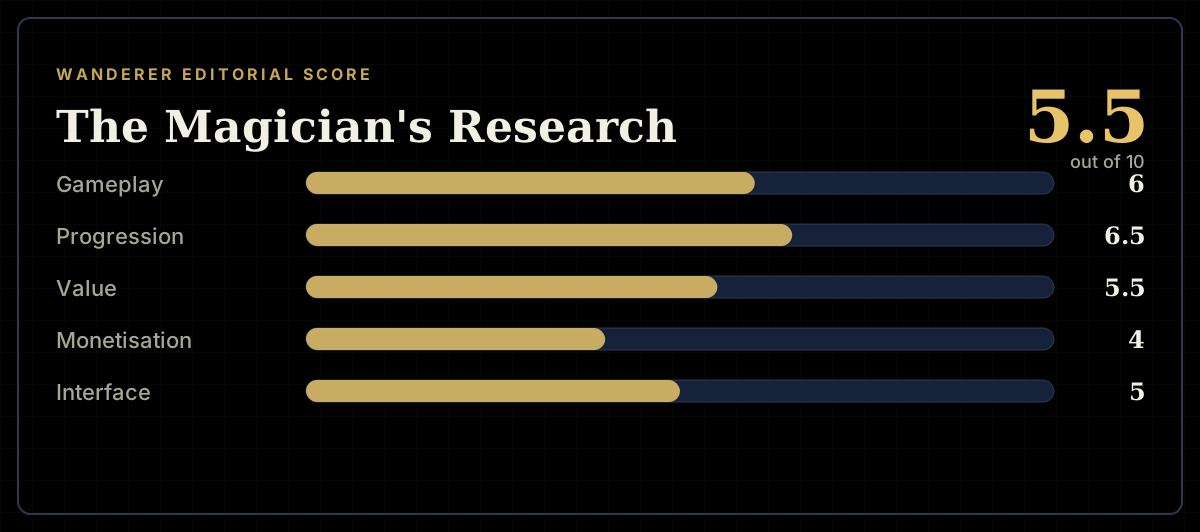
How the review scores each part of the gameWanderer Editorial -
The short versionWanderer Editorial