
Game review
Sect And Monsters
5.5 / 10
- Developer
- StarMatrix Labs
- Publisher
- StarMatrix Labs
- Released
- 24 January 2024
- Platforms
- Windows
- Genre
- Idle RPG with sect-management and autobattle combat
- Monetisation
- One-time purchase; no in-game store or real-money currency found in official materials or player reviews
- Players
- Single-player only
The short version
Sect And Monsters casts you as the head of a struggling cultivation sect rather than a single hero, recruiting handyman disciples, alchemists and cultivators into three tiers of staff who gather resources, brew pills and fight monsters largely on their own. That management layer over a standard idle-RPG shell is the game's most distinctive idea, and a real slice of its playerbase has put hundreds or even over a thousand hours into optimising it. Set against that is a documented pattern of stalled content — an equipment system reviewers say was planned for thirteen tiers and stopped updating at seven, gem tiers with nowhere further to go, and a patch history that shows real, rapid support through mid-2024 before slowing to almost nothing, with several reviewers explicitly reporting that the developer disappeared and disbanded the game's community group.
Biggest strengths
- The three-tier staff structure — handyman disciples gathering resources, alchemists brewing recovery and experience pills, and ranked cultivators fighting for equipment — gives the management layer real substance most single-hero idle RPGs don't attempt
- Multiple reviewers report extraordinary playtime, including one past 1,340 hours and another past 1,000, still actively optimising damage output and gem loadouts
- The developer shipped a genuinely rapid string of numbered patches — dozens of version bumps between late January and June 2024 — a real, verifiable burst of early post-launch support
Biggest weaknesses
- Several reviewers state the equipment system was designed for thirteen tiers but stopped receiving content at tier seven, with gem enhancement similarly left without further tiers to grow into
- Multiple reviews independently report that the developer disbanded the game's community group and stopped communicating, with one long-time player calling the framework good but rough and declining to recommend it on that basis alone
- A high-playtime reviewer (over 640 hours) describes a specific late-game nerf to pet and enhancement-stone drop rates that turned what were once fast dungeon clears into multi-hour idle runs yielding almost nothing
Who it's for: Players who enjoy xianxia cultivation settings and want an idle RPG built around managing a small staff of specialists rather than gearing up one avatar, and who are comfortable playing a game whose entire visible review base communicates in Chinese with no English discussion to lean on.
Our recommendation: Worth the low asking price for the sect-management idea alone, but go in expecting the back half of the content roadmap to be unfinished rather than merely difficult, and don't expect further updates — the developer's attention has visibly moved to a newer title.
5.5 / 10
Most idle RPGs put you in charge of one growing hero. Sect And Monsters puts you in charge of a growing institution instead: a xianxia cultivation sect, staffed by three ranks of recruits who gather wood and spirit stones, brew recovery pills, and fight monsters for gear largely without your direct input. It's a small reframing of a familiar genre, but it's a real one, and it's the reason a solo NZD 7.39 release from developer StarMatrix Labs has pulled in reviewers who report four-digit hour counts. What that reframing runs into is a documented, specific pattern: a fast, genuine burst of post-launch support that visibly slows within a year, leaving systems that reviewers say were designed to go further than they currently do.
Running a sect instead of levelling a hero
The store page lays out three staff ranks — handyman disciples, alchemists, and ranked cultivators moving from Qi Refining through Foundation Establishment to Nascent Soul — and reviewer accounts confirm the loop runs on delegation rather than a single controllable character. Disciples chop wood, mine ore, and gather spiritual stones to fund upgrades and recruitment; alchemists turn those resources into pills that heal and buff the roster; cultivators take those buffs into combat for equipment and further resources, which loop back into upgrading the sect itself. Elders sit above all three ranks, adding sect-wide buffs. It's a genuinely different shape from the "grind one hero to the next zone" template the genre defaults to, closer to managing a small production chain than piloting a party, and several long-session reviewers describe the appeal in exactly those terms — one, with 172 hours logged at the time of writing and far more since, calls it a satisfying loop of gearing, gem-hunting, and beast-catching in pursuit of ever-higher damage output.
A system with a stated ceiling it never reached
The trouble reported most consistently isn't difficulty, it's incompleteness. One reviewer states plainly that the equipment system was planned to run to thirteen tiers and stopped receiving new content at tier seven, and that the gem-enhancement system has no further tiers to grow into either, once late-game numbers scale past what the existing tiers were tuned for. A separate long-time player, writing after 642 hours, describes a specific balance change that hit exactly this kind of endgame content: drop rates for pets and enhancement stones were cut sharply after an early period of faster progress, turning dungeon runs that once cleared quickly into multi-hour idle sessions that yield almost nothing, even run overnight. That's a harder complaint than "the grind is slow" — it describes a system moving backward for players who were already deep into it, not simply failing to add more.
The community's read: promising, then abandoned
The strongest, most repeated signal across the sample is about the developer rather than the game's mechanics. Multiple reviews, independently, describe the developer disbanding the game's community discussion group and going quiet — one flatly opens with "作者跑路解散群了" (the developer fled and disbanded the group) before listing the stalled equipment tiers as evidence; another writes that the game's foundation is genuinely good but that it appears abandoned, calling that a real shame rather than a reason to write the game off entirely; a third, more clipped, says they were drawn in by the screenshots, that the framework is solid but rough, and declines to recommend it once they'd heard the same thing. That reading lines up with what Steam's own partner events feed shows directly: a rapid, dense run of numbered patches from launch in late January 2024 through June 2024 — the kind of "diarrhea-style" update pace idle-genre fans specifically praise when they see it — followed by a single further update in December 2024, a UI-only pass in May 2025, and then nothing about this game at all. The January 2026 post on the same feed announces the developer's next title, Idle Wuxia, and a March 2026 post cross-promotes an unrelated survival game, confirming the studio moved on rather than paused.
Not every account is this dire, and it's worth weighing the contradiction rather than smoothing over it: one reviewer credits a May 2024 patch window with fixing "most of the previous issues" and recommends the game strongly on that basis, which is consistent with the update feed's own record of real activity during exactly that stretch. The honest read is that Sect And Monsters had a genuine, responsive development period of roughly ten months, and that the abandonment complaints describe what happened after that period ended, not a game that was never supported at all.
Rough edges even active fans ask to fix
Set aside the abandonment question and the day-to-day interface still draws consistent, specific complaints from players who otherwise recommend the game. One asks for a way to see what each assigned disciple is currently doing, after reassigning a woodcutter's gear only to find them mining instead; the same review asks for gem sorting that groups by more than colour, and for the crafting station panels to stop crowding the main screen. Another separately asks for one-click batch recruitment instead of hiring one disciple at a time, and calls the growth curve "extremely uneven" rather than smoothly paced. A Traditional Chinese-language review flags that certain enchantment visual effects are close to unreadable, calling them close to blinding, and that the Escape key doesn't reliably close the settings window once a second window is open. None of these are severe on their own, but their volume and specificity — coming from reviewers with double-digit to quadruple-digit hours already invested — describes a UI that was never polished past its functional first pass, consistent with a support window that ended before quality-of-life work caught up with the content.
No monetisation to complain about, oddly mislabeled
One clean point in the game's favour: nothing in the full review sample, across reviewers with wildly different playtimes and opinions of the content, describes an in-game store, a premium currency, or any pressure to spend beyond the NZD 7.39 asking price. That's worth stating plainly given how often idle and cultivation-themed games in particular lean on gacha-style monetisation. It makes it stranger that Steam's own genre tags for the page list "Free To Play" alongside the paid price — an apparent labelling leftover or error rather than a reflection of how the game actually works, since every reviewer treats it as a one-time purchase and none report any purchasable content inside it.
An entirely Chinese-language track record
One structural gap is worth flagging on its own: every review currently on the store page is written in Simplified or Traditional Chinese, and a direct query for English-language reviews returns zero results, despite English being listed as a fully audio-supported language. The promotional screenshots back this up indirectly, showing menu text entirely in Chinese. That doesn't make the existing review sample any less credible — the accounts above are detailed, specific, and consistent with each other and with the developer's own public patch history — but it does mean there is no English-speaking playerbase experience to check that sample against, and any English-speaking buyer is relying entirely on translated text for a game whose active support has already ended.
Final verdict
Sect And Monsters is a better-than-average idea inside an idle RPG that stopped growing before it finished growing. The sect-management structure, splitting labour across disciples, alchemists and cultivators rather than funnelling everything into one hero, is a real point of difference that's kept a slice of its playerbase engaged for hundreds of hours. But the same sample that praises the idea documents, in specific and repeated terms, an equipment system that never reached its planned depth, a late-game balance change that made grinding harder rather than more rewarding, and a developer whose real, rapid post-launch support ran for roughly ten months before fading into silence and a pivot to a new project. At NZD 7.39 with no monetisation traps, it's a reasonable gamble for players drawn specifically to the cultivation-sect framing — just one to go into expecting an unfinished back half rather than a completed idle RPG.
Pros and cons
Pros
- The three-tier staff structure — handyman disciples gathering resources, alchemists brewing recovery and experience pills, and ranked cultivators fighting for equipment — gives the management layer real substance most single-hero idle RPGs don't attempt
- Multiple reviewers report extraordinary playtime, including one past 1,340 hours and another past 1,000, still actively optimising damage output and gem loadouts
- The developer shipped a genuinely rapid string of numbered patches — dozens of version bumps between late January and June 2024 — a real, verifiable burst of early post-launch support
- No reviewer in the full sample, across hundreds of hours of reported playtime each, describes any real-money purchase option or predatory currency, despite the storefront's own genre tags oddly including "Free To Play"
- A May 2024 update pass that multiple reviewers credit with fixing "most of the previous issues" shows the developer was responsive to feedback while support was active
Cons
- Several reviewers state the equipment system was designed for thirteen tiers but stopped receiving content at tier seven, with gem enhancement similarly left without further tiers to grow into
- Multiple reviews independently report that the developer disbanded the game's community group and stopped communicating, with one long-time player calling the framework good but rough and declining to recommend it on that basis alone
- A high-playtime reviewer (over 640 hours) describes a specific late-game nerf to pet and enhancement-stone drop rates that turned what were once fast dungeon clears into multi-hour idle runs yielding almost nothing
- Several reviewers ask for basic quality-of-life features that never arrived: one-click batch selling of crafted gear, one-click recruitment instead of one-at-a-time hiring, and a way to see what each assigned disciple is actually doing after tasks get silently reassigned
- Zero English-language reviews exist for a store page that lists English with full audio support, and the promotional screenshots show menus entirely in Chinese, so there is no English-speaking track record to weigh against the Chinese-language sample this review relies on
Screenshots
-

Sect And MonstersImage: StarMatrix Labs via Steam -

Sect And MonstersImage: StarMatrix Labs via Steam -

Sect And MonstersImage: StarMatrix Labs via Steam -
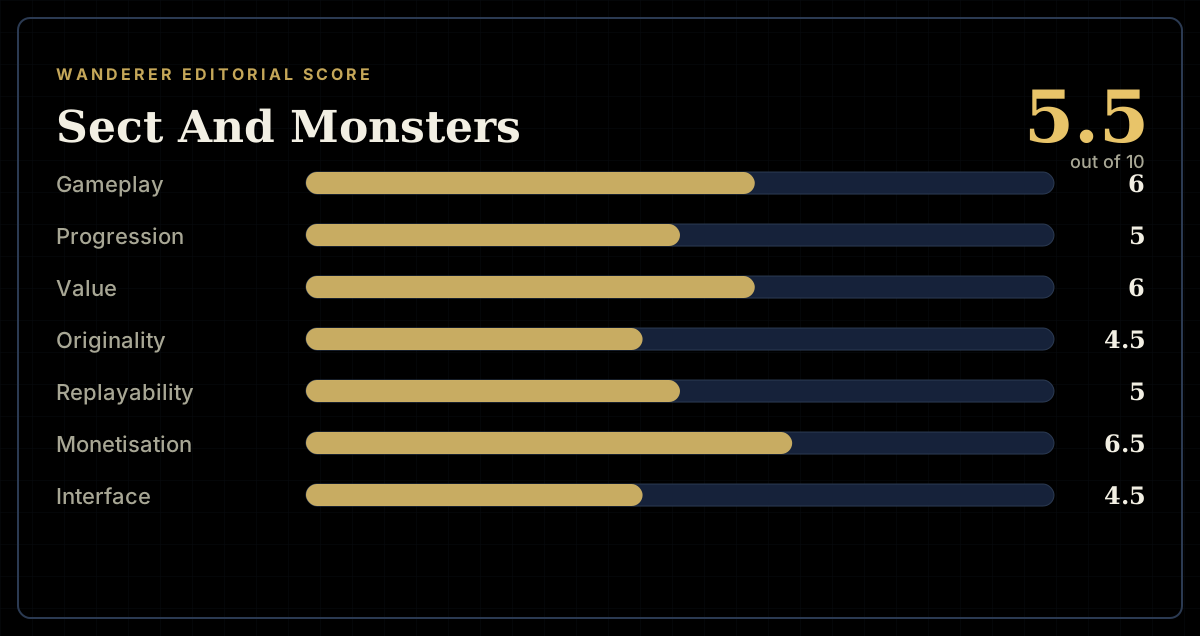
How the review scores each part of the gameWanderer Editorial -
The short versionWanderer Editorial