Game review
Torchlight: Infinite
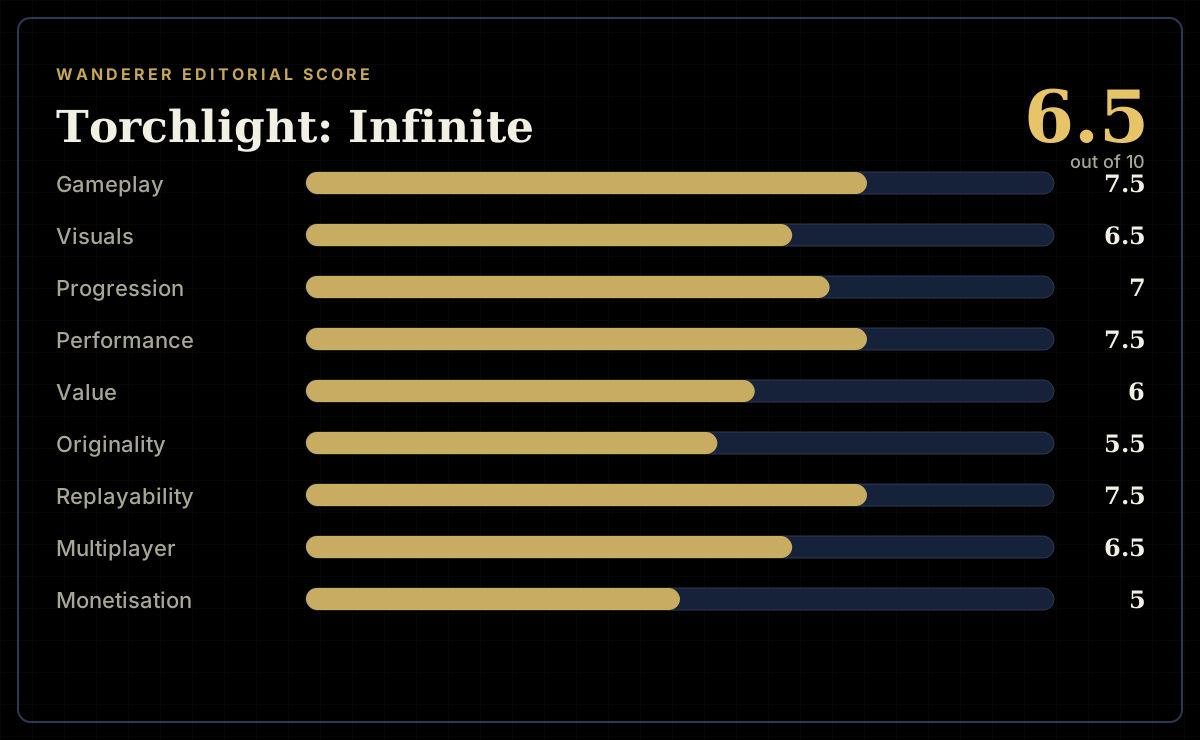
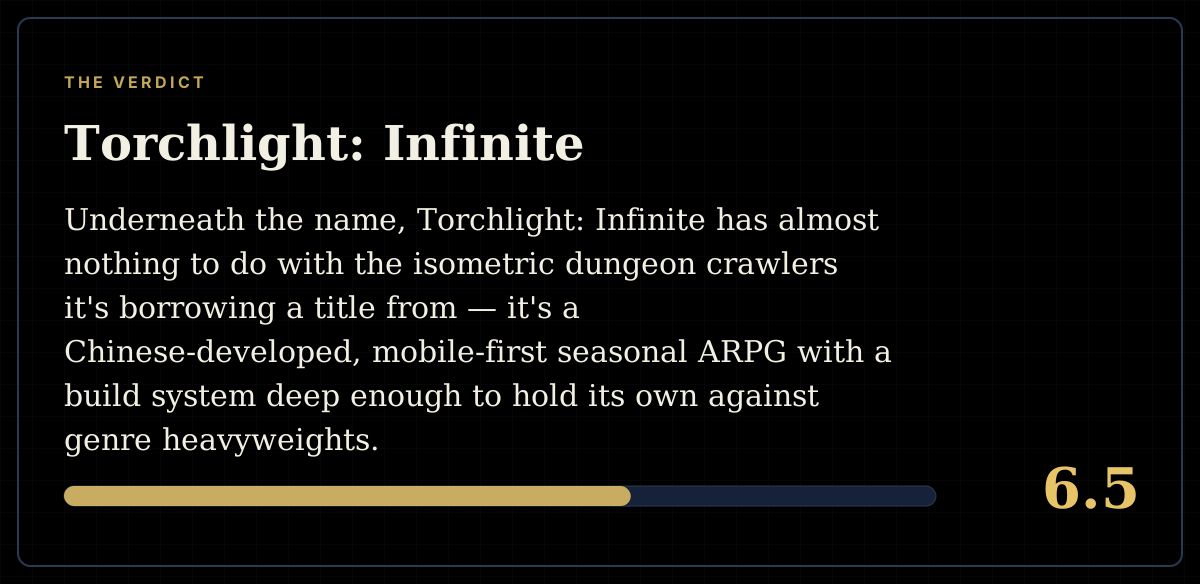
6.5 / 10
- Developer
- XD Inc.
- Publisher
- XD Inc.
- Released
- 9 May 2023
- Platforms
- Windows, Android, iOS
- Genre
- Action RPG
- Monetisation
- Free-to-play. Gacha "Pactspirit" pulls for loot- and power-boosting pets, paid seasonal supporter packs and premium currency, purely cosmetic skins, and a taxed player Trade House (checked 30 July 2026).
- Players
- Online co-op parties and a shared player-run Trade House; no direct PvP.
The short version
Underneath the name, Torchlight: Infinite has almost nothing to do with the isometric dungeon crawlers it's borrowing a title from — it's a Chinese-developed, mobile-first seasonal ARPG with a build system deep enough to hold its own against genre heavyweights. Hero Traits, 24 talent tabs and 200-plus legendary items give it real theorycrafting weight, and the core combat is fast and stamina-free in a way that respects your time.
Where it loses points is exactly where free-to-play ARPGs usually lose them: gacha pets that affect drop rates and raw power despite the developer's own early promise to keep monetisation cosmetic, a Trade House that taxes the economy players are pushed toward using, and a current season whose balance changes have visibly soured its own community. It's a good game with an honest asterisk next to "free."
Biggest strengths
- Combat has no stamina or cooldown gating, so builds live or die on gear and skill choices rather than resource meters
- Hero Traits plus 24 talent tabs give returning players a genuine reason to rebuild rather than replay the same character
- A large share of long-tenured Steam reviewers report reaching endgame content without spending money
Biggest weaknesses
- Loot- and power-boosting "Pactspirit" pets are sold through gacha pulls, which sits uneasily against the developer's own stated no-pay-to-win intent
- Season 13 "Afterlight" balance changes have pulled recent Steam sentiment down to 55% positive, well below the game's 69% all-time score
- Trade House transaction tax is a recurring complaint among players who rely on the market to fund their builds
Who it's for: ARPG players who want Path of Exile-style build depth on a phone, and who are willing to read the shop tab carefully before they fall in love with a build.
Our recommendation: Worth downloading and playing free through a season or two before deciding whether to spend anything. Go in expecting a pet-and-pass economy that gets more insistent the closer you get to the top of the ladder.
6.5 / 10
Torchlight: Infinite is not, by any honest accounting, a Torchlight game. It carries the name of Runic Games' isometric dungeon crawlers, it has Diablo co-creator David Brevik attached as a consulting producer, and it shares almost nothing else with either — not the tone, not the structure, not the studio. It's a mobile-first seasonal action RPG built by the Chinese developer XD Inc., debuting in open beta in China in October 2022 before a global PC and mobile launch on 9 May 2023, and it has spent the three years since running the same seasonal-reset model that defines the genre's biggest names: fresh economy, fresh mechanics, fresh grind, every few months. The current one, Season 13 "Afterlight," launched 16 July 2026.
None of that franchise baggage is really the point, though. What Torchlight: Infinite actually is — a free, cross-platform ARPG with a build system built to rival Path of Exile's — is a more interesting subject than what it's called, and it's worth judging on those terms.
A build system that earns the comparison to the genre's best
The skeleton is familiar to anyone who has spent time in this genre: pick a hero, pick a weapon archetype, pour points into a sprawling passive structure, chase legendary items that rewrite how your skills behave. Torchlight: Infinite's version of that skeleton is genuinely well put together. Each hero carries a signature Hero Trait — a build-defining passive tied to that character, like Tide Whisper Selena's "Dance of the Deep," which reshapes how her water-magic skills move and combo — layered on top of 24 talent tabs shared across the roster, over 240 skills, and more than 200 legendary items that each do something specific enough to build an entire loadout around rather than just adding a percentage to a stat.
Combat itself has no stamina bar and no global cooldowns holding it back, which sounds like a small thing until you notice how much friction that removes from a genre built on chaining skills together. You press buttons, things explode, and the pace of the encounter is set by your build rather than by a resource meter telling you to wait. It's a smart baseline decision, and it's the reason even the game's harshest Steam reviews — and there are a lot of harsh ones this season — tend to concede that the core feel of hitting things is still good.
Season 13 layers two new systems on top of that foundation. Nether King's Divinity introduces Divinity Slates that let you "brand" Divine Remnants with effects like Judgment, Contamination and Banishment, opening another axis of build customisation on top of talents and gear. Divine Ascent is a new roguelite-style challenge mode: climb procedurally escalating floors against a three- minute timer, fight floor bosses, and chase a place on a first-clear leaderboard. Neither system is revolutionary — climbing towers against a clock is a well-worn ARPG endgame trope — but they're competently built additions to a game that already had a lot of moving parts, and Solo Self Found and Hardcore modes introduced this season give players who want a harder, self-imposed ruleset somewhere to point that ambition.
If you've spent time with Path of Exile 2 or Last Epoch, the shape of all this will feel immediately familiar. Torchlight: Infinite doesn't match either for sheer systemic depth or for the sense that every mechanic has been stress-tested by a decade of theorycrafters, but it doesn't need to — it's solving a different problem, which is putting a comparable build-crafting experience in your pocket, with full cross-save between PC and phone, and asking nothing up front to try it.
Season 13 lands badly, and the numbers show it
This is where the timing of this review matters. Steam's review data currently shows a real split between the game's reputation over its lifetime and its reputation right now. All-time, Torchlight: Infinite sits at roughly 69% positive across 21,287 reviews — solidly "Mixed" by Steam's own classification, but close enough to the "Mostly Positive" line that it reads as a genuinely contested game rather than a bad one. Reviews from the last 30 days, covering the Afterlight launch, sit at 55% positive across 543 reviews — a meaningfully worse number, and one that lines up with what those recent reviews actually say.
The complaints cluster tightly. Long-time players describe secretly reduced loot drops this season, talent and skill changes that have pushed the viable build count down sharply, and — repeatedly — a sense that money spent on pets and league-specific investment in previous seasons evaporates when the next season's mechanics roll over without any compensation. "The last two seasons have turned it into a total mess," reads one review with tens of thousands of minutes logged, a pattern that recurs across reviewers with genuinely enormous playtime rather than people bouncing off in the tutorial. That's a different, more concerning signal than ordinary launch grumbling: it's players with years invested describing a live-service game actively spending down the goodwill it built up.
None of this is unique to Torchlight: Infinite — seasonal ARPGs live and die by whether each reset feels like a fresh start or a punishment, and Afterlight is, on the current evidence, landing closer to the latter for a meaningful slice of the returning playerbase. It's the kind of dip a season or two of corrective patches can fix. It's also exactly the kind of thing a prospective player should know before committing time to a specific season's economy.
The free-to-play ledger
XD Inc.'s producer has previously said the studio wanted to avoid monetising skill or power progression, keeping purchases cosmetic. Reading the actual shop and the actual player reports against that stated intent is where this review earns its score.
The core loop — killing things, socketing gear, filling talent tabs — is playable to a real endgame without spending a cent, and a large number of Steam reviews back that up specifically: players describe reaching top-end content on free currency alone, just on a longer timeline than a paying player would need. That's a genuinely important distinction, and it's more generous than a lot of the genre's mobile-adjacent competition.
Where it gets murkier is "Pactspirit" pets, sold through gacha-style pulls, which come in two flavours: drop pets that increase the rate and quality of loot you find, and battle pets that add raw combat power. Both are purchasable, both are optional, and both are also, functionally, power — not cosmetic power, but the kind that changes how fast you clear content and how strong your character is relative to someone who didn't buy them. That's the gap between the stated design philosophy and the lived one: nobody is locked out of the game without paying, but the players paying are farming and fighting faster, which is a real competitive edge even in a game without direct PvP, because leaderboards, trade prices and season rankings are all downstream of how fast you can clear.
Layered on top of that: seasonal supporter packs and battle-pass-style passes (long-time players describe a modestly priced basic tier as reasonable value, alongside far more expensive bundles built around those same pets), a premium-currency shop, and a player-run Trade House that takes a cut of every transaction — a tax that shows up constantly in player feedback as a drag on the very economy the game encourages you to participate in. None of this is disguised or hidden behind dark patterns; it's visible, and a disciplined free player can genuinely ignore most of it. But "genuinely optional" and "doesn't shape the meta" are different claims, and only the first one holds up here. Stash and inventory pressure is present but not severe by genre standards — the bigger squeeze is economic rather than spatial, felt through the trade tax and the pet gap rather than a shortage of bag slots.
Where the seams still show
Performance has come a long way. The 2023 global launch was rough — stuttering, long load times, system requirements that punished mid-range PCs unnecessarily for how the game actually looks — and recent player reports describe a genuinely different, much smoother experience, with fast zone transitions and low system requirements that let it run comfortably on mobile hardware. That's a real turnaround worth crediting.
Server coverage hasn't caught up to the same standard. Several regions, South America prominently among them, have no dedicated servers, which leaves players there fighting latency that Steam reviews describe as making the game genuinely unplayable rather than just inconvenient. And PC players run into a strange piece of friction at the front door: because the game is built cross-platform against mobile app stores, even the Steam version requires binding a third-party account such as TapTap to log in — a step that has nothing to do with Steam and exists purely because of how the backend was built.
Verdict
Torchlight: Infinite deserves more credit for its build system than its name recognition would suggest, and less credit for its economics than its "no pay-to-win" pitch promised. The combat is fast and unencumbered, the talent and legendary-item systems give it real staying power for players who like optimising a character, and a genuinely large slice of its audience plays it entirely free. Set against that: gacha pets that move the needle on power and pace, a trade tax players resent, and a current season that has visibly damaged the game's own review scores in the last month, dragging recent sentiment well below its lifetime average.
Six and a half lands it in "worth trying, go in with your eyes open" territory — good enough that ARPG fans without a PC, or without the appetite for Path of Exile's density, should give it a season on its free tier, but not good enough to recommend spending real money into without watching how Afterlight's balance patches land first.
Steam data and pricing checked 30 July 2026.
Pros and cons
Pros
- Combat has no stamina or cooldown gating, so builds live or die on gear and skill choices rather than resource meters
- Hero Traits plus 24 talent tabs give returning players a genuine reason to rebuild rather than replay the same character
- A large share of long-tenured Steam reviewers report reaching endgame content without spending money
- Recent optimisation has fixed the stutter and load-time complaints that dogged the 2023 global launch
- The Trade House gives loot real value beyond your own stash, turning drops into a small player-run economy
Cons
- Loot- and power-boosting "Pactspirit" pets are sold through gacha pulls, which sits uneasily against the developer's own stated no-pay-to-win intent
- Season 13 "Afterlight" balance changes have pulled recent Steam sentiment down to 55% positive, well below the game's 69% all-time score
- Trade House transaction tax is a recurring complaint among players who rely on the market to fund their builds
- Several regions, including South America, have no dedicated servers, leaving some players with high latency
- Even the Steam release requires binding a third-party account such as TapTap, an odd hurdle for PC-only players
Screenshots
-
Torchlight: InfiniteImage: XD via Steam -
Torchlight: InfiniteImage: XD via Steam -

Torchlight: InfiniteImage: XD via Steam -
How the review scores each part of the gameWanderer Editorial -
The short versionWanderer Editorial