Game review
Torchlight II
8 / 10
- Developer
- Runic Games
- Publisher
- XD International
- Released
- 20 September 2012
- Platforms
- Windows, macOS, Linux, PlayStation 4, Xbox One, Nintendo Switch
- Genre
- Action RPG
- Monetisation
- Premium, one-off purchase with no DLC or expansions ever released; official Steam Workshop support and modding tools (GUTS) are free
- Players
- Online and LAN co-op for up to 6 players, peer-to-peer with no dedicated servers, alongside full single-player
The short version
Torchlight II is a fast, colourful, generous loot game built by people who had already made Diablo and Diablo II, and it still plays that way: dense itemisation, four genuinely distinct classes, and a pet that removes half the genre's usual inventory busywork. Fourteen years on, its real second life is the mod scene — Steam Workshop and the Synergies overhaul have kept adding content long after Runic Games itself closed its doors.
What keeps it from the top tier is everything nobody has touched since: peer-to-peer multiplayer running on account infrastructure that predates the current publisher by three ownership changes, no official respec option for a wrong build choice, and an endgame that leans on New Game Plus rather than any real systemic depth.
Biggest strengths
- Four classes — Engineer, Outlander, Berserker and Embermage — each carry three skill trees that genuinely change how the character plays, not just how it looks
- The pet companion can be sent to town to sell loot and buy potions while you keep exploring, cutting out a lot of the genre's usual backtracking
- Matt Uelmen, the composer behind Diablo and Diablo II, scores Torchlight II too, and the atmosphere it buys punches well above a 2012 indie budget
Biggest weaknesses
- Multiplayer is peer-to-peer on Runic's original account infrastructure, and years of Steam reviews describe broken logins, non-functional password resets and connections that simply fail
- There is no official respec option in the base game, so an early skill point spent badly is permanent unless you install a mod to fix it
- Steam's own achievement data shows barely half of players who attempt multiplayer ever get MULTIPLAYER_JOIN to register, undercutting one of the box's headline features
Who it's for: Players who want the classic Diablo II shape of ARPG — fast clicking, dense loot, no live-service season structure — on hardware from any era, and anyone curious about the game that modding kept alive for over a decade.
Our recommendation: Buy it once on Steam and treat the Synergies mod as the real endgame rather than an optional extra. Play solo or with people you already trust to troubleshoot a broken connection together, and don't go in expecting matchmaking.
8 / 10
In September 2012, three months after Diablo III launched with a mandatory always-online connection and a real-money auction house that most of its own fanbase came to hate, Runic Games shipped a game built by people who actually knew what that fanbase wanted, because several of them had made the games that fanbase loved in the first place. Torchlight II's founders — Max Schaefer, Erich Schaefer and Travis Baldree — were core designers on the original Diablo and Diablo II at Blizzard North, and the game they shipped read like a direct, pointed answer: fully offline single player, no auction house, LAN support, and official mod tools handed straight to the community on day one. It wasn't marketed as an act of revenge. It didn't need to be. The timing did the talking.
Fourteen years later, Torchlight II is still very much playable, still sitting at a 93% positive Steam rating across more than 17,000 reviews, and still doing something unusual for a single-studio indie ARPG from 2012: it has a longer post-launch history than the studio that made it. Runic Games closed in November 2017. The Torchlight IP has since been sold, sold again, and sold a third time — Perfect World held it first, then Embracer Group picked it up in 2021, and as of December 2025 it belongs to the Chinese developer XD Inc., the same company behind the free-to-play spin-off Torchlight: Infinite, which despite sharing a name and a current publisher is a completely different game built by a completely different studio. Torchlight II, the one this review covers, hasn't received an owner-driven update in years. What's kept it alive instead is the modding scene it was designed from day one to support.
Four classes that actually feel different
The class roster is small by modern standards — Engineer, Outlander, Berserker and Embermage — but each one carries three separate skill trees, and the game is generous enough with respec-free commitment that picking a tree isn't a cosmetic choice. An Engineer running the Aegis tree plays like an armoured turret operator surrounded by summoned cannons; the same class leaning Battle instead becomes a shield-charging brawler. Outlander splits similarly between ranged gunplay and elemental traps, Berserker between melee frenzy and shapeshifting, Embermage between fire-and-ice burst damage and a more defensive storm-and-frost kit. None of the four classes is a reskin of another, and that's still true set against a genre that's had fourteen years to raise the bar on what "distinct classes" means.
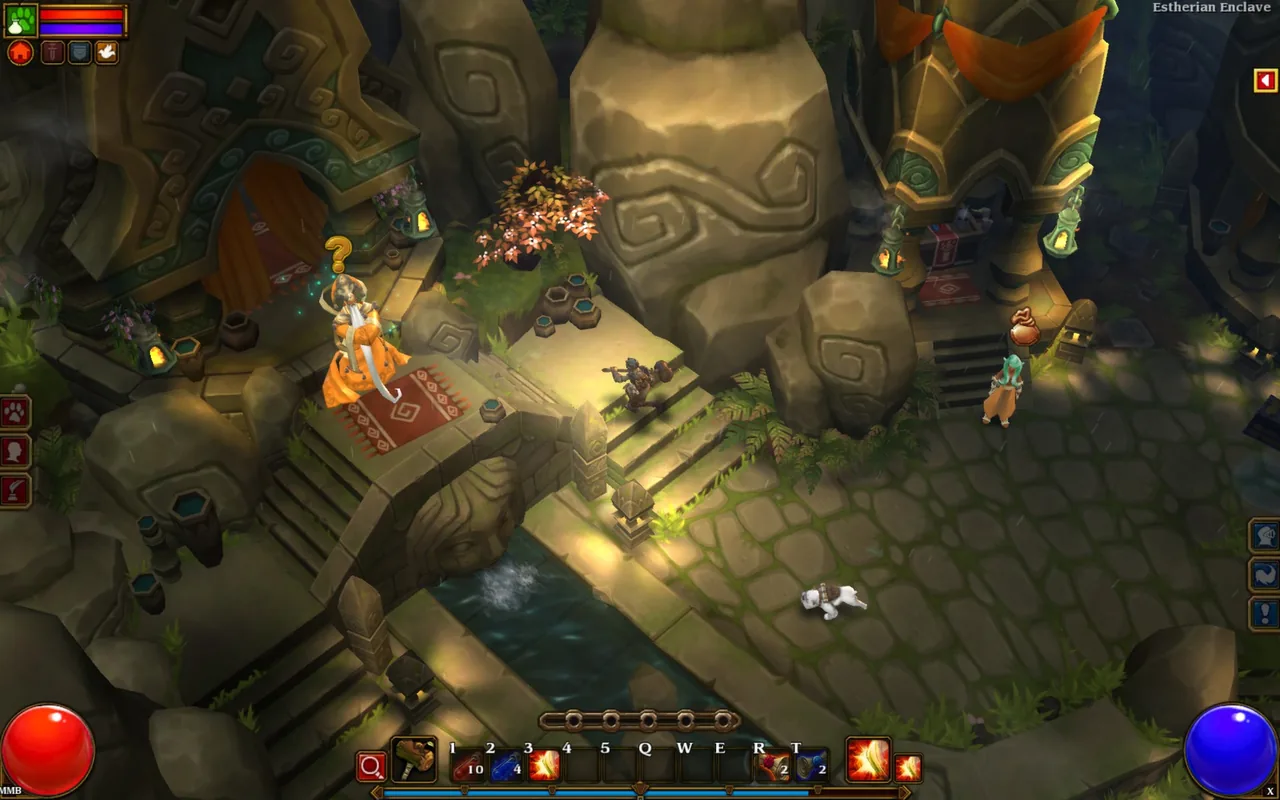
The pet system is the other piece of the combat loop worth calling out specifically, because it solves a problem most ARPGs still have. Your companion — a dog, cat or one of several other creature types, each with its own fishing-derived transformation options — can be sent back to town alone to sell your junk and buy potions while you keep playing, and it comes back with the change. It sounds small. In practice it removes a genuine amount of the genre's busywork, the constant walk-back-to-town-to-vendor cycle that games a decade newer still make you do by hand.
The mod scene is not an afterthought — it's the endgame
Where Torchlight II earns its ongoing relevance is Steam Workshop, and specifically SynergiesMOD, a full conversion overhaul that adds two custom towns, reworked difficulty tiers built around Veteran and Elite settings with randomised monster affixes, a fifty-level Fame system, and enough new itemisation to function as a genuine second game layered over the original. Runic built the game's GUTS editor and shipped it publicly at launch specifically so this could happen, and it's difficult to overstate how much that decision has extended the game's life. Vanilla Torchlight II is a solid, finite ARPG campaign with a New Game Plus loop bolted on. Torchlight II plus Synergies is something closer to what the base game's endgame always needed and never quite had on its own — at the cost of noticeably heavier framerate demands once the mod's larger enemy counts and effects stack up, which is worth knowing if you're running it on genuinely old hardware.
That the community, rather than the studio, ended up carrying the game's long-term development forward isn't a knock on the modding scene. It's a fact about who's been doing the work since 2017, and it means the base game you buy today is functionally the same one that shipped in 2012, plus whatever you choose to layer on top yourself.
Where the age shows: multiplayer and the missing respec
Two of the game's original selling points haven't aged well, and both come down to Runic never having the resources — or, after 2017, the existence — to keep supporting them. Co-op for up to six players, online or LAN, was one of Torchlight II's headline features at launch, a direct contrast with Diablo III's four-player cap and server-side matchmaking. It runs peer-to-peer against Runic's original account system, and that system hasn't been meaningfully maintained in years. Steam's own achievement data tells the story without needing to quote a single review: only 47.9% of players who attempt multiplayer ever trigger the MULTIPLAYER_JOIN achievement, a completion rate barely above half for a feature the game was partly built around. The negative-review corpus fills in why — recurring reports of broken password resets, firewall errors that persist through every suggested fix, and friends simply unable to connect to each other's games, spanning reviews written more than a decade apart, which rules out a single bad patch as the explanation.
The other gap is smaller but sharper: there's no official respec option. Skill points, once spent, stay spent, in a game whose class trees are deep enough that an early mistake is easy to make before you understand what a tree is actually building toward. It's consistently one of the most-requested fixes in community discussion, and it's telling that a respec mod exists and is popular — the absence is a real design gap, not just a stylistic choice players have made peace with.
Set those two issues against a game that otherwise runs beautifully. System requirements were modest even in 2012, and Torchlight II remains one of the easiest ARPGs to run on genuinely old or low-power hardware in 2026, no compromise required. It's a strange split: the parts of the game that depend on Runic's live infrastructure have decayed, and the parts that only depend on your own machine haven't aged a day.
Sound, presentation and what the console port added
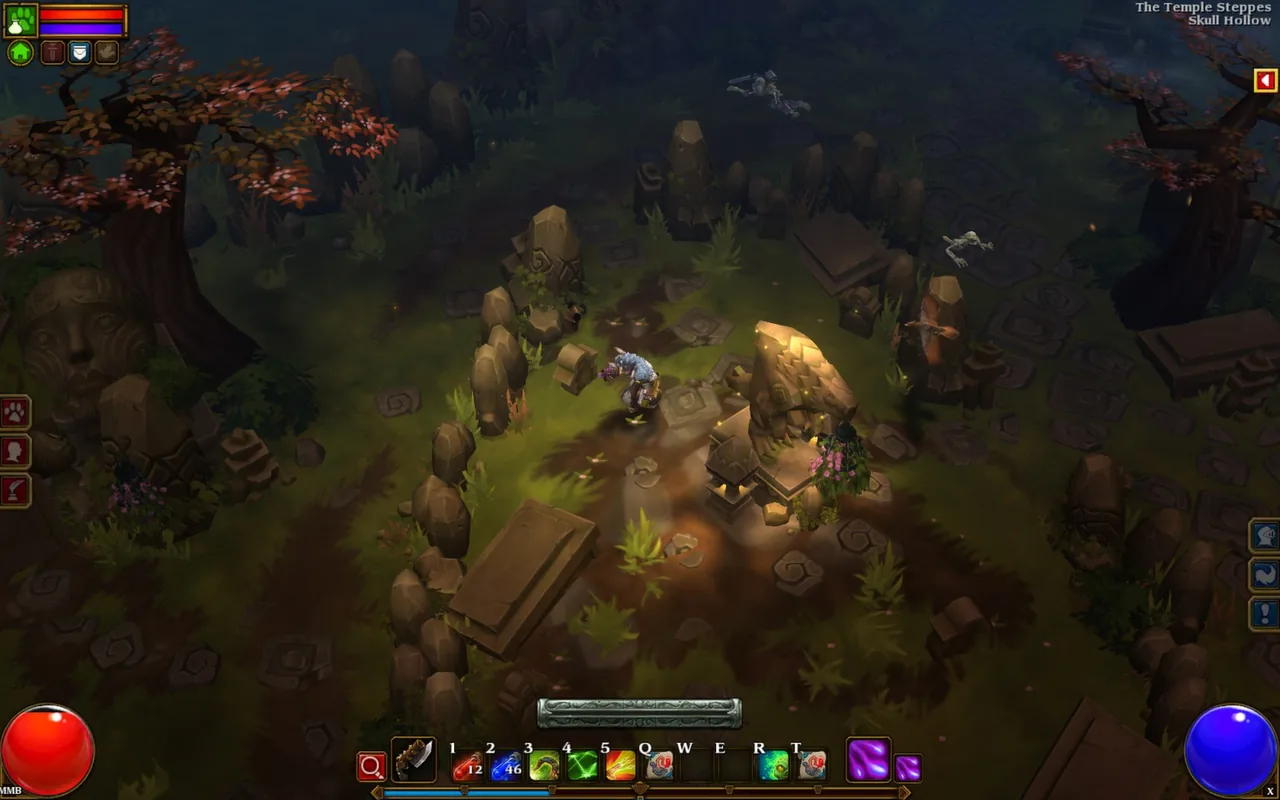
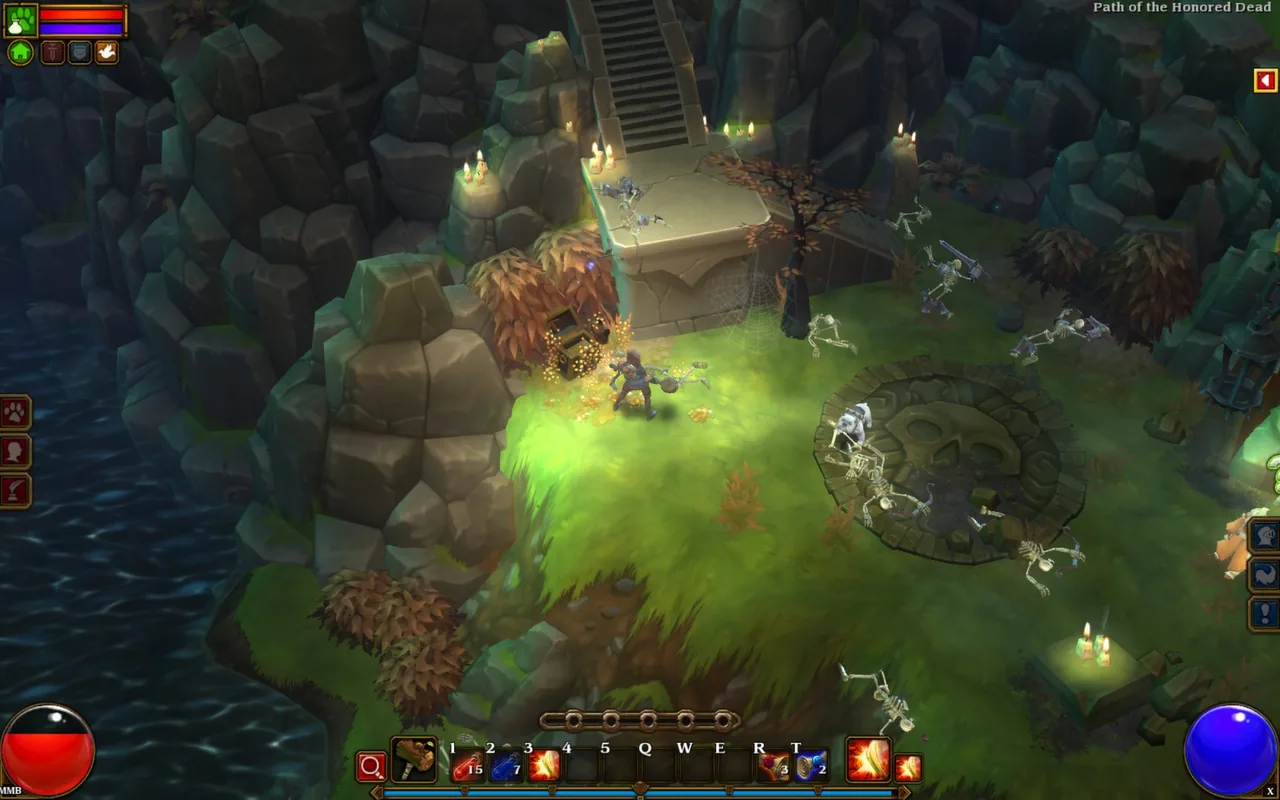
Matt Uelmen composed the score for Diablo, Diablo II and Diablo II: Lord of Destruction before joining Runic to score both Torchlight games, and it shows — the same patient, atmospheric guitar and ambient work that defined the Diablo series' identity carries Torchlight II's dungeons in a way that a 2012 indie budget had no business affording. The visual style holds up for similar reasons: a painterly, stylised look was always going to age better than an attempt at 2012-era realism would have, and it mostly has.
Torchlight II wasn't a PC exclusive forever, either. Panic Button ported it to PlayStation 4, Xbox One and Nintendo Switch in September 2019, seven years after the original release, with a controller-friendly interface redesign and some exclusive content bundled in. That port sits outside what this review has directly verified beyond its release date, price and developer credit, but its existence is worth knowing if a controller matters more to you than a keyboard and mouse — the base PC version, which this review focuses on, was never built with a gamepad in mind.
Verdict
Torchlight II earns its reputation honestly. Four classes that actually diverge, a pet system that quietly fixes one of the genre's oldest annoyances, a soundtrack from the composer who defined the genre's sound in the first place, and — unusually for a game whose developer closed down nine years ago — a modding scene still adding genuine content to it today. Judged purely as the loot-driven action RPG it set out to be in 2012, that's a strong, still-relevant package.
It loses ground exactly where you'd expect an unmaintained live feature to lose ground: multiplayer that barely half its attempted users get working, no way to fix a bad skill point without a third-party mod, and an endgame that was never rebuilt into anything beyond New Game Plus. None of that erases what the base game does well. Eight out of ten reflects a genuinely good, still very playable ARPG whose best content increasingly lives in the Workshop rather than the box — buy it for what Runic built, and get comfortable installing Synergies for what the community built after.
Steam pricing and review data checked 3 August 2026.
Players who'd rather their character kept progressing without needing a community patch to fix a skipped feature might also want to look at Wanderer.
Pros and cons
Pros
- Four classes — Engineer, Outlander, Berserker and Embermage — each carry three skill trees that genuinely change how the character plays, not just how it looks
- The pet companion can be sent to town to sell loot and buy potions while you keep exploring, cutting out a lot of the genre's usual backtracking
- Matt Uelmen, the composer behind Diablo and Diablo II, scores Torchlight II too, and the atmosphere it buys punches well above a 2012 indie budget
- Official Steam Workshop support and the Synergies overhaul mod have kept adding real content for over a decade after Runic Games itself shut down
- Runs comfortably on almost any PC built in the last fifteen years, with no performance tax for playing it in 2026
Cons
- Multiplayer is peer-to-peer on Runic's original account infrastructure, and years of Steam reviews describe broken logins, non-functional password resets and connections that simply fail
- There is no official respec option in the base game, so an early skill point spent badly is permanent unless you install a mod to fix it
- Steam's own achievement data shows barely half of players who attempt multiplayer ever get MULTIPLAYER_JOIN to register, undercutting one of the box's headline features
- Combat at higher difficulties leans on stat-check attrition more than tactical decisions, a complaint that recurs across reviews from every era of the game's lifespan
- No first-party patch has meaningfully touched the game since Runic Games closed in 2017, and the Torchlight IP has changed hands three more times since
Screenshots
-
Torchlight IIImage: XD via Steam -
Torchlight IIImage: XD via Steam -
Torchlight IIImage: XD via Steam -
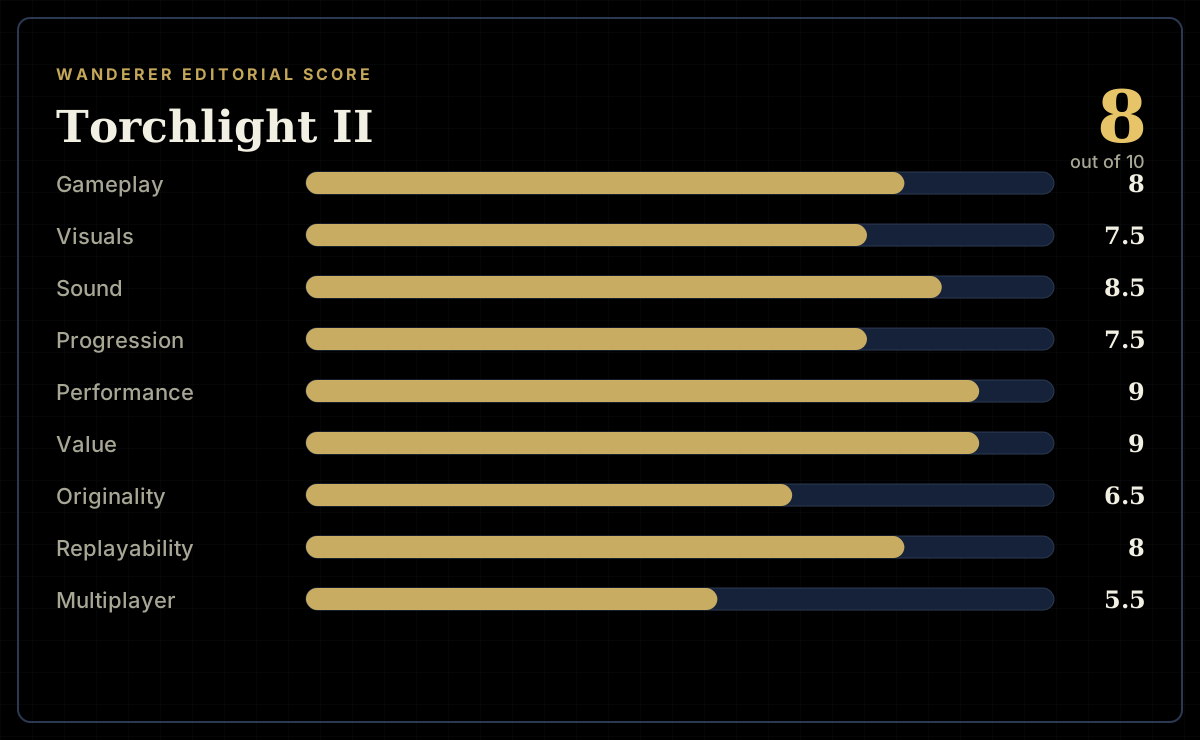
How the review scores each part of the gameWanderer Editorial -
The short versionWanderer Editorial