Game review
Diablo II: Resurrected
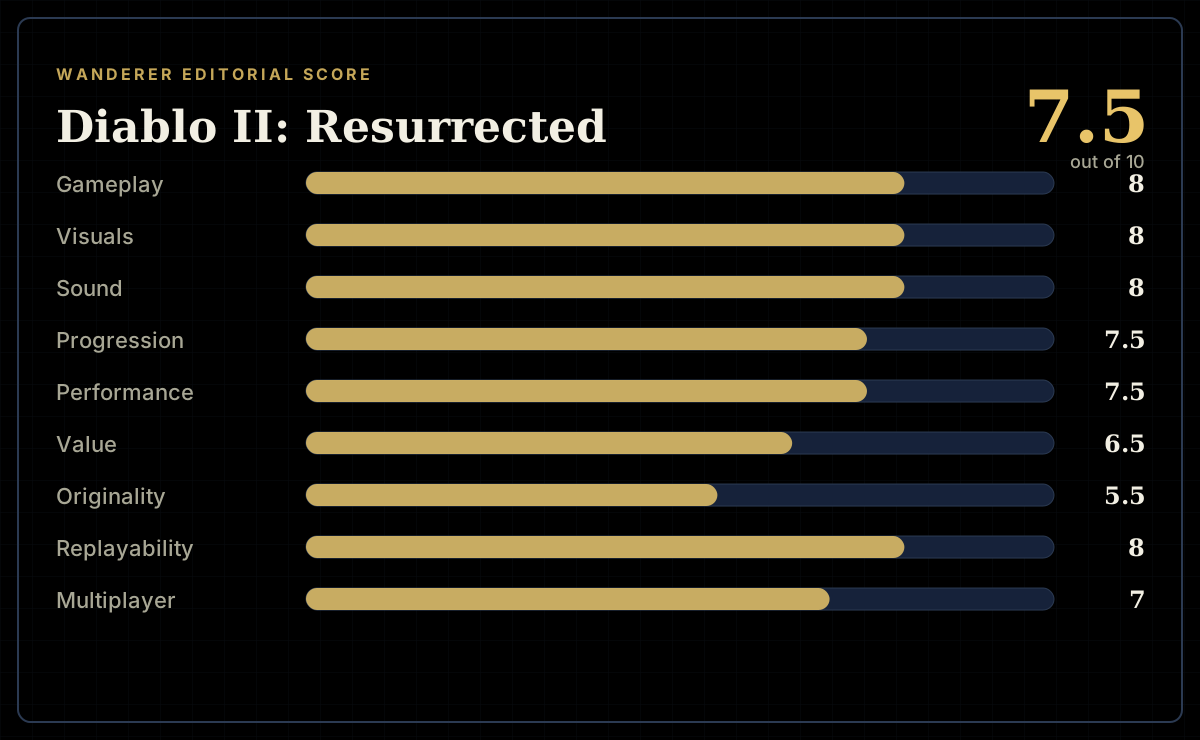
7.5 / 10
- Developer
- Blizzard Entertainment
- Publisher
- Blizzard Entertainment
- Released
- 23 September 2021
- Platforms
- Windows, PlayStation 4, PlayStation 5, Xbox One, Xbox Series X|S, Nintendo Switch
- Genre
- Action RPG
- Monetisation
- Premium, one-off purchase. On Steam the game is sold only as the Infernal Edition — base remaster, Lord of Destruction and the Reign of the Warlock class DLC bundled together, with no cheaper Steam listing for players who just want the classic remaster. An optional soundtrack is sold separately, and the edition unlocks cosmetic rewards in Diablo IV and World of Warcraft that require owning or subscribing to those games too
- Players
- Online co-op multiplayer with cross-platform play listed on Steam; requires a Battle.net account and the Battle.net desktop app even on Steam, with no LAN or open Battle.net play restored from the original release
The short version
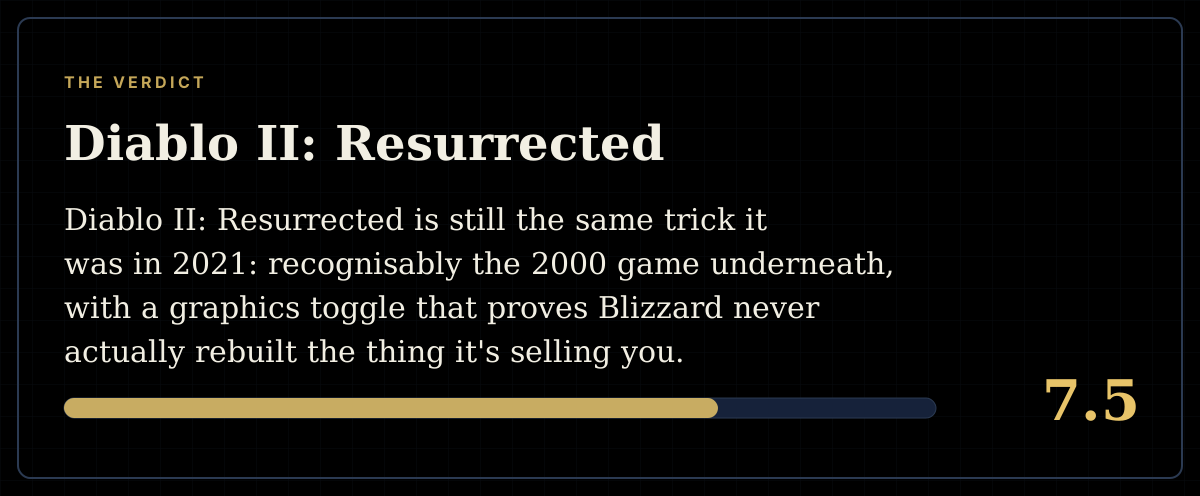
Diablo II: Resurrected is still the same trick it was in 2021: recognisably the 2000 game underneath, with a graphics toggle that proves Blizzard never actually rebuilt the thing it's selling you. That's mostly a compliment — the item hunt, the rune system and the class design hold up on their own terms, and Reign of the Warlock's new class is a genuine, well-built addition rather than a token gesture toward Steam's arrival.
What keeps it from scoring higher is the packaging around that content. Steam buyers in 2026 aren't offered the classic remaster on its own; the only listing is the full Infernal Edition, priced as if the new class were mandatory, with promotional rewards tied to owning or subscribing to other Blizzard games layered on top. The game hasn't gotten worse. What it costs to get into it, and what you're required to buy along the way, has.
Biggest strengths
- The classic-to-remastered graphics toggle still works exactly as advertised, snapping between 2000-era sprites and the 3D overlay with no loading pause
- Reign of the Warlock is a real eighth class with three distinct skill paths, not a reskinned existing kit bolted on for the Steam relaunch
- Ladder Play and Terror Zones give the endgame a returning-player hook the 2021 launch initially lacked
Biggest weaknesses
- Steam sells only the Infernal Edition; there is no cheaper listing for players who want the classic remaster without the new class content
- A Battle.net account and the Battle.net desktop app are mandatory even when the game is bought and launched through Steam
- The Infernal Edition's bonus rewards require owning Diablo IV or an active World of Warcraft subscription, which reads as cross-promotion rather than content
Who it's for: Original Diablo II players who never followed the remaster to Battle.net, Steam-native ARPG fans curious what a 26-year-old design still does better than most modern ones, and anyone chasing ladder resets and rune hunting rather than a seasonal battle pass.
Our recommendation: Worth buying if you want the real thing and are fine paying for the Warlock DLC as part of the price of entry. Skip it if you were hoping for a cheap way to revisit the classic remaster alone — that option doesn't exist on Steam.
7.5 / 10
For four and a half years, the only way to buy Diablo II: Resurrected on PC was through Battle.net. That changed on 11 February 2026, when Blizzard finally listed the game on Steam — except Steam buyers aren't offered the same product PC players have owned since 2021. The Steam listing is the Infernal Edition: the original remaster, the Lord of Destruction expansion, and a brand-new eighth class called the Warlock, sold as one NZ$64.99 package with no cheaper option underneath it. The classic game is still in there, and it's still very good. Whether it's still being sold as itself is a different question, and it's the one this review keeps coming back to.
What "remaster" actually means here
Diablo II: Resurrected isn't a rebuild on a new engine dressed up in old clothes. It's closer to the opposite: upgraded 3D models layered on top of the original 2000 game's 2D sprites and systems, with a bound key that swaps between them instantly. Hold it down mid-dungeon and the game snaps from painterly, modern lighting back to the exact isometric sprite work Blizzard North shipped a quarter-century ago, no loading screen, no visual seam. At launch, Blizzard didn't touch the item systems or the balance underneath either — the numbers that made the original's economy and build diversity work were left alone, because they didn't need fixing.
That's the correct call for a remaster, and it's why Resurrected earned its reputation as one of the better examples of the format: it resists the temptation to "improve" a design that already had twenty years of player goodwill behind it. It also means every criticism levelled at the 2000 original about pacing, interface friction or systems that assume you already know the game applies here too, largely unchanged. Blizzard built a very good window onto Diablo II. It did not build a new game.
The Infernal Edition problem
Here's where the Steam release gets complicated. Search the Steam store for "Diablo II" and exactly one listing comes back for the base game: Diablo II: Resurrected – Infernal Edition, at NZ$64.99, bundling the original remaster, Lord of Destruction, and the new Reign of the Warlock DLC into a single non-optional package. There's no separate, cheaper Steam listing for a player who just wants the 2021 remaster they've heard about — the class content and endgame additions that came with it are baked into the only price on offer.
That's a genuinely different situation from buying the game on Battle.net, where the base remaster and its expansion content have historically been available and priced on their own terms. On Steam specifically, in 2026, new players are being sold a bundle whether they want the new class or not. It's not predatory pricing — NZ$64.99 for a remaster plus an expansion plus a new class isn't unreasonable on its face — but it does mean the packaging decision was made for you, and there's no way around it if all you wanted was the classic experience at a classic price.
The edition also carries promotional rewards into other Blizzard products: cosmetics for Diablo IV that require owning Diablo IV, and a housing item for World of Warcraft that requires an active WoW subscription (or, in some regions, its own expansion purchase) to claim. None of that affects Diablo II: Resurrected's own gameplay, and none of it is presented as mandatory — but stacking cross-game promotional unlocks onto a single-game purchase is the kind of thing that reads better in a press release than it does on a Steam store page, and it's worth knowing it's there before you click buy expecting a self-contained remaster.
Reign of the Warlock: a real new class, for once
The good news is that the content justifying the bundle isn't filler. Diablo II shipped with seven classes in 2000 — Amazon, Assassin, Barbarian, Druid, Necromancer, Paladin and Sorceress — and that roster hadn't grown in twenty-five years of patches, expansions and one full remaster. Reign of the Warlock breaks that streak with an eighth class built around three skill paths — Demon, Eldritch and Chaos — that read as genuinely distinct rather than a reskinned Sorceress with new particle effects. Paired with expanded endgame content and a new player-progression system Blizzard calls the Chronicle, plus a customisable loot filter and reworked stash tabs, this is the most substantial content addition Diablo II: Resurrected has received since Ladder Play returned in 2022.
The loot filter and stash updates matter more than they might sound. Diablo II's itemisation has always produced an enormous volume of nearly-identical white and grey items that exist mainly to be identified, evaluated and discarded, and a filter that can suppress that noise is a genuine quality-of-life upgrade rather than a cosmetic one. It doesn't change what makes the loot chase compelling — that's still the same rune, unique and set-item hunt it's always been — it just makes the chase less tedious to sit through.
What Blizzard left alone, on purpose
The spine of this review is deciding which of Diablo II's 2000-era frictions are still here because they're load-bearing, and which are here because nobody got around to changing them. The inventory is the clearest example of the first kind. It's still a rigid grid where every item occupies a fixed shape, forcing constant decisions about what to carry, what to sell and what to leave on the ground — genuinely tedious in the moment, and also one of the most-imitated systems in the genre precisely because it makes inventory management a real decision instead of an afterthought. Removing it would make the game friendlier and worse. Leaving it in was the right call, and it's stayed untouched through every patch and this latest expansion alike.
Runewords sit in a greyer area. Building one still means socketing an exact, ordered sequence of runes into a base item with the right number of sockets — Ist, then Lo, then whatever the third rune happens to be — and the game still gives you nothing in the interface to tell you which sequences exist or what they do. That's a deliberate piece of Diablo II's identity: the community knowledge and external references around runewords have been part of how players engage with the game since 2001. It's also a real barrier for anyone arriving in 2026 with no history with the series, and unlike the inventory, there's no obvious design reason a discovered-runeword codex would hurt the experience. This is the one preserved friction that reads as inertia rather than intent.
The always-online requirement is squarely in the "nobody fixed this" category. Every version of Resurrected, Steam included, needs a Battle.net account and the Battle.net desktop app running in the background, and the original's LAN and open Battle.net multiplayer — the way a huge number of players actually experienced Diablo II socially in 2000 — has never been restored. For a single-player-capable ARPG built around an item economy that doesn't require real-money trading, mandating an always-online client is a decision that protects Blizzard's control over the game far more than it protects players from anything.
Ladder, Terror Zones and the loop that still works
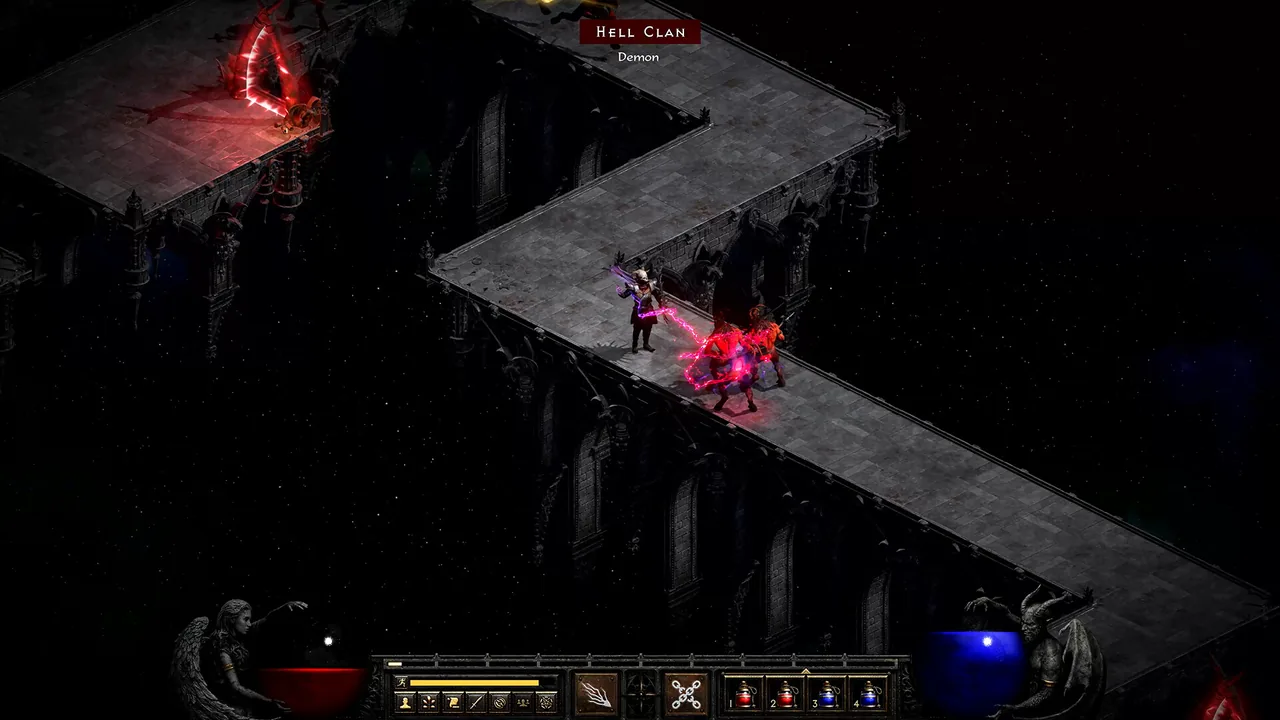
Underneath all of that, the actual playing of Diablo II: Resurrected remains excellent. Combat is fast, animation-cancel-heavy and still rewards knowing your class's specific rhythms in a way few modern ARPGs bother to demand. Ladder Play — competitive seasons with their own economy and ladder-exclusive runewords, a system well-known from the original but missing at the remaster's 2021 launch — returned in a 2022 patch and remains the game's main structured return hook, giving committed players a reason to start fresh characters on a reset economy rather than sitting on a single permanent stash of hoarded uniques. Terror Zones, which randomly supercharge specific areas of the map with higher-level monsters and better drops, keep the endgame loop from being a single predictable farming route, and Reign of the Warlock's endgame additions build on both systems rather than replacing them.
None of this is dressed up the way a live-service ARPG's endgame usually is now. There's no battle pass tracking your Terror Zone clears, no seasonal narrative wrapping the Ladder reset in lore. It's closer to the original game's approach: here are systems, here is a reset, go build something and see how far it gets you. Players who want that structure with no marketing layer on top of it will find it refreshing. Players used to Diablo IV or Path of Exile 2's more elaborate seasonal theming may find it feels thin by comparison.
Presentation and performance
The remastered audio holds up as well as the graphics toggle does — 7.1 surround support and re-recorded music that doesn't clash with the original sound design when you flip back to classic visuals mid-fight. On the technical side, Resurrected asks very little of a modern PC: an Intel Core i3-3250 or AMD FX-4350 and a GTX 660-class card cover the minimum spec, and even the recommended tier — a Core i5-9600K or Ryzen 5 2600 with a GTX 1060 — describes hardware most players replaced years ago. For a genre where flagship releases increasingly assume recent mid-range GPUs, that's a real point in Resurrected's favour, and it means the game is one of the more accessible ARPGs on this list for anyone without current hardware.
The accessibility options listed alongside it go further than you'd expect from a remaster of a 2000 game: adjustable text size, colour alternatives, a mouse-only control scheme, and the ability to play without timed input. None of that changes the core difficulty curve, but it's a genuine widening of who can comfortably sit down with this specific game, and it's not something the original ever had to consider.
The one shadow over performance is historical rather than current: the 2021 launch was hit by server outages Blizzard attributed to legacy game-creation code colliding with modern player behaviour, including well-documented botting and stress strategies the original 2000 servers never had to withstand at that scale. That's not a live concern nearly five years and one full Steam relaunch later, but it's worth knowing this game has a specific history of infrastructure strain around major updates, and the Steam debut and Warlock launch represent exactly the kind of surge that pattern warns about.
Where it sits against the rest of the genre
Compared with the other ARPGs already covered here, Diablo II: Resurrected occupies a specific niche: it's the only one actively arguing that the genre's 2000-era design instincts don't need fixing. Diablo IV chased scale and live-service seasonal structure and paid for it in complexity and cost; Grim Dawn built forward from a similar era with a decade of patient expansion instead of a single graphics pass; Last Epoch and Path of Exile 2 both assume a player who wants precise, granular control over crafting and itemisation that Diablo II never offered and still doesn't. None of them ask you to memorise a rune sequence with no in-game reference, and none of them require a desktop client running in the background just to load a single-player game. Resurrected's appeal is narrower and more specific than any of those: it's for players who want the actual 2000 design, preserved rather than modernised, and who are willing to tolerate its rougher edges as the price of that authenticity.
Verdict
Diablo II: Resurrected earns its reputation honestly. The graphics toggle isn't a gimmick, the item hunt and class design still hold up against ARPGs built twenty-five years later, and Reign of the Warlock is a real, well-considered addition rather than a token reason to relaunch on a new storefront. Ladder Play and Terror Zones give it a genuine return hook, and it runs on hardware most current releases have left behind.
What keeps this at 7.5 rather than higher is entirely about how the Steam version is sold and what it still refuses to fix. Bundling the new class into the only available Steam listing removes the option of buying the classic remaster on its own, the always-online Battle.net requirement protects nothing a player benefits from, and runewords remain deliberately, unnecessarily opaque for anyone without outside references. This is still one of the best-preserved remasters on the market. It's a harder recommendation at full Infernal Edition price than the base remaster alone would have been, and that's a packaging decision Blizzard made, not a limitation of the original game underneath it.
Pricing, packaging and Steam listing details checked 30 July 2026.
Players who'd rather their character kept growing between sessions without a Battle.net client running in the background may also want to look at Wanderer.
Pros and cons
Pros
- The classic-to-remastered graphics toggle still works exactly as advertised, snapping between 2000-era sprites and the 3D overlay with no loading pause
- Reign of the Warlock is a real eighth class with three distinct skill paths, not a reskinned existing kit bolted on for the Steam relaunch
- Ladder Play and Terror Zones give the endgame a returning-player hook the 2021 launch initially lacked
- Remastered audio and a genuinely modest set of PC requirements mean this runs comfortably on hardware that struggles with newer ARPGs
- Accessibility options — adjustable text size, colour alternatives, a mouse-only control scheme — go further than the 2000 original ever considered
Cons
- Steam sells only the Infernal Edition; there is no cheaper listing for players who want the classic remaster without the new class content
- A Battle.net account and the Battle.net desktop app are mandatory even when the game is bought and launched through Steam
- The Infernal Edition's bonus rewards require owning Diablo IV or an active World of Warcraft subscription, which reads as cross-promotion rather than content
- The classic Tetris-grid inventory and cryptic rune-socket runewords are untouched, so newcomers get zero in-game guidance for either
- No LAN or open Battle.net multiplayer has ever been restored, closing off the way a lot of players actually met this game in 2000
Screenshots
-

Diablo II: Resurrected – Infernal EditionImage: Blizzard Entertainment, Inc. via Steam -
Diablo II: Resurrected – Infernal EditionImage: Blizzard Entertainment, Inc. via Steam -
Diablo II: Resurrected – Infernal EditionImage: Blizzard Entertainment, Inc. via Steam -
How the review scores each part of the gameWanderer Editorial -
The short versionWanderer Editorial