Game review
Grim Dawn
8.5 / 10
- Developer
- Crate Entertainment
- Publisher
- Crate Entertainment
- Released
- 25 February 2016
- Platforms
- Windows, Xbox
- Genre
- Action RPG
- Monetisation
- Premium, one-off purchase for the base game plus separately priced expansions; cosmetic item packs and a soundtrack are also sold as optional DLC with no gameplay effect
- Players
- 4-person online and LAN co-op via direct connection, alongside single-player
The short version
Grim Dawn's dual-mastery system — pick any two of ten classes and build the overlap yourself — is the most generous character sandbox a mainstream action RPG currently sells, and a decade of near-continuous support, including a genuine new expansion that shipped one week before this review, has only widened it. Devotion's constellation map and component-based crafting stack real decisions on top of that sandbox rather than padding it.
What holds it back from the very top tier is everything that hasn't been touched since 2016: movement and combat that feel visibly older than their modern rivals, a campaign now spread across three expansions with no way to compress it, and an endgame built on repeatable modes rather than the seasonal ladder structure that's become the genre's expected return hook.
Biggest strengths
- Ten masteries and forty-five possible dual-class pairings make this the most generous character-build sandbox a mainstream ARPG currently sells
- Devotion's shrine-hunting constellation map layers a genuinely separate set of build decisions on top of class skills, not just more stat sticks
- Three real paid expansions and a decade of free patches have kept the game meaningfully growing well past its 2016 launch
Biggest weaknesses
- Component-based crafting is still closer to a recipe-driven gamble than Last Epoch's exact-affix targeting, and the best items remain drops you hope for
- Base movement and combat read as visibly dated next to any ARPG built in the last five years, with no universal dodge roll outside specific skills
- Multiplayer runs on direct Steam invites rather than matchmaking, so finding a co-op group outside your friends list is entirely on you
Who it's for: Players who want to actually design their own class rather than pick one off a menu, anyone who values a game that keeps getting real content years after launch, and ARPG fans who don't mind a slower, more deliberate pace than Diablo or Path of Exile set.
Our recommendation: Buy the base game and Ashes of Malmouth first — that pairing alone justifies the price. Add Forgotten Gods and Fangs of Asterkarn once you know you're staying, in that order. Skip the cosmetic Loyalist packs unless you specifically want the pets.
8.5 / 10
Most action RPGs let you pick a class. Grim Dawn makes you build one. Choose any two of its ten masteries — say Soldier for the melee frame and Occultist for the curses and pets layered on top — and the game doesn't hand you a hybrid template someone else designed. It hands you two full skill trees, tells you to spend your points however you want across both, and gets out of the way. Ten masteries means forty-five possible pairings, and that number just grew: Fangs of Asterkarn, Crate Entertainment's third paid expansion, landed on 23 July 2026 with a tenth mastery, a chunk of new map, and a patch the studio is calling its most comprehensive quality-of-life update since launch. For a game that first shipped nine years ago, that's a genuinely unusual thing to still be true.
Grim Dawn has never chased the scale of Path of Exile or the production budget of Diablo. What it built instead, patiently, across a decade of paid expansions and free patches, is the deepest character-building toolkit in the genre wrapped around a world that takes its factions and its consequences seriously. The trade-off is that plenty of what surrounds those systems — the movement, the pacing, the UI — has aged in place rather than kept up, and buying in today means weighing a genuinely best-in-class build sandbox against a game that plays like it's from 2016, because in most of the ways that matter to feel, it still is.
Ten masteries, forty-five identities
The base game shipped with six masteries — Soldier, Demolitionist, Occultist, Nightblade, Arcanist and Shaman — each built around roughly two dozen skills and their own modifier trees. Ashes of Malmouth added Necromancer and Inquisitor in 2017, Forgotten Gods added Oathkeeper in 2019, and Fangs of Asterkarn adds Berserker this year, a shapeshifting mastery built around transforming into beastlike forms. Ten masteries, and because you commit to exactly two rather than picking from a fixed list, the game supports forty-five distinct class pairings rather than ten distinct classes.
What makes that number mean something rather than just look good on a feature list is that the masteries weren't designed in isolation. A Soldier/Demolitionist build plays like an armoured grenadier; the same Soldier paired with Arcanist instead becomes a spellsword leaning on elemental procs. The overlap is where Grim Dawn's design actually lives, and it's why builds that look similar on paper — two characters both running Occultist, say — can end up feeling like entirely different games depending on what they're paired with. Compared with Last Epoch's fixed fifteen-mastery roster, each with a deep specialization tree of its own, Grim Dawn trades some of that per-skill granularity for sheer combinatorial breadth. Which approach you prefer is genuinely a matter of taste; which one gives you more total distinct builds to try isn't close.
Devotion and the crafting bench: two more layers, not padding
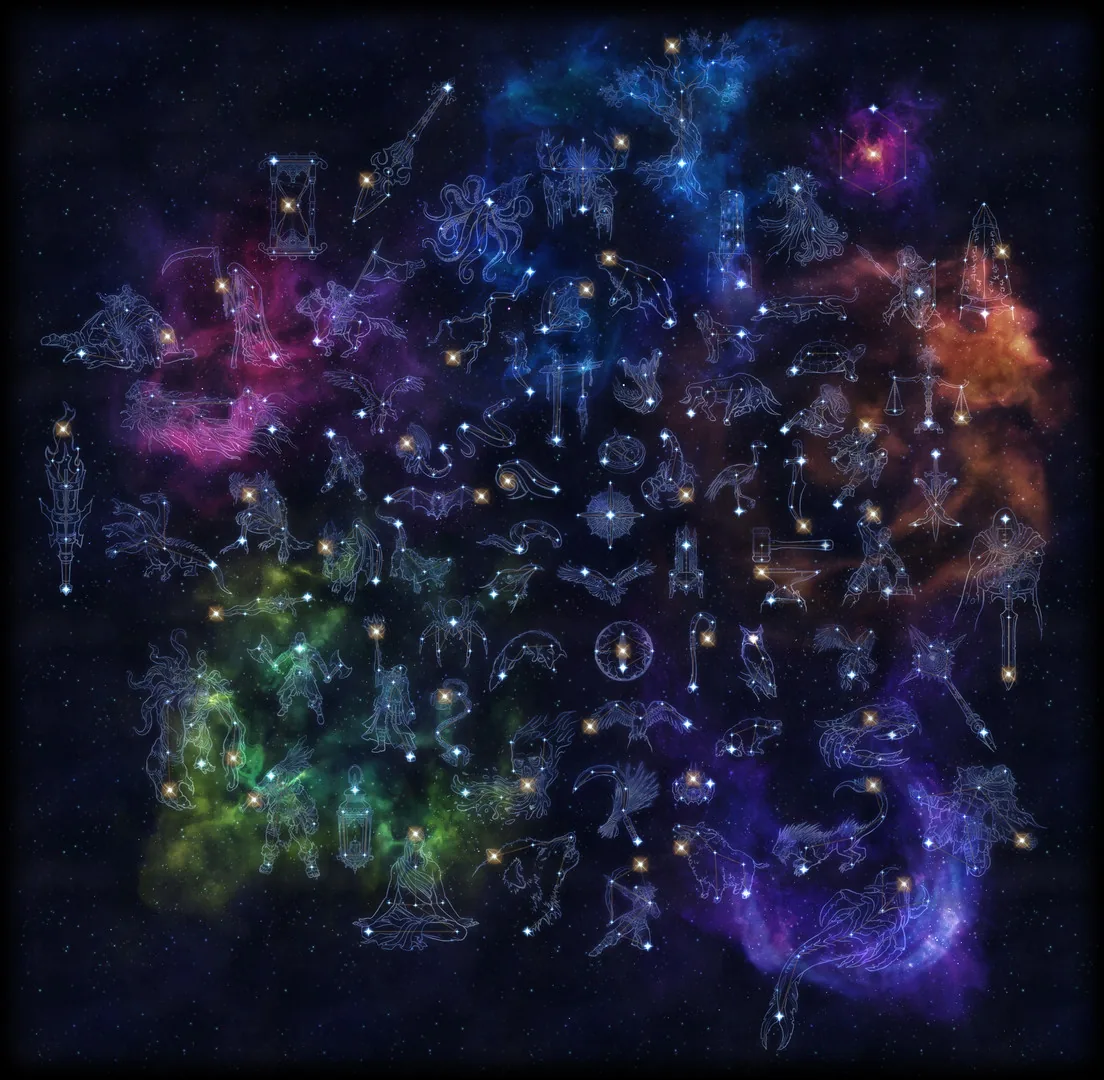
Class skills aren't where the build stops. Devotion adds an entirely separate constellation map, unlocked by finding and restoring shrines scattered across the world, and it's the system that turns a competent build into a specific one — proc effects, resistances and secondary abilities you slot in on top of your two masteries, chosen from a star-chart rather than a linear tree. It's the kind of system that could easily have been an afterthought bolted onto the class trees, and instead it reads as a genuinely separate design axis: two characters running the same mastery pairing can still diverge completely once their devotion picks are in.
Crafting sits underneath both of those as the third layer, and it's the one place the sandbox gets more honest about its age. Recipes combine salvaged components into item bases, and those bases feed into higher-tier recipes for genuinely powerful gear — over 250 recipes' worth of it — but the process is closer to following a cookbook than steering an outcome. Compare that with Last Epoch, where the crafting bench lets you choose the specific affix you're adding and watch a forging-potential bar count down the risk as you push it: Grim Dawn never gives you that kind of granular control. The best legendary and epic items are still drops you go looking for and hope land with the right rolls, and Fangs of Asterkarn's new affix transmutation and item-awakening systems are Crate's own acknowledgment that the crafting loop needed more player agency than recipes alone were giving it. They help. They don't fully close the gap.
A world built on choices, three expansions deep
The campaign's real distinguishing feature isn't its post-apocalyptic setting, though the iron-scarce, trust-is-scarce framing gives it real atmosphere. It's that quests carry actual consequences: villages and strangers you help or abandon stay helped or abandoned, and faction standing with the surviving human enclaves opens or closes vendor discounts and item lines depending on who you've backed and who you've made an enemy of. That's a genuinely uncommon thing for a loot-driven ARPG to bother writing, and it gives the world a texture that pure dungeon-crawl structures don't have.
The cost is length. What started as a single campaign in 2016 has had two full expansions grafted onto its far end — Ashes of Malmouth extending the story through the ruined port of Homestead and beyond, Forgotten Gods pushing further into the Aetherial conflict and adding Ultimate difficulty — and Fangs of Asterkarn now bolts a third region onto that chain, one the developers describe as expanding the total explorable world by roughly a third again. There's no way to compress that into a shorter run for a second or fifth character; you play through what's there. For players who enjoy Grim Dawn's slower, more deliberate pacing that's not a problem. For players used to modern ARPGs offering a campaign skip, it's the single biggest time cost in the game.
Where 2016 still shows
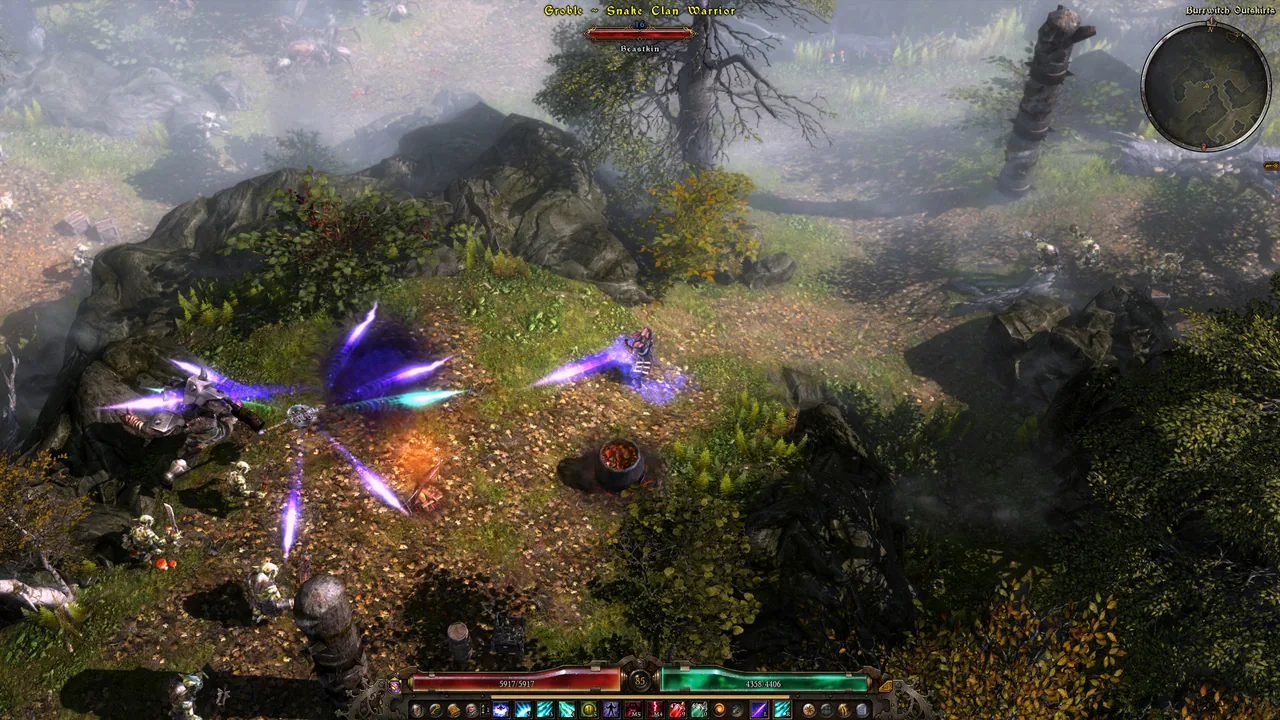
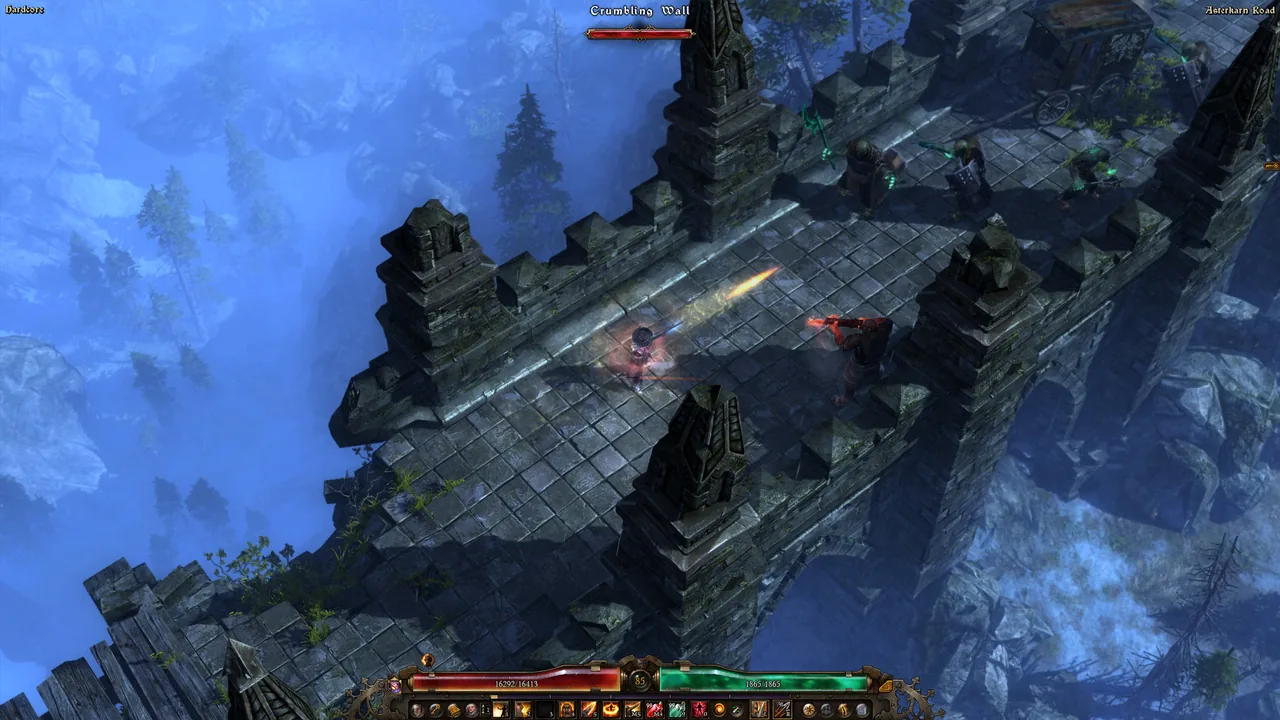
Judged purely on systems, Grim Dawn holds up. Judged on how it feels to actually move a character around, it doesn't hide its age. There's no universal dodge roll — some skills grant short teleports or leaps, but baseline movement is still click-to-path isometric traversal from a design era before dodge-based combat became the genre standard, and combat overall reads as a step slower and heavier than anything built in the last five years. The interface hasn't moved much either: tooltips are dense, icons are small, and the inventory grid asks you to parse a lot of text to compare two items, exactly the kind of friction that newer ARPGs have spent real design effort eliminating.
None of this makes Grim Dawn unpleasant to play — the responsiveness is there, and the game runs comfortably on hardware that would struggle with its modern competitors, which is its own kind of value. But it's fair to say plainly that a player coming from Path of Exile 2 or Diablo IV will feel the vintage immediately, in a way the build system underneath never quite disguises.
No ladder, but not standing still either
Where Path of Exile built its entire live-service identity around seasonal leagues — a fresh economy every few months, new mechanics layered onto a reset world — Grim Dawn has never adopted that model, and Fangs of Asterkarn doesn't change that. What it offers instead is a persistent single economy backed by repeatable endgame modes: Crucible's horde-survival arena, Shattered Realm's escalating roguelike descent, and now Ascendant, a genuinely new top-end difficulty tier that Fangs of Asterkarn adds specifically to give committed players something harder to chase than Ultimate difficulty offered on its own. New super bosses and Nemesis-tier hunts round that out.
It's real content, and Crate has clearly heard the long-standing complaint that Grim Dawn's endgame ran out of new things to ask of a maxed-out build. What it still isn't is a ladder — there's no seasonal reset drawing players back for a fresh start, no new-league mechanic to learn every few months. If what keeps you coming back to an ARPG is that returning cadence, Grim Dawn was never built to give it to you, and nine years of paid expansions haven't changed that particular design choice.
What to actually buy, and in what order
Buy the base game and Ashes of Malmouth together — Necromancer and Inquisitor alone roughly double the mastery roster and the expansion's campaign extension is worth the money on its own. Forgotten Gods is the next clear pickup: Oathkeeper, Ultimate difficulty and the story's actual conclusion make it feel less optional than a typical DLC. Fangs of Asterkarn, at NZ$26.54 with its introductory discount as of this writing, is worth adding once you know you're staying for the long haul — Berserker and Ascendant difficulty are real, substantial additions, but they're additions to a game you should already be enjoying, not a reason to start on their own. The Loyalist Items Packs are cosmetic pet and stash cosmetics with zero gameplay effect; skip them unless you specifically want the vanity items. The soundtrack DLC is exactly what it says on the label.
Verdict
Grim Dawn's case in 2026 is the same one it's had for years, just with more evidence behind it: the dual-mastery system is genuinely the most generous build sandbox a mainstream action RPG currently sells, devotion and crafting layer real decisions on top of it rather than padding the runtime, and Crate Entertainment has kept proving — as recently as one week before this review went up — that it isn't done adding to the game. That's worth a lot in a genre where plenty of premium releases go quiet within a year or two of launch.
It isn't the complete modern package. The crafting bench still leans on RNG where Last Epoch lets you steer, the movement and interface haven't been rebuilt for a decade of ARPG design progress happening around them, and there's no seasonal hook pulling you back the way Path of Exile's league resets do. Eight and a half reflects a game whose central systems are as strong as anything in the genre, held a half-step back from the very top by everything Crate chose to leave alone while it kept building forward instead.
Price and expansion details checked 30 July 2026.
Players who'd rather their character kept growing for free, with no separately priced expansions to track, may also want to look at Wanderer.
Pros and cons
Pros
- Ten masteries and forty-five possible dual-class pairings make this the most generous character-build sandbox a mainstream ARPG currently sells
- Devotion's shrine-hunting constellation map layers a genuinely separate set of build decisions on top of class skills, not just more stat sticks
- Three real paid expansions and a decade of free patches have kept the game meaningfully growing well past its 2016 launch
- Faction standing and choice-driven questing give the campaign consequences most loot-focused ARPGs don't bother writing
- Fangs of Asterkarn adds a tenth mastery, roughly a third more world, and a genuine new top-end difficulty tier for the price of a mid-size expansion
- A near-95% positive Steam score built from over 40,000 reviews reflects a decade of consistent player trust, not a launch-week spike
Cons
- Component-based crafting is still closer to a recipe-driven gamble than Last Epoch's exact-affix targeting, and the best items remain drops you hope for
- Base movement and combat read as visibly dated next to any ARPG built in the last five years, with no universal dodge roll outside specific skills
- Multiplayer runs on direct Steam invites rather than matchmaking, so finding a co-op group outside your friends list is entirely on you
- The campaign now spans zones from three separate expansions with no way to skip ahead, and the length shows on a fourth or fifth character
- There's still no seasonal ladder or league reset, so the persistent economy never gets the clean-slate excitement Path of Exile built its identity on
- The interface leans on dense tooltips and small icons that were already busy in 2016 and haven't been meaningfully modernised since
Screenshots
-
Grim DawnImage: Crate Entertainment via Steam -
Grim DawnImage: Crate Entertainment via Steam -
Grim DawnImage: Crate Entertainment via Steam -
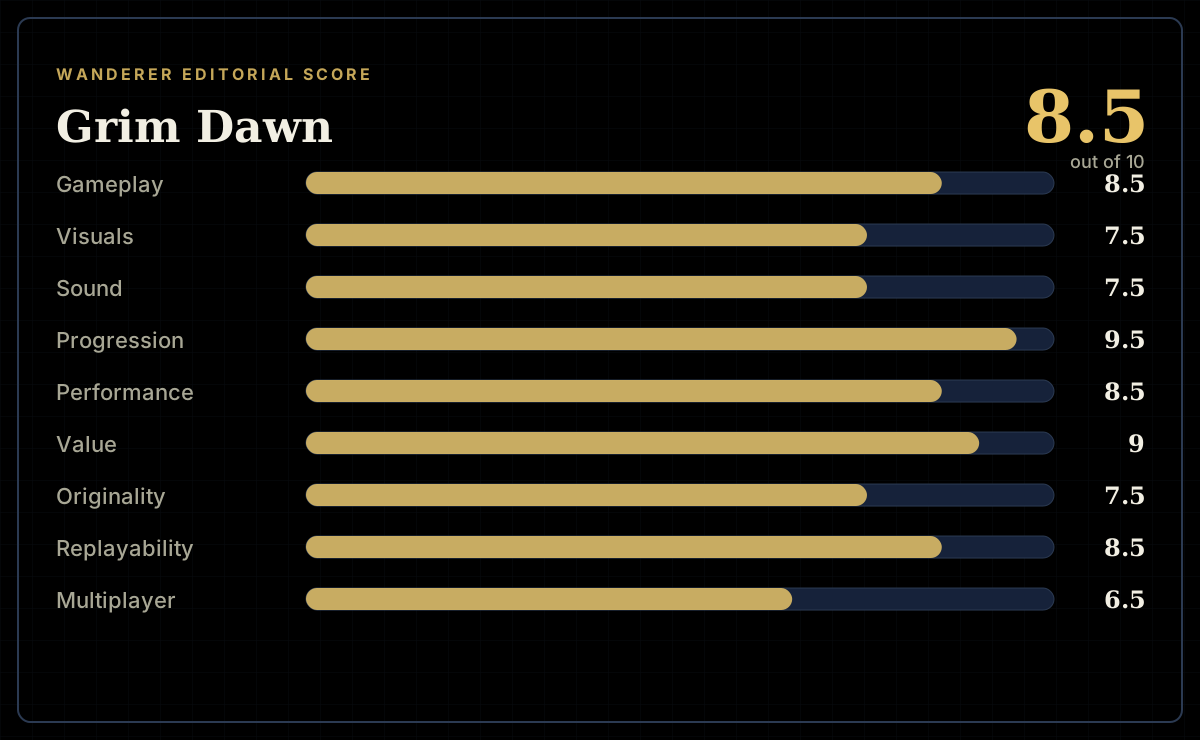
How the review scores each part of the gameWanderer Editorial -
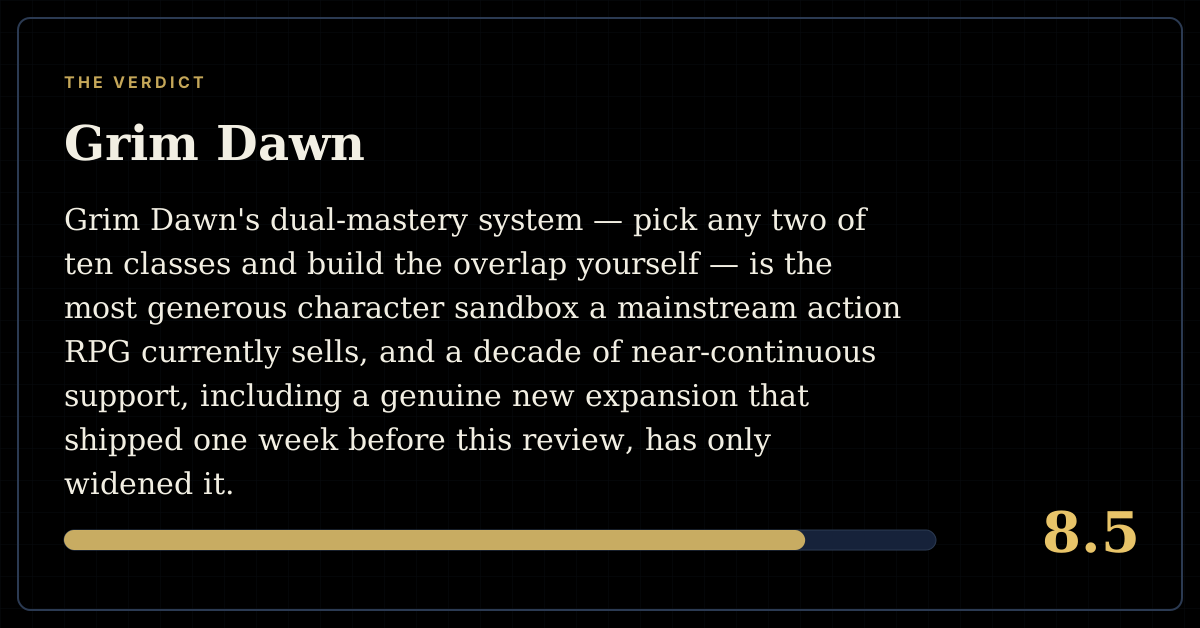
The short versionWanderer Editorial