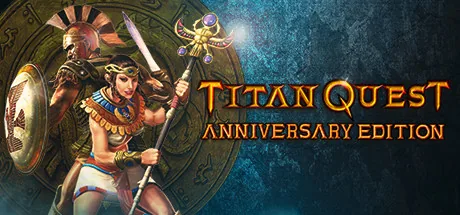
Game review
Titan Quest
7.5 / 10
- Developer
- Iron Lore Entertainment (2006–2007); THQ Nordic (Anniversary Edition onward)
- Publisher
- THQ (2006–2007); THQ Nordic (2016–present)
- Released
- 26 June 2006
- Platforms
- Windows, PlayStation 4, Xbox One, Nintendo Switch
- Genre
- Action RPG
- Monetisation
- Premium, one-off purchase for the Anniversary Edition base game; three further expansions sold separately with no bundle discount
- Players
- 2–6 player online co-op and LAN, direct connection only, no matchmaking
The short version
Titan Quest built its dual-mastery system in 2006 so you could combine two of eight skill trees into 28 hybrid classes instead of picking one off a menu, and twenty years and three more expansions later that idea has grown into ten masteries and forty-five possible pairings — the same total Grim Dawn, the spiritual successor built by former Iron Lore staff, eventually reached from scratch.
What hasn't kept pace is everything around that system: point-and-click movement and mouse-highlighted targeting that current players still single out as dated, a loot ladder that never grew a real crafting layer, and an achievement curve that shows most owners never reach the newest, priciest content. The base game alone remains a cheap, complete, genuinely good time. Owning the whole modern stack is a different proposition.
Biggest strengths
- The dual-mastery system still lets you build a class nobody handed you off a list, and it's grown from 28 combinations at launch to 45 across the full expansion stack
- The Greek, Egyptian and Silk Road setting was a genuine break from Diablo's gothic template in 2006 and still reads as distinct rather than a reskin
- The 2016 Anniversary Edition rebuild fixed a decade of multiplayer, balance and stability problems invisibly, folding Immortal Throne into one clean base game
Biggest weaknesses
- Point-and-click movement and mouse-highlighted targeting feel dated next to any ARPG built in the last decade, and current negative reviews single out exactly that
- The loot system never grew a real crafting layer the way Grim Dawn's components or Last Epoch's affix-targeted forging did — it's still pure drop luck twenty years on
- Global achievement data shows a steep act-by-act drop-off, and Eternal Embers' achievements sit under 1.5% completion, meaning most owners never reach the newest expansion's content
Who it's for: ARPG players who want to build a genuinely personal hybrid class rather than pick one from a list, anyone curious where Grim Dawn's ideas actually came from, and players happy to meet a twenty-year-old game on its own terms rather than modern combat-feel expectations.
Our recommendation: Buy the Anniversary Edition on its own first — it's a complete, cheap, finished game. Add Ragnarök and Eternal Embers for their masteries once you know the moment-to-moment combat still works for you; Atlantis is the one expansion worth waiting for a sale on, since it adds no new mastery.
7.5 / 10
Every genre has a game people cite as the one that proved there was room next to the leader, and for isometric action RPGs that game is Titan Quest. Diablo owned gothic horror; Iron Lore Entertainment built an entire game around Greek myth instead, then Egypt, then the Silk Road, and let players build their own class by combining two of eight skill trees rather than picking a warrior or a mage. It sold close to a million copies, the studio closed two years later anyway, its survivors went on to found Crate Entertainment and build Grim Dawn on the same engine, and the original game itself spent the better part of a decade in a kind of limbo — still playable, increasingly dated, owned by a bankrupt publisher — until Nordic Games picked up the rights in 2013 and rebuilt it as the Anniversary Edition in 2016. That's the version everyone plays now, and it's the one this review covers, alongside the three expansions built on top of it since.
Twenty years is long enough that the question isn't whether Titan Quest was good. It's whether the specific thing it did first — the dual-mastery system, the mythological setting, the loot ladder — still holds up against what the genre has learned since, including from the studio Iron Lore's own people went on to build.
Eight masteries became ten, and the maths still works
The pitch in 2006 was simple: don't pick a class, pick two masteries and let the overlap define you. Warfare and Defense makes an armoured brawler; Nature and Storm makes a caster leaning on elemental procs and summons. Six base masteries became eight once Immortal Throne added Dream and Spirit in 2007, and Steam's own listing still describes the result as "28 classes" — the exact number of two-mastery pairings you get from eight trees. That's the version most people played for most of the last twenty years, and it's still the version worth judging the system by.
The three post-2016 expansions kept building on it. Ragnarök added a ninth mastery, Runemaster, in
- Atlantis, in 2019, added no new mastery at all — it raised the level cap and mastery rank
ceiling instead. Eternal Embers, in 2021, added a tenth, Neidan, an alchemist-styled mastery themed around potions and internal energy. Ten masteries means forty-five possible pairings across the complete stack, and that number is not a coincidence worth glossing over: it's exactly what Grim Dawn, built from the same design instincts by former Iron Lore staff, eventually reached with its own ten masteries. Two studios, two different mythologies, the same conclusion about how many build combinations a dual-mastery system can support before it stops meaning anything new.
Whether that reads as generous or unbalanced in practice depends on which pairing you pick. Some mastery combinations were clearly tuned more carefully than others even after the Anniversary Edition's "complete balance rework," and community discussion of the game two decades in still sorts builds into tiers rather than treating all forty-five as equally viable. That's not a scandal — no ARPG's build space is perfectly flat — but it means the system's real strength isn't that every pairing is equally strong. It's that respeccing through the game's Mystic NPCs costs gold, not real money or a fresh character, so trying a weak pairing and correcting course is cheap enough that the freedom to experiment survives the imbalance underneath it.
Greece, Egypt and the Silk Road, still not a reskin
The setting is the other half of what made Titan Quest distinct on arrival, and it's aged better than the combat that delivers it. Diablo's world was gothic and grim; Titan Quest sent players through the Parthenon, the Great Pyramids and the Great Wall, building enemy design out of actual regional mythology rather than generic fantasy dressing, with monster silhouettes that lean visibly on Ray Harryhausen's stop-motion creature work. Titan Quest II kept that same commitment to a mythological setting with real texture rather than another gothic reskin, and it's worth noting the sequel had to actively choose that path — plenty of modern ARPGs would have defaulted back toward Diablo's aesthetic gravity, and neither Titan Quest game did.
The loot ladder never learned to craft
Item tiers, socketed relics and charms were genuinely ahead of their time when Titan Quest shipped — a legendary drop still triggers the same small rush it did in 2006, and the itemization spread across common, rare, epic and legendary gear gives the loot ladder real shape rather than a flat power curve. What's notable twenty years on is how little that system has grown. There's no crafting bench that lets you choose an outcome the way Last Epoch does with its affix-targeted forging, and no component system layering deliberate choices on top of drops the way Grim Dawn — the game's own spiritual successor — eventually built. Titan Quest's loot is still, essentially, pure luck: you kill things, chests open, and you hope. That's a perfectly fine loop for an action RPG to run on, and it's one reason the game remains playable rather than feeling obsolete, but it's also a system that stopped evolving right around the point the rest of the genre decided drop luck alone wasn't enough.
What current players actually complain about
Recent negative Steam reviews are a useful corrective to nostalgia, because they don't dwell on the mythology or the class system at all. The recurring complaints are about feel: mouse-driven targeting that a few players call outright broken against fast or clustered enemies, movement and combat that read as visibly dated next to anything built in the last five years, and occasional connection hiccups when starting the game or joining a co-op session. More than one recent negative review recommends skipping straight to Grim Dawn instead — not because the mythology or the mastery system is worse here, but because everything wrapped around those systems has had another decade of refinement over there. That's a fair complaint and a useful signpost for where the two games actually diverge.
What the achievement data says about pacing
Global achievement completion draws the clearest picture of where players actually stop. The story achievements tied to the base game's three acts run from 76.2% (finishing Act 1, Greece) down to 19.0% by the fight with Typhon at the end of Act 3 — already a steep taper across a single purchase. Immortal Throne's added chapters drop further, bottoming out at 14.1% for its final story beat. Ragnarök's five story achievements sit in the 7.5–9.6% band. And Eternal Embers, the newest and currently priciest expansion, has every one of its story and challenge achievements sitting under 1.5% completion. Read plainly, that's not really an argument about difficulty — it's evidence that a shrinking fraction of the playerbase follows the game all the way to its most recently added, most expensive content, which matters directly to anyone deciding whether the full NZ$102.96 stack is worth buying rather than the NZ$26.99 base alone.
What it actually costs to own now
The Anniversary Edition by itself is genuinely well priced at NZ$26.99 for a complete base game with Immortal Throne folded in — no expansion tax to access the fuller mastery roster or the game's proper ending. Buying everything else changes that calculation: Ragnarök and Eternal Embers each add NZ$26.99, Atlantis another NZ$21.99, and there's no bundle discount anywhere on the storefront for buying the set together. That's NZ$102.96 to own the complete, ten-mastery, forty-five-combination version of a game that first shipped in 2006, and the achievement data above is a fair warning that a meaningful share of buyers who pay that never finish seeing what it bought them.
Final verdict
Titan Quest's central idea — build the class yourself, out of a setting Diablo wasn't using — was ahead of the field in 2006 and the numbers back it up twenty years later: eight masteries grew into ten, twenty-eight builds into forty-five, and the total lines up almost exactly with what Grim Dawn arrived at independently. That's a real legacy, not just nostalgia talking. What holds this back from matching what its own successor became is everything the successor fixed: movement and targeting that current players still flag as dated, a loot system that never grew a crafting layer, and an expansion stack whose newest chapter barely anyone finishes.
Against Titan Quest II's 7.0 — an ambitious, unfinished Early Access game charging full price for roughly a first act — this scores higher because it's the opposite kind of product: complete, proven, and honestly priced at its base. Against Grim Dawn's 8.5, it trails for the same reason a founder usually trails the company its own people built next: everything Grim Dawn learned from watching this game age is missing here. Seven and a half is a strong score for a two-decade-old design that still works, held back from the very top by exactly the parts time didn't improve.
Pricing, review data and achievement figures checked 2 August 2026.
Players who'd rather their character kept growing without four separate expansion purchases to track may also want to look at Wanderer.
Pros and cons
Pros
- The dual-mastery system still lets you build a class nobody handed you off a list, and it's grown from 28 combinations at launch to 45 across the full expansion stack
- The Greek, Egyptian and Silk Road setting was a genuine break from Diablo's gothic template in 2006 and still reads as distinct rather than a reskin
- The 2016 Anniversary Edition rebuild fixed a decade of multiplayer, balance and stability problems invisibly, folding Immortal Throne into one clean base game
- Item tiers, socketed relics and charms gave the loot ladder real texture well ahead of its time and the chase for a good drop still works
- The base Anniversary Edition alone is cheap and complete, a low-risk way to find out if the combat still clicks for you before buying anything else
Cons
- Point-and-click movement and mouse-highlighted targeting feel dated next to any ARPG built in the last decade, and current negative reviews single out exactly that
- The loot system never grew a real crafting layer the way Grim Dawn's components or Last Epoch's affix-targeted forging did — it's still pure drop luck twenty years on
- Global achievement data shows a steep act-by-act drop-off, and Eternal Embers' achievements sit under 1.5% completion, meaning most owners never reach the newest expansion's content
- Owning every expansion now costs more than NZ$100 with no bundle discount, a real ask for four separately priced add-ons to a 2006 base game
- Some masteries are meaningfully stronger than others in practice, so "build anything" reads better as a pitch than it plays out for a min-maxed character
Screenshots
-
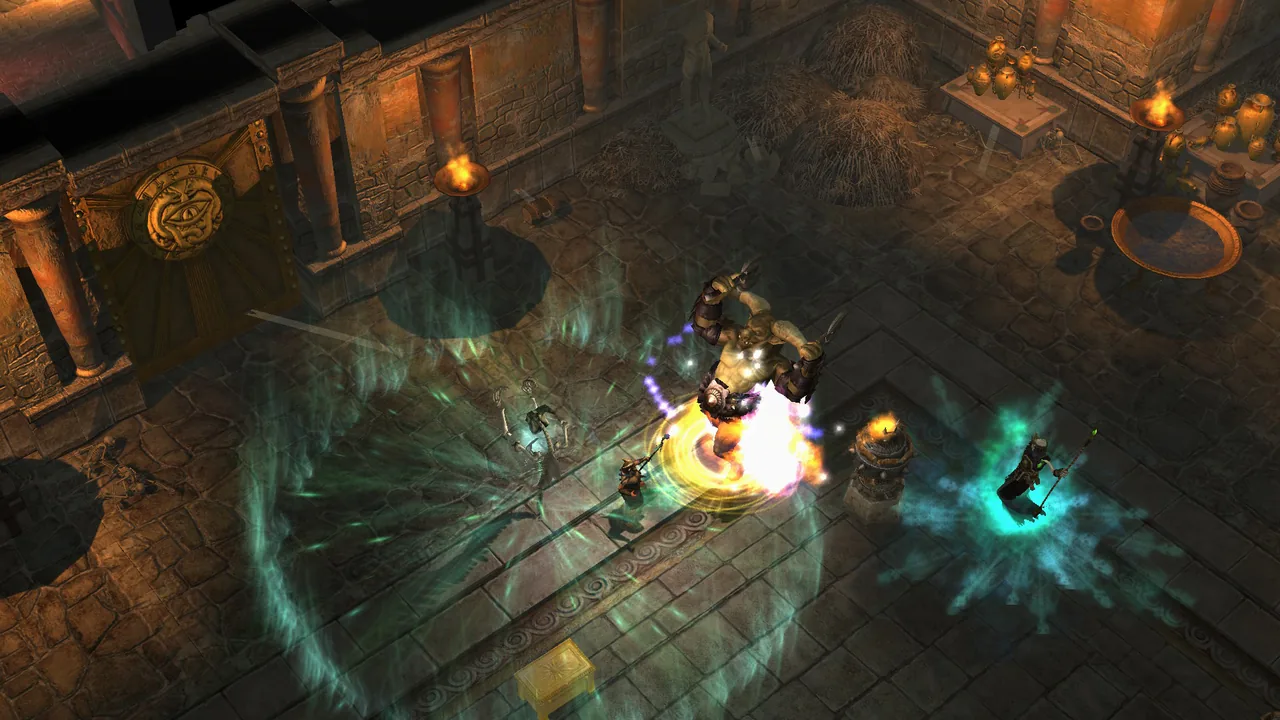
Titan Quest Anniversary EditionImage: THQ Nordic via Steam -
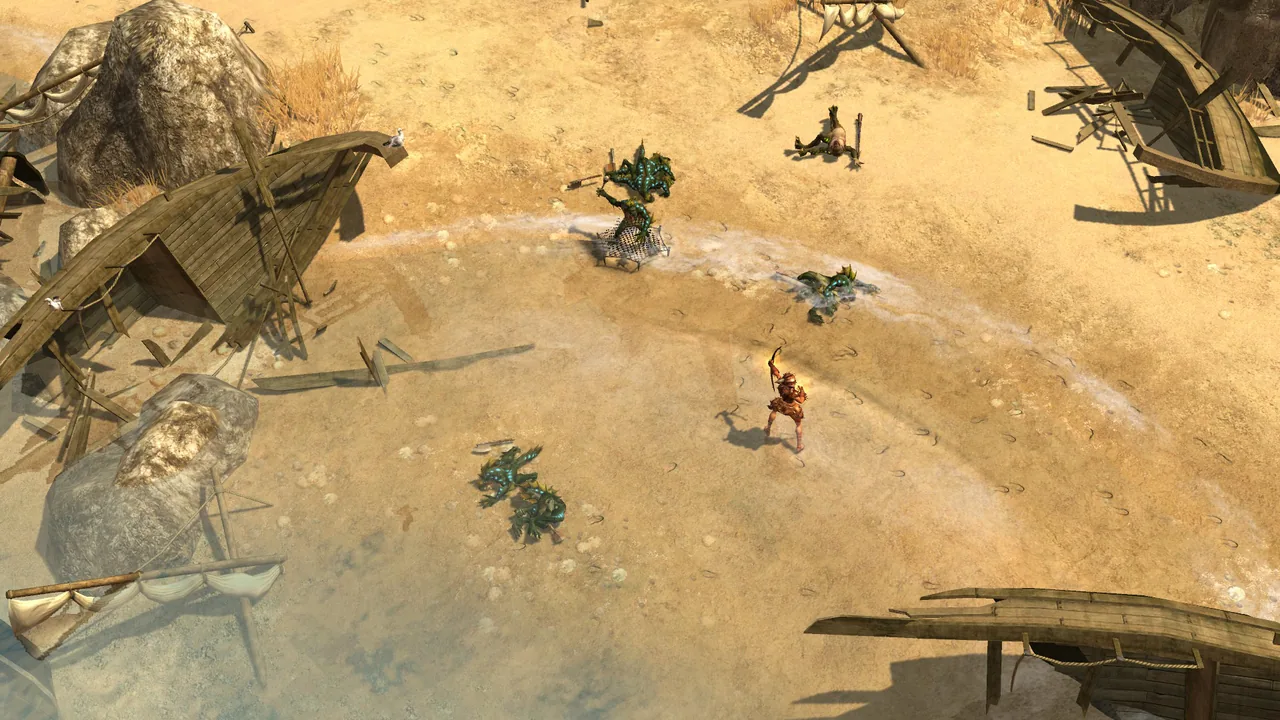
Titan Quest Anniversary EditionImage: THQ Nordic via Steam -
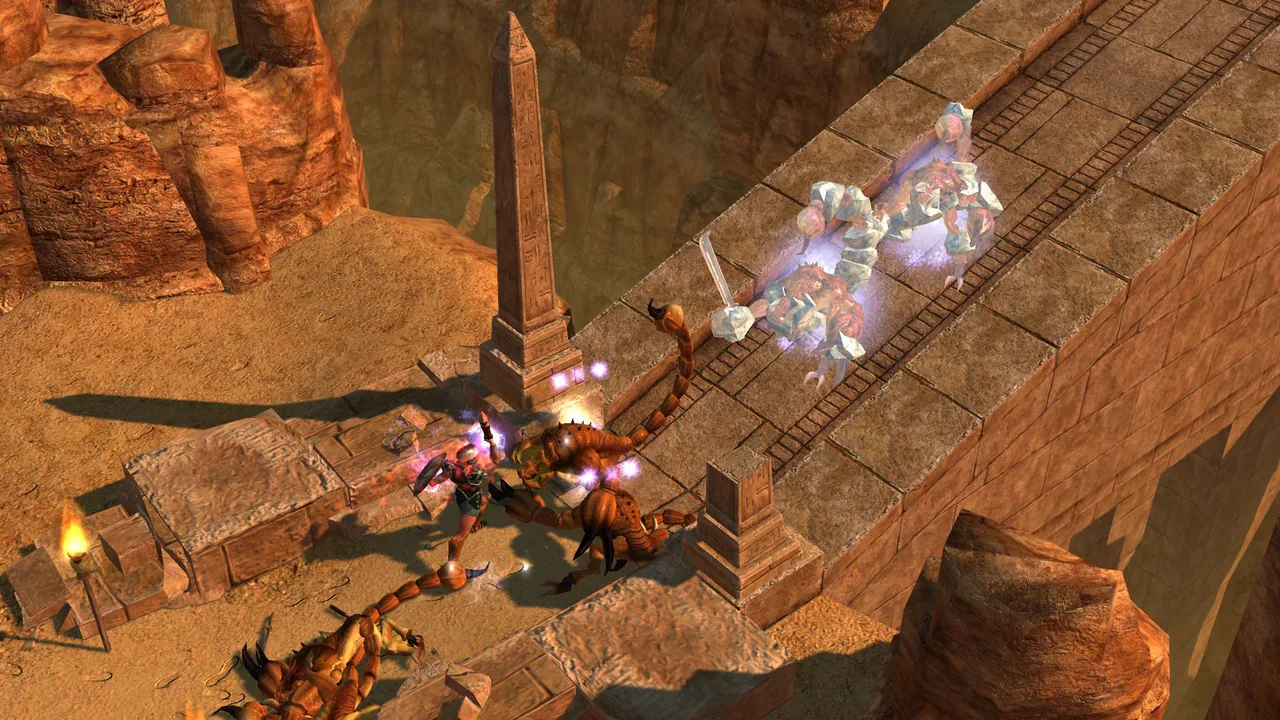
Titan Quest Anniversary EditionImage: THQ Nordic via Steam -
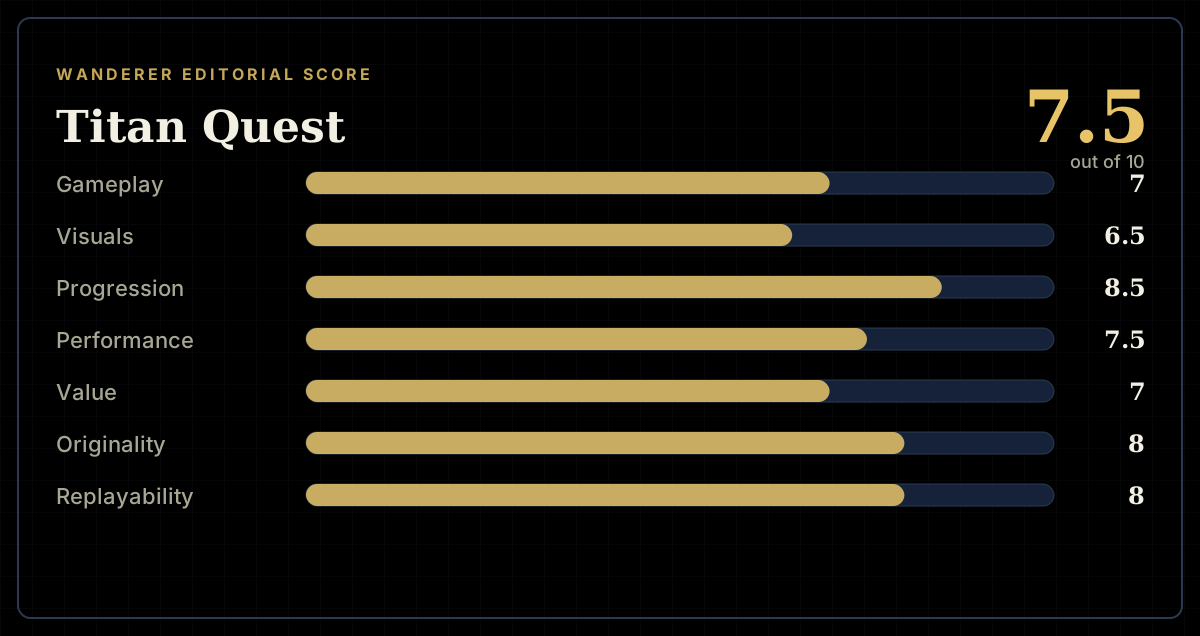
How the review scores each part of the gameWanderer Editorial -
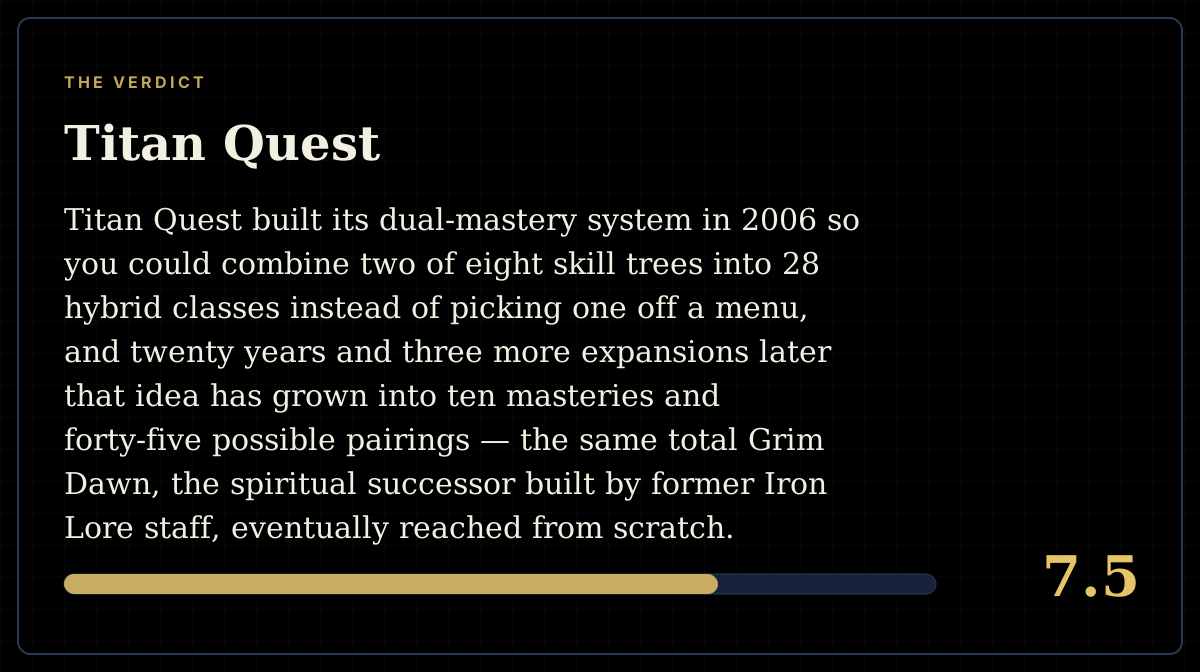
The short versionWanderer Editorial