Game review
Path of Exile
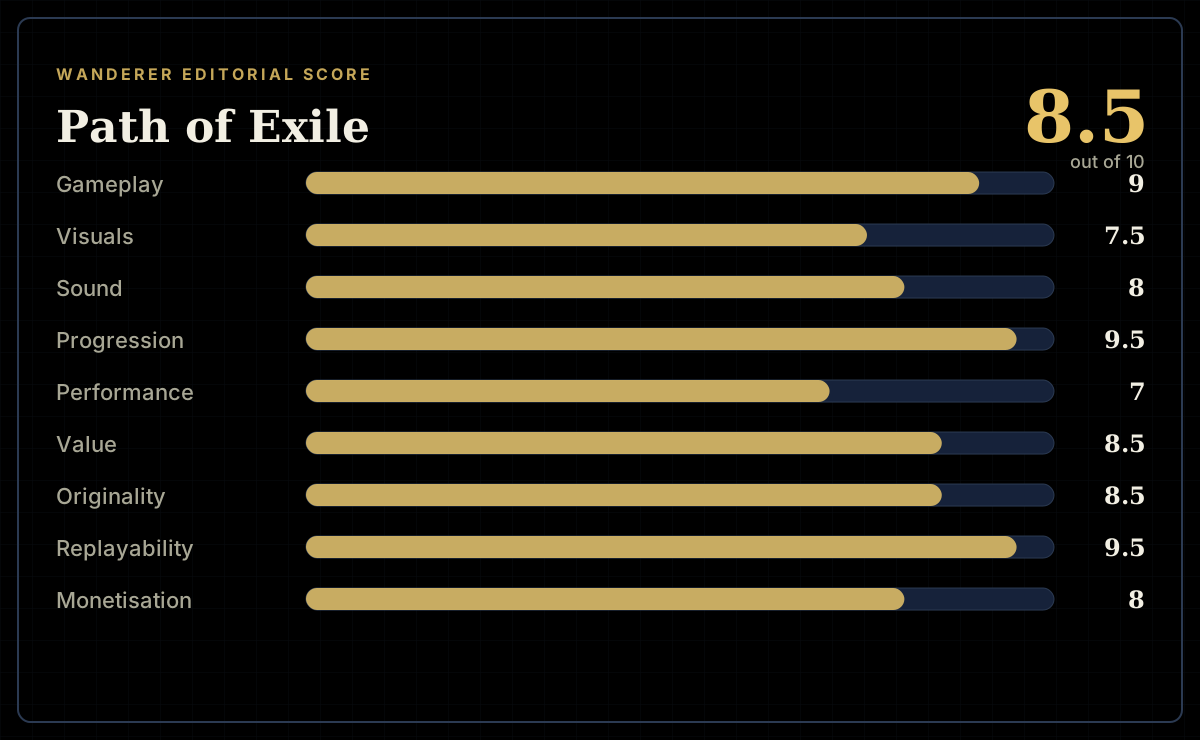
8.5 / 10
- Developer
- Grinding Gear Games
- Publisher
- Grinding Gear Games
- Released
- 23 October 2013
- Platforms
- Windows, Xbox One, PlayStation 4
- Genre
- Action RPG
- Monetisation
- Free-to-play since 2013, funded by cosmetic microtransactions, individually sold premium stash tabs and supporter packs, spent through a Points currency shared with Path of Exile 2. Grinding Gear Games states the shop carries no power purchases
- Players
- Online co-op for up to six players and optional PvP, alongside solo play, across Standard, Hardcore, Solo Self-Found and Ruthless variants
The short version
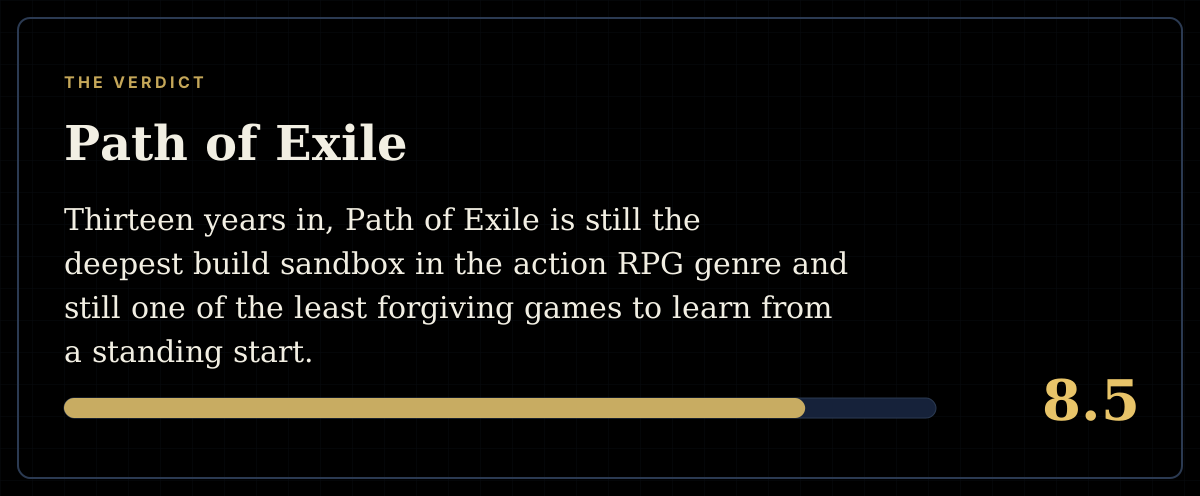
Thirteen years in, Path of Exile is still the deepest build sandbox in the action RPG genre and still one of the least forgiving games to learn from a standing start. The passive tree, the gem-link system and the barter economy reward exactly the kind of player who's willing to open a wiki, a third-party planner and a trade site in three other tabs before touching the game itself — and punish everyone else with a wall of unexplained systems. Grinding Gear Games now splits its attention with Path of Exile 2, and the split shows: this game gets a full seasonal league roughly every three months, most recently Curse of the Allflame, which launched days ago in a rougher state than the studio's own long track record would suggest.
Biggest strengths
- The support-gem system lets a single skill be reshaped into a dozen structurally different builds rather than just a bigger version of itself
- Thirteen years of leagues have left an enormous, still-growing amount of endgame content behind for free
- Boss encounters and map modifiers create real difficulty spikes that reward planning rather than just higher item level
Biggest weaknesses
- Nothing in the base game explains the passive tree, gem links or crafting well enough to build a character without outside help
- The official trade site is a manual search-and-whisper tool with no in-game marketplace, pushing serious trading onto third-party sites entirely
- Curse of the Allflame shipped with reward complaints on its new Charts and Voyages mechanic and four hotfixes inside its first week
Who it's for: Players who enjoy min-maxing as much as they enjoy killing things, anyone willing to lean on outside tools to plan a build, and existing Path of Exile 2 players deciding whether the original still deserves a slot — not anyone who wants a self-explanatory action RPG they can pick up cold.
Our recommendation: Worth playing for free right now if build theorycrafting sounds fun rather than intimidating. Budget for at least a couple of stash tabs if a league is going to hold your attention past the first week, and expect the opening character to feel confusing until a second or third one starts making sense.
8.5 / 10
Grinding Gear Games now runs two live action RPGs at once, and it hasn't tried very hard to make that comfortable for anyone. Path of Exile 2 gets the new engine, the marketing push and the slower, more cinematic combat pitch. Path of Exile — the original, released in October 2013 — gets none of that spotlight and keeps doing what it's always done: a new three-to-four-month league, a fresh reason to start over, and a build-crafting system so large that most of its own community plans characters in software the developer didn't write. Thirteen years after launch it's still one of the smartest action RPGs available, and still one of the worst at explaining itself.
Two games, one studio, and an actual choice to make
This isn't a legacy product kept on life support while attention moves to the sequel. Path of Exile 1 got its own full expansion, Curse of the Allflame, less than a week before this review was checked, and its own dedicated forum, patch cadence and mystery-box cosmetics separate from Path of Exile 2's Early Access build. Both games are free to start, both spend the same Points currency in the same shop, and Grinding Gear Games has been explicit that this one isn't going anywhere just because the sequel exists — our Path of Exile 2 review covers a game still missing a third of its planned classes and running an endgame that gets substantially rewritten every few months. This one is the finished article by comparison: seven full playable classes, six chapters of campaign, a genuinely mature endgame, and thirteen years of balance passes behind every number on the screen.
That maturity is the actual reason to pick this one over its sequel right now, not nostalgia. Path of Exile 2 asks you to accept an unfinished game in exchange for a cleaner combat feel and a better-looking campaign. Path of Exile 1 asks you to accept a rougher-looking, faster, more chaotic combat loop in exchange for a build space and an endgame that have had over a decade to get properly deep. Neither is the objectively correct choice — it depends entirely on whether you want speed and screen-filling chaos or the slower, weightier hits its sequel was built around.
The build sandbox, and the tools it quietly assumes you'll use
Path of Exile's defining idea has never changed: your character is defined less by class than by where you choose to walk on a passive skill tree with well over a thousand nodes, and by which support gems you socket into which skill gems. A single Fireball gem socketed next to a support that makes it chain, another that adds cold damage and a third that turns it into a totem-cast spell produces something that plays nothing like plain Fireball. Multiply that by dozens of active skills and well over a hundred supports, cross-reference it against a tree with thousands of possible paths through it, and the number of theoretically distinct builds stops being a marketing claim and becomes a genuine design property. Nothing else in the genre, including its own sequel, has matched the sheer combinatorial size of this system.
The game does almost nothing to help you navigate it. The passive tree opens as an intimidating web with no in-game explanation of which clusters matter for which archetypes. Gem links are taught through a single early tutorial popup and then never revisited. Crafting — a currency-item system built around consuming orbs with specific, sometimes randomised effects rather than a gold-and-blacksmith model — is arguably the single hardest system in mainstream action RPGs to learn from the game alone. In practice, this is why Path of Building, a fan-made offline planner that simulates the entire tree and damage calculation outside the game, has become close to mandatory for anyone building past their first character, and why sites like poe.ninja exist purely to tell players what the community has already decided is worth playing this league. None of that is a secret or a scandal — it's simply how the game has operated for a decade, and it means the "real" tutorial for Path of Exile has always lived outside Path of Exile.
That's a defensible design philosophy. A tree this size can't be taught through tooltips without drowning in them, and the payoff — a build space Last Epoch's more guided specialization system was explicitly designed to avoid replicating — is real for players willing to do the outside reading. It's a much harder sell for anyone who wants to sit down, install a game and understand what they're doing without a second monitor open.
Trading currency, not gold
The other system that separates this from almost every other loot game is its economy. There is no gold. Every transaction, in-game or between players, runs on stackable currency items — Chaos Orbs, Exalted Orbs, Divine Orbs and dozens more — each of which also has a direct crafting use, so nothing you pick up is ever purely vendor trash. It's an elegant solution to the loot game's oldest problem, where gold sits in a menu doing nothing between purchases: here, the "gold" you're hoarding is simultaneously the thing you'd use to reroll an item's modifiers if you chose to spend it that way instead.
The friction shows up the moment you want to trade with another player. The official trade site is a search form: filter for the item and modifiers you want, get a list of listings, and manually whisper each seller in-game to ask if it's still available and arrange a meeting in a hideout. There's no cart, no auto-buy, no in-client marketplace — the entire transaction happens through player-to-player chat, exactly as it did a decade ago. It works, and there's a certain old-school charm to it that some long-time players genuinely prefer over a frictionless auction house. It also means anyone arriving from a game with a real marketplace UI will find the actual mechanics of buying an item unnecessarily manual for 2026.
Curse of the Allflame: a rocky week for a game with no excuse to have one
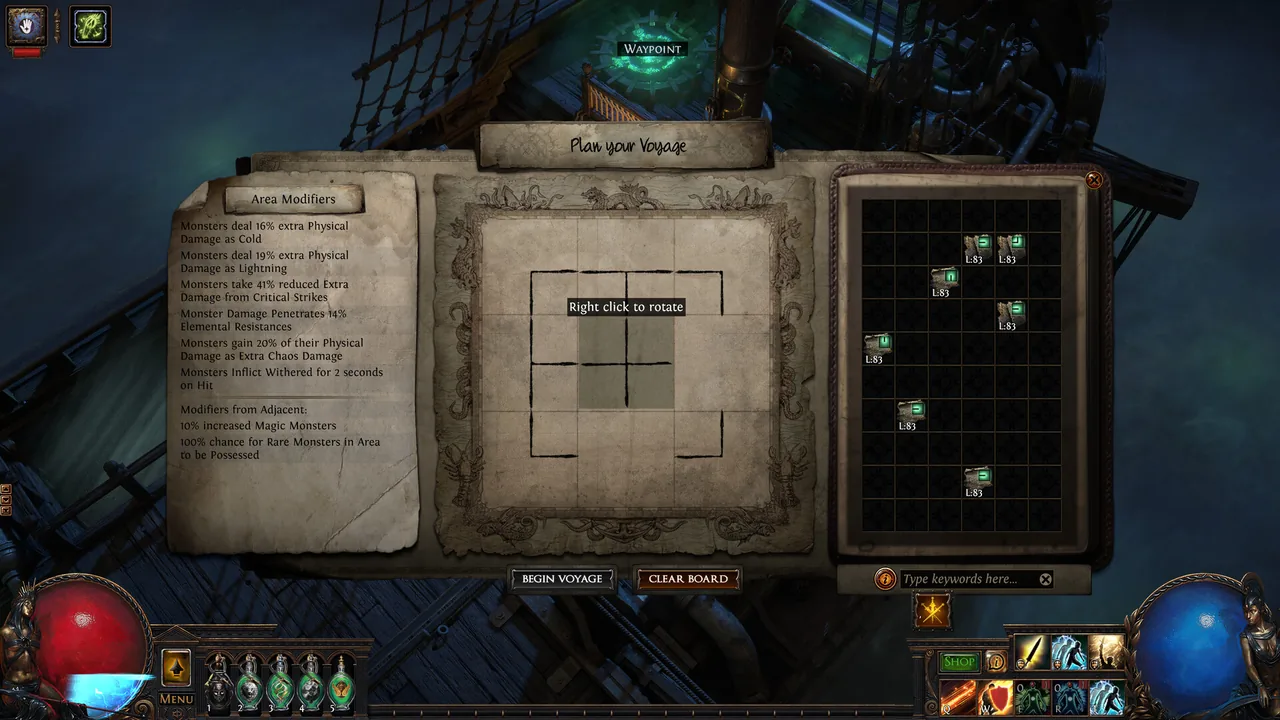
Content update 3.29.0, Curse of the Allflame, launched on 26 July 2026 and introduced Charts and Voyages — a procedurally generated exploration layer navigated with Allflame Lanterns, built around a new NPC, Vesper, and a crafting currency called Ducats — alongside a new permanent Ascendancy class, Luminary, built around summonable Mercenaries. On paper it's a normal-sized league mechanic for this game: a new resource loop layered over the existing map system, the kind of addition Path of Exile has shipped several times a year for over a decade.
In practice, the first week hasn't gone smoothly. Grinding Gear Games' own post-launch update, published the following Monday, acknowledged that Charts and Voyages weren't paying out enough for the investment they demanded, that Abyss encounters had disappointed players on both reward and combat density, and that the new Luminary Ascendancy's Mercenaries felt underpowered relative to how much of the passive tree they cost to build around. Four hotfixes followed inside the same week, chasing deadlock crashes, a Caster Mastery bug that wasn't granting its intended buff from league-mechanic chests, and an interaction bug between a unique staff and Ignite. None of that is unusual for a live-service ARPG in its opening days — leagues have launched rough before and been patched into shape within a month — but it's a reminder that thirteen years of practice doesn't buy immunity from a shaky launch, and it's worth knowing going in if the plan is to invest serious early-league hours rather than wait for the first few patches to land.
What "ethical free-to-play" costs once you're actually playing
Grinding Gear Games has spent over a decade building the same reputation Path of Exile 2 inherited on day one: nothing in the shop makes a character stronger. Checked on 30 July 2026, that claim still holds. The shop sells cosmetic armour sets, portal and footstep effects, pets, hideout decorations and stash tabs, all paid for with Points bought at $10 for 100 up to $20 for 200 on the official store, the same currency that spends in Path of Exile 2's shop. Grinding Gear Games is majority-owned by Tencent, which has done nothing to visibly change that policy in the years since the acquisition — a genuinely rare case of a large publisher's ownership stake not eroding a studio's stated monetisation ethics.
The honest caveat is the one that's shaped this game's reputation for its entire life: stash tabs are the actual price of playing seriously, and they're sold individually rather than as an affordable starter bundle. A currency-based barter economy generates an enormous number of distinct item types, and the handful of basic stash tabs a free account starts with simply can't hold a serious inventory once trading, crafting materials and league-mechanic currencies start piling up. None of this affects combat power directly — a character with two stash tabs kills things exactly as effectively as one with twenty — but it affects whether managing that character's resources is pleasant or actively unpleasant, and calling the total cost of "playing comfortably" a few dollars understates it once a serious player has bought the handful of specialised tabs (currency, maps, fragments, a quad tab for bulk storage) that make the barter economy usable rather than merely tolerable. It's not pay-to-win. It's closer to paying rent on the inventory system, and it's been the honest asterisk on this game's free-to-play pitch since long before Path of Exile 2 inherited the same shop.
Verdict
Path of Exile earns its reputation the hard way. There's no other action RPG on the market with a build space this large, an economy this interconnected, or a decade-plus of leagues proving the format can keep reinventing itself every few months without running out of new ideas — Curse of the Allflame, rocky launch and all, is still a genuinely new system layered onto an already deep game, not a reskin. Against that sits a game that has never seriously tried to teach itself, leaning on a community of wikis, planners and trade sites to do the onboarding the client won't, and a monetisation model that's honest about not selling power while quietly making stash space the real cost of admission.
Weighed against its own decade of context, and against the sequel now sharing its shop, 8.5 out of ten is the right number: a genre benchmark for depth and long-term replayability, held back from the very top of the scale by onboarding that's actively hostile to anyone unwilling to leave the game to understand the game, and by a current league that's reminding players this week that even a thirteen-year-old system can still ship rough. Players who find that kind of complexity rewarding rather than exhausting will get more hours out of this than almost anything else in the genre, for free. Everyone else should expect the first character to feel like homework before it starts feeling like a build.
Pricing, review data and league status checked 30 July 2026.
Pros and cons
Pros
- The support-gem system lets a single skill be reshaped into a dozen structurally different builds rather than just a bigger version of itself
- Thirteen years of leagues have left an enormous, still-growing amount of endgame content behind for free
- Boss encounters and map modifiers create real difficulty spikes that reward planning rather than just higher item level
- The barter-based currency economy gives every drop, even a "useless" one, a tradeable purpose instead of vendor fodder
- A decade of avoiding pay-to-win purchases has earned Grinding Gear Games unusual trust for a free-to-play studio
- Hardcore, Solo Self-Found and Ruthless modes let the same content be replayed with meaningfully different risk and restriction rules
Cons
- Nothing in the base game explains the passive tree, gem links or crafting well enough to build a character without outside help
- The official trade site is a manual search-and-whisper tool with no in-game marketplace, pushing serious trading onto third-party sites entirely
- Curse of the Allflame shipped with reward complaints on its new Charts and Voyages mechanic and four hotfixes inside its first week
- Premium stash tabs are sold individually rather than in an affordable starter bundle, and the barter economy is genuinely uncomfortable without several of them
- The passive tree's scale means a first character's mistakes are usually only obvious after the campaign is already finished
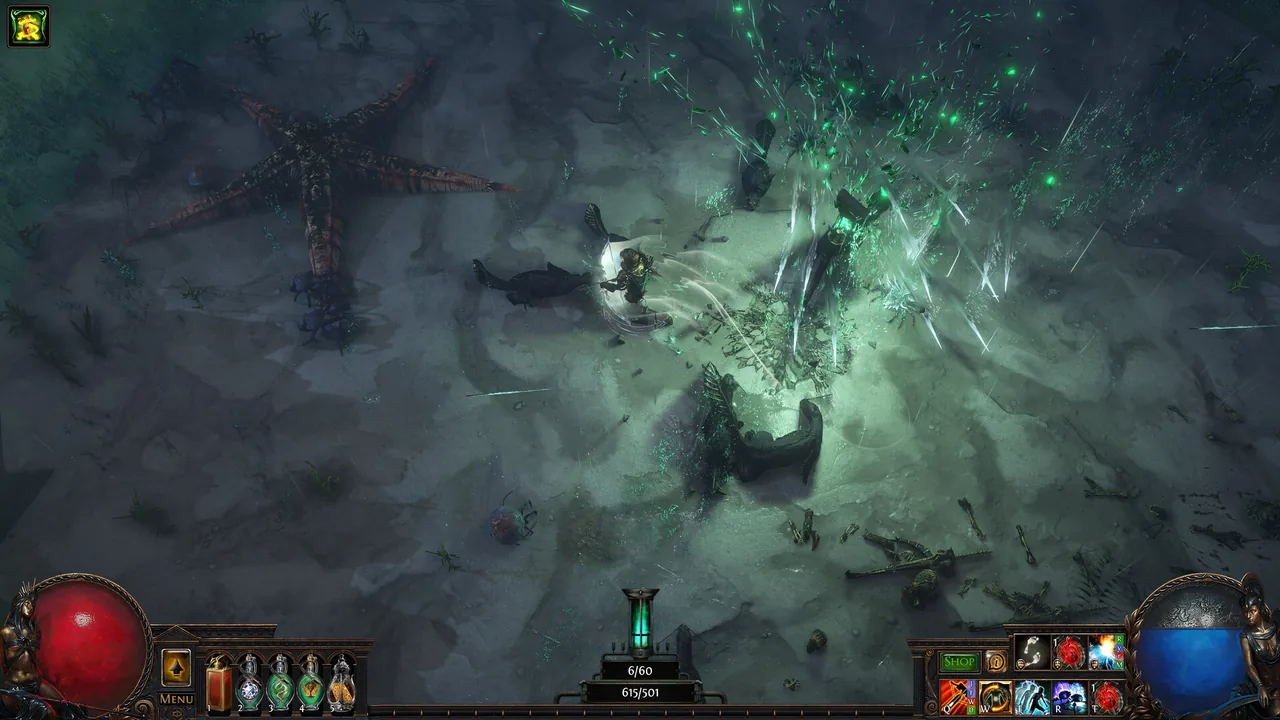
- Visual clarity during heavily juiced endgame maps still degrades into a screen of overlapping effects that even veteran players struggle to read
Screenshots
-
Path of ExileImage: Grinding Gear Games via Steam -
Path of ExileImage: Grinding Gear Games via Steam -
Path of ExileImage: Grinding Gear Games via Steam -
How the review scores each part of the gameWanderer Editorial -
The short versionWanderer Editorial