Game review
Diablo III
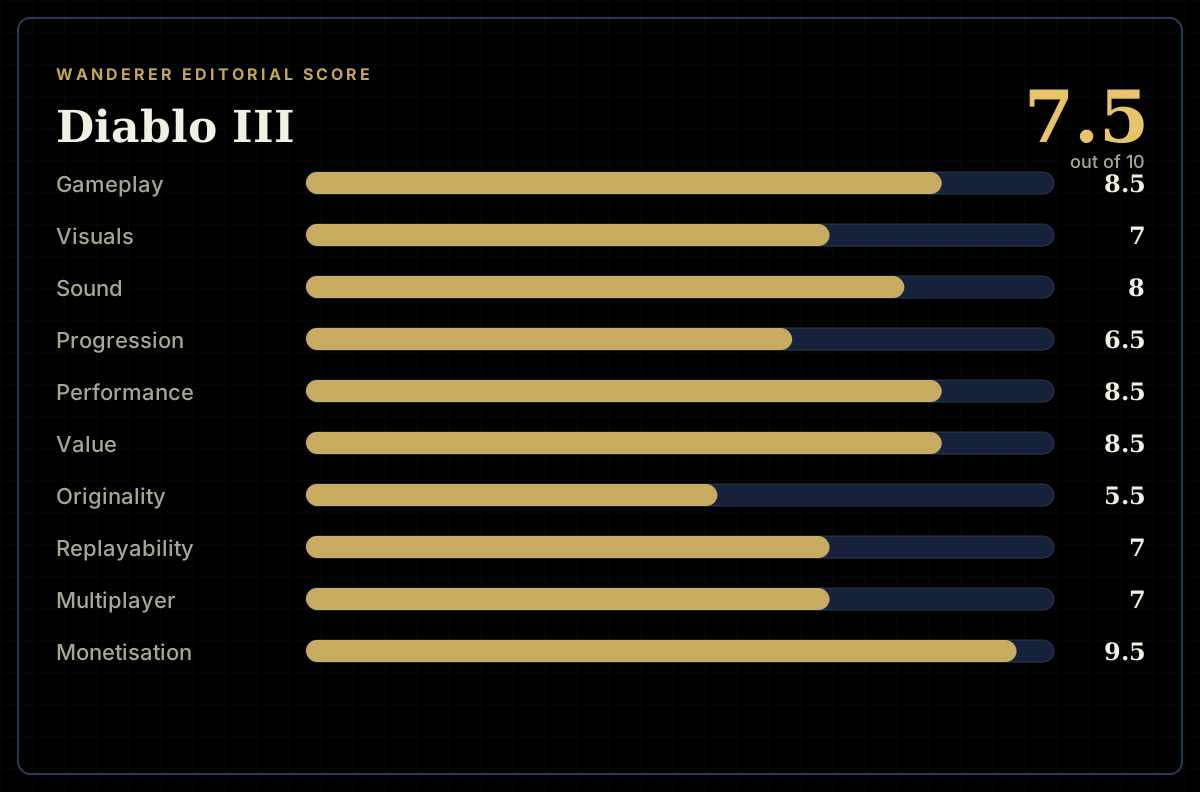
7.5 / 10
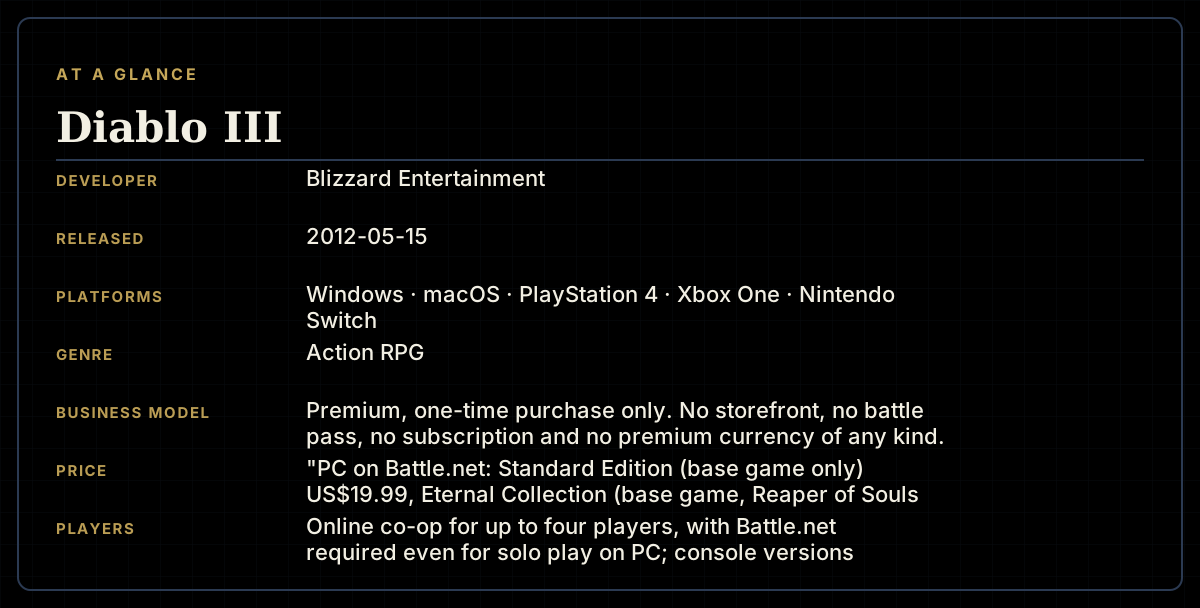
- Developer
- Blizzard Entertainment
- Publisher
- Blizzard Entertainment
- Released
- 15 May 2012
- Platforms
- Windows, macOS, PlayStation 4, Xbox One, Nintendo Switch
- Genre
- Action RPG
- Monetisation
- Premium, one-time purchase only. No storefront, no battle pass, no subscription and no premium currency of any kind. The Rise of the Necromancer class was sold as a standalone US$14.99 DLC pack in 2017 and is now folded into the Eternal Collection at no extra charge
- Players
- Online co-op for up to four players, with Battle.net required even for solo play on PC; console versions support offline solo and local co-op. No structured PvP since the old Arena mode was removed years ago
The short version
Diablo III today is not the game that launched in 2012, and treating it as though it still is misses the point of fourteen years of patches. The real-money auction house it shipped with actively warped its own loot design around a marketplace; killing that market in 2014 and rebuilding itemization from scratch alongside the Reaper of Souls expansion is still one of the best-executed course corrections the genre has ever produced. What's left now is a cheap, complete, beautifully responsive action RPG that asks for one payment and nothing else ever again — and a game that has quietly stopped growing, cycling the same six season themes on autopilot while an always-online rule it no longer needs stays welded to the PC version.
Biggest strengths
- One-time purchase with genuinely zero ongoing monetisation — no battle pass, cosmetic shop, premium currency or subscription of any kind
- Loot 2.0's set-driven itemization still produces some of the best screen-clearing class fantasy the genre has ever shipped
- Bounties and Nephalem Rifts are tightly paced, twenty-minute sessions that respect a player who only has one to spend
Biggest weaknesses
- The game has been in maintenance mode since around Season 30, rotating the same six repeatable season themes rather than adding new systems
- Greater Rift pushing past a certain depth stops being about build decisions and becomes almost entirely Paragon levels and stat-roll variance
- The PC version still has no offline mode, an always-online requirement that has outlived the real-money auction house it existed to protect by more than a decade
Who it's for: Anyone who wants the best click-to-kill combat feel in the genre for under US$40 and doesn't need a live-service reason to keep coming back; a weaker fit for players chasing the deep, granular crafting systems Diablo III's own successors built to answer it.
Our recommendation: Buy the Eternal Collection on PC if you've never played it — at US$39.99 with zero ongoing costs, it's one of the best-value purchases in the genre. Console buyers should wait for a sale given the higher list price. Returning veterans chasing a Greater Rift push should know the ceiling is mostly Paragon farming and stat variance now, not new decisions.
7.5 / 10
Diablo III's opening weekend in May 2012 is still the story most people reach for first — server queues, Error 37, a launch so overloaded it became a punchline. That story is fourteen years old and it isn't the game anyone is actually deciding whether to buy in 2026. The game on sale right now is a different, considerably better product: post-expansion, post-auction-house, sold as a single US$39.99 package with zero ongoing costs, and still delivering some of the best moment-to-moment combat feedback the genre has produced. The interesting review isn't "was the launch bad" — everyone already knows that. It's what Blizzard actually did to fix it, and what fourteen years of running the fixed version on autopilot has and hasn't cost the game since.
The auction house did more damage than people remember
Diablo III shipped with two auction houses: a gold one and a real-money one, the latter letting players buy and sell items for actual currency with Blizzard taking a cut of every transaction. The problem wasn't just that trading existed — Diablo II had a thriving player-run trade economy for a decade with none of this controversy. The problem was that Diablo III's itemization was built with that marketplace in mind from the start. Legendary and rare item drop rates, affix rolls and the overall scarcity curve were tuned assuming a large fraction of upgrades would come from the market rather than a player's own kills, which meant the drops you actually found in the world were deliberately, mathematically less likely to be useful to your own build. The game was quietly steering you toward the auction house every time it handed you an item, because the person tuning the drop table knew the auction house existed and tuned around it. That's a fundamentally different failure than "loot felt bad" — it's a live economy shaping a single-player progression system before a single expansion had even shipped.
Blizzard shut both auction houses down on 18 March 2014, a week before Reaper of Souls launched, after announcing the closure the previous September. The community reaction was telling: an informal poll at the time put support for killing the auction house north of 70%, from a player base that had, months earlier, been using it constantly. People wanted the drops back. Patch 2.0.1, released alongside the shutdown, rebuilt the loot system from the ground up — legendary drop rates went up dramatically, affixes became smarter and more build-relevant, and set items were redesigned around class-defining bonuses rather than incremental stat sticks. Reaper of Souls then built the rest of the modern game — Adventure Mode, Bounties, Nephalem Rifts — on top of that rebuilt foundation. Reviewers noticed: Reaper of Souls sits around 87 on Metacritic, in the neighbourhood of the top few percent of games critics scored that year, with the removal of the auction house and the itemization rework cited as the reason almost every launch complaint had been addressed. It remains the cleanest example in the genre of what happens when a developer notices its own monetisation is warping the core loop and actually reverses course, rather than patching around the symptom. Diablo IV had its own itemization crisis a decade later — a different mechanism, the same lesson learned slower — and its Loot Reborn rework owes a structural debt to what Blizzard proved worked here first.
Loot 2.0, sets, and why the combat still lands
What that 2014 rebuild actually produced is a build model that still holds up. Skills come from a rune system rather than a talent tree — every active skill has several selectable runes that change its damage type, resource cost or entire function, so "Frost Nova" and "Frost Nova: Bone Chill" aren't the same button. Layer that against class sets that hand out enormous, build-warping bonuses at two, four and six pieces equipped together, and the result is a game where finding the right set doesn't just make you stronger — it changes which buttons you press and in what order. That's the source of Diablo III's reputation for having the best "feel" of any current-generation click-to-kill ARPG: resource generators and spenders are paced so there's almost always a decision half a second away, screen-clearing builds get visibly, audibly bigger payoffs the more a run snowballs, and the sound design sells every proc and explosion with a weight the genre still hasn't matched a decade on. This is a legitimate strength, not nostalgia talking — it's the reason people who bounced off the 2012 version came back for Reaper of Souls and never really left.
The trade-off is itemization depth. Where Path of Exile and Last Epoch built granular, player-directed crafting systems specifically because Diablo III's model felt too automatic once you had the right set, Diablo III's own answer to "what do I do with a good item" is mostly Kanai's Cube extraction and a handful of augment recipes — powerful, but shallow next to what its successors offer. That's a reasonable design choice for a game built around fast, readable power spikes rather than theorycrafting, but it's worth naming plainly: this is combat feel and build identity done extremely well, layered over an itemization system that stopped growing once Loot 2.0 landed.
Seasons, bounties and the Paragon treadmill
Diablo III's season structure is one of the clearer idle-adjacent loops in the genre, and it's worth describing precisely rather than just calling it "grindy." Every roughly three months, a new season starts a fresh seasonal economy — new characters, no carried-over gear, a season-only set of cosmetic rewards and, on rotation, one of six repeatable seasonal mechanics (an Ethereal weapon theme, a Kanai's Cube variant, and so on). Within a season, the loop is Bounties (five short, parallel objectives per Act that hand out crafting materials and Death's Breath currency), Nephalem Rifts (randomly generated dungeon crawls built for legendary farming) and Greater Rifts (the same idea on a timer, against a Rift Guardian, at a numbered difficulty tier that functions as the game's real benchmark of build strength). None of these individually take more than fifteen or twenty minutes, which is a genuine strength — this is a game built for players who want a complete, satisfying unit of progress in the time they actually have, not a game that demands a two-hour session to feel like anything happened.
Paragon levels sit underneath all of that as the true idle-style number-go-up system: uncapped, account-wide, and gained from any XP source at a rate that never stops mattering even after your build is otherwise finished, because every level adds a small permanent stat allocation you choose yourself. It's the closest thing Diablo III has to Wanderer's own away-from-keyboard philosophy — progress that keeps accumulating in small increments for as long as you're willing to keep farming — except it resets to zero every season rather than persisting, which is the one honest knock against how well it "respects a player's time." A three-month reset is a fair trade for players who like a clean seasonal economy and a leaderboard worth chasing. It's a much rougher deal for anyone who wants their Paragon investment to mean something a year from now, since it categorically won't.
Where the endgame's real ceiling sits
Here's the part worth being honest about: build decisions in Diablo III have a shorter shelf life than the season does. Once a character has its class set, the correct legendary gems socketed and the right Kanai's Cube powers extracted — which, with community guides, takes a competent player a handful of hours per season — the remaining climb through Greater Rift tiers stops being about choices and starts being almost entirely about two things: how many Paragon levels you've farmed, and how close your gear rolls are to the maximum possible on each affix. Past a certain GR depth, two players running the same guide-approved build are separated by grind time and drop luck, not by anything either of them decided. That's not unique to Diablo III — every seasonal ARPG has some version of this flattening — but Diablo III's version arrives earlier and flatter than most, because the build space per class is narrower than in Path of Exile or Grim Dawn, both of which keep meaningfully different builds viable at much higher relative power. If you're chasing a leaderboard position, that's a fine trade for a faster, less overwhelming build process. If you're hoping late-game Diablo III keeps handing you new decisions the way its own sequel or its genre rivals do, it doesn't, and the game is honest about that rather than pretending otherwise with cosmetic system additions.
An always-online rule that outlived its own justification
Diablo III's PC version has never had an offline single-player mode, even for a fully solo character with no interest in trading. At launch, that was at least explicable, if not popular: everything ran through Blizzard's servers partly to protect the real-money auction house from item duping and account fraud, and the always-online requirement provoked genuine backlash at the time — a widely circulated petition, consumer-advocacy complaints in Germany, and the "Error 37" launch meltdown that became the requirement's most visible failure mode. The auction house that justified all of that has been gone since March 2014. The always-online requirement on PC has not followed it out the door, more than a decade later, for a mode of play — solo, no trading, no market — that no longer has anything left to protect. Console versions, notably, do support offline solo and local co-op, which only underlines that this isn't a technical necessity so much as a PC-specific decision Blizzard never revisited. It's a small thing in any single session and a genuinely bad look on paper for a game that otherwise asks so little of you.
What it actually costs today
Pricing here is refreshingly simple compared to most of what this site reviews. On Battle.net, the Standard Edition — the base 2012 campaign with no expansion — is US$19.99. The Eternal Collection, which bundles the base game, Reaper of Souls and the Rise of the Necromancer class DLC, is US$39.99, and that's the version worth buying; there's no reason to buy the base game alone today. Console pricing runs higher: the Eternal Collection lists at US$59.99 on PlayStation and Xbox storefronts, and NZ$99.99 on the NZ Nintendo eShop, though it's currently discounted to NZ$32.99 through early August. That console list price has crept up from the collection's original 2018 launch cost without the content inside changing, which is worth knowing before paying full price on a console storefront when the PC version delivers the same game for two-thirds less.
Set against the rest of the genre, that's an excellent price for what you get, and the total absence of ongoing monetisation is the real story. Diablo III has no cosmetic shop, no seasonal battle pass and no premium currency of any kind — a sharp contrast with its own sequel's recurring Battle Pass, Path of Exile's supporter-pack economy, or Torchlight: Infinite's gacha pet pulls, all of which ask for some kind of ongoing spend to stay fully current. You pay once here, and the game does not subsequently try to sell you anything, ever. That single fact does more for its value score than anything else in this review.
Verdict
Diablo III earns its 7.5 for a genuinely different reason than Diablo IV or Diablo II: Resurrected land at the same number. Diablo IV is held back by a live-service relationship that keeps asking more of returning players; Diablo II: Resurrected is held back by how its Steam edition is packaged and priced. Diablo III has neither problem — it's cheap, complete, and asks for nothing after the initial purchase — and it's held back instead by simple staleness: a maintenance-mode content cadence that's been cycling the same six season themes for years, an endgame that stops rewarding decisions well before most players stop playing it, and a PC always-online rule that never got walked back after the system it existed to protect was shut down. None of that erases what's genuinely still here. The combat is still some of the best in the genre. The price is still one of the fairest. The auction house saga remains the clearest lesson the genre has ever taught about what a real-money market does to loot design when nobody catches it in time — and the fact Blizzard actually reversed it, rather than living with it, is still worth the credit it gets here.
Buy the Eternal Collection on PC if you've never played the post-2014 version of this game. Skip the console listing unless it's discounted. And if you're chasing a Greater Rift leaderboard spot, know going in that the interesting decisions run out well before the numbers stop climbing.
Players who like their progression to keep accumulating quietly between sessions, rather than resetting on a quarterly clock, might also want to look at Wanderer.
Pricing, season and platform details checked 1 August 2026.
Pros and cons
Pros
- One-time purchase with genuinely zero ongoing monetisation — no battle pass, cosmetic shop, premium currency or subscription of any kind
- Loot 2.0's set-driven itemization still produces some of the best screen-clearing class fantasy the genre has ever shipped
- Bounties and Nephalem Rifts are tightly paced, twenty-minute sessions that respect a player who only has one to spend
- Runs comfortably on almost any hardware after fourteen years of optimisation, with none of the GPU demands of the ARPGs it inspired
- Season journeys still deliver a full fresh economy, class sets and cosmetic rewards every three months at no extra cost
Cons
- The game has been in maintenance mode since around Season 30, rotating the same six repeatable season themes rather than adding new systems
- Greater Rift pushing past a certain depth stops being about build decisions and becomes almost entirely Paragon levels and stat-roll variance
- The PC version still has no offline mode, an always-online requirement that has outlived the real-money auction house it existed to protect by more than a decade
- Diablo III has no Steam listing at all, so anyone outside the Battle.net ecosystem needs to create yet another launcher account just to play it
- The Eternal Collection's console list price has crept from its 2018 launch cost up toward full current-release pricing for content that hasn't meaningfully changed since
Screenshots
-
How the review scores each part of the gameWanderer Editorial -
The game at a glanceWanderer Editorial -
The short versionWanderer Editorial