
Game review
Sands of Salzaar
5.5 / 10
- Developer
- Han-Squirrel Studio
- Publisher
- XD
- Released
- 2 January 2020
- Platforms
- Windows
- Genre
- Sandbox Action RPG
- Monetisation
- Paid, one-time purchase, plus several DLC packs released after launch.
- Players
- Single-player only.
The short version
Sands of Salzaar's pitch — recruit, train and command an army across a Mount & Blade-style political sandbox, but fight personally with real-time action-RPG combat rather than tactical battle resolution — is genuinely original, and reviewers consistently credit the fusion as more interesting than either genre alone. Very Positive across more than 21,000 reviews reflects real enthusiasm for that idea. What a dominant, years-long complaint documents just as clearly is that a meaningful share of the game's text was never fully translated out of its original Chinese, visible even in the developer's own official promotional screenshots, alongside a broader perception that development slowed to releasing paid DLC rather than fixing the game underneath it.
Biggest strengths
- A genuinely original fusion of Mount & Blade-style faction politics and army command with real-time, skill-based action RPG combat rather than tactical battle resolution.
- Deep character-build variety across classes, talents and companion recruitment that reviewers consistently credit as more flexible than most genre peers.
- A distinctive desert-and-anime-influenced art direction that gives the game real visual identity within its genre.
Biggest weaknesses
- A dominant, years-long complaint documents a meaningfully incomplete English translation, with real portions of quest and system text left in Chinese; this is independently visible in the developer's own official screenshots.
- Reviewers consistently describe development as stalled on meaningful fixes and translation work while new paid DLC continues to release.
- Basic interface polish is repeatedly flagged as missing, including a specific, reproducible report that pressing Escape doesn't close many in-game windows.
Who it's for: Fans of Mount & Blade-style sandbox RPGs curious about a genuinely different action-combat and anime-influenced take on the format, who can tolerate real, ongoing localisation gaps and general rough edges.
Our recommendation: A genuinely original concept worth trying at a discount, but go in expecting incomplete translation and real polish issues that have persisted for years without a fix.
5.5 / 10
A genuinely original hybrid concept
Sands of Salzaar's premise stands out clearly from its most obvious genre comparison. The store page frames it plainly: "bringing you to an exotic desert where you'll recruit, train, and guide your troops into battle against rival cities and factions," with "customizable characters, professions, and factions" layered on top. Reviewers consistently reach for the same comparison to explain what makes it distinctive — one 2024 review calls it "anime Mount & Blade in an East Asian setting," but goes on to argue that framing undersells it: "actually it is a well-thought-out fantasy RPG with a decent story and world, lively characters, dialogue choices, diplomacy, and talent" systems layered underneath the surface comparison. Where the game most clearly departs from Mount & Blade's template is combat: rather than commanding troops through tactical formations and letting battles resolve at a remove, the player fights personally in real-time, skill-based action combat reminiscent of an ARPG, while still managing the broader political and army-recruitment sandbox around those fights. A 2022 review captures the appeal of that combination directly even while ultimately criticising other aspects: "Fun Combat - Fun character builds - Mount and blade but with sorcery... generally fun gameplay."
A translation gap the developer's own materials confirm
What keeps this genuinely inventive concept from a stronger recommendation is a specific, dominant and years-long complaint about localisation. Checking a broad sample of negative reviews, more than half raise the same issue independently. "Decent game but the translations are incomplete. Only 80% of the game is in English and 20% is in Chinese," reads a November 2024 review — three years after the game's full 2021 release. A January 2023 review makes the same point more pointedly: "I play the game in english, but a huge lot of text is still in chinese. However, the game is not marked as an Early Access game. Therefore, a negative review. Be honest with your players." This review didn't need to take these claims purely on faith — one of the game's own official promotional screenshots, a close character portrait used in the store gallery, itself displays a line of untranslated Chinese UI text in the top corner, independently corroborating exactly what reviewers describe. That's an unusually direct piece of evidence: the localisation gap complained about is visible in the developer's own marketing material, not just in players' anecdotal accounts of deep menus.
A perception of stalled development, contested by continued DLC
Layered on top of the translation complaint is a broader argument that development slowed to a crawl on the core game while commercial activity continued elsewhere. "The reviews are positive because people expected fixes to bugs and updates to the translation but here we are with paid dlc," reads a January 2024 review, "the game is so interesting and good but millions of little things make it frustrating." A December 2024 review frames the same observation more sympathetically toward the game itself: "Very beloved game by the community even with all the problems that it has, but looks very left behind by the developers. It hasn't received any important update since it launched, except for some [minor] [content]." A March 2024 review is blunter about the trajectory: "Game was good when it first launched because it had a good foundation with lots of potential. Time has passed and not much was improved or fixed. The potential is gone." Together, these describe a specific, community- recognised pattern rather than a single frustrated player's complaint — real, continued affection for the underlying design, paired with real, documented disappointment that known issues haven't been addressed years on.
Smaller, concrete polish gaps
A handful of reviews flag more specific, mechanical issues worth naming plainly. A 2023 review points to a basic interface gap: "being able to click ESC to close windows, haven't even been implemented in many of the windows," describing a general "lack of polish" beyond that one example. A detailed 2021 review from a 100-hour player reports the combat becoming "boring towards the end" once its early variety is exhausted, and a 2023 review separately criticises the game's systems for tracking too much simultaneous information without giving players adequate tools to manage it. None of these individually would be disqualifying, but together they reinforce the broader pattern of a genuinely strong foundation that never received the follow-through polish pass its own community has been asking for.
Why a partial translation is a different problem than partial content
It's worth being precise about why an incomplete translation is a harder flaw to forgive than most other unfinished-feeling aspects of a game. Missing content or rough balance can often be worked around or simply accepted as a limitation of scope. An incomplete translation is different: it isn't a design trade-off a player can adapt to, it's a direct barrier to actually understanding systems, quests and dialogue the developer already built and presumably wants players to engage with. A player who can't read a crafting requirement, a quest objective, or a diplomacy option because it's still in Chinese isn't experiencing a simplified version of the game — they're missing information the game assumes they have, which can make otherwise well-designed systems feel arbitrary or broken even when the underlying design is sound. That's a meaningfully different category of problem than "the combat gets repetitive late-game," and it's why this review treats the translation complaint as the more serious of the two dominant threads in the negative review sample, even though both are real and well documented.
What genre fans specifically should weigh
For a reader specifically drawn to the Mount & Blade comparison, it's worth being clear about what carries over and what doesn't. The political sandbox — recruiting companions, building reputation with factions, managing an army's loyalty and supply — is reported as a genuine, faithful expansion on that template rather than a shallow imitation. What doesn't carry over is Mount & Blade's own reputation for extensive modding support and long-tail community-driven content; nothing in this review's research suggests Sands of Salzaar has developed a comparable modding ecosystem to compensate for its own slowed official development. A genre fan hoping the community might eventually patch around the translation and polish gaps the way Mount & Blade's community has patched around that game's own rough edges shouldn't assume the same safety net exists here.
Final verdict
Sands of Salzaar's core idea — real-time action combat layered onto a Mount & Blade-style political and army sandbox — is genuinely distinctive, and its Very Positive reception reflects real, justified enthusiasm for that fusion. What keeps this review's score below that aggregate is a dominant, well-corroborated, years-old translation gap that the developer's own promotional material confirms, combined with a broad community perception that meaningful fixes stopped arriving while paid content continued. This is a genuinely worthwhile concept for genre fans prepared to tolerate real rough edges that, on the evidence available, show no clear sign of being resolved years after launch.
Pros and cons
Pros
- A genuinely original fusion of Mount & Blade-style faction politics and army command with real-time, skill-based action RPG combat rather than tactical battle resolution.
- Deep character-build variety across classes, talents and companion recruitment that reviewers consistently credit as more flexible than most genre peers.
- A distinctive desert-and-anime-influenced art direction that gives the game real visual identity within its genre.
- Real, active combat that a majority of reviewers find personally satisfying even when critical of the game's other systems.
Cons
- A dominant, years-long complaint documents a meaningfully incomplete English translation, with real portions of quest and system text left in Chinese; this is independently visible in the developer's own official screenshots.
- Reviewers consistently describe development as stalled on meaningful fixes and translation work while new paid DLC continues to release.
- Basic interface polish is repeatedly flagged as missing, including a specific, reproducible report that pressing Escape doesn't close many in-game windows.
- A detailed 100-hour review reports combat becoming repetitive and system tracking becoming overwhelming in the mid-to-late game.
Screenshots
-

Sands of SalzaarImage: XD via Steam -

Sands of SalzaarImage: XD via Steam -

Sands of SalzaarImage: XD via Steam -
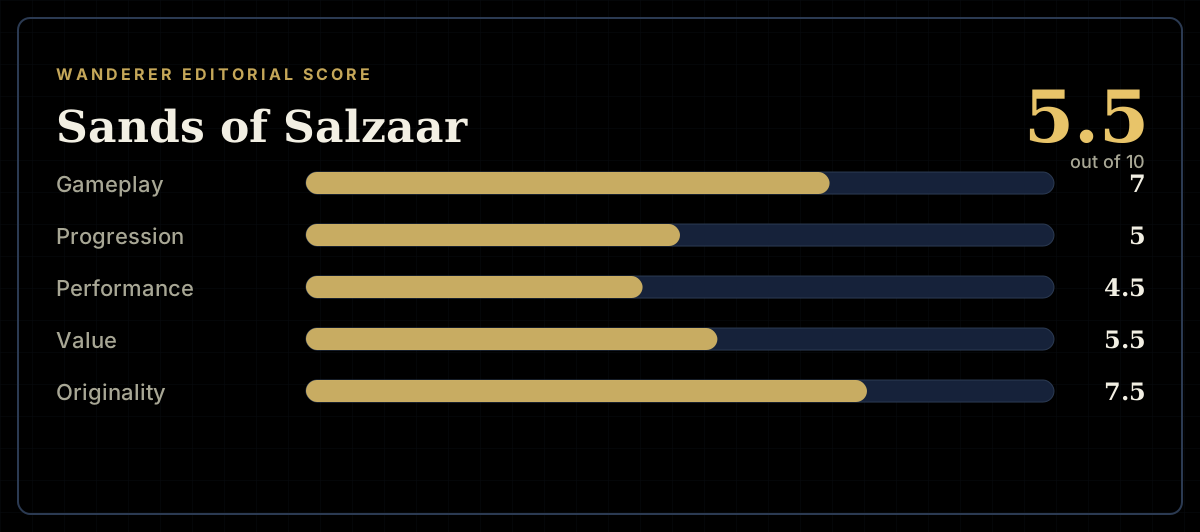
How the review scores each part of the gameWanderer Editorial -
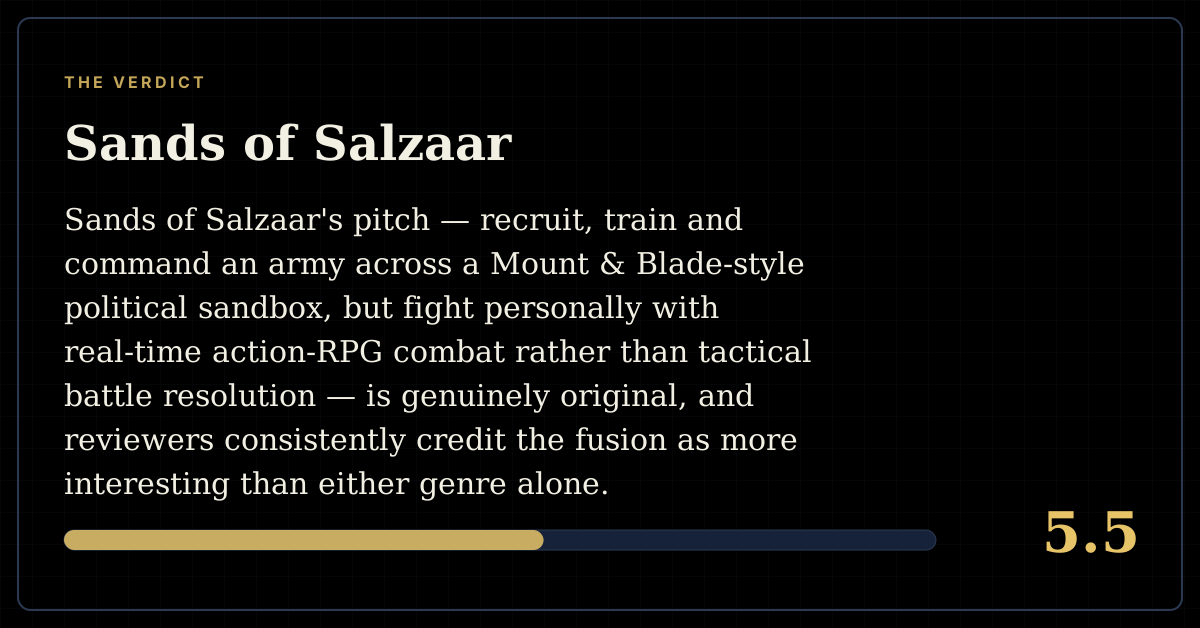
The short versionWanderer Editorial